PUBLISHER: Mordor Intelligence | PRODUCT CODE: 2073624

PUBLISHER: Mordor Intelligence | PRODUCT CODE: 2073624
United States Electric Bus - Market Share Analysis, Industry Trends & Statistics, Growth Forecasts (2026 - 2031)
According to Mordor Intelligence, the united states electric bus market size was valued at USD 8.02 billion in 2025 and is projected to grow from USD 8.96 billion in 2026 to USD 15.55 billion by 2031, registering a CAGR of 11.67% over the same period.
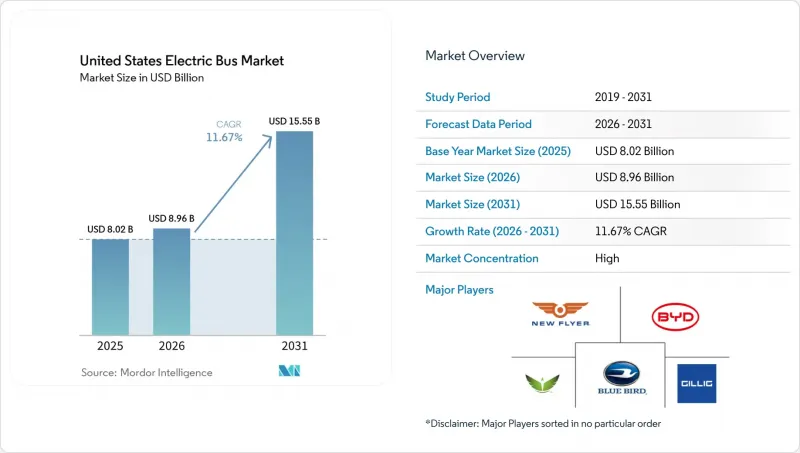
This report is Segmented by Propulsion (Battery Electric and More), Application (City / Transit and More), Battery Chemistry (LFP and More), Length (Below 9 M and More), Motor Architecture (PMSM and More), Motor Power (Below 100 KW and More), Range (Below 100 Km and More), End Use (Public and Private), and State. The Market Forecasts are Provided in Terms of Value (Units) and Volume (Units).
United States Electric Bus Market Trends and Insights
Federal and State Zero-Emission Mandates
California's Innovative Clean Transit rule obliges large agencies to procure only zero-emission buses from the beginning of 2029, compressing traditional replacement cycles and raising demand visibility for suppliers. Fleet managers respond by accelerating infrastructure design so that utility upgrades, charger selection, and workforce training all proceed in parallel with vehicle tenders. New York, Washington, and Massachusetts mirror the regulatory template, giving manufacturers confidence to plan multiyear production slots instead of one-off batches. Because most rules favor domestic content, builders who localize battery packs, motors, and wiring harnesses enjoy clearer paths through Buy America certification. The cumulative effect of those mandates is a nationwide procurement wave that locks in the United States electric bus market's growth trajectory.
Federal Transit Electrification Funding
EPA Clean School Bus rebates and FTA Low-No grants convert policy intent into signed purchase orders, particularly for agencies that lack bonding capacity. Grant scoring tends to reward shovel-ready infrastructure, so bidders often align bus deliveries with charger commissioning to avoid stranded assets. Suppliers increasingly bundle vehicles, depot design, and long-term maintenance in a single contract, simplifying agency oversight while guaranteeing parts availability. The promise of continued federal appropriations also reassures lenders, enabling competitive interest rates on any remaining capital outlay. Together, those financial levers reduce the risk premium that once discouraged early movers.
Depot Grid-Connection Delays
Interconnection queues at urban utilities often exceed the construction timeline for the depot itself, forcing agencies to stage bus deliveries or lease temporary charging assets. Project managers must coordinate city permitting, utility engineering, and contractor schedules with near-surgical precision to avoid idle equipment. Staffing constraints at public-works departments add further uncertainty, especially when multiple depots in the same region pursue upgrades simultaneously. Some agencies mitigate delay risk by installing on-site battery storage that buffers peak demand, yet doing so raises capital intensity. Until utility processes speed up, grid access remains a gating item for many rollouts.
Other drivers and restraints analyzed in the detailed report include:
- Declining Battery-Pack Prices
- TCO Parity for City Routes by 2026
- Sparse High-Power Charging Network
For complete list of drivers and restraints, kindly check the Table Of Contents.
Segment Analysis
Battery-electric buses retained a 72.16% United States electric bus market share in 2025, yet fuel-cell variants are forecast to grow at a 24.24% CAGR as hydrogen stations extend beyond California. Early deployments in the South Coast Air Basin validate 300-mile duty cycles without lengthy charge dwell, appealing to mountainous or cold-weather operations. Agencies recognize that battery units cover most urban needs, but fuel-cell range and 10-minute refueling closely replicate diesel patterns, easing driver scheduling. Manufacturers localize stack assembly to meet Buy America rules, although green-hydrogen supply costs must still fall to unlock broad adoption.
Transit authorities experimenting with blended fleets see operational value in assigning battery buses to predictable urban loops and reserving fuel-cell units for express or terrain-intensive routes. As the national hydrogen-hub program channels USD 8 billion into production and logistics, the technology's path to parity improves, but infrastructure timelines push material volume to the latter half of the forecast period. Integration of common storage and safety codes reduces permitting friction, making hydrogen a realistic lever for segment expansion in the United States electric bus market.
City and transit fleets accounted for 62.75% of 2025 revenue, benefiting from continuous grant flows and clear legislative targets. Yet intercity and regional routes post a 16.02% CAGR because battery densities now support 300-450 km operations, and utilities co-fund roadside megawatt charging. Initial corridor build-outs between Sacramento-Reno and Dallas-Houston demonstrate timetable resilience when 30-minute top-ups align with driver breaks. School districts rapidly absorb EPA rebates, but fragmented ownership slows national scaling despite strong public health narratives.
Airports and corporate campuses deploy zero-emission shuttles to meet Scope 1 reduction pledges, serving as visible showcases that reinforce municipal policy ambitions. Coach operators remain cautious until winter-range performance and resale values stabilize, yet pilot programs with extended-pack buses suggest achievable economics on premium tourist routes. The diverse use-case mosaic sustains order backlogs, helping OEMs amortize platform investments across the United States electric bus market size spectrum.
Lithium-iron-phosphate batteries maintained a 59.21% United States electric bus market share in 2025, owing to thermal stability and cost advantages over nickel chemistries. Lithium-titanate's 18.78% CAGR comes from agencies in Minnesota, Illinois, and upstate New York that prize 10-minute charge capability and robust sub-zero performance for overnight outdoor parking. Nickel-manganese-cobalt remains constrained to long-range coaches where energy density outweighs cost.
Sodium-ion and solid-state pilots continue under DOE grants, but will not affect volume before 2028. Supply-chain localization efforts bring new LFP cell plants online in the Midwest, mitigating tariff exposure and strengthening grant eligibility. Meanwhile, battery-end-of-life policies under development by the EPA encourage second-life stationary storage, lowering residual-value risk that once stymied procurements in budget-sensitive municipalities.
Complete Report Scope:
- By Propulsion
- Battery Electric Bus (BEB)
- Plug-in Hybrid Electric Bus (PHEB)
- Fuel Cell Electric Bus (FCEB)
- By Application
- City/Transit
- Intercity/Regional
- Coach/Tourist
- School Bus
- Airport
- Others
- By Battery Chemistry
- Lithium Iron Phosphate (LFP)
- NMC/NCA
- Lithium Titanate (LTO)
- Others (Sodium-ion, pilots)
- By Length
- Below 9 m
- 9 to 14 m
- 14 to 18 m
- Above 18 m
- By Motor Architecture
- Permanent Magnet Synchronous Motor (PMSM)
- Induction/Asynchronous AC
- Switched Reluctance Motor (SRM)
- Others
- By Motor Power
- Below 100 kW
- 100 to 150 kW
- 151 to 200 kW
- 201 to 250 kW
- 251 to 320 kW
- Above 320 kW
- By Range
- Below 100 km
- 100 to 200 km
- 201 to 300 km
- 300 to 450 km
- Above 450 km
- By End Use
- Public
- Private
- By State
- Alabama
- Alaska
- Arizona
- Arkansas
- California
- Colorado
- Connecticut
- Delaware
- Florida
- Georgia
- Hawaii
- Idaho
- Illinois
- Indiana
- Iowa
- Kansas
- Kentucky
- Louisiana
- Maine
- Maryland
- Massachusetts
- Michigan
- Minnesota
- Mississippi
- Missouri
- Montana
- Nebraska
- Nevada
- New Hampshire
- New Jersey
- New Mexico
- New York
- North Carolina
- North Dakota
- Ohio
- Oklahoma
- Oregon
- Pennsylvania
- Rhode Island
- South Carolina
- South Dakota
- Tennessee
- Texas
- Utah
- Vermont
- Virginia
- Washington
- West Virginia
- Wisconsin
- Wyoming
List of Companies Covered in this Report:
- New Flyer of America
- BYD Auto Co. Ltd.
- GILLIG LLC
- Blue Bird Corporation
- Lion Electric Co.
- Daimler Truck Holding AG (Thomas Built)
- REV Group Inc. (ENC)
- Volvo Group (Nova Bus)
- GreenPower Motor Co. Inc.
- Phoenix Motorcars
- Vicinity Motor Corp.
- Cummins Inc. (Battery & Fuel-Cell)
- Van Hool NV
- TEMSA Skoda USA
- Alexander Dennis Ltd.
- Complete Coach Works (CCW)
Additional Benefits:
- The market estimate (ME) sheet in Excel format
- 3 months of analyst support
TABLE OF CONTENTS
1 Introduction
- 1.1 Study Assumptions and Market Definition
- 1.2 Scope of the Study
- 1.3 Glossary of Key Terms
2 Research Methodology
3 Executive Summary
4 Market Context and Structural Factors
- 4.1 Urbanization, Population and Transit Demand
- 4.2 Public Transport Share and Mode Shift
- 4.3 Diesel vs Electricity/Hydrogen Price Spread
- 4.4 Vehicle and Infrastructure CAPEX / OPEX
- 4.5 Financing Models
- 4.6 Bus Specs and Vehicle Standards
- 4.7 Charging Stations and Charging Topology
- 4.8 Hydrogen Stations Serving Buses
- 4.9 Subsidy/Incentive Value
- 4.10 OEM Line-up and Model Pipeline
- 4.11 Regulatory Framework
- 4.12 Vehicle Homologation and Safety
- 4.13 Procurement and Contracting Rules
- 4.14 Fiscal and Industrial Policy (Incentives, Duties, Localization, EPR)
5 Market Landscape
- 5.1 Market Overview
- 5.2 Market Drivers
- 5.2.1 Federal and State Zero-Emission Mandates
- 5.2.2 Federal Transit Electrification Funding
- 5.2.3 Declining Battery-Pack Prices
- 5.2.4 TCO Parity for City Routes by 2026
- 5.2.5 School-Fleet Health-Driven Adoption
- 5.2.6 Carbon-Credit Revenue Streams
- 5.3 Market Restraints
- 5.3.1 Depot Grid-Connection Delays
- 5.3.2 Sparse High-Power Charging Network
- 5.3.3 High Upfront FCEB Cost
- 5.3.4 Limited Hydrogen Corridors
- 5.4 Value/Supply-Chain Analysis
- 5.5 Technological Outlook
- 5.6 Porter's Five Forces
- 5.6.1 Threat of New Entrants
- 5.6.2 Bargaining Power of Suppliers
- 5.6.3 Bargaining Power of Buyers
- 5.6.4 Threat of Substitutes
- 5.6.5 Competitive Rivalry
6 Market Size and Growth Forecasts (Value (USD) and Volume (Units))
- 6.1 By Propulsion
- 6.1.1 Battery Electric Bus (BEB)
- 6.1.2 Plug-in Hybrid Electric Bus (PHEB)
- 6.1.3 Fuel Cell Electric Bus (FCEB)
- 6.2 By Application
- 6.2.1 City/Transit
- 6.2.2 Intercity/Regional
- 6.2.3 Coach/Tourist
- 6.2.4 School Bus
- 6.2.5 Airport
- 6.2.6 Others
- 6.3 By Battery Chemistry
- 6.3.1 Lithium Iron Phosphate (LFP)
- 6.3.2 NMC/NCA
- 6.3.3 Lithium Titanate (LTO)
- 6.3.4 Others (Sodium-ion, pilots)
- 6.4 By Length
- 6.4.1 Below 9 m
- 6.4.2 9 to 14 m
- 6.4.3 14 to 18 m
- 6.4.4 Above 18 m
- 6.5 By Motor Architecture
- 6.5.1 Permanent Magnet Synchronous Motor (PMSM)
- 6.5.2 Induction/Asynchronous AC
- 6.5.3 Switched Reluctance Motor (SRM)
- 6.5.4 Others
- 6.6 By Motor Power
- 6.6.1 Below 100 kW
- 6.6.2 100 to 150 kW
- 6.6.3 151 to 200 kW
- 6.6.4 201 to 250 kW
- 6.6.5 251 to 320 kW
- 6.6.6 Above 320 kW
- 6.7 By Range
- 6.7.1 Below 100 km
- 6.7.2 100 to 200 km
- 6.7.3 201 to 300 km
- 6.7.4 300 to 450 km
- 6.7.5 Above 450 km
- 6.8 By End Use
- 6.8.1 Public
- 6.8.2 Private
- 6.9 By State
- 6.9.1 Alabama
- 6.9.2 Alaska
- 6.9.3 Arizona
- 6.9.4 Arkansas
- 6.9.5 California
- 6.9.6 Colorado
- 6.9.7 Connecticut
- 6.9.8 Delaware
- 6.9.9 Florida
- 6.9.10 Georgia
- 6.9.11 Hawaii
- 6.9.12 Idaho
- 6.9.13 Illinois
- 6.9.14 Indiana
- 6.9.15 Iowa
- 6.9.16 Kansas
- 6.9.17 Kentucky
- 6.9.18 Louisiana
- 6.9.19 Maine
- 6.9.20 Maryland
- 6.9.21 Massachusetts
- 6.9.22 Michigan
- 6.9.23 Minnesota
- 6.9.24 Mississippi
- 6.9.25 Missouri
- 6.9.26 Montana
- 6.9.27 Nebraska
- 6.9.28 Nevada
- 6.9.29 New Hampshire
- 6.9.30 New Jersey
- 6.9.31 New Mexico
- 6.9.32 New York
- 6.9.33 North Carolina
- 6.9.34 North Dakota
- 6.9.35 Ohio
- 6.9.36 Oklahoma
- 6.9.37 Oregon
- 6.9.38 Pennsylvania
- 6.9.39 Rhode Island
- 6.9.40 South Carolina
- 6.9.41 South Dakota
- 6.9.42 Tennessee
- 6.9.43 Texas
- 6.9.44 Utah
- 6.9.45 Vermont
- 6.9.46 Virginia
- 6.9.47 Washington
- 6.9.48 West Virginia
- 6.9.49 Wisconsin
- 6.9.50 Wyoming
7 Competitive Landscape
- 7.1 Market Concentration
- 7.2 Strategic Moves
- 7.3 Market Share Analysis
- 7.4 Company Profiles (includes Global level Overview, Market level overview, Core Segments, Financials, Strategic Information, Market Rank/Share, Products and Services, Recent Developments)
- 7.4.1 New Flyer of America
- 7.4.2 BYD Auto Co. Ltd.
- 7.4.3 GILLIG LLC
- 7.4.4 Blue Bird Corporation
- 7.4.5 Lion Electric Co.
- 7.4.6 Daimler Truck Holding AG (Thomas Built)
- 7.4.7 REV Group Inc. (ENC)
- 7.4.8 Volvo Group (Nova Bus)
- 7.4.9 GreenPower Motor Co. Inc.
- 7.4.10 Phoenix Motorcars
- 7.4.11 Vicinity Motor Corp.
- 7.4.12 Cummins Inc. (Battery & Fuel-Cell)
- 7.4.13 Van Hool NV
- 7.4.14 TEMSA Skoda USA
- 7.4.15 Alexander Dennis Ltd.
- 7.4.16 Complete Coach Works (CCW)
8 Market Opportunities and Future Outlook
- 8.1 White-Space and Unmet-Need Assessment
9 Key Strategic Questions for CEOs

