PUBLISHER: Mordor Intelligence | PRODUCT CODE: 2073642

PUBLISHER: Mordor Intelligence | PRODUCT CODE: 2073642
Microinsurance - Market Share Analysis, Industry Trends & Statistics, Growth Forecasts (2026 - 2031)
According to Mordor Intelligence, the microinsurance market size in terms of premium value is projected to expand from USD 73.76 billion in 2025 and USD 77.83 billion in 2026 to USD 101.82 billion by 2031, registering a CAGR of 5.52% between 2026 to 2031.
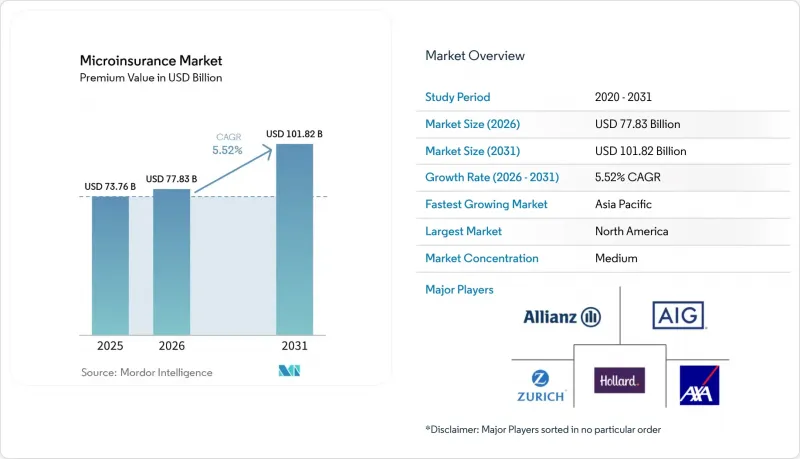
This report is Segmented by Model Type (Partner-Agent Model and Full-Service Model), Product Type (Life, Health & Hospital Cash, Property & Crop, and More), Distribution Channel (Direct Sales, Financial Institutions & MFIs, and Digital), Provider (Commercial, Cooperative & Mutual Insurers, and Aid-/Government-supported Schemes), and Geography. The Market Forecasts are Provided in Value (USD).
Global Microinsurance Market Trends and Insights
Access to Financial Services via Mobile Money Expansion
Mobile money ecosystems are unlocking first-time cover for low-income users by collapsing payment, identity, and policy servicing into a single handset journey. Ethiopia processed USD 82 billion of mobile transactions in 2024, a 50% jump that widened the addressable base for global microinsurance market growth. Zambia shows similar traction, with 58.4% of adults active on mobile wallets, giving insurers a direct, low-cost channel. Chubb's Grab Ride Cover sells trip delay protection at check-out, illustrating how contextual offerings convert digital traffic into premium income. In markets where traditional penetration sits below 5%, handset-first delivery is cutting acquisition expenses by more than 60%, strengthening unit economics for mass-market products.
Government Mandates for Inclusive Insurance
Multiple regulators now frame insurance as an essential service. India's Insurance Regulatory and Development Authority (IRDAI) launched the "insurance for all by 2047" roadmap, and its Bima Sugam digital marketplace went live in 2024 to offer fee-free policy purchase and servicing. Brazil's SUSEP introduced Open Insurance data-sharing rules, enabling customers to transfer their records seamlessly. This initiative is expected to foster significant product innovation by encouraging insurers to develop tailored offerings based on shared data. Meanwhile, Indonesia's OJK Regulation No. 8 of 2024 expedites product approvals to just five days, significantly reducing the time to market for new insurance products. By merging enforcement with robust infrastructure, these regulations aim to ensure consistent premium inflows, enhance operational efficiency, and reduce compliance challenges for the development of innovative designs.
Data Privacy & Security Concerns
New York's Department of Financial Services mandates board-approved AI governance programs to ensure accountability and transparency in the use of artificial intelligence. Meanwhile, Colorado enforces algorithmic bias testing, which aims to identify and mitigate discriminatory outcomes, thereby increasing compliance costs for insurers leveraging alternative data. The EU AI Act introduces a tiered risk framework, categorizing AI systems based on their potential risks, with penalties for non-compliance reaching up to 6% of global turnover. Insurers relying on handset metadata are compelled to invest in encryption, consent management, and audit tools to safeguard data integrity and privacy, further challenging the already tight economics of micro-insurance. Providers unable to demonstrate algorithmic fairness or compliance with these regulations risk facing significant market-access restrictions, potentially impacting their operational viability.
Other drivers and restraints analyzed in the detailed report include:
- Rise of Digital Platforms & Insurtech Partnerships
- Parametric Micro-insurance for Climate Risk
- Limited Actuarial Data for Pricing
For complete list of drivers and restraints, kindly check the Table Of Contents.
Segment Analysis
The partner-agent architecture accounted for 43.15% of the 2025 premium, the largest slice of the global microinsurance market, and it is forecast to expand at an 7.92% CAGR through 2031. This dominance reflects how local credit unions, cooperatives, and postal networks act as last-mile enablers in communities where core banking penetration is still below 30% and where consumer trust rests with familiar institutions. Insurers provide the balance-sheet capacity and product design, while agents supply on-the-ground enrollment and servicing capability, producing a blended cost of acquisition that sits 20%-40% below pure agency models. Digital tablets and USSD flows now allow agents to issue policies in under five minutes, slashing paperwork and keeping compliance records audit-ready. These efficiencies are critical because the typical micro-ticket policy generates less than USD 5 of annual premium.
The partner-agent model also supports flexible cash-collection cycles that match informal income patterns. AXA's essential, for example, bundles accident, life, and hospital cash into a single cover and lets policyholders pay weekly through mobile wallets, a feature that lifted renewal rates by 14 percentage points in 2024. VSure Tech's SME platform in Malaysia pushes the approach further by embedding liability insurance inside point-of-sale software used by micro-retailers, reaching 60,000 firms without a dedicated sales force. Regulators endorse the arrangement because partner entities typically maintain robust KYC files, reducing money-laundering risk. Due to these advantages, the model is projected to keep widening its global microinsurance market share even as fully digital challengers scale.
Life products, including credit-life, term, and funeral cover, still hold 36.22% of 2025 premium, yet health and hospital cash plans are the global microinsurance market's fastest-growing line at a 5.49% CAGR to 2031. Post-pandemic awareness, rising out-of-pocket medical costs, and government subsidy programs steer households toward even minimal inpatient cash benefits. India's INR 48,000 crore (USD 5.7 billion) allocation to low-ticket health schemes created a pipeline of bundled policies that reimburse hospital stays at USD 10-15 per day, bridging liquidity gaps for informal workers. Africa shows similar momentum as mPharma's pharmacy-led subscription covers 14 chronic diseases and lets members pay monthly fees equivalent to two cups of coffee.
Growth also owes much to product modularity. Carriers can append dental, maternity, or telemedicine riders without redesigning the core policy wording, a strategy that helps keep regulatory filing times short. Index-based crop and livestock lines use satellite weather data to trigger payouts, enabling global microinsurance market size expansion in agricultural regions where traditional loss adjustment is infeasible. Accident and disability riders are gaining traction among ride-hailing and delivery workers who seek income-replacement benefits priced at less than 1% of their monthly earnings. As more governments mandate digital health records, underwriters will gain granular claims data that can further refine pricing and reduce loss ratios.
Complete Report Scope:
- By Model Type
- Partner-Agent Model
- Full-Service Model
- By Product Type
- Life (Credit-Life, Term, Funeral)
- Health & Hospital Cash
- Property & Crop
- Accident & Disability
- Livestock & Index-based Agriculture
- By Distribution Channel
- Direct Sales (Agent / Branch)
- Financial Institutions & MFIs
- Digital
- By Provider
- Commercial Insurers
- Cooperative & Mutual Insurers
- Aid-/Government-supported Schemes
- By Geography
- North America
- United States
- Canada
- Mexico
- South America
- Brazil
- Peru
- Chile
- Argentina
- Rest of South America
- Europe
- Germany
- United Kingdom
- France
- Italy
- Spain
- BENELUX (Belgium, Netherlands, and Luxembourg)
- Nordics (Sweden, Norway, Denmark, Finland)
- Rest of Europe
- Asia Pacific
- China
- India
- Japan
- South Korea
- Australia
- South East Asia
- Indonesia
- Rest of Asia
- Middle East & Africa
- United Arab Emirates
- Saudi Arabia
- South Africa
- Nigeria
- Rest of Middle East
- North America
Geography Analysis
In 2025, North America accounted for 26.12% of global insurance premiums within the microinsurance market, driven by the National Association of Insurance Commissioners' efforts to promote financial inclusion. This initiative has encouraged broader access to insurance products across diverse demographics. In California, major insurers are now mandated to provide basic coverage equivalent to 85% of their market share, a move that directs resources towards areas vulnerable to wildfires, addressing a critical need for risk mitigation in high-risk zones. The U.S. grapples with a concentrated health insurance market, with 95% of states classified as highly concentrated, creating an opportunity for niche micro-products that sidestep traditional employer plans. These micro-products cater to specific consumer needs, offering flexibility and affordability. Meanwhile, Canada fosters growth via federal fintech sandboxes, which provide a controlled environment for innovation in financial services, and Mexico's FinTech Law is hastening the adoption of open data, enabling greater transparency and efficiency in the insurance sector.
Asia-Pacific is on track to be the fastest-growing region in the microinsurance market, boasting a 5.97% CAGR through 2031 as 4 billion consumers transition to digital wallets. This shift is transforming payment ecosystems and driving demand for digital insurance solutions. ZhongAn Online reported a 24.7% surge in gross written premiums in 2024, alongside a 40% boost in tech-export revenue, underscoring the region's "insurance + tech" momentum. The integration of technology into insurance operations is enhancing customer experience and operational efficiency. India's IRDAI is steering reforms towards universal coverage by 2047, aiming to make insurance accessible to every citizen. The Bima Sugam platform offers citizens a portable policy locker across insurers, simplifying policy management and improving transparency. The gig economy in Southeast Asia is driving demand for embedded personal accident coverage, addressing the unique risks faced by gig workers. Additionally, Indonesia is streamlining product launches with five-day approval cycles, enabling insurers to respond quickly to market demands and innovate at a faster pace.
Europe is witnessing steady growth in the microinsurance market, bolstered by the EU AI Act, which standardizes algorithm governance and expedites cross-border operations. This regulatory framework fosters innovation while ensuring compliance and consumer protection. Allianz's acquisition of Viridium for EUR 3.5 billion underscores a trend of life-portfolio consolidation on the continent, reflecting a strategic focus on optimizing portfolio performance and achieving scale. Pilot programs in the Nordics are showcasing the feasibility of real-time policy portability, which enhances customer convenience and promotes market competitiveness. South America is making strides with Brazil's Open Insurance initiative and Mexico's Fintech Law, which are driving innovation and improving market accessibility. However, inflation and currency fluctuations are putting a damper on profit margins, posing challenges for insurers in maintaining profitability. The Middle East & Africa present untapped potential, with Kenya's parametric drought covers and South Africa's flood insurance highlighting the opportunities in the microinsurance market for addressing climate-related risks. However, infrastructural challenges, such as limited technological adoption and underdeveloped distribution networks, pose scalability issues that need to be addressed for sustainable growth.
- Allianz SE
- AXA SA
- Zurich Insurance Group
- American International Group (AIG)
- Hollard Insurance Company
- Bajaj Allianz Life Insurance
- SBI Life Insurance
- ICICI Prudential Life Insurance
- Ping An Insurance
- MAPFRE SA
- Manulife Financial
- Prudential plc
- Sun Life Financial
- Blue Marble Microinsurance
- BIMA (Milvik)
- MicroEnsure (Turaco)
- Britam Holdings
- Pioneer Life (Philippines)
- Banco do Nordeste do Brasil
- CLIMBS Life & General Insurance Co-op
Additional Benefits:
- The market estimate (ME) sheet in Excel format
- 3 months of analyst support
TABLE OF CONTENTS
1 Introduction
- 1.1 Study Assumptions & Market Definition
- 1.2 Scope of the Study
2 Research Methodology
3 Executive Summary
4 Market Landscape
- 4.1 Market Overview
- 4.2 Market Drivers
- 4.2.1 Access to Financial Services via Mobile Money Expansion
- 4.2.2 Government Mandates for Inclusive Insurance
- 4.2.3 Rise of Digital Platforms & Insurtech Partnerships
- 4.2.4 Parametric Micro-insurance for Climate Risk
- 4.2.5 Embedded Insurance in E-commerce & Ride-hailing Apps
- 4.2.6 Satellite & Remote-Sensing Data Enabling Micro Crop Insurance
- 4.3 Market Restraints
- 4.3.1 Data Privacy & Security Concerns
- 4.3.2 Limited Actuarial Data for Pricing
- 4.3.3 Low Claims-Settlement Trust due to Fraudulent Agents
- 4.3.4 Regulatory Arbitrage Limiting Cross-border Product Scaling
- 4.4 Value / Supply-Chain Analysis
- 4.5 Regulatory Landscape
- 4.6 Technological Outlook
- 4.7 Porter's Five Forces
- 4.7.1 Threat of New Entrants
- 4.7.2 Bargaining Power of Buyers
- 4.7.3 Bargaining Power of Suppliers
- 4.7.4 Threat of Substitutes
- 4.7.5 Competitive Rivalry
- 4.8 Industry Trends & Innovations
5 Market Size & Growth Forecasts (Value, USD)
- 5.1 By Model Type
- 5.1.1 Partner-Agent Model
- 5.1.2 Full-Service Model
- 5.2 By Product Type
- 5.2.1 Life (Credit-Life, Term, Funeral)
- 5.2.2 Health & Hospital Cash
- 5.2.3 Property & Crop
- 5.2.4 Accident & Disability
- 5.2.5 Livestock & Index-based Agriculture
- 5.3 By Distribution Channel
- 5.3.1 Direct Sales (Agent / Branch)
- 5.3.2 Financial Institutions & MFIs
- 5.3.3 Digital
- 5.4 By Provider
- 5.4.1 Commercial Insurers
- 5.4.2 Cooperative & Mutual Insurers
- 5.4.3 Aid-/Government-supported Schemes
- 5.5 By Geography
- 5.5.1 North America
- 5.5.1.1 United States
- 5.5.1.2 Canada
- 5.5.1.3 Mexico
- 5.5.2 South America
- 5.5.2.1 Brazil
- 5.5.2.2 Peru
- 5.5.2.3 Chile
- 5.5.2.4 Argentina
- 5.5.2.5 Rest of South America
- 5.5.3 Europe
- 5.5.3.1 Germany
- 5.5.3.2 United Kingdom
- 5.5.3.3 France
- 5.5.3.4 Italy
- 5.5.3.5 Spain
- 5.5.3.6 BENELUX (Belgium, Netherlands, and Luxembourg)
- 5.5.3.7 Nordics (Sweden, Norway, Denmark, Finland)
- 5.5.3.8 Rest of Europe
- 5.5.4 Asia Pacific
- 5.5.4.1 China
- 5.5.4.2 India
- 5.5.4.3 Japan
- 5.5.4.4 South Korea
- 5.5.4.5 Australia
- 5.5.4.6 South East Asia
- 5.5.4.7 Indonesia
- 5.5.4.8 Rest of Asia
- 5.5.5 Middle East & Africa
- 5.5.5.1 United Arab Emirates
- 5.5.5.2 Saudi Arabia
- 5.5.5.3 South Africa
- 5.5.5.4 Nigeria
- 5.5.5.5 Rest of Middle East
- 5.5.1 North America
6 Competitive Landscape
- 6.1 Market Concentration
- 6.2 Strategic Moves
- 6.3 Market Share Analysis
- 6.4 Company Profiles (includes Global level Overview, Market level overview, Core Segments, Financials as available, Strategic Information, Market Rank/Share for key companies, Products & Services, and Recent Developments)
- 6.4.1 Allianz SE
- 6.4.2 AXA SA
- 6.4.3 Zurich Insurance Group
- 6.4.4 American International Group (AIG)
- 6.4.5 Hollard Insurance Company
- 6.4.6 Bajaj Allianz Life Insurance
- 6.4.7 SBI Life Insurance
- 6.4.8 ICICI Prudential Life Insurance
- 6.4.9 Ping An Insurance
- 6.4.10 MAPFRE SA
- 6.4.11 Manulife Financial
- 6.4.12 Prudential plc
- 6.4.13 Sun Life Financial
- 6.4.14 Blue Marble Microinsurance
- 6.4.15 BIMA (Milvik)
- 6.4.16 MicroEnsure (Turaco)
- 6.4.17 Britam Holdings
- 6.4.18 Pioneer Life (Philippines)
- 6.4.19 Banco do Nordeste do Brasil
- 6.4.20 CLIMBS Life & General Insurance Co-op
7 Market Opportunities & Future Outlook
- 7.1 White-space & Unmet-need Assessment

