PUBLISHER: Mordor Intelligence | PRODUCT CODE: 2073647

PUBLISHER: Mordor Intelligence | PRODUCT CODE: 2073647
Car Wash - Market Share Analysis, Industry Trends & Statistics, Growth Forecasts (2026 - 2031)
According to Mordor Intelligence, the car wash market size is expected to grow from USD 28.07 billion in 2025 to USD 30.35 billion in 2026 and is forecast to reach USD 43.65 billion by 2031, advancing at a 7.54% CAGR during the forecast period (2026-2031).
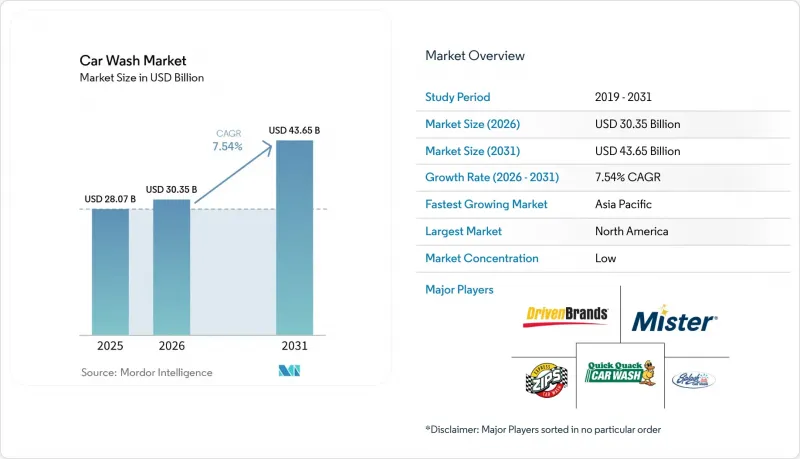
This report is Segmented by Type (Automatic Tunnels, In-Bay Roll-Over, and More), Mode of Payment (Cash, Cashless, and More), Service Model (Single-Service Wash, Full-Service, and More), End User (Passenger Vehicles and More), Ownership (Independent Operators and Franchised / Chain Operators), and Geography. The Market Forecasts are Provided in Terms of Value (USD).
Global Car Wash Market Trends and Insights
Growth of Subscription-Based Unlimited Wash Programs
Operators transitioning from episodic ticket sales to membership-based models are turning unpredictable demand into a steady cash flow in the car wash market. Rinsed reported consistent growth in membership revenue, even as walk-in sales experienced a decline. Once customers embraced routine washing, churn rates stabilized at a low level, significantly increasing their lifetime value. Mister Car Wash revealed that club members accounted for a substantial portion of total sales, highlighting the potential dominance of subscriptions in established revenue streams . Furthermore, unlimited plans act as a buffer against weather fluctuations, ensuring consistent revenue even during typically slow winter months, and bolstering the company's capacity for technology-related debt upgrades.
Shift to Cashless and In-App Payments
Cashless transactions have seen significant growth in the car wash market, driven by advancements such as License Plate Recognition (LPR) and Near Field Communication (NFC). These technologies have simplified entry processes, removed the need for kiosks, and enhanced operational efficiency. GO Car Wash has implemented LPR technology with high accuracy, enabling seamless and contactless customer experiences . Daiwa House Parking's D-Wash system utilizes artificial intelligence for plate recognition, allowing for instant payment settlements and aiming to expand its presence across multiple locations in Japan. The adoption of cashless systems has proven to reduce theft, minimize the need for cash-handling labor, and enable dynamic pricing strategies that enhance revenue potential by increasing the average ticket size.
Soaring Land and Construction Costs
Site budgets have significantly increased, extending payback cycles and driving a rise in sale-leaseback transactions. Mister Car Wash has utilized these transactions to secure funding for license plate recognition systems and other upgrades. Lengthy permitting processes have significantly extended build timelines in major metropolitan areas, reducing the net present value of projects and encouraging developers to shift their focus to secondary markets, where land prices are substantially lower. The increase in capital expenditures has raised entry barriers for independent operators, further accelerating private equity firms' market consolidation.
Other drivers and restraints analyzed in the detailed report include:
- Expansion of Express-Exterior Conveyor Formats
- Rising Fleet and Ride-Hailing Vehicle Counts
- Municipal Water-Use Restrictions and Drought Fees
For complete list of drivers and restraints, kindly check the Table Of Contents.
Segment Analysis
Automatic tunnels controlled 48.12% of the car wash market share in 2025; however, express-exterior sites are advancing at an 8.27% CAGR by streamlining cycle times and reducing labor intensity. Quick Quack's modular blueprint supports rapid greenfield builds, and Autobell's stick-built or pre-engineered options reduce design overhead. The car wash market size for express formats is set to expand steadily as operators leverage standardized layouts and reinvest labor savings into LPR and reclaim technology.
Express tunnels attract subscribers who value speed over detailed cleaning, with 3-4 washes per month versus 1-2 for pay-per-visit users. Hybrid layouts now pair express exterior service with optional interior upsells, balancing high-volume throughput and revenue-per-vehicle goals. In-bay roll-overs serve gas stations and urban infill where lot depth is limited, while hand-wash and mobile services target niche luxury segments.
Cashless methods accounted for 63.23% of the car wash market share in 2025, and their 11.84% CAGR underscores a structural shift away from handling cash. LPR, NFC, and app wallets merge access control and billing, raising the average ticket as add-ons surface during checkout. The car wash market size tied to app-based subscriptions is increasing because recurring billing requires digital rails.
Cash transactions persist in some self-service bays, while app enrollment increases as consumers adopt contactless behavior post-pandemic. Independent operators must bridge technology gaps or risk attrition to franchised chains, which offer seamless entry. Rich usage telemetry also informs marketing spend, staffing, and site selection, giving data-driven operators a widening edge within the car wash market.
Complete Report Scope:
- By Type
- Automatic Tunnel
- In-Bay Roll-Over
- Self-Service Bay
- Express Exterior
- Mobile / Hand Wash
- By Mode of Payment
- Cash
- Cashless (Card / NFC)
- Subscription / Membership App
- By Service Model
- Single-Service Wash
- Full-Service (Wash + Detailing)
- Subscription-Based Unlimited
- By End-User
- Passenger Vehicles
- Light Commercial Vehicles
- Medium and Heavy Commercial Vehicles
- By Ownership
- Independent Operators
- Franchised / Chain Operators
- By Geography
- North America
- United States
- Canada
- Rest of North America
- South America
- Brazil
- Argentina
- Rest of South America
- Europe
- Germany
- United Kingdom
- France
- Italy
- Spain
- Russia
- Rest of Europe
- Asia-Pacific
- China
- India
- Japan
- South Korea
- Australia
- Rest of Asia-Pacific
- Middle East and Africa
- United Arab Emirates
- Saudi Arabia
- Turkey
- South Africa
- Egypt
- Nigeria
- Rest of Middle East and Africa
- North America
Geography Analysis
North America retained 40.76% of the car wash market share in 2025, sustained by dense chain networks, high vehicle ownership, and club penetration. However, elevated land values and drought conditions in California, Texas, and Arizona require capital-intensive water recycling, which poses challenges for small operators. Private-equity platforms, such as Boyne Capital, continue to consolidate second-tier markets, while Canada faces seasonal swings that necessitate winter membership pauses to defend retention.
The Asia-Pacific region is expected to register the fastest CAGR of 8.43% through 2031, as urban households adopt paid laundry services rather than rely on declining gas-station bays. China's rise in used-car trading expands the total vehicle base, and EV owners prefer transparent, app-linked services that many local independents lack. Japan is modernizing coin-op sites with pure-water rinses and AI payment, while India's expanding middle class and Amazon's electric vans boost demand for fleet-compatible tunnels. Water-scarce Australia mirrors the United States' Southwest compliance pressures, further amplifying the appeal of high-efficiency reclaimed water equipment.
Europe, South America, and the Middle East & Africa round out the car wash market. Germany, the United Kingdom, and France are rapidly adopting automated tunnels and cashless payments, whereas Eastern Europe remains fragmented. Brazil and Argentina offer long-run growth tied to urbanization, but currency volatility complicates financing. The Gulf states benefit from year-round operations, yet they face acute water scarcity that necessitates full-cycle reuse from project launch. Early movers who secure compliant infrastructure and prime land can solidify their position before PE-backed entrants expand internationally.
- Mister Car Wash
- Whistle Express Car Wash
- Driven Brands Inc
- Zips Car Wash
- Quick Quack Car Wash
- Splash Car Wash
- Autobell Car Wash
- Super Star Car Wash
- True Blue Car Wash
- Hoffman Car Wash
- Tommy's Express Car Wash
- Circle K Car Wash
- Petro-Canada SuperWash
- Spotless Brands
- Club Car Wash
- Car Spa Inc.
Additional Benefits:
- The market estimate (ME) sheet in Excel format
- 3 months of analyst support
TABLE OF CONTENTS
1 Introduction
- 1.1 Study Assumptions and Market Definition
- 1.2 Scope of the Study
2 Research Methodology
3 Executive Summary
4 Market Landscape
- 4.1 Market Overview
- 4.2 Market Drivers
- 4.2.1 Growth Of Subscription-Based Unlimited Wash Programs
- 4.2.2 Rising Fleet and Ride-Hailing Vehicle Counts
- 4.2.3 Shift To Cashless and In-App Payments
- 4.2.4 Expansion of Express-Exterior Conveyor Formats
- 4.2.5 Water-Recycling and Eco-Compliance Regulations
- 4.2.6 AI-Driven Dynamic Pricing and Upsell Kiosks
- 4.3 Market Restraints
- 4.3.1 Soaring Land and Construction Costs
- 4.3.2 Municipal Water-Use Restrictions and Drought Fees
- 4.3.3 High Staff Turnover in Labor-Tight Markets
- 4.3.4 Neighborhood Opposition To 24/7 Operations
- 4.4 Value / Supply-Chain Analysis
- 4.5 Regulatory Landscape
- 4.6 Technological Outlook
- 4.7 Porter's Five Forces
- 4.7.1 Threat of New Entrants
- 4.7.2 Bargaining Power of Buyers/Consumers
- 4.7.3 Bargaining Power of Suppliers
- 4.7.4 Threat of Substitute Products
- 4.7.5 Intensity of Competitive Rivalry
5 Market Size and Growth Forecasts (Value (USD))
- 5.1 By Type
- 5.1.1 Automatic Tunnel
- 5.1.2 In-Bay Roll-Over
- 5.1.3 Self-Service Bay
- 5.1.4 Express Exterior
- 5.1.5 Mobile / Hand Wash
- 5.2 By Mode of Payment
- 5.2.1 Cash
- 5.2.2 Cashless (Card / NFC)
- 5.2.3 Subscription / Membership App
- 5.3 By Service Model
- 5.3.1 Single-Service Wash
- 5.3.2 Full-Service (Wash + Detailing)
- 5.3.3 Subscription-Based Unlimited
- 5.4 By End-User
- 5.4.1 Passenger Vehicles
- 5.4.2 Light Commercial Vehicles
- 5.4.3 Medium and Heavy Commercial Vehicles
- 5.5 By Ownership
- 5.5.1 Independent Operators
- 5.5.2 Franchised / Chain Operators
- 5.6 By Geography
- 5.6.1 North America
- 5.6.1.1 United States
- 5.6.1.2 Canada
- 5.6.1.3 Rest of North America
- 5.6.2 South America
- 5.6.2.1 Brazil
- 5.6.2.2 Argentina
- 5.6.2.3 Rest of South America
- 5.6.3 Europe
- 5.6.3.1 Germany
- 5.6.3.2 United Kingdom
- 5.6.3.3 France
- 5.6.3.4 Italy
- 5.6.3.5 Spain
- 5.6.3.6 Russia
- 5.6.3.7 Rest of Europe
- 5.6.4 Asia-Pacific
- 5.6.4.1 China
- 5.6.4.2 India
- 5.6.4.3 Japan
- 5.6.4.4 South Korea
- 5.6.4.5 Australia
- 5.6.4.6 Rest of Asia-Pacific
- 5.6.5 Middle East and Africa
- 5.6.5.1 United Arab Emirates
- 5.6.5.2 Saudi Arabia
- 5.6.5.3 Turkey
- 5.6.5.4 South Africa
- 5.6.5.5 Egypt
- 5.6.5.6 Nigeria
- 5.6.5.7 Rest of Middle East and Africa
- 5.6.1 North America
6 Competitive Landscape
- 6.1 Market Concentration
- 6.2 Strategic Moves
- 6.3 Market Share Analysis
- 6.4 Company Profiles (Includes Global level Overview, Market level overview, Core Segments, Financials as available, Strategic Information, Market Rank/Share for key companies, Products & Services, and Recent Developments)
- 6.4.1 Mister Car Wash
- 6.4.2 Whistle Express Car Wash
- 6.4.3 Driven Brands Inc
- 6.4.4 Zips Car Wash
- 6.4.5 Quick Quack Car Wash
- 6.4.6 Splash Car Wash
- 6.4.7 Autobell Car Wash
- 6.4.8 Super Star Car Wash
- 6.4.9 True Blue Car Wash
- 6.4.10 Hoffman Car Wash
- 6.4.11 Tommy's Express Car Wash
- 6.4.12 Circle K Car Wash
- 6.4.13 Petro-Canada SuperWash
- 6.4.14 Spotless Brands
- 6.4.15 Club Car Wash
- 6.4.16 Car Spa Inc.
7 Market Opportunities and Future Outlook

