PUBLISHER: Mordor Intelligence | PRODUCT CODE: 2097074

PUBLISHER: Mordor Intelligence | PRODUCT CODE: 2097074
Dermatological Therapeutics - Market Share Analysis, Industry Trends & Statistics, Growth Forecasts (2026 - 2031)
According to Mordor Intelligence, the dermatological therapeutics market size is projected to increase from USD 49.54 billion in 2025 to USD 54.06 billion in 2026, and reach USD 83.59 billion by 2031, growing at a CAGR of 9.12% from 2026 to 2031.
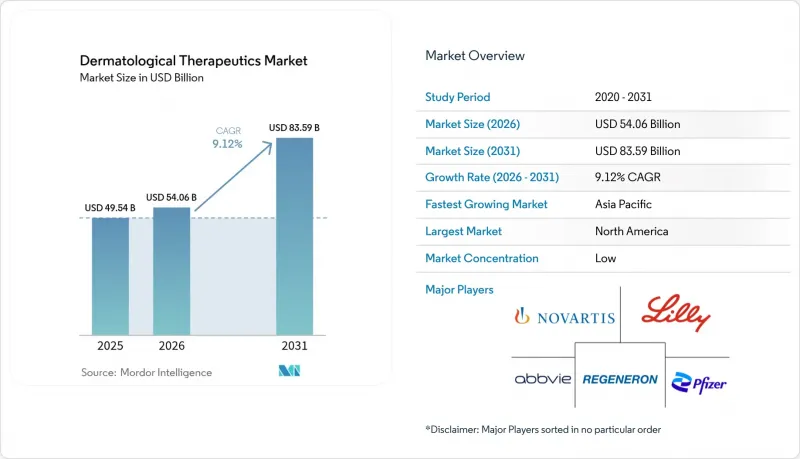
This report is Segmented by Disease (Acne Vulgaris, Psoriasis, and More), Drug Class (Topical Corticosteroids, Retinoids, and More), Route of Administration (Topical, Oral, and More), Distribution Channel (Hospital Pharmacies, Retail Pharmacies & Drugstores and More), Therapy Type (Prescription Drugs, Over-The-Counter Drugs), and Geography. The Market Forecasts are Provided in Terms of Value (USD).
Global Dermatological Therapeutics Market Trends and Insights
Rising Prevalence of Chronic Dermatological Diseases
Urban air pollution, processed-food consumption, and delayed diagnosis combined to double atopic-dermatitis prevalence in Chinese and Indian cities between 2019 and 2024. Psoriasis incidence climbed 18% in the United States over 2020-2025, with the Centers for Disease Control and Prevention linking the increase to metabolic-syndrome comorbidities and pandemic-era care gaps. An American Academy of Dermatology campaign trained 12,000 primary-care doctors to detect hidradenitis suppurativa, producing a 40% surge in confirmed cases. Greater diagnostic reach is enlarging the patient pool for both first-line topicals and second-line biologics, especially in regions where specialty capacity is catching up to disease burden.
Rapid Uptake of Biologics & Targeted Therapies
Biologic prescriptions for dermatology rose 31% year over year in 2025, surpassing uptake rates in oncology and rheumatology. FDA approvals of upadacitinib for adolescent atopic dermatitis and for hidradenitis suppurativa broadened access for 2.3 million U.S. patients. The European Medicines Agency cleared baricitinib for alopecia areata, and Germany's Federal Joint Committee backed reimbursement, creating the first oral pathway in hair-loss care. Payers are abandoning rigid step-therapy sequences and moving toward direct biologic initiation for moderate disease, trimming time to treatment from 18 months to 6 months within many U.S. commercial plans. Biosimilar entry is accelerating adoption by lowering annual adalimumab costs to USD 28,000 from USD 45,000.
High Cost & Reimbursement Hurdles for Biologics
Annual dermatology biologic regimens cost USD 35,000-65,000, a figure beyond reach for 68% of patients in middle-income economies dominated by out-of-pocket payment. U.S. insurers placed prior-authorization controls on 89% of biologic claims in 2025, generating 14-day average approval lags and 22% first-cycle denials. NICE limited dupilumab coverage to severe eczema cases, excluding about 40% of moderate patients. Indian biosimilar adalimumab remains triple the price of oral immunosuppressants, keeping uptake low outside urban tertiary centers. Industry copay-assistance programs assisted only 18% of eligible U.S. patients in 2025 as manufacturers tightened rules in anticipation of biosimilar erosion.
Other drivers and restraints analyzed in the detailed report include:
- Growing Aesthetic Consciousness & Disposable Income
- AI-Driven Teledermatology Boosting Treatment Adherence
- Patent Cliffs & Biosimilar Price Erosion
For complete list of drivers and restraints, kindly check the Table Of Contents.
Segment Analysis
Hidradenitis suppurativa is the fastest-growing indication, advancing at a 14.25% CAGR through 2031, even though acne vulgaris retained 27.55% of 2025 revenue. Cosentyx secured FDA approval for moderate-to-severe cases in 2024, and Humira label expansions opened adolescent access, unlocking reimbursement for 1.8 million U.S. patients. Psoriasis and atopic dermatitis together drive the highest biologic volumes, with dupilumab covering 22% of moderate-to-severe atopic-dermatitis patients in North America by 2025. Alopecia areata diagnoses climbed after baricitinib's approval, illustrating how therapeutic breakthroughs stimulate diagnostic vigilance.
Market bifurcation is evident: high-volume, low-margin acne competes alongside hidradenitis, a low-volume yet high-margin niche that relies on premium biologics. The dermatological therapeutics market size for hidradenitis is small today but poised for outsized revenue influence as pipeline IL-17 and TNF inhibitors mature. Rosacea and seborrheic dermatitis remain dominated by generics, but microbiome-directed candidates are now in Phase II, hinting at future high-value subsegments. Such heterogeneity sustains innovation incentives while complicating payer forecasting within the dermatological therapeutics market.
Small-molecule inhibitors across PDE-4, JAK, and TYK2 pathways are on track to grow at a 15.75% CAGR, surpassing biologics and topical corticosteroids. Ritlecitinib gained FDA approval for alopecia areata in 2024 and delivered 40% scalp-hair regrowth in pivotal studies. Ruxolitinib cream expanded into vitiligo, representing the first topical JAK inhibitor to secure a second indication. Deucravacitinib achieved plaque-psoriasis approval and awaits psoriatic-arthritis clearance, which could add USD 2 billion in peak sales.
Topical corticosteroids retained a 25.53% dermatological therapeutics market share in 2025, reflecting entrenched guideline placement and low cost. Yet profit pressure is intensifying because excipient disruptions raise manufacturing risk. Retinoid demand remains steady at 14% of prescriptions, buoyed by new androgen-receptor antagonist clascoterone. Calcineurin inhibitors lose share as JAKs capture moderate-atopic-dermatitis scripts. Biologic revenue faces 2027-2029 patent cliffs, making small molecules central to revenue continuity within the dermatological therapeutics market.
Complete Report Scope:
- By Disease
- Acne Vulgaris
- Psoriasis
- Atopic Dermatitis / Eczema
- Alopecia Areata
- Hidradenitis Suppurativa
- Seborrheic Dermatitis
- Rosacea
- Others
- By Drug Class
- Topical Corticosteroids
- Retinoids
- Anti-infectives (Antibiotics & Antifungals)
- Calcineurin Inhibitors
- Biologics & Biosimilars
- Small-molecule Inhibitors (PDE-4, JAK, TYK2)
- Others
- By Route of Administration
- Topical
- Oral
- Injectable
- Transdermal Patches
- Others
- By Distribution Channel
- Hospital Pharmacies
- Retail Pharmacies & Drugstores
- Dermatology & Aesthetic Clinics
- Online Pharmacies
- By Therapy Type
- Prescription Drugs
- Over-the-Counter (OTC) Drugs
- By Geography
- North America
- United States
- Canada
- Mexico
- Europe
- Germany
- United Kingdom
- France
- Italy
- Spain
- Rest of Europe
- Asia-Pacific
- China
- India
- Japan
- Australia
- South Korea
- Rest of Asia-Pacific
- Middle East and Africa
- GCC
- South Africa
- Rest of Middle East and Africa
- South America
- Brazil
- Argentina
- Rest of South America
- North America
Geography Analysis
North America generated 38.23% of 2025 revenue, driven by high biologic penetration and favorable reimbursement. Medicare Part D covers 14 dermatology biologics under specialty tiers, offering catastrophic-cost protection after USD 8,000 in out-of-pocket spending. Canada added dupilumab and ustekinumab to provincial plans in 2024, giving 1.2 million additional patients subsidized access. Mexico's approval of six biosimilars during 2024-2025 cut originator pricing by 35%. Workforce shortages persist, and the Association of American Medical Colleges forecasts a deficit of 3,200 dermatologists by 2030. Teledermatology rose 52% over 2023-2025 but reimbursement parity varies by state Medicaid program.
Asia-Pacific is the fastest-growing region at 10.12% CAGR through 2031, propelled by regulatory harmonization and income gains. China approved 14 dermatology biologics in 2024-2025, including local biosimilars priced 60% below originators. Japan granted accelerated clearance to five JAK inhibitors in 2024, leveraging robust post-marketing surveillance. India streamlined biosimilar reviews from 18 months to 10 months in 2025, cementing export ambitions. South Korea and Australia recorded USD 2.1 billion in aesthetic-dermatology sales during 2025, backed by medical-tourism infrastructure. Out-of-pocket expenses still exceed 70% in parts of Southeast Asia, limiting biologic penetration.
Europe presents stringent price controls yet broad access. Germany extended dupilumab reimbursement to adolescents in 2024, covering 340,000 insured lives. NICE evaluated four biologics in 2024-2025, approving three and restricting one to severe cases. France and Italy mandated biosimilar substitution in 2025 and achieved 42% market share within 12 months. The Middle East is emerging, with GCC nations investing USD 1.2 billion in dermatology centers. South America saw Anvisa green-light seven biosimilars over 2024-2025, but public procurement dominates 65% of distribution.
- Abbvie
- Almirall S.A.
- Amgen
- Arcutis Biotherapeutics
- Bausch Health
- Bayer
- Boehringer Ingelheim
- Bristol-Myers Squibb
- Dermavant Sciences
- Eli Lilly and Company
- Galderma
- Glenmark Pharmaceuticals
- Incyte
- Johnson & Johnson
- Leo Pharma
- Merck
- Novartis
- Pfizer
- Regeneron Pharmaceuticals
- Sanofi
- Sun Pharmaceuticals Industries
- Teva Pharmaceutical Industries
- UCB
- Viatris
Additional Benefits:
- The market estimate (ME) sheet in Excel format
- 3 months of analyst support
TABLE OF CONTENTS
1 Introduction
- 1.1 Study Assumptions & Market Definition
- 1.2 Scope of the Study
2 Research Methodology
3 Executive Summary
4 Market Landscape
- 4.1 Market Overview
- 4.2 Market Drivers
- 4.2.1 Rising prevalence of chronic dermatological diseases
- 4.2.2 Rapid uptake of biologics & targeted therapies
- 4.2.3 Growing aesthetic consciousness & disposable income
- 4.2.4 AI-driven teledermatology boosting treatment adherence
- 4.2.5 Microbiome-modulating topicals gaining regulatory traction
- 4.2.6 GLP-1 weight-loss boom creating new skin-repair demand
- 4.3 Market Restraints
- 4.3.1 High cost & reimbursement hurdles for biologics
- 4.3.2 Patent cliffs & biosimilar price erosion
- 4.3.3 Global dermatologist workforce shortage
- 4.3.4 Critical excipient shortages disrupting topical supply chains
- 4.4 Supply-Chain Analysis
- 4.5 Regulatory Landscape
- 4.6 Technological Outlook
- 4.7 Porter's Five Forces
- 4.7.1 Bargaining Power of Buyers
- 4.7.2 Bargaining Power of Suppliers
- 4.7.3 Threat of New Entrants
- 4.7.4 Threat of Substitutes
- 4.7.5 Intensity of Competitive Rivalry
5 Market Size & Growth Forecasts (Value, USD)
- 5.1 By Disease
- 5.1.1 Acne Vulgaris
- 5.1.2 Psoriasis
- 5.1.3 Atopic Dermatitis / Eczema
- 5.1.4 Alopecia Areata
- 5.1.5 Hidradenitis Suppurativa
- 5.1.6 Seborrheic Dermatitis
- 5.1.7 Rosacea
- 5.1.8 Others
- 5.2 By Drug Class
- 5.2.1 Topical Corticosteroids
- 5.2.2 Retinoids
- 5.2.3 Anti-infectives (Antibiotics & Antifungals)
- 5.2.4 Calcineurin Inhibitors
- 5.2.5 Biologics & Biosimilars
- 5.2.6 Small-molecule Inhibitors (PDE-4, JAK, TYK2)
- 5.2.7 Others
- 5.3 By Route of Administration
- 5.3.1 Topical
- 5.3.2 Oral
- 5.3.3 Injectable
- 5.3.4 Transdermal Patches
- 5.3.5 Others
- 5.4 By Distribution Channel
- 5.4.1 Hospital Pharmacies
- 5.4.2 Retail Pharmacies & Drugstores
- 5.4.3 Dermatology & Aesthetic Clinics
- 5.4.4 Online Pharmacies
- 5.5 By Therapy Type
- 5.5.1 Prescription Drugs
- 5.5.2 Over-the-Counter (OTC) Drugs
- 5.6 By Geography
- 5.6.1 North America
- 5.6.1.1 United States
- 5.6.1.2 Canada
- 5.6.1.3 Mexico
- 5.6.2 Europe
- 5.6.2.1 Germany
- 5.6.2.2 United Kingdom
- 5.6.2.3 France
- 5.6.2.4 Italy
- 5.6.2.5 Spain
- 5.6.2.6 Rest of Europe
- 5.6.3 Asia-Pacific
- 5.6.3.1 China
- 5.6.3.2 India
- 5.6.3.3 Japan
- 5.6.3.4 Australia
- 5.6.3.5 South Korea
- 5.6.3.6 Rest of Asia-Pacific
- 5.6.4 Middle East and Africa
- 5.6.4.1 GCC
- 5.6.4.2 South Africa
- 5.6.4.3 Rest of Middle East and Africa
- 5.6.5 South America
- 5.6.5.1 Brazil
- 5.6.5.2 Argentina
- 5.6.5.3 Rest of South America
- 5.6.1 North America
6 Competitive Landscape
- 6.1 Market Concentration
- 6.2 Market Share Analysis
- 6.3 Company Profiles (includes Global level Overview, Market level overview, Core Segments, Financials as available, Strategic Information, Market Rank/Share for key companies, Products & Services, and Recent Developments)
- 6.3.1 AbbVie Inc.
- 6.3.2 Almirall S.A.
- 6.3.3 Amgen Inc.
- 6.3.4 Arcutis Biotherapeutics
- 6.3.5 Bausch Health Companies Inc.
- 6.3.6 Bayer AG
- 6.3.7 Boehringer Ingelheim
- 6.3.8 Bristol-Myers Squibb
- 6.3.9 Dermavant Sciences
- 6.3.10 Eli Lilly and Company
- 6.3.11 Galderma S.A.
- 6.3.12 Glenmark Pharmaceuticals Ltd.
- 6.3.13 Incyte Corporation
- 6.3.14 Johnson & Johnson Services Inc.
- 6.3.15 LEO Pharma A/S
- 6.3.16 Merck & Co. Inc.
- 6.3.17 Novartis AG
- 6.3.18 Pfizer Inc.
- 6.3.19 Regeneron Pharmaceuticals Inc.
- 6.3.20 Sanofi
- 6.3.21 Sun Pharmaceutical Industries Ltd.
- 6.3.22 Teva Pharmaceutical Industries Ltd.
- 6.3.23 UCB S.A.
- 6.3.24 Viatris Inc.
7 Market Opportunities & Future Outlook
- 7.1 White-space & Unmet-need Assessment

