PUBLISHER: Mordor Intelligence | PRODUCT CODE: 2097171

PUBLISHER: Mordor Intelligence | PRODUCT CODE: 2097171
Dental Fluoride Treatment - Market Share Analysis, Industry Trends & Statistics, Growth Forecasts (2026 - 2031)
According to Mordor Intelligence, the dental fluoride treatment market size was valued at USD 12.63 billion in 2025 and estimated to grow from USD 13.31 billion in 2026 to reach USD 17.29 billion by 2031, at a CAGR of 5.38% during the forecast period (2026-2031).
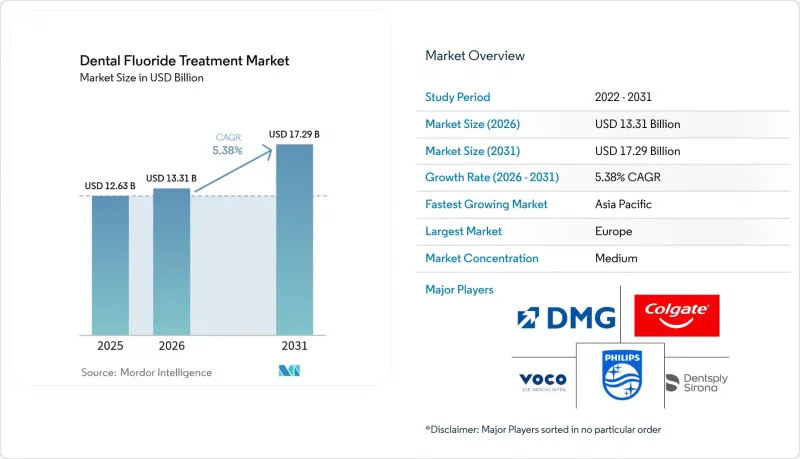
This report is Segmented by Product (Gels, Toothpaste, Mouth Rinse and More), by Application (Caries Prevention, Dentinal Hypersensitivity Treatment and More), by Age Group (Children, Adult and More), by End User (Dental Clinics, Hospitals and More) and Geography (North America, Europe, Asia-Pacific and More). The Market Forecasts are Provided in Terms of Value (USD).
Global Dental Fluoride Treatment Market Trends and Insights
Rising Prevalence of Dental Caries Worldwide
Dental caries affects an estimated 2.3 billion individuals, underpinning persistent demand for fluoride-based prevention. Incidence is accelerating in emerging economies where diets high in processed sugars outpace access to professional dental care. The World Health Organization's 2021 endorsement of silver diamine fluoride highlights its suitability as a scalable, low-cost intervention, especially in resource-constrained settings. Clinical data show 38% silver diamine fluoride can halt roughly 70% of active lesions, reducing the need for restorative procedures. Pediatric and geriatric cohorts benefit most, given their higher caries vulnerability and treatment barriers. Continuous global surveillance of caries prevalence is therefore expected to sustain growth momentum for the dental fluoride treatment market.
Government Reimbursement Policies for Preventive Fluoride Varnish
Shift toward value-based healthcare is broadening insurance coverage for professional fluoride varnish. Integration of varnish application within primary-care workflows allows trained medical staff to deliver interventions cost-effectively, extending reach beyond dental offices. Longitudinal studies indicate varnish use can cut coronal caries by 27% and root caries by 23% in community-dwelling elders. Standardized clinical guidelines from the American Dental Association further streamline provider adoption, encouraging insurers to reimburse evidence-backed preventive care. As Medicaid and private payers scale coverage, varnish utilization is poised to rise, elevating topical fluoride consumption across age groups.
Fluorosis Risk Driving Stricter Dosage Guidelines
Growing scrutiny of fluoride safety is prompting regulators to tighten pediatric dosage recommendations. The May 2025 FDA action to pull concentrated supplements cited potential gut microbiome disruption and neurodevelopmental concerns. Epidemiological data link high systemic intake during enamel formation to irreversible fluorosis, resulting in mottling and aesthetics-driven quality-of-life impacts. Consequently, producers must invest in precision-dosing formats and transparent labeling to reassure clinicians and consumers. Stricter limits could temper overall volume growth, even while stimulating innovation in safer topical delivery.
Other drivers and restraints analyzed in the detailed report include:
- Advances in High-Adhesion Fluoride Delivery Systems
- Growing Adoption of Minimally-Invasive Dentistry Protocols
- Consumer Shift Toward Fluoride-Free Oral-Care Products
For complete list of drivers and restraints, kindly check the Table Of Contents.
Segment Analysis
Silver diamine fluoride posted a 5.74% CAGR outlook, outperforming the broader dental fluoride treatment market. Clinical studies showing 70% lesion-arrest efficacy underpin adoption in school-based sealant programs and geriatric facilities. Toothpaste remains the volume anchor with 37.78% of dental fluoride treatment market share in 2025, benefiting from daily-use frequency and established consumer trust. Varnish formulations are gaining ground as professional standards evolve toward quarterly high-fluoride applications, leveraging sustained-release profiles validated by 24-hour elution testing. Gel and foam formats continue serving niche roles in custom trays and chairside prophylaxis but face substitution from high-adhesion varnishes. Mouth rinses enjoy moderate growth, driven by convenience-oriented adults seeking incremental fluoride exposure between hygiene visits. Hydrogel patches and nano-carrier sprays represent pipeline innovations, offering targeted therapy for orthodontic brackets and interproximal sites.
Growing silver diamine fluoride uptake is catalyzing new delivery form factors, including single-dose applicators that limit cross-contamination and simplify billing in community clinics. Retail toothpaste innovation centers on higher-ppm fluoride bands and calcium-phosphate co-formulations, aiming to retain loyal users amid fluoride-free competition. Chewable tablets are declining after the FDA supplement withdrawal, prompting pediatric dentists to shift toward varnish during medical well-child appointments. Overall, toothpaste will likely preserve a dominant revenue role, yet product diversification enlarges the total dental fluoride treatment market, especially in emerging economies adopting evidence-based caries-arrest protocols.
Caries prevention held 60.84% of the dental fluoride treatment market size in 2025, reflecting its centrality in public-health dentistry. Professional guidelines advocating biannual varnish for moderate-risk adults assure stable demand across developed regions. Dentinal hypersensitivity treatments, advancing at 6.21% CAGR, leverage fluoride's tubule-occluding and nerve-calming properties. High-fluoride rinses and bioactive glass pastes are capturing patients dissatisfied with potassium-nitrate alternatives. Enamel remineralization occupies a rising niche as AI imaging detects early white-spot lesions, allowing non-invasive fluoride infiltration therapies such as Curodont Repair Fluoride Plus. Root-caries management gains salience with global aging; fluoride gel trays combined with chlorhexidine rinse show promising root-surface hardening in elders with dexterity limitations.
In hypersensitivity, premium SKU pricing offsets lower unit volumes, encouraging firms to incorporate arginine, calcium silicate, or stannous compounds for faster relief. Early remineralization therapies rely on dentist-led education to shift mindsets from drill-and-fill to preserve-and-protect. Public-sector programs in Latin America increasingly fund high-fluoride gel for schoolchildren, aiming to cut untreated decay prevalence. As preventive-first paradigms consolidate, overlapping indications blur lines among applications, yet the high share of caries prevention ensures continued bulk purchasing of basic fluoride formulations.
Complete Report Scope:
- By Product Type
- Toothpaste
- Gel
- Mouth Rinse
- Varnish
- Silver Diamine Fluoride
- Chewable Tablets
- Novel Hydrogel & Other Delivery Systems
- By Application
- Caries Prevention
- Dentinal Hypersensitivity Treatment
- Enamel Remineralization
- Root-caries Management
- By Age Group
- Pediatric
- Adult
- Geriatric
- By End User
- Dental Clinics
- Hospitals
- Home-care / OTC Use
- Other Institutional Care (Schools, Public Health)
- By Geography
- North America
- United States
- Canada
- Mexico
- Europe
- Germany
- United Kingdom
- France
- Italy
- Spain
- Russia
- Rest of Europe
- Asia-Pacific
- China
- Japan
- India
- South Korea
- Australia
- Rest of Asia-Pacific
- Middle East and Africa
- GCC
- South Africa
- Rest of Middel East and Africa
- South America
- Brazil
- Argentina
- Rest of South America
- North America
Geography Analysis
Europe remains the largest regional contributor with a 31.95% share thanks to entrenched preventive protocols, mandatory insurance coverage, and strict product-safety regulation. High awareness translates into routine professional varnish every six months and near-universal toothpaste penetration. Growth is comparatively modest yet stable, supported by incremental upgrades to sustained-release formulations and expanding senior-care initiatives.
Asia-Pacific leads in growth rate at 6.98% CAGR, propelled by urban middle-class expansion and aggressive public-health programs in China and India. Government subsidies for school-based varnish, domestic manufacturing incentives, and the proliferation of private clinics are key drivers. However, rural-urban disparities and dentist shortages temper full potential. Multinationals are partnering with local producers to navigate price-sensitive segments while complying with divergent regulatory standards.
North America shows mixed dynamics. Robust evidence-based practice supports premium product uptake, but state-level fluoridation bans in Florida and Utah introduce policy uncertainty, prompting municipalities to explore alternative topical delivery. Medicaid expansion of fluoride-varnish coverage in medical offices mitigates risks by sustaining public-sector demand. Latin America and the Middle East & Africa collectively represent emerging opportunities, characterized by low baseline penetration yet high disease burden. International NGOs and multilaterals financing school sealant programs are seeding demand, setting the stage for gradual uptake of professional fluoride products.
- 3M
- Colgate-Palmolive Company
- Dentsply Sirona
- GC Corporation
- Ivoclar Vivadent
- Ultradent Products
- Centrix Inc.
- Henry Schein
- Preventech
- Young Innovations
- VOCO
- Pulpdent Corporation
- Premier Dental Products
- Kuraray Noritake Dental
- Keystone Industries
- Medicom
- Darby Dental Supply
- Crosstex International
- Elevate Oral Care
- Oral BioTech
- SDI
- Church & Dwight (Arm & Hammer)
- Sunstar Group
- DSI Dental Solutions Israel
- Rising Pharma Holdings
- Benco Dental
- PureLife Dental
- Patterson Dental
Additional Benefits:
- The market estimate (ME) sheet in Excel format
- 3 months of analyst support
TABLE OF CONTENTS
1 Introduction
- 1.1 Study Assumptions & Market Definition
- 1.2 Scope of the Study
2 Research Methodology
3 Executive Summary
4 Market Landscape
- 4.1 Market Overview
- 4.2 Market Drivers
- 4.2.1 Rising prevalence of dental caries worldwide
- 4.2.2 Government reimbursement policies for preventive fluoride varnish
- 4.2.3 Advances in high-adhesion fluoride delivery systems
- 4.2.4 Growing adoption of minimally-invasive dentistry protocols
- 4.2.5 State-level mandates expanding fluoride-varnish coverage (e.g., CA AB-350)
- 4.2.6 Bioactive glass-enhanced fluoride varnishes targeting geriatric caries
- 4.3 Market Restraints
- 4.3.1 Fluorosis risk driving stricter dosage guidelines
- 4.3.2 Consumer shift toward fluoride-free oral-care products
- 4.3.3 Supply-chain volatility for pharmaceutical-grade sodium fluoride
- 4.3.4 Environmental scrutiny on fluoride effluent from dental offices
- 4.4 Supply-Chain Analysis
- 4.5 Regulatory Landscape
- 4.6 Technological Outlook
- 4.7 Porter's Five Forces
- 4.7.1 Threat of New Entrants
- 4.7.2 Bargaining Power of Suppliers
- 4.7.3 Bargaining Power of Buyers
- 4.7.4 Threat of Substitutes
- 4.7.5 Competitive Rivalry
5 Market Size & Growth Forecasts
- 5.1 By Product Type
- 5.1.1 Toothpaste
- 5.1.2 Gel
- 5.1.3 Mouth Rinse
- 5.1.4 Varnish
- 5.1.5 Silver Diamine Fluoride
- 5.1.6 Chewable Tablets
- 5.1.7 Novel Hydrogel & Other Delivery Systems
- 5.2 By Application
- 5.2.1 Caries Prevention
- 5.2.2 Dentinal Hypersensitivity Treatment
- 5.2.3 Enamel Remineralization
- 5.2.4 Root-caries Management
- 5.3 By Age Group
- 5.3.1 Pediatric
- 5.3.2 Adult
- 5.3.3 Geriatric
- 5.4 By End User
- 5.4.1 Dental Clinics
- 5.4.2 Hospitals
- 5.4.3 Home-care / OTC Use
- 5.4.4 Other Institutional Care (Schools, Public Health)
- 5.5 By Geography
- 5.5.1 North America
- 5.5.1.1 United States
- 5.5.1.2 Canada
- 5.5.1.3 Mexico
- 5.5.2 Europe
- 5.5.2.1 Germany
- 5.5.2.2 United Kingdom
- 5.5.2.3 France
- 5.5.2.4 Italy
- 5.5.2.5 Spain
- 5.5.2.6 Russia
- 5.5.2.7 Rest of Europe
- 5.5.3 Asia-Pacific
- 5.5.3.1 China
- 5.5.3.2 Japan
- 5.5.3.3 India
- 5.5.3.4 South Korea
- 5.5.3.5 Australia
- 5.5.3.6 Rest of Asia-Pacific
- 5.5.4 Middle East and Africa
- 5.5.4.1 GCC
- 5.5.4.2 South Africa
- 5.5.4.3 Rest of Middel East and Africa
- 5.5.5 South America
- 5.5.5.1 Brazil
- 5.5.5.2 Argentina
- 5.5.5.3 Rest of South America
- 5.5.1 North America
6 Competitive Landscape
- 6.1 Market Concentration
- 6.2 Market Share Analysis
- 6.3 Company Profiles (includes Global level Overview, Market level overview, Core Segments, Financials as available, Strategic Information, Market Rank/Share for key companies, Products & Services, and Recent Developments)
- 6.3.1 3M Company
- 6.3.2 Colgate-Palmolive Company
- 6.3.3 Dentsply Sirona
- 6.3.4 GC Corporation
- 6.3.5 Ivoclar Vivadent
- 6.3.6 Ultradent Products Inc.
- 6.3.7 Centrix Inc.
- 6.3.8 Henry Schein Inc.
- 6.3.9 Preventech
- 6.3.10 Young Innovations Inc.
- 6.3.11 VOCO GmbH
- 6.3.12 Pulpdent Corporation
- 6.3.13 Premier Dental Products
- 6.3.14 Kuraray Noritake Dental
- 6.3.15 Keystone Industries
- 6.3.16 Medicom
- 6.3.17 Darby Dental Supply
- 6.3.18 Crosstex International
- 6.3.19 Elevate Oral Care
- 6.3.20 Oral BioTech
- 6.3.21 SDI Limited
- 6.3.22 Church & Dwight (Arm & Hammer)
- 6.3.23 Sunstar Group
- 6.3.24 DSI Dental Solutions Israel
- 6.3.25 Rising Pharma Holdings
- 6.3.26 Benco Dental
- 6.3.27 PureLife Dental
- 6.3.28 Patterson Dental
7 Market Opportunities & Future Outlook
- 7.1 White-space & Unmet-Need Assessment

