PUBLISHER: Mordor Intelligence | PRODUCT CODE: 2097175

PUBLISHER: Mordor Intelligence | PRODUCT CODE: 2097175
Permanent Magnet - Market Share Analysis, Industry Trends & Statistics, Growth Forecasts (2026 - 2031)
According to Mordor Intelligence, the permanent magnet market size is projected to grow from USD 51.80 billion in 2025 to USD 54.91 billion in 2026, and reach USD 74.11 billion by 2031, growing at a CAGR of 6.18% from 2026 to 2031.
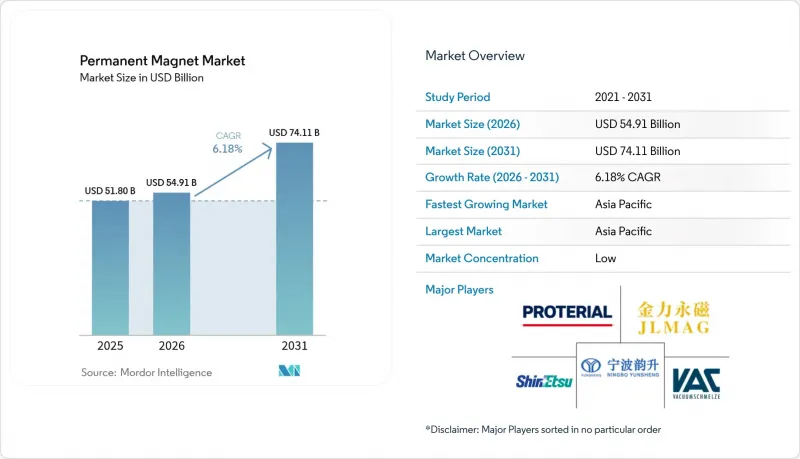
This report is Segmented by Material Type (Neodymium-Iron-Boron, Ferrite, Samarium-Cobalt, and Alnico), End-User Industry (Automotive, Electronics, Industrial, Power Generation, and Other End-User Industries), and Geography (Asia-Pacific, North America, Europe, South America, and Middle East and Africa). The Market Forecasts are Provided in Terms of Value (USD).
Global Permanent Magnet Market Trends and Insights
Electrification of Passenger and Commercial EV Fleets
Battery-electric vehicle output hit 14 million units in 2025, with each passenger car averaging 2 kg of sintered NdFeB and heavy trucks using up to 8 kg. BYD's e-platform 3.0 specified 180 °C-rated NdFeB rotors, while Daimler Truck and Volvo doubled magnet content in dual-motor drivetrains. The Euro 7 tailpipe rule, effective July 2025, locks in permanent-magnet synchronous machines for new urban buses, embedding long-run demand across a 40,000-unit replacement cycle in the permanent magnet market.
Surging Direct-Drive Wind-Turbine Installations
Offshore wind added 22 GW in 2025, and 68% used direct-drive generators that require 600-1,200 kg of NdFeB per turbine. China's 42 GW pipeline and recent US lease areas specify the same topology, tightening the supply-demand balance for high-grade rare-earth magnets.
Rare-Earth Price Volatility and Export Controls
Neodymium oxide spiked 42% in 2025 after Myanmar halted heavy-rare-earth output and China imposed a 15% export tariff, squeezing non-Chinese refiners and trimming Lynas margins to 22%. Spot prices of praseodymium-neodymium alloy averaged USD 68/kg, adding USD 32 to a 2 kg EV motor bill-of-materials, creating cost pressures across the permanent magnet market.
Other drivers and restraints analyzed in the detailed report include:
- Miniaturization in High-Precision Consumer Electronics
- Industrial Automation and Humanoid-Robot Investments
- Rise of Ferrite/Soft-Magnetic Composite Substitutes
For complete list of drivers and restraints, kindly check the Table Of Contents.
Segment Analysis
Neodymium-Iron-Boron (NdFeB) magnets outpace the permanent magnet market at 7.18% CAGR through 2031 as electric-mobility and wind-power designers demand energy products above 35 MGOe. Ferrite retained 46.76% of 2025 revenue because smartphones, loudspeakers, and low-speed motors value low cost per kilogram, yet its share erodes as traction motors standardize on sintered NdFeB. Samarium-cobalt remains a niche for aerospace and oil-and-gas tools thanks to stability beyond 250 °C, while alnico slips under 5% after rare-earth options displaced it in sensors and precision instruments. Shin-Etsu shipped 14% more sintered NdFeB in fiscal 2025, underscoring the shift from bonded forms.
Bonded NdFeB is relegated to thin micro-speaker rings and smartwatch haptics where net-shape molding outweighs energy limits. The permanent magnet market size for NdFeB is therefore projected to capture an outsized share of absolute value gains through 2031 while ferrite largely tracks global GDP.
Complete Report Scope:
- By Material Type
- Neodymium-Iron-Boron
- Ferrite
- Samarium-Cobalt
- Alnico
- By End-user Industry
- Automotive
- Electronics
- Industrial
- Power Generation
- Other End-user Industries (Medical and Healthcare)
- By Geography
- Asia-Pacific
- China
- Japan
- India
- South Korea
- Rest of Asia-Pacific
- North America
- United States
- Canada
- Mexico
- Europe
- Germany
- United Kingdom
- France
- Italy
- Rest of Europe
- South America
- Brazil
- Argentina
- Rest of South America
- Middle East and Africa
- Saudi Arabia
- South Africa
- Rest of Middle East and Africa
- Asia-Pacific
Geography Analysis
Asia-Pacific generated 53.72% of global value in 2025 and is rising at a 7.25% CAGR, reinforcing its leadership in the permanent magnet market. China alone refined 85% of global rare-earth oxides and produced 187,000 tons of NdFeB magnets, bolstered by low electricity costs and integrated mine-to-magnet clusters. Japan maintains technology leadership, but limited domestic raw materials capped output at 31,000 tons. India's production grew 18% under Production-Linked Incentives that reimburse up to 20% of capital outlay for new plants.
North America plus Europe accounted for significant revenue in 2025. MP Materials' Stage II refinery produced neodymium-praseodymium oxide in California, marking the first US upstream step toward integrated magnets since 2015, strengthening the US permanent magnet market. Germany's VACUUMSCHMELZE lifted Hanau's sintering capacity 30% to supply European EV plants under multiyear take-or-pay contracts.
South America and the Middle East and Africa are witnessing a rising demand for permanent magnets. Brazil's offshore wind build-out supports local magnet assemblies, and South African mines install permanent-magnet conveyor drives to save 25% energy. South Korea exported 18,000 tons of magnets in 2025, feeding Vietnamese and Thai supply chains. Across Europe, the extended Ecodesign Directive, effective 2025, pushes industrial motor efficiency thresholds that effectively favor permanent-magnet synchronous machines in ratings above 7.5 kW.
- Arnold Magnetic Technologies
- Daido Steel Co., Ltd.
- Dmegc.de
- Galaxymagnets
- Hitachi Metals, Ltd.
- JL MAG Rare-Earth Co., Ltd.
- Lynas Rare Earths Ltd.
- NEO
- NINGBO YUNSHENG co., Ltd
- Powder Metallurgy
- Shin-Etsu Chemical Co., Ltd.
- TDK Corporation
- VACUUMSCHMELZE GmbH & Co. KG
- Yantai Zhenghai Magnetic Material Co.,Ltd.
- Zhongke Sanhuan
Additional Benefits:
- The market estimate (ME) sheet in Excel format
- 3 months of analyst support
TABLE OF CONTENTS
1 Introduction
- 1.1 Study Assumptions and Market Definition
- 1.2 Scope of the Study
2 Research Methodology
3 Executive Summary
4 Market Landscape
- 4.1 Market Overview
- 4.2 Market Drivers
- 4.2.1 Electrification of passenger and commercial EV fleets
- 4.2.2 Surging direct-drive wind-turbine installations
- 4.2.3 Miniaturisation in high-precision consumer electronics
- 4.2.4 Industrial automation and humanoid-robot investments
- 4.2.5 Commercialisation of 3-D-printed net-shape magnets
- 4.3 Market Restraints
- 4.3.1 Rare-earth price volatility and export controls
- 4.3.2 Rise of ferrite/soft-magnetic composite substitutes
- 4.3.3 Patent restrictions on high-grade NdFeB technology
- 4.4 Value Chain Analysis
- 4.5 Porter's Five Forces
- 4.5.1 Bargaining Power of Suppliers
- 4.5.2 Bargaining Power of Buyers
- 4.5.3 Threat of New Entrants
- 4.5.4 Threat of Substitutes
- 4.5.5 Degree of Competition
5 Market Size and Growth Forecasts (Value)
- 5.1 By Material Type
- 5.1.1 Neodymium-Iron-Boron
- 5.1.2 Ferrite
- 5.1.3 Samarium-Cobalt
- 5.1.4 Alnico
- 5.2 By End-user Industry
- 5.2.1 Automotive
- 5.2.2 Electronics
- 5.2.3 Industrial
- 5.2.4 Power Generation
- 5.2.5 Other End-user Industries (Medical and Healthcare)
- 5.3 By Geography
- 5.3.1 Asia-Pacific
- 5.3.1.1 China
- 5.3.1.2 Japan
- 5.3.1.3 India
- 5.3.1.4 South Korea
- 5.3.1.5 Rest of Asia-Pacific
- 5.3.2 North America
- 5.3.2.1 United States
- 5.3.2.2 Canada
- 5.3.2.3 Mexico
- 5.3.3 Europe
- 5.3.3.1 Germany
- 5.3.3.2 United Kingdom
- 5.3.3.3 France
- 5.3.3.4 Italy
- 5.3.3.5 Rest of Europe
- 5.3.4 South America
- 5.3.4.1 Brazil
- 5.3.4.2 Argentina
- 5.3.4.3 Rest of South America
- 5.3.5 Middle East and Africa
- 5.3.5.1 Saudi Arabia
- 5.3.5.2 South Africa
- 5.3.5.3 Rest of Middle East and Africa
- 5.3.1 Asia-Pacific
6 Competitive Landscape
- 6.1 Market Concentration
- 6.2 Strategic Moves
- 6.3 Market Share(%)/Ranking Analysis
- 6.4 Company Profiles (includes Global level Overview, Market level overview, Core Segments, Financials as available, Strategic Information, Products and Services, Recent Developments)
- 6.4.1 Arnold Magnetic Technologies
- 6.4.2 Daido Steel Co., Ltd.
- 6.4.3 Dmegc.de
- 6.4.4 Galaxymagnets
- 6.4.5 Hitachi Metals, Ltd.
- 6.4.6 JL MAG Rare-Earth Co., Ltd.
- 6.4.7 Lynas Rare Earths Ltd.
- 6.4.8 NEO
- 6.4.9 NINGBO YUNSHENG co., Ltd
- 6.4.10 Powder Metallurgy
- 6.4.11 Shin-Etsu Chemical Co., Ltd.
- 6.4.12 TDK Corporation
- 6.4.13 VACUUMSCHMELZE GmbH & Co. KG
- 6.4.14 Yantai Zhenghai Magnetic Material Co.,Ltd.
- 6.4.15 Zhongke Sanhuan
7 Market Opportunities and Future Outlook
- 7.1 White-space and Unmet-need Assessment

