PUBLISHER: Mordor Intelligence | PRODUCT CODE: 2097182

PUBLISHER: Mordor Intelligence | PRODUCT CODE: 2097182
Acoustic Vehicle Alerting System - Market Share Analysis, Industry Trends & Statistics, Growth Forecasts (2026 - 2031)
According to Mordor Intelligence, the acoustic vehicle alerting system (AVAS) market size is expected to grow from USD 1.63 billion in 2025 to USD 1.85 billion in 2026 and is forecast to reach USD 3.43 billion by 2031 at 13.22% CAGR over 2026-2031.
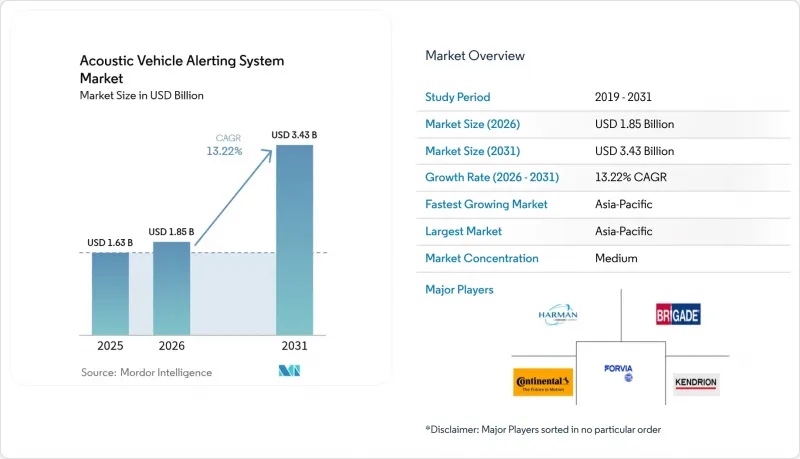
This report is Segmented by Vehicle Type (Passenger Cars, Two-Wheelers and Micro Mobility, and More), Propulsion (Battery Electric Vehicles, Plug-In Hybrid Electric Vehicles, and Hybrid Electric Vehicles), Sales Channel (OEM and Aftermarket), System Component (Speakers, and More), and Geography. The Market Forecasts are Provided in Terms of Value (USD).
Global Acoustic Vehicle Alerting System Market Trends and Insights
Regulatory Mandates for Pedestrian-Safety Compliance
Australia will require AVAS on all new electric vehicles starting November 2025, adding to mandates already in force across the EU, Canada, and the United States. UNECE Regulation R138 compels vehicles to emit artificial noise at 0-20 km/h, specifying minimum sound levels and gradual frequency shifts correlating with speed unece.org. Canada aligned its CMVSS 141 rule set with these guidelines, synchronising safety expectations throughout North America. Such uniform, non-negotiable rules eliminate demand uncertainty for the AVAS market by making acoustic systems a prerequisite for vehicle registration in regulated zones. With every compliance cycle, OEM purchasing departments lock in higher AVAS volumes, anchoring the forward order books of module suppliers.
Rapid Growth in Global EV Production Volumes
In 2024, global electric car production reached 17.3 million units, up 25% from 2023, with China responsible for more than 70% of the total. Each vehicle built in these plants requires an AVAS module, knitting the fortunes of acoustic suppliers to the robust EV growth curve. Model proliferation is also broadening, with the number of distinct electric car nameplates expected to top 1,000 by 2026, including many large SUVs that generate additional acoustic tuning work. Scaling effects are already driving down transducer and amplifier costs, encouraging faster adoption even in price-sensitive segments. Plug-in hybrids further enlarge the target pool because they must still emit artificial sound whenever the internal-combustion engine is off.
Lack of Globally Harmonised Sound-Level Regulations
UNECE rules serve as a baseline, yet the United States imposes slightly different spectral and decibel targets under FMVSS 141, obliging OEMs to engineer multiple hardware-software variants. That fragmentation raises validation costs and slows simultaneous global launches because each acoustic profile must pass local certification. Working-group negotiations at GlobalAutoRegs continue, but national priorities diverge between pedestrian safety and community noise control, delaying full convergence. The engineering burden lands hardest on mid-tier suppliers that lack the resources to maintain multiple product lines, thereby tempering short-term growth
Other drivers and restraints analyzed in the detailed report include:
- Rising OEM Focus on Brand-Customised Exterior Sound Signatures
- Integration of AVAS with V2X and Smart-City Infrastructure
- Incremental BOM Cost Pressure for Mass-Market BEVs
For complete list of drivers and restraints, kindly check the Table Of Contents.
Segment Analysis
In 2025, passenger cars dominated the Acoustic Vehicle Alerting System market, holding a 62.74% share, underscoring the maturity of compliance programs among global OEMs. Suppliers benefit from fleetwide integrations, securing predictable, high-volume contracts that bolster production planning. Two-wheelers and micromobility are witnessing the fastest growth, with a CAGR of 16.94%. This surge is attributed to regulators extending their safety focus to compact urban vehicles. OECD injury statistics highlight a growing number of pedestrian incidents tied to silent two-wheelers, prompting cities to enforce audible warning mandates. Consequently, specialist suppliers catering to these compact form factors are carving out a significant presence in the AVAS market.
Commercial vehicles adopt at a steadier pace, buffered by fleet procurement cycles and the need for ruggedized hardware. Yet the segment's risk profile in dense delivery corridors still spurs gradual but persistent demand. EU Regulation 168/2013, which sets functional safety rules for L-category vehicles, guarantees that micromobility makers will require acoustics during type approval. The widening scope of regulated vehicle classes cements multi-segment growth for the AVAS market.
Battery electric vehicles owned 65.22% of the Acoustic Vehicle Alerting System market share in 2025 and carry the highest forecast CAGR at 14.35%, confirming that fully electric drivetrains remain the prime catalyst for acoustic alerting demand. Because BEVs are silent in every low-speed phase, their compliance windows are broader than those of hybrids, making AVAS non-negotiable. Plug-in hybrids contribute incremental volume because their electric-only mode requires artificial sound below 20 km/h.
Design complexity varies by propulsion. BEVs need continuous output management that minimizes battery drain, while PHEVs must toggle the sound on and off when engines start. Hybrid electric vehicles present narrower activation windows yet still create obligatory volume. Each configuration nuance gives control unit suppliers opportunities to differentiate through software efficiency, further deepening the AVAS market.
Complete Report Scope:
- By Vehicle Type
- Passenger Cars
- Two-Wheelers and Micromobility
- Commercial Vehicles
- By Propulsion Type
- Battery Electric Vehicles (BEV)
- Plug-in Hybrid Electric Vehicles (PHEV)
- Hybrid Electric Vehicles (HEV)
- By Sales Channel
- OEM-fitted
- Aftermarket
- By System Component
- Speakers (External Sound Emitters)
- Electronic Control Units
- Software / DSP Algorithms
- Wiring and Harness
- By Geography
- North America
- United States
- Canada
- Rest of North America
- South America
- Brazil
- Argentina
- Rest of South America
- Europe
- Germany
- United Kingdom
- France
- Italy
- Spain
- Rest of Europe
- Asia-Pacific
- China
- Japan
- India
- South Korea
- Rest of Asia-Pacific
- Middle East and Africa
- Saudi Arabia
- United Arab Emirates
- South Africa
- Rest of Middle East and Africa
- North America
Geography Analysis
Asia-Pacific dominates the Acoustic Vehicle Alerting System market with a 43.10% revenue share in 2025 and a leading 14.98% CAGR outlook. China's GB/T 37153-2018 standard obliges every low-speed BEV, HEV, and FCEV to emit a calibrated sound signature, providing a uniform regulatory bedrock. Coupled with China's 70% share of global EV manufacturing, this rule guarantees a large local consumption base. Hong Kong's blanket requirement for AVAS on all electrified vehicles adds another layer of demand, while Japan and India review similar measures that could unlock further volume. Infrastructure pilots in Shanghai and Shenzhen already feed V2X data into Acoustic Vehicle Alerting System controllers, signaling future integration pathways.
North America ranks second in the Acoustic Vehicle Alerting System market, propelled by FMVSS 141 in the United States and Canada's harmonized CMVSS 141 regulation. Federal investment in V2X corridors enhances the technology roadmap and positions the region to pioneer connected acoustic services. Luxury brands headquartered in the United States increasingly monetize customizable sound portfolios, reinforcing high-margin growth within the regional Acoustic Vehicle Alerting System market.
Europe benefits from its early July 2021 mandate that covers every new electric or hybrid vehicle. Regulation 2019/2144 obliges advanced safety systems that protect vulnerable road users, including acoustic alerting devices. European OEMs leverage long-standing acoustics research to overlay musical principles onto compliant noise, creating signature tones that elevate brand perceptions. Additionally, the European Green Deal's urban noise objectives encourage adaptive Acoustic Vehicle Alerting System outputs that curtail excessive sound in quiet zones, stimulating research into context-aware signal processing
- HELLA GmbH & Co. KGaA (FORVIA Hella)
- Harman International Industries Inc.
- Continental Engineering Services GmbH
- Kendrion N.V.
- Brigade Electronics Group plc
- Robert Bosch GmbH
- Valeo SA
- DENSO Corp.
- Hyundai Mobis Co. Ltd.
- Aptiv plc
- ZF Friedrichshafen AG
- SoundRacer AB
Additional Benefits:
- The market estimate (ME) sheet in Excel format
- 3 months of analyst support
TABLE OF CONTENTS
1 Introduction
- 1.1 Study Assumptions & Market Definition
- 1.2 Scope of the Study
2 Research Methodology
3 Executive Summary
4 Market Landscape
- 4.1 Market Overview
- 4.2 Market Drivers
- 4.2.1 Regulatory Mandates For Pedestrian-Safety Compliance
- 4.2.2 Rapid Growth in Global EV Production Volumes
- 4.2.3 Brand-Customised Exterior Sound Signatures
- 4.2.4 Integration Of AVAS With V2X And Smart-City Infrastructure
- 4.2.5 Expansion Of Micromobility EV Categories
- 4.2.6 Advances in Low-Power Transducer Technologies
- 4.3 Market Restraints
- 4.3.1 Lack of Globally Harmonised Sound-Level Regulations
- 4.3.2 Incremental BOM Cost Pressure For Mass-Market Bevs
- 4.3.3 NVH Trade-Offs With Cabin Quietness Targets
- 4.3.4 Limited Consumer Awareness in Price-Sensitive Markets
- 4.4 Value / Supply-Chain Analysis
- 4.5 Regulatory Landscape
- 4.6 Technological Outlook
- 4.7 Porter's Five Forces Analysis
- 4.7.1 Threat of New Entrants
- 4.7.2 Bargaining Power of Buyers/Consumers
- 4.7.3 Bargaining Power of Suppliers
- 4.7.4 Threat of Substitute Products
- 4.7.5 Intensity of Competitive Rivalry
5 Market Size & Growth Forecasts (Value)
- 5.1 By Vehicle Type
- 5.1.1 Passenger Cars
- 5.1.2 Two-Wheelers and Micromobility
- 5.1.3 Commercial Vehicles
- 5.2 By Propulsion Type
- 5.2.1 Battery Electric Vehicles (BEV)
- 5.2.2 Plug-in Hybrid Electric Vehicles (PHEV)
- 5.2.3 Hybrid Electric Vehicles (HEV)
- 5.3 By Sales Channel
- 5.3.1 OEM-fitted
- 5.3.2 Aftermarket
- 5.4 By System Component
- 5.4.1 Speakers (External Sound Emitters)
- 5.4.2 Electronic Control Units
- 5.4.3 Software / DSP Algorithms
- 5.4.4 Wiring and Harness
- 5.5 By Geography
- 5.5.1 North America
- 5.5.1.1 United States
- 5.5.1.2 Canada
- 5.5.1.3 Rest of North America
- 5.5.2 South America
- 5.5.2.1 Brazil
- 5.5.2.2 Argentina
- 5.5.2.3 Rest of South America
- 5.5.3 Europe
- 5.5.3.1 Germany
- 5.5.3.2 United Kingdom
- 5.5.3.3 France
- 5.5.3.4 Italy
- 5.5.3.5 Spain
- 5.5.3.6 Rest of Europe
- 5.5.4 Asia-Pacific
- 5.5.4.1 China
- 5.5.4.2 Japan
- 5.5.4.3 India
- 5.5.4.4 South Korea
- 5.5.4.5 Rest of Asia-Pacific
- 5.5.5 Middle East and Africa
- 5.5.5.1 Saudi Arabia
- 5.5.5.2 United Arab Emirates
- 5.5.5.3 South Africa
- 5.5.5.4 Rest of Middle East and Africa
- 5.5.1 North America
6 Competitive Landscape
- 6.1 Market Concentration
- 6.2 Strategic Moves
- 6.3 Market Share Analysis
- 6.4 Company Profiles (includes Global level Overview, Market level overview, Core Segments, Financials as available, Strategic Information, Market Rank/Share for key companies, Products & Services, and Recent Developments)
- 6.4.1 HELLA GmbH & Co. KGaA (FORVIA Hella)
- 6.4.2 Harman International Industries Inc.
- 6.4.3 Continental Engineering Services GmbH
- 6.4.4 Kendrion N.V.
- 6.4.5 Brigade Electronics Group plc
- 6.4.6 Robert Bosch GmbH
- 6.4.7 Valeo SA
- 6.4.8 DENSO Corp.
- 6.4.9 Hyundai Mobis Co. Ltd.
- 6.4.10 Aptiv plc
- 6.4.11 ZF Friedrichshafen AG
- 6.4.12 SoundRacer AB
7 Market Opportunities & Future Outlook
- 7.1 White-space & Unmet-Need Assessment

