PUBLISHER: Mordor Intelligence | PRODUCT CODE: 2097185

PUBLISHER: Mordor Intelligence | PRODUCT CODE: 2097185
Pneumatic Nebulizer - Market Share Analysis, Industry Trends & Statistics, Growth Forecasts (2026 - 2031)
According to Mordor Intelligence, the pneumatic nebulizer market size is expected to grow from USD 0.85 billion in 2025 to USD 0.90 billion in 2026 and is forecast to reach USD 1.21 billion by 2031 at 6.03% CAGR over 2026-2031.
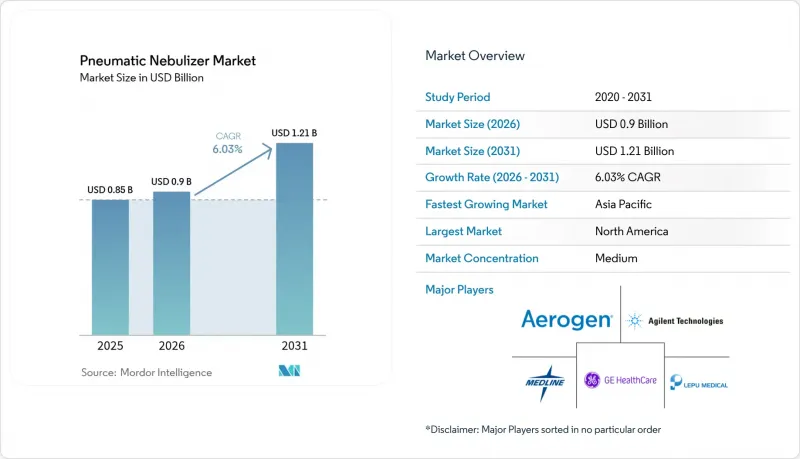
This report is Segmented by Portability (Tabletop and Portable), by Technology (Conventional Compressor, Noise-Reduced Compressor and More), by Patient Age Group (Pediatric, Adult and More), by Application (COPD, Asthma and More), Geography (North America, Europe, Asia-Pacific, and More). The Market Forecasts are Provided in Terms of Value (in USD).
Global Pneumatic Nebulizer Market Trends and Insights
Accelerating COPD Prevalence & Aging Population
Ambient particulate matter now accounts for 22.2% of COPD disability-adjusted life years worldwide Respiratory Research. Because hospitalization costs for COPD exceed USD 24 billion annually in the United States, providers view pneumatic nebulizers as cost-effective maintenance therapy. This epidemiological pressure sustains long-term growth across the pneumatic nebulizer market.
Home-Based Respiratory Therapy Adoption Surge
Hospital discharge programs such as the Re-Engineered Discharge (RED) framework lower readmissions by embedding nebulizer use into structured home protocols. Medicare's 2024 rule covering virtual pulmonary rehabilitation extends these benefits to rural communities American Thoracic Society. Tele-health monitoring combined with nebulizer data feeds lets clinicians adjust therapy remotely, strengthening adherence while opening subscription software revenue.
Rapid Cannibalization by Mesh & Ultrasonic Tech
A 2025 pediatric asthma trial showed mesh nebulizers produced greater gains in FEV1 compared with compressors, driving clinician preference toward quieter, faster units. Mesh devices now operate below 23 dBA and in any orientation, advantages that erode institutional demand for pneumatic models. Unless compressor makers match noise and efficiency metrics, mesh adoption could siphon share from the pneumatic nebulizer market in high-value hospital accounts.
Other drivers and restraints analyzed in the detailed report include:
- Government Reimbursement Expansion (EU, China)
- Technological Shift to Low-Noise Smart Compressors
- Infection-Control & Aerosolization Safety Concerns
For complete list of drivers and restraints, kindly check the Table Of Contents.
Segment Analysis
Benchtop devices captured 57.65% of pneumatic nebulizer market share in 2025, anchored by strong compressor output and large medication cups that suit chronic COPD therapy. Their stable power supply enables dependable droplet formation for viscous formulations. Portable models, however, are logging a 7.06% CAGR to 2031. The segment profits from miniaturized motors and rechargeable batteries that meet rising patient mobility expectations.
Benchtop units retain favor among elderly users who value simple controls and consistent performance. Yet holiday travel and work commitments spur younger patients to opt for hand-held formats like OMRON's MicroAir, which weighs just 4.2 ounces and works at any angle OMRON Healthcare. As home-based care grows, dual-ownership households-one benchtop for routine therapy and one portable for on-the-go dosing-are becoming commonplace, broadening total spending inside the pneumatic nebulizer market.
Conventional compressors accounted for 68.72% of the pneumatic nebulizer market size in 2025 thanks to attractive unit pricing and a well-established service network. Cost-sensitive payers in emerging economies continue to specify tried-and-tested pneumatic engines. Smart-connected compressors are gaining momentum, advancing at 7.42% CAGR as payers reimburse remote monitoring.
Noise-optimized units serve as a bridge technology, bringing sound levels below 52 dB without the premium price of mesh devices. Data-enabled models allow clinicians to download adherence logs, a feature that improves medication titration and supports pay-for-performance contracts. Over time, digital health ecosystems could shift revenue mix from one-off hardware sales to recurring software packages, raising lifetime value per patient within the pneumatic nebulizer market.
Complete Report Scope:
- By Portability (Value)
- Portable/ Handheld
- Benchtop/ Tabletop
- By Technology (Value)
- Conventional Compressor
- Noise-Reduced Compressor
- Smart/ Digital-Integrated Compressor
- By Patient Age Group (Value)
- Pediatric
- Adult
- Geriatric
- By Application (Value)
- COPD
- Asthma
- Cystic Fibrosis
- Others (Bronchiectasis, Pneumonia)
- By Geography (Value)
- North America
- United States
- Canada
- Mexico
- Europe
- Germany
- United Kingdom
- France
- Italy
- Spain
- Rest of Europe
- Asia-Pacific
- China
- India
- Japan
- South Korea
- Australia
- Rest of Asia-Pacific
- South America
- Brazil
- Argentina
- Rest of South America
- Middle East and Africa
- GCC
- South Africa
- Rest of Middle East and Africa
- North America
Geography Analysis
North America led with 40.15% share of the pneumatic nebulizer market in 2025. High COPD prevalence, comprehensive insurance coverage, and strong distributor networks underpin sales. Recent Medicare coding updates simplify provider billing, keeping adoption momentum in both hospital and home settings. Canada benefits from single-payer reimbursement that subsidizes devices for low-income seniors, while Mexico's Seguro Popular reform is piloting respiratory home-care programs that could expand compressor uptake.
Asia-Pacific is the fastest-growing arena, registering a 7.55% CAGR to 2031. China drives volume as air pollution and smoking rates lift respiratory disease cases. OMRON reported double-digit nebulizer growth in its China portfolio during 2024. India contributes through public-private schemes that finance affordable devices for rural clinics, and Japan's super-aged society sustains steady demand for high-end models featuring quiet operation and smart connectivity.
Europe shows stable progress, aided by universal health coverage and strong clinical guidelines favoring nebulizer therapy for COPD and cystic fibrosis. Germany anchors volume due to robust outpatient infrastructure, while the United Kingdom's National Health Service streamlines device provision across primary-care centers. The European Commission's trade rules limiting certain Chinese suppliers give domestic manufacturers an opening to consolidate share. South America and the Middle East & Africa remain under-penetrated but are targeted for future expansion as distributors establish last-mile logistics networks.
- Koninklijke Philips
- OMRON
- PARI Pharma
- Drive DeVilbiss Healthcare
- Medtronic
- Rossmax
- GE HealthCare Technologies Inc.
- Agilent Technologies
- Briggs Healthcare
- GF Health Products
- Beckton Dickinson
- Salter Labs (SunMed)
- Vyaire Medical
- Trudell Medical International
- Armstrong Medical Ltd.
- Besmed Health Business
- Allied Healthcare Products
- Dehaier Medical Systems
- O2 CONCEPTS
- Well Lead Medical
Additional Benefits:
- The market estimate (ME) sheet in Excel format
- 3 months of analyst support
TABLE OF CONTENTS
1 Introduction
- 1.1 Study Assumptions & Market Definition
- 1.2 Scope of the Study
2 Research Methodology
3 Executive Summary
4 Market Landscape
- 4.1 Market Overview
- 4.2 Market Drivers
- 4.2.1 Accelerating COPD Prevalence & Aging Population
- 4.2.2 Home-Based Respiratory Therapy Adoption Surge
- 4.2.3 Government Reimbursement Expansion (EU, China)
- 4.2.4 Technological Shift to Low-Noise Smart Compressors
- 4.2.5 E-Commerce Boom in Compressor Replacement Kits
- 4.2.6 AI-Guided Adherence Platforms Bundled with Devices
- 4.3 Market Restraints
- 4.3.1 Rapid Cannibalization by Mesh & Ultrasonic Tech
- 4.3.2 Infection-Control & Aerosolization Safety Concerns
- 4.3.3 Low Reimbursement / Affordability in LMICs
- 4.3.4 Global Helium & Specialty-Gas Supply Constraints
- 4.4 Value / Supply-Chain Analysis
- 4.5 Regulatory Landscape
- 4.6 Technological Outlook
- 4.7 Porter's Five Forces
- 4.7.1 Threat of New Entrants
- 4.7.2 Bargaining Power of Suppliers
- 4.7.3 Bargaining Power of Buyers
- 4.7.4 Threat of Substitutes
- 4.7.5 Competitive Rivalry
5 Market Size & Growth Forecasts
- 5.1 By Portability (Value)
- 5.1.1 Portable/ Handheld
- 5.1.2 Benchtop/ Tabletop
- 5.2 By Technology (Value)
- 5.2.1 Conventional Compressor
- 5.2.2 Noise-Reduced Compressor
- 5.2.3 Smart/ Digital-Integrated Compressor
- 5.3 By Patient Age Group (Value)
- 5.3.1 Pediatric
- 5.3.2 Adult
- 5.3.3 Geriatric
- 5.4 By Application (Value)
- 5.4.1 COPD
- 5.4.2 Asthma
- 5.4.3 Cystic Fibrosis
- 5.4.4 Others (Bronchiectasis, Pneumonia)
- 5.5 By Geography (Value)
- 5.5.1 North America
- 5.5.1.1 United States
- 5.5.1.2 Canada
- 5.5.1.3 Mexico
- 5.5.2 Europe
- 5.5.2.1 Germany
- 5.5.2.2 United Kingdom
- 5.5.2.3 France
- 5.5.2.4 Italy
- 5.5.2.5 Spain
- 5.5.2.6 Rest of Europe
- 5.5.3 Asia-Pacific
- 5.5.3.1 China
- 5.5.3.2 India
- 5.5.3.3 Japan
- 5.5.3.4 South Korea
- 5.5.3.5 Australia
- 5.5.3.6 Rest of Asia-Pacific
- 5.5.4 South America
- 5.5.4.1 Brazil
- 5.5.4.2 Argentina
- 5.5.4.3 Rest of South America
- 5.5.5 Middle East and Africa
- 5.5.5.1 GCC
- 5.5.5.2 South Africa
- 5.5.5.3 Rest of Middle East and Africa
- 5.5.1 North America
6 Competitive Landscape
- 6.1 Market Concentration
- 6.2 Market Share Analysis
- 6.3 Company Profiles (includes Global level Overview, Market level overview, Core Segments, Financials as available, Strategic Information, Market Rank/Share for key companies, Products & Services, and Recent Developments)
- 6.3.1 Koninklijke Philips N.V.
- 6.3.2 Omron Corporation
- 6.3.3 PARI GmbH
- 6.3.4 Drive DeVilbiss Healthcare
- 6.3.5 Medtronic plc
- 6.3.6 Rossmax International Ltd.
- 6.3.7 GE HealthCare Technologies Inc.
- 6.3.8 Agilent Technologies Inc.
- 6.3.9 Briggs Healthcare
- 6.3.10 GF Health Products Inc.
- 6.3.11 Becton, Dickinson & Company
- 6.3.12 Salter Labs (SunMed)
- 6.3.13 Vyaire Medical Inc.
- 6.3.14 Trudell Medical International
- 6.3.15 Armstrong Medical Ltd.
- 6.3.16 Besmed Health Business Corp.
- 6.3.17 Allied Healthcare Products Inc.
- 6.3.18 Dehaier Medical Systems
- 6.3.19 O2 Concepts LLC
- 6.3.20 Well Lead Medical
7 Market Opportunities & Future Outlook
- 7.1 White-space & Unmet-Need Assessment

