PUBLISHER: Mordor Intelligence | PRODUCT CODE: 2097189

PUBLISHER: Mordor Intelligence | PRODUCT CODE: 2097189
Software Defined Radio - Market Share Analysis, Industry Trends & Statistics, Growth Forecasts (2026 - 2031)
According to Mordor Intelligence, the software-defined radio (SDR) market size is expected to grow from USD 19.95 billion in 2025 to USD 21.33 billion in 2026 and is forecast to reach USD 29.78 billion by 2031 at 6.9% CAGR over 2026-2031.
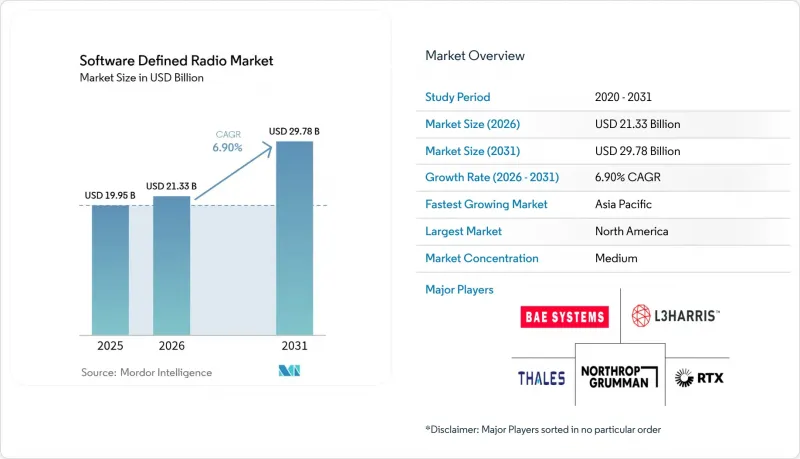
This report is Segmented by Platform (Land, Sea, Air, and Space), Component (Hardware and Software), Frequency Band (High Frequency, Very High Frequency, Ultra High Frequency, Super High Frequency, and Extremely High Frequency and MmWave), End-User (Government, Defense, and Commercial), and Geography (North America, Europe, and More). The Market Forecasts are Provided in Terms of Value (USD).
Global Software Defined Radio Market Trends and Insights
Transition to Network-Centric Warfare Driving Next-Gen SDR Adoption
Armed forces are standardizing architectures in which every platform-from soldier radios to surface vessels-shares data across a common tactical backbone. This operational shift hinges on radios able to load new waveforms and encryption suites on demand, a requirement that places the SDR market solutions at the center of modernization budgets. The United Kingdom earmarked GBP 2.9 billion (USD 3.99 billion) to acquire such reconfigurable systems. L3Harris secured a USD 999 million US Navy MIDS JTRS contract in 2024, illustrating supplier traction. Lessons from Ukraine's fielding of CJADC2 frameworks have further validated SDR's resilience under dense electronic-warfare environments, accelerating procurement cycles among NATO partners. The driver, therefore, extends beyond conventional communications to homeland-security grids that demand the same waveform agility.
Proliferation of 5G and Private Wireless Networks Boosting Radio Infrastructure Demand
Enterprise digitization compels factories, ports, and campuses to install private 5G systems to merge Wi-Fi, cellular, and sensor traffic on one physical layer. Because each site operates different spectrum slices, operators prefer radios that can switch bands through software, limiting truck rolls. Over 3,000 US organizations registered CBRS installations by late 2024, and AT&T committed USD 14 billion to Ericsson for Open RAN deployments that lean on software-defined radio units. The same multi-band versatility is designed into 5G-NTN gateways, enabling seamless switching between terrestrial and Low Earth Orbit links. Consequently, the SDR market addresses classic macro-cell rollouts and bespoke industrial networks.
Elevated Capital Costs Associated with Advanced FPGA and ADC Integration
High-end FPGAs and GHz-class ADCs that underpin today's wideband SDRs often exceed USD 10,000 per unit for ruggedized variants, limiting affordability for commercial clients. Additional outlays emerge from forced-air or liquid cooling required to dissipate 40-100 W per card under peak workloads. RTX and AMD are co-funding multi-chip packages aimed at doubling performance per watt, with a USD 20 million S2MARTS contract accelerating prototypes. Meanwhile, NXP's LA9310 shows how integrated RF-DSP silicon priced near USD 250 can unlock entry-level segments. Until such alternatives scale, cost remains a headwind for broader software-defined radio market penetration outside premium defense budgets.
Other drivers and restraints analyzed in the detailed report include:
- Regulatory Push for Dynamic Spectrum Access and Sharing Frameworks
- Expansion of Satellite Constellations Increasing Demand for Flexible Ground Terminals
- Persistent Vulnerabilities to Cyber Threats and Electronic Jamming
For complete list of drivers and restraints, kindly check the Table Of Contents.
Segment Analysis
Space systems accounted for a modest revenue slice in 2025, yet are projected to expand at an 7.95% CAGR, the fastest among all platforms. The software-defined radio market size for space-borne terminals is expected to climb steadily as software-reconfigurable payloads enable on-orbit beam steering and dynamic bandwidth allocation. SpainSat NG I, launched in January 2025, features a fully reprogrammable transponder that operators can retune in real time. Land platforms nevertheless held 39.55% of the software-defined radio market share in 2025, anchored by extensive armored-vehicle and manpack upgrades across NATO and Indo-Pacific armies.
The growth of space platforms spills into terrestrial segments because gateways must track dozens of Low Earth Orbit satellites simultaneously. Ground-station vendors integrate multiband SDR cards that switch between S- and Ka-bands to ensure link availability. Naval forces adopt similar gear to bridge ship-borne networks with proliferating satellite constellations. As a result, platform-agnostic architectures dominate supplier roadmaps, reinforcing cross-domain interoperability within the broader software-defined radio market.
Hardware captured 55.05% of 2025 revenue; yet the software submarket is forecast to outpace at 7.55% CAGR through 2031. Operators value the ability to download new waveforms over the air rather than dispatch field technicians to swap circuit cards. Consequently, the software-defined radio market size for firmware upgrades and security patches is expanding almost in lock-step with hardware refresh cycles. Telefonica Germany's rollout of a cloud-native RAN illustrates how containerized signal-processing functions can spin up within minutes on commercial servers.
Hardware advances remain crucial. RTX's work with AMD targets denser FPGA fabrics that fold AI accelerators directly onto radio boards, boosting spectral-efficiency metrics while trimming latency. Modularization trends also see mezzanine daughter cards hosting frequency-conversion chains, a design that lets integrators tailor radio front-ends to mission profiles. These co-design dynamics ensure silicon innovation and code refinement progress symbiotically inside the software-defined radio market.
Complete Report Scope:
- By Platform
- Land
- Sea
- Air
- Space
- By Component
- Hardware
- Software
- By Frequency Band
- High Frequency (HF)
- Very High Frequency (VHF)
- Ultra High Frequency (UHF)
- Super High Frequency (SHF)
- Extremely High Frequency (EHF) and mmWave
- By End-user
- Government and Defense
- Commercial
- By Geography
- North America
- United States
- Canada
- Mexico
- Europe
- United Kingdom
- Germany
- France
- Italy
- Rest of Europe
- Asia-Pacific
- China
- India
- Japan
- South Korea
- Australia
- Rest of Asia-Pacific
- South America
- Brazil
- Rest of South America
- Middle East and Africa
- Middle East
- Saudi Arabia
- Israel
- Rest of Middle East
- Africa
- South Africa
- Rest of Africa
- Middle East
- North America
Geography Analysis
North America retained 33.22% of global revenue in 2025, owing to sustained Pentagon budgets and an early lead in CBRS-based private networks. The region's suppliers locked in large orders such as L3Harris's USD 999 million Navy MIDS JTRS program and RTX's USD 646 million SPY-6 radar production lot. Federal Communications Commission policies that authorize shared-spectrum models further accelerate local commercialization. As defense and enterprise channels converge, the software-defined radio market in North America remains a bellwether for global standards and security certifications.
Asia-Pacific posts the highest 8.6% CAGR through 2031, propelled by record USD 411 billion regional defense spending in 2023 and aggressive 5G macro-cell and factory-floor builds. Japanese operator Sky Perfect JSAT contracted Thales for the software-defined JSAT-31 satellite, highlighting the region's appetite for next-generation space communications. Chinese and South Korean yards outfit naval fleets with reconfigurable radios to coordinate unmanned surface vehicles, widening the addressable base for the software-defined radio market.
Europe maintains steady expansion underpinned by sovereign-secure communications mandates. The United Kingdom's GBP 2.9 billion (USD 3.98 billion) SDR allocation and France's Syracuse IV program exemplify sustained institutional funding. The EU's spectrum policy targets cognitive-radio adoption by 2026, nurturing domestic demand while guiding interoperability norms. European primes also pursue export contracts in the Middle East and Africa, extending geographic reach for solutions engineered to European cybersecurity baselines.
- BAE Systems plc
- L3Harris Technologies, Inc.
- Northrop Grumman Corporation
- RTX Corporation
- Thales Group
- Elbit Systems Ltd.
- General Dynamics Corporation
- Leonardo S.p.A
- Rafael Advanced Defense Systems Ltd.
- ASELSAN A.S.
- Israel Aerospace Industries Ltd.
- Ultra Electronics Group
- Rohde & Schwarz GmbH and Co. KG
- Curtiss-Wright Corporation
- Keysight Technologies, Inc.
- National Instruments Corporation (Emerson Electric Co.)
- Ettus Research
- FlexRadio
Additional Benefits:
- The market estimate (ME) sheet in Excel format
- 3 months of analyst support
TABLE OF CONTENTS
1 INTRODUCTION
- 1.1 Study Assumptions and Market Definition
- 1.2 Scope of the Study
2 RESEARCH METHODOLOGY
3 EXECUTIVE SUMMARY
4 MARKET LANDSCAPE
- 4.1 Market Overview
- 4.2 Market Drivers
- 4.2.1 Transition to network-centric warfare driving next-gen SDR adoption
- 4.2.2 Proliferation of 5G and private wireless networks boosting radio infrastructure demand
- 4.2.3 Regulatory push for dynamic spectrum access and sharing frameworks
- 4.2.4 Expansion of satellite constellations increasing demand for flexible ground terminals
- 4.2.5 Secure mesh communication needs in UAV swarms elevating SDR relevance
- 4.2.6 Virtualization of base stations through Open RAN accelerating SDR integration
- 4.3 Market Restraints
- 4.3.1 Elevated capital costs associated with advanced FPGA and ADC integration
- 4.3.2 Persistent vulnerabilities to cyber threats and electronic jamming
- 4.3.3 Export regulations limiting the global deployment of reconfigurable SDR technologies
- 4.3.4 Thermal constraints hindering high-performance edge computing in SDR systems
- 4.4 Value Chain Analysis
- 4.5 Regulatory Landscape
- 4.6 Technological Outlook
- 4.7 Porter's Five Forces Analysis
- 4.7.1 Bargaining Power of Buyers/Consumers
- 4.7.2 Bargaining Power of Suppliers
- 4.7.3 Threat of New Entrants
- 4.7.4 Threat of Substitute Products
- 4.7.5 Intensity of Competitive Rivalry
5 MARKET SIZE AND GROWTH FORECASTS (VALUE)
- 5.1 By Platform
- 5.1.1 Land
- 5.1.2 Sea
- 5.1.3 Air
- 5.1.4 Space
- 5.2 By Component
- 5.2.1 Hardware
- 5.2.2 Software
- 5.3 By Frequency Band
- 5.3.1 High Frequency (HF)
- 5.3.2 Very High Frequency (VHF)
- 5.3.3 Ultra High Frequency (UHF)
- 5.3.4 Super High Frequency (SHF)
- 5.3.5 Extremely High Frequency (EHF) and mmWave
- 5.4 By End-user
- 5.4.1 Government and Defense
- 5.4.2 Commercial
- 5.5 By Geography
- 5.5.1 North America
- 5.5.1.1 United States
- 5.5.1.2 Canada
- 5.5.1.3 Mexico
- 5.5.2 Europe
- 5.5.2.1 United Kingdom
- 5.5.2.2 Germany
- 5.5.2.3 France
- 5.5.2.4 Italy
- 5.5.2.5 Rest of Europe
- 5.5.3 Asia-Pacific
- 5.5.3.1 China
- 5.5.3.2 India
- 5.5.3.3 Japan
- 5.5.3.4 South Korea
- 5.5.3.5 Australia
- 5.5.3.6 Rest of Asia-Pacific
- 5.5.4 South America
- 5.5.4.1 Brazil
- 5.5.4.2 Rest of South America
- 5.5.5 Middle East and Africa
- 5.5.5.1 Middle East
- 5.5.5.1.1 Saudi Arabia
- 5.5.5.1.2 Israel
- 5.5.5.1.3 Rest of Middle East
- 5.5.5.2 Africa
- 5.5.5.2.1 South Africa
- 5.5.5.2.2 Rest of Africa
- 5.5.5.1 Middle East
- 5.5.1 North America
6 COMPETITIVE LANDSCAPE
- 6.1 Market Concentration
- 6.2 Strategic Moves
- 6.3 Market Share Analysis
- 6.4 Company Profiles (includes Global level Overview, Market level overview, Core Segments, Financials as available, Strategic Information, Market Rank/Share for key companies, Products and Services, and Recent Developments)
- 6.4.1 BAE Systems plc
- 6.4.2 L3Harris Technologies, Inc.
- 6.4.3 Northrop Grumman Corporation
- 6.4.4 RTX Corporation
- 6.4.5 Thales Group
- 6.4.6 Elbit Systems Ltd.
- 6.4.7 General Dynamics Corporation
- 6.4.8 Leonardo S.p.A
- 6.4.9 Rafael Advanced Defense Systems Ltd.
- 6.4.10 ASELSAN A.S.
- 6.4.11 Israel Aerospace Industries Ltd.
- 6.4.12 Ultra Electronics Group
- 6.4.13 Rohde & Schwarz GmbH and Co. KG
- 6.4.14 Curtiss-Wright Corporation
- 6.4.15 Keysight Technologies, Inc.
- 6.4.16 National Instruments Corporation (Emerson Electric Co.)
- 6.4.17 Ettus Research
- 6.4.18 FlexRadio
7 MARKET OPPORTUNITIES AND FUTURE OUTLOOK
- 7.1 White-space and Unmet-need Assessment

