
PUBLISHER: Mordor Intelligence | PRODUCT CODE: 2097192

PUBLISHER: Mordor Intelligence | PRODUCT CODE: 2097192
Digital Signage Services - Market Share Analysis, Industry Trends & Statistics, Growth Forecasts (2026 - 2031)
According to Mordor Intelligence, digital signage services market size in 2026 is estimated at USD 5.45 billion, growing from 2025 value of USD 5.12 billion with 2031 projections showing USD 7.42 billion, growing at 6.38% CAGR over 2026-2031.
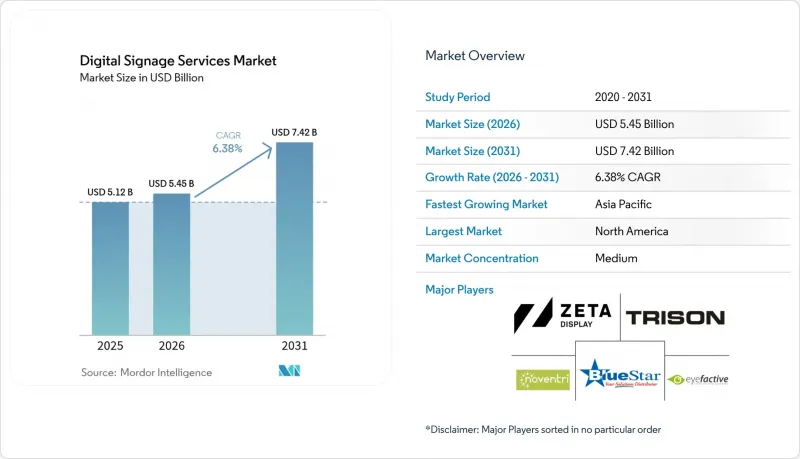
This report is Segmented by Service Type (Network Design and Installation, Maintenance and Support, and More), Deployment Mode (On-Premise Managed, and Cloud/Hosted Managed), Location (Indoor, Outdoor, and Semi-Outdoor), End-User Vertical (Retail and Wholesale, Transportation and Logistics, Hospitality and Leisure, and More), and Geography. The Market Forecasts are Provided in Terms of Value (USD).
Global Digital Signage Services Market Trends and Insights
Retail demand for dynamic in-store messaging
Retailers redesigned store communication around real-time data feeds. Walmart's roll-out of digital price screens across 2,300 stores represented a USD 200 million capital program that needs ongoing content orchestration and device monitoring. Convenience chains such as 7-Eleven run more than 8,400 cloud-managed displays that synchronize promotions with inventory levels. Specialist integrators benefit from consulting revenues tied to data architecture and workflow automation. Regional grocers like Kwik Trip reported USD 1.9 million in annual savings after shifting to system-on-chip displays that reduce hardware points.
Transportation hubs modernize passenger communication
Bus, rail and airport operators are replacing isolated displays with unified, cloud-hosted networks that push live travel data across sites. Greyhound connected over 50 cities using Philips D-Line and P-Line screens managed through a single content platform. Centralized control simplifies template standards, branding and emergency alerts while creating multi-year service contracts covering design, integration and 24 X 7 support. Multilingual content, accessibility compliance and mobile hand-off features widen project scope for service providers.
High TCO for Multi-Site Networks in Emerging Economies
Deploying digital signage across multiple locations can require substantial upfront and ongoing investment. Costs typically include displays, media players, installation, networking, software licenses, maintenance, and periodic hardware replacement. In emerging economies, these expenses can be harder to absorb because budgets are tighter and access to financing may be limited. Connectivity and power reliability issues can also increase operating costs and service interruptions. For businesses managing large networks, the total cost of ownership can rise quickly over time. This makes it harder for some organizations to scale digital signage beyond pilot deployments. As a result, high TCO remains a major restraint in cost-sensitive markets.
Other drivers and restraints analyzed in the detailed report include:
- Rapid deployment of 4K/8K LED walls
- Subscription-based CMS adoption by SMBs
- Content Refresh Fatigue Causing ROI Concerns for Small Retailers
For complete list of drivers and restraints, kindly check the Table Of Contents.
Segment Analysis
Maintenance and Support accounted for 44.10% of the Digital Signage Services market share in 2025, underscoring the importance of round-the-clock diagnostics, firmware updates and field repairs. Managed / Cloud Network Services is expanding at an 7.95% CAGR as enterprises favor remote monitoring, automated content distribution and analytics dashboards. The Digital Signage Services market size tied to break-fix contracts is therefore evolving toward predictive models that bundle spare-part pools and device health alerts.
Ongoing cloud migration is reshaping revenue mixes. Providers wrap subscription billing around hosting, API integrations and performance reporting, creating stable recurring cash flows. Consulting, content creation and analytics services ride this shift by helping clients connect inventory feeds, loyalty data and audience metrics to dynamic playlists. Specialist touchless-interaction projects add incremental services as retailers aim for hygienic experiences.
On-premise Managed solutions held 58.90% of the Digital Signage Services market size in 2025 as healthcare, finance and government users insisted on local servers and data residency. Cloud / Hosted Managed platforms are growing at 7.52% CAGR, propelled by SMBs that lack in-house IT support and by multi-site brands seeking centralized control.
Hybrid topologies are emerging that store content locally yet draw scheduling logic from the cloud, balancing uptime with scalability. Vendors differentiate through encrypted media pipelines, role-based access and automated patching frameworks. As bandwidth costs fall, even data-sensitive sectors pilot cloud sandboxes for non-personal content, signaling future share gains for hosted services.
Complete Report Scope:
- By Service Type
- Network Design and Installation
- Maintenance and Support
- Content Creation and Consulting
- Managed/Cloud Network Services
- Analytics and Reporting Services
- Other Specialized Services (Interactive and Touchless Integration)
- By Deployment Mode
- On-premise Managed
- Cloud/Hosted Managed
- By Location
- Indoor
- Outdoor
- Semi-Outdoor
- By End-User Vertical
- Retail and Wholesale
- Transportation and Logistics
- Hospitality and Leisure
- Healthcare
- Education
- Corporate and BFSI
- Government and Public Institutions
- Sports and Entertainment Venues
- Others
- By Display Format
- Video Walls
- Kiosks and Self-Service Terminals
- Menu Boards
- Digital Posters and Billboards
- Interactive Touch Screens
- Transparent and Holographic Displays
- By Geography
- North America
- United States
- Canada
- Mexico
- Europe
- Germany
- United Kingdom
- France
- Spain
- Rest of Europe
- South America
- Brazil
- Rest of South America
- Asia-Pacific
- China
- Japan
- India
- South-East Asia
- Rest of Asia-Pacific
- Middle East and Africa
- Middle East
- Gulf Cooperation Council Countries
- Turkey
- Rest of Middle East
- Africa
- South Africa
- Rest of Africa
- Middle East
- North America
Geography Analysis
North America kept 37.40% of 2025 revenue based on large-scale retail make-overs, nationwide transportation networks and early cloud adoption. Walmart's 2,300-store price label project and 7-Eleven's 8,400-display estate underline deal sizes that require multi-year managed-service contracts. Government stimulus for infrastructure upgraded bus and rail passenger information, further fuelling demand.
Asia-Pacific is the fastest-growing region at 6.95% CAGR to 2031. High urban growth, competitive retail markets and supportive SME digitalisation grants drive uptake. Subscription CMS solutions trim capex, fostering entry for local retailers and QSR chains. Strong panel manufacturing ecosystems in China and South Korea shorten supply cycles and lower hardware prices.
Europe advances steadily yet absorbs compliance overheads. Firms increased security budgets to satisfy the NIS 2 Directive. Energy-efficiency directives and city-level carbon targets encourage LED retrofits and life-cycle service agreements. EU recovery funds cushion SME adoption costs even as the Digital Signage Services industry navigates complex privacy regulations.
- STRATACACHE Inc.
- Samsung SDS Co., Ltd.
- LG Electronics Inc.
- Sharp NEC Display Solutions Ltd.
- Scala Enterprise (STRATACACHE)
- Four Winds Interactive LLC
- Mood Media Corp.
- Mvix Digital Signage
- Spectrio LLC
- BrightSign LLC
- Broadsign International Inc.
- Signagelive Ltd.
- Visix Inc.
- NoviSign Digital Signage
- Yodeck (Flipnode LLC)
- Enplug, Inc. (Spectrio)
- Nanonation Inc.
- Trison World
- ZetaDisplay AB
- Panasonic Connect Co., Ltd.
- eyefactive GmbH
Additional Benefits:
- The market estimate (ME) sheet in Excel format
- 3 months of analyst support
TABLE OF CONTENTS
1 INTRODUCTION
- 1.1 Study Assumptions and Market Definition
- 1.2 Scope of the Study
2 RESEARCH METHODOLOGY
3 EXECUTIVE SUMMARY
4 MARKET LANDSCAPE
- 4.1 Market Overview
- 4.2 Market Drivers
- 4.2.1 Retail Demand for Dynamic In-Store Messaging Accelerated by Real-Time Data Integration in North America
- 4.2.2 Transportation Hubs Modernize Passenger Communication Through Centralized Cloud-Managed Networks
- 4.2.3 Rapid Deployment of 4K/8K LED Walls Fueling Long-Term Maintenance Contracts
- 4.2.4 Subscription-Based CMS Adoption by SMBs in Asia-Pacific Reducing Up-Front Capex
- 4.2.5 Healthcare Way-Finding and Patient Engagement Screens Boost Service Outsourcing
- 4.2.6 Energy-Efficiency Mandates Driving LED Retrofits and Lifecycle Service Agreements
- 4.3 Market Restraints
- 4.3.1 High TCO for Multi-Site Networks in Emerging Economies
- 4.3.2 Content Refresh Fatigue Causing ROI Concerns for Small Retailers
- 4.3.3 Cyber-Security and Data-Privacy Compliance Costs in Europe
- 4.3.4 Margin Pressure from Low-Service System Integrator Price-Cutting
- 4.4 Industry Ecosystem Analysis
- 4.5 Porter's Five Forces Analysis
- 4.5.1 Threat of New Entrants
- 4.5.2 Bargaining Power of Buyers/Consumers
- 4.5.3 Bargaining Power of Suppliers
- 4.5.4 Threat of Substitute Products
- 4.5.5 Intensity of Competitive Rivalry
5 MARKET SIZE AND GROWTH FORECASTS (VALUES)
- 5.1 By Service Type
- 5.1.1 Network Design and Installation
- 5.1.2 Maintenance and Support
- 5.1.3 Content Creation and Consulting
- 5.1.4 Managed/Cloud Network Services
- 5.1.5 Analytics and Reporting Services
- 5.1.6 Other Specialized Services (Interactive and Touchless Integration)
- 5.2 By Deployment Mode
- 5.2.1 On-premise Managed
- 5.2.2 Cloud/Hosted Managed
- 5.3 By Location
- 5.3.1 Indoor
- 5.3.2 Outdoor
- 5.3.3 Semi-Outdoor
- 5.4 By End-User Vertical
- 5.4.1 Retail and Wholesale
- 5.4.2 Transportation and Logistics
- 5.4.3 Hospitality and Leisure
- 5.4.4 Healthcare
- 5.4.5 Education
- 5.4.6 Corporate and BFSI
- 5.4.7 Government and Public Institutions
- 5.4.8 Sports and Entertainment Venues
- 5.4.9 Others
- 5.5 By Display Format
- 5.5.1 Video Walls
- 5.5.2 Kiosks and Self-Service Terminals
- 5.5.3 Menu Boards
- 5.5.4 Digital Posters and Billboards
- 5.5.5 Interactive Touch Screens
- 5.5.6 Transparent and Holographic Displays
- 5.6 By Geography
- 5.6.1 North America
- 5.6.1.1 United States
- 5.6.1.2 Canada
- 5.6.1.3 Mexico
- 5.6.2 Europe
- 5.6.2.1 Germany
- 5.6.2.2 United Kingdom
- 5.6.2.3 France
- 5.6.2.4 Spain
- 5.6.2.5 Rest of Europe
- 5.6.3 South America
- 5.6.3.1 Brazil
- 5.6.3.2 Rest of South America
- 5.6.4 Asia-Pacific
- 5.6.4.1 China
- 5.6.4.2 Japan
- 5.6.4.3 India
- 5.6.4.4 South-East Asia
- 5.6.4.5 Rest of Asia-Pacific
- 5.6.5 Middle East and Africa
- 5.6.5.1 Middle East
- 5.6.5.1.1 Gulf Cooperation Council Countries
- 5.6.5.1.2 Turkey
- 5.6.5.1.3 Rest of Middle East
- 5.6.5.2 Africa
- 5.6.5.2.1 South Africa
- 5.6.5.2.2 Rest of Africa
- 5.6.5.1 Middle East
- 5.6.1 North America
6 COMPETITIVE LANDSCAPE
- 6.1 Market Concentration
- 6.2 Strategic Moves
- 6.3 Market Share Analysis
- 6.4 Company Profiles {(includes Global level Overview, Market level overview, Core Segments, Financials as available, Strategic Information, Market Rank/Share for key companies, Products and Services, and Recent Developments)}
- 6.4.1 STRATACACHE Inc.
- 6.4.2 Samsung SDS Co., Ltd.
- 6.4.3 LG Electronics Inc.
- 6.4.4 Sharp NEC Display Solutions Ltd.
- 6.4.5 Scala Enterprise (STRATACACHE)
- 6.4.6 Four Winds Interactive LLC
- 6.4.7 Mood Media Corp.
- 6.4.8 Mvix Digital Signage
- 6.4.9 Spectrio LLC
- 6.4.10 BrightSign LLC
- 6.4.11 Broadsign International Inc.
- 6.4.12 Signagelive Ltd.
- 6.4.13 Visix Inc.
- 6.4.14 NoviSign Digital Signage
- 6.4.15 Yodeck (Flipnode LLC)
- 6.4.16 Enplug, Inc. (Spectrio)
- 6.4.17 Nanonation Inc.
- 6.4.18 Trison World
- 6.4.19 ZetaDisplay AB
- 6.4.20 Panasonic Connect Co., Ltd.
- 6.4.21 eyefactive GmbH
7 MARKET OPPORTUNITIES AND FUTURE OUTLOOK
- 7.1 White-Space and Unmet-Need Assessment

