PUBLISHER: Mordor Intelligence | PRODUCT CODE: 2097198

PUBLISHER: Mordor Intelligence | PRODUCT CODE: 2097198
Oncology Clinical Trials - Market Share Analysis, Industry Trends & Statistics, Growth Forecasts (2026 - 2031)
According to Mordor Intelligence, the oncology clinical trials market size was valued at USD 13.91 billion in 2025 and estimated to grow from USD 14.63 billion in 2026 to reach USD 18.79 billion by 2031, at a CAGR of 5.14% during the forecast period (2026-2031).
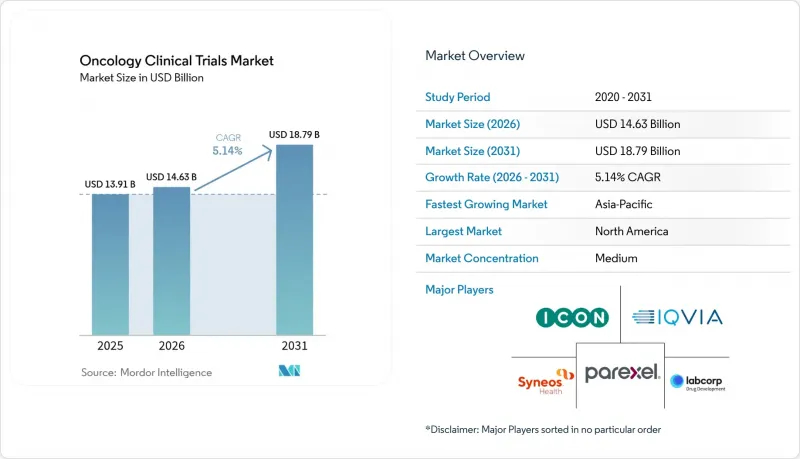
This report Segments the Industry Into by Phase (Phase I, Phase II, Phase III, Phase IV), Design (Treatment Studies and Observational Studies), Cancer Type (Lung Cancer, Breast Cancer, and More), Therapeutic Modality (Immunotherapy, and More), and Geography (North America, Europe, Asia-Pacific, Middle East and Africa, South America). The Market Forecasts are Provided in Terms of Value (USD).
Global Oncology Clinical Trials Market Trends and Insights
Rising Global Cancer Incidence & Prevalence
Cancer cases are projected to surpass 35 million annually by 2050, placing persistent demand on the oncology clinical trials market. Aging populations in developed economies and lifestyle shifts in emerging markets are reshaping epidemiology, while biomarker-defined subgroups fragment patient pools into smaller cohorts that need targeted recruitment tactics. China's large treatment-naive populations now attract both domestic and multinational sponsors; local cancer registries are becoming essential for biomarker-stratified enrollment. CROs able to integrate registry data with real-time algorithms gain a clear competitive edge. The resulting rise in multi-regional trials supports broader regulatory submissions and improves data diversity.
Increasing Pharma & Biotech Oncology-R&D Spend
Leading drug makers directed 40-50% of their 2024 development budgets toward oncology programs, seeking premium-priced launches and combination portfolios. AstraZeneca's strategic target of USD 80 billion revenue by 2030 underscores its oncology focus. Venture funding for oncology start-ups broke records in 2024, yet policy moves such as the Inflation Reduction Act are sharpening project selection toward first-in-class or best-in-class assets. Platform technologies-especially antibody-drug conjugates and cell therapies-require high upfront capital but promise repeatable indications, pushing sponsors into deeper alliances with specialty biotechs. Those collaborations share risk, accelerate technology transfer, and broaden therapeutic exploration.
Stringent, Complex Eligibility Criteria Slow Recruitment
Only 17.0% of oncology patients qualify for trials under legacy inclusion rules, while 56.0% have no local study options. Research confirms that removing three common exclusion factors can double eligible populations without undermining safety. Precision protocols requiring multiple genetic alterations further narrow pools to segments representing fewer than 5% of patients. The Clinical Trials Transformation Initiative lists patient identification as the chief recruitment hurdle, escalating the need for AI-powered screening tools. Regulators now encourage broader eligibility, yet site adoption remains uneven, prolonging startup timelines and boosting per-patient costs.
Other drivers and restraints analyzed in the detailed report include:
- Fast-Track Regulatory Pathways (Breakthrough, PRIME, etc.)
- Precision-Medicine & Biomarker-Driven Therapy Momentum
- Escalating Trial Costs and Operational Burden
For complete list of drivers and restraints, kindly check the Table Of Contents.
Segment Analysis
Phase III trials held 38.96% of 2025 revenue, confirming their financial weight in the oncology clinical trials market. Sponsors allocate significant capital to these pivotal studies because regulatory approvals and reimbursement are directly tied to Phase III success rates. At the other end, Phase I volumes are rising at a 7.52% CAGR as novel modalities enter first-in-human pipelines earlier. Adaptive platform formats help developers test multiple candidates and dosing regimens concurrently, trimming timelines and heightening portfolio optionality. START's new Shanghai Phase I center-China's first to align with major agency standards-illustrates how geographic diversification supports regional filings and access to naive populations.
Global demand for early-stage capacity also drives CRO expansion into oncology-focused incubators and translational-medicine hubs. Biomarker selection in Phase I improves downstream efficiency by filtering non-responders early, lifting compound survival odds. Phase II studies serve as inflection points where efficacy proof can justify breakthrough designations and investor commitments. Post-approval Phase IV trials are now essential for real-world safety surveillance, a requirement that increasingly includes decentralized follow-up and digital symptom tracking.
Treatment/interventional models commanded 72.10% of total revenue in 2025, emphasizing their central role in validating clinical benefit. Regulatory authorities still regard randomized controlled trials as the highest evidentiary standard, especially for curative-intent indications. Even so, the 6.74% CAGR forecast for observational studies underscores mounting interest in real-world evidence to complement controlled endpoints. The FDA's Real-World Evidence Program provides a formal regulatory framework, encouraging hybrid designs that blend randomization with pragmatic data capture.
Decentralized clinical trials expand reach to rural and mobility-constrained patients, cutting travel barriers and enriching recruitment pools. Electronic PRO platforms such as eSyM improve symptom surveillance and reduce acute care utilization. Pragmatic designs championed by Project Pragmatica limit data fields to those essential for decision-making, curbing operational overhead. As sponsors fine-tune site selection algorithms, protocol customization can align with region-specific standard-of-care benchmarks, thereby reducing deviations and boosting retention.
Complete Report Scope:
- By Phase
- Phase I
- Phase II
- Phase III
- Phase IV
- By Design
- Treatment / Interventional Studies
- Observational Studies
- By Cancer Type
- Lung Cancer
- Breast Cancer
- Colorectal Cancer
- Leukemia
- Prostate Cancer
- Other Cancers
- By Therapeutic Modality
- Immunotherapy
- Targeted Therapy
- Chemotherapy
- Cell & Gene Therapy
- Other Therapeutic Modalities
- Geography
- North America
- United States
- Canada
- Mexico
- Europe
- Germany
- United Kingdom
- France
- Italy
- Spain
- Rest of Europe
- Asia-Pacific
- China
- Japan
- India
- Australia
- South Korea
- Rest of Asia-Pacific
- Middle East & Africa
- GCC
- South Africa
- Rest of Middle East & Africa
- South America
- Brazil
- Argentina
- Rest of South America
- North America
Geography Analysis
North America retained industry leadership with 46.12% revenue in 2025, supported by the FDA's flexible fast-track mechanisms and robust payer infrastructure. Academic centers furnish deep expertise in molecular oncology, enabling intricate adaptive protocols. Yet policy debates on drug-pricing reform and potential HHS budget constraints introduce strategic uncertainty that could temper new-trial volume. Sponsors respond by prioritizing high-value assets and emphasizing surrogate endpoints to secure quicker returns.
Asia-Pacific is the fastest-growing territory, progressing at a 6.31% CAGR to 2031. China accounted for 26.5% of new global trial starts in 2024 after slashing review timelines from 265 to 65 days, making it the prime destination for large-scale, treatment-naive enrollment. India's streamlined 2019 rules offer similar efficiency, and oncology-specific clusters in Hyderabad and Bengaluru provide specialized Phase I infrastructure. Regional governments fund local genomic initiatives, expanding the precision-medicine ecosystem and improving trial readiness.
Europe maintains a vibrant oncology clinical trials market through EMA harmonization and strong academic-industry synergy. GDPR demands sophisticated data-privacy compliance, prompting sponsors to adopt federated-data architectures that anonymize personal health information at the source. Eastern Europe joins Latin America and the Middle East as emerging secondary hubs; lower per-patient costs and faster enrollment appeal to cost-sensitive sponsors, even if infrastructure variability still requires targeted site mentorship. Decentralized technologies mitigate cross-border logistics by bringing remote visits, eConsent, and home health-nursing to diverse settings.
- IQVIA
- Parexel International
- ICON
- Syneos Health
- LabCorp
- Thermo Fisher Scientific (PPD)
- Medpace Holdings
- Charles River
- Wuxi Clinical CRO
- AstraZeneca
- Johnson & Johnson
- Roche
- Pfizer
- Novartis
- Bristol-Myers Squibb
- Merck
- Abbvie
- Eli Lilly and Company
- Takeda Pharmaceuticals
- BeiGene Ltd.
- Clovis Oncology
Additional Benefits:
- The market estimate (ME) sheet in Excel format
- 3 months of analyst support
TABLE OF CONTENTS
1 Introduction
- 1.1 Study Assumptions & Market Definition
- 1.2 Scope of the Study
2 Research Methodology
3 Executive Summary
4 Market Landscape
- 4.1 Market Overview
- 4.2 Market Drivers
- 4.2.1 Rising Global Cancer Incidence & Prevalence
- 4.2.2 Increasing Pharma & Biotech Oncology-R&D Spend
- 4.2.3 Fast-Track Regulatory Pathways (Breakthrough, Prime, Etc.)
- 4.2.4 Precision-Medicine & Biomarker-Driven Therapy Momentum
- 4.2.5 Expansion Of Trial Sites In Emerging-Market Secondary Hospitals
- 4.2.6 Real-World-Data Integration Shaping Hybrid Evidence Protocols
- 4.3 Market Restraints
- 4.3.1 Stringent, Complex Eligibility Criteria Slow Recruitment
- 4.3.2 Escalating Trial Costs and Operational Burden
- 4.3.3 Patient-Pool Saturation from Overlapping Competing Studies
- 4.3.4 Cross-Border Data-Privacy Laws Complicate Multi-Region Trials
- 4.4 Regulatory Landscape
- 4.5 Porter's Five Forces Analysis
- 4.5.1 Bargaining Power of Buyers/?Sponsors
- 4.5.2 Bargaining Power of CRO/?Site Suppliers
- 4.5.3 Threat of New Entrants
- 4.5.4 Threat of Substitutes (real-world evidence, in-silico)
- 4.5.5 Intensity of Competitive Rivalry
5 Market Size & Growth Forecasts (Value, USD)
- 5.1 By Phase
- 5.1.1 Phase I
- 5.1.2 Phase II
- 5.1.3 Phase III
- 5.1.4 Phase IV
- 5.2 By Design
- 5.2.1 Treatment / Interventional Studies
- 5.2.2 Observational Studies
- 5.3 By Cancer Type
- 5.3.1 Lung Cancer
- 5.3.2 Breast Cancer
- 5.3.3 Colorectal Cancer
- 5.3.4 Leukemia
- 5.3.5 Prostate Cancer
- 5.3.6 Other Cancers
- 5.4 By Therapeutic Modality
- 5.4.1 Immunotherapy
- 5.4.2 Targeted Therapy
- 5.4.3 Chemotherapy
- 5.4.4 Cell & Gene Therapy
- 5.4.5 Other Therapeutic Modalities
- 5.5 Geography
- 5.5.1 North America
- 5.5.1.1 United States
- 5.5.1.2 Canada
- 5.5.1.3 Mexico
- 5.5.2 Europe
- 5.5.2.1 Germany
- 5.5.2.2 United Kingdom
- 5.5.2.3 France
- 5.5.2.4 Italy
- 5.5.2.5 Spain
- 5.5.2.6 Rest of Europe
- 5.5.3 Asia-Pacific
- 5.5.3.1 China
- 5.5.3.2 Japan
- 5.5.3.3 India
- 5.5.3.4 Australia
- 5.5.3.5 South Korea
- 5.5.3.6 Rest of Asia-Pacific
- 5.5.4 Middle East & Africa
- 5.5.4.1 GCC
- 5.5.4.2 South Africa
- 5.5.4.3 Rest of Middle East & Africa
- 5.5.5 South America
- 5.5.5.1 Brazil
- 5.5.5.2 Argentina
- 5.5.5.3 Rest of South America
- 5.5.1 North America
6 Competitive Landscape
- 6.1 Market Concentration
- 6.2 Market Share Analysis
- 6.3 Company Profiles (includes Global level Overview, Market level overview, Core Business Segments, Financials, Headcount, Key Information, Market Rank, Market Share, Products and Services, and analysis of Recent Developments)
- 6.3.1 IQVIA
- 6.3.2 Parexel International
- 6.3.3 ICON plc
- 6.3.4 Syneos Health
- 6.3.5 Labcorp Drug Development
- 6.3.6 Thermo Fisher Scientific (PPD)
- 6.3.7 Medpace Holdings
- 6.3.8 Charles River Laboratories
- 6.3.9 Wuxi Clinical CRO
- 6.3.10 AstraZeneca PLC
- 6.3.11 Johnson & Johnson
- 6.3.12 F. Hoffmann-La Roche Ltd
- 6.3.13 Pfizer Inc.
- 6.3.14 Novartis AG
- 6.3.15 Bristol Myers Squibb
- 6.3.16 Merck & Co., Inc.
- 6.3.17 AbbVie Inc.
- 6.3.18 Eli Lilly and Company
- 6.3.19 Takeda Pharmaceutical
- 6.3.20 BeiGene Ltd.
- 6.3.21 Clovis Oncology
7 Market Opportunities & Future Outlook
- 7.1 White-space & Unmet-Need Assessment

