PUBLISHER: Mordor Intelligence | PRODUCT CODE: 2097211

PUBLISHER: Mordor Intelligence | PRODUCT CODE: 2097211
Veterinary Oncology - Market Share Analysis, Industry Trends & Statistics, Growth Forecasts (2026 - 2031)
According to Mordor Intelligence, veterinary oncology market size in 2026 is estimated at USD 1.95 billion, growing from 2025 value of USD 1.74 billion with 2031 projections showing USD 3.43 billion, growing at 11.98% CAGR over 2026-2031.
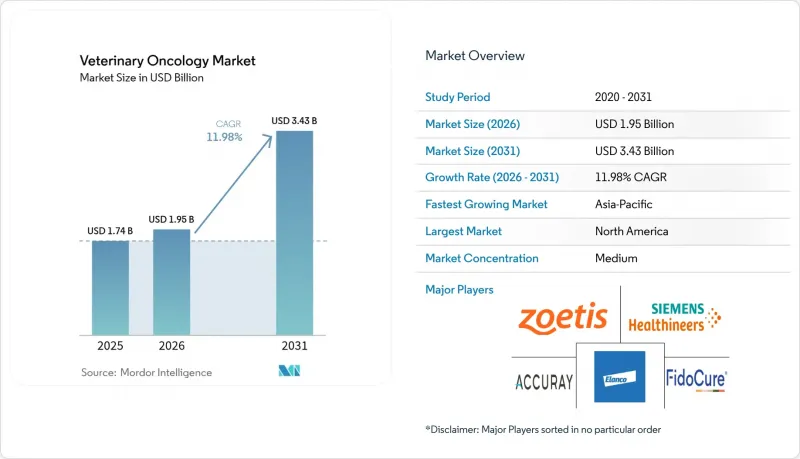
This report Segments the Industry Into by Treatment Modality (Radiotherapy, Surgery, and More), by Animal Type (Canine, Feline, and More), by Cancer Type (Lymphoma, Mast Cell Tumor, and More), and Geography. The Market Sizes and Forecasts are Provided in Terms of Value (USD).
Global Veterinary Oncology Market Trends and Insights
Rising Prevalence of Companion-Animal Cancers
Nearly half of dogs over 10 years develop a neoplasm, a rate that keeps demand elevated for oncology services as preventive medicine lengthens life expectancy. Breed predispositions sharpen this need, with Golden Retrievers and Boxers exhibiting above-average lymphoma incidence. Earlier diagnosis now directs more cases into curative pathways, fuelling uptake of surgery, radiation, and emerging immunotherapies. Owners' growing willingness to pursue aggressive protocols reinforces long-run service intensity, especially in markets with mature insurance penetration.
Increasing Corporate & Academic R&D Funding in Veterinary Oncology
Pharmaceutical firms cite translational value between companion-animal tumors and human oncology, prompting expansion of dedicated biologics capacity. Elanco's USD 130 million Kansas facility emphasizes monoclonal antibody output for canine cancers. Universities add momentum; Virginia Tech's histotripsy studies seek non-invasive osteosarcoma solutions. Non-profits such as Morris Animal Foundation channel grants toward limb-sparing immunotherapies, accelerating clinical timelines and broadening protocol sophistication.
High Out-of-Pocket Costs for Owners Despite Insurance Gaps
Comprehensive protocols can range from USD 10,000 to USD 30,000, often exceeding insurance caps and forcing difficult affordability decisions. Coverage exclusions for pre-existing conditions leave policyholders responsible for a large share of expenses. As immunotherapies and precision treatments enter the market at premium price points, the cost disparity between basic and advanced care widens, tempering uptake among middle-income households.
Other drivers and restraints analyzed in the detailed report include:
- Rapid Adoption of Advanced Imaging & Liquid-Biopsy Diagnostics
- AI-Assisted Early-Screening Platforms Entering Clinical Use
- Geographic Scarcity of Radiotherapy & Advanced Care Centers
For complete list of drivers and restraints, kindly check the Table Of Contents.
Segment Analysis
Surgery secured 40.12% of global 2025 revenues, underscoring its role as a frontline curative option for solid tumors within the veterinary oncology market. Advances in intraoperative imaging and minimally invasive techniques enhance margin control while reducing recovery times. Concurrently, immunotherapy's 13.04% CAGR reflects successful commercial launches of autologous cellular vaccines and small-molecule immune modulators that complement existing standards of care. Radiotherapy continues to grow as stereotactic protocols cut total fractions from 18 to three, shrinking owner travel commitments. Chemotherapy retains value for systemic malignancies, though genetic profiling refines dosing to minimize toxicity.
The therapeutic toolbox is moving toward truly multimodal regimens that marry surgical debulking with adjuvant radiation and checkpoint inhibitor courses. Focused ultrasound and photodynamic approaches add minimally invasive options for deep-seated or anatomically delicate lesions and are gaining traction as costs fall. AI-guided treatment planning leverages tumor genomics and imaging data to match patients with high-response regimens, improving outcomes and supporting evidence-based reimbursement.
Complete Report Scope:
- By Treatment Modality
- Radiotherapy
- Surgery
- Chemotherapy
- Immunotherapy
- Other Treatments (Laser, Photodynamic, Focused Ultrasound)
- By Animal Type
- Canine
- Feline
- Equine
- Other Companion Animals (exotics, small mammals)
- By Cancer Type
- Lymphoma
- Mast-Cell Tumour
- Mammary & Squamous-Cell Carcinoma
- Osteosarcoma
- Hemangiosarcoma
- Melanoma
- Other Cancers
- By Geography
- North America
- United States
- Canada
- Mexico
- Europe
- Germany
- United Kingdom
- France
- Italy
- Spain
- Rest of Europe
- Asia-Pacific
- China
- Japan
- India
- Australia
- South Korea
- Rest of Asia-Pacific
- Middle East & Africa
- GCC
- South Africa
- Rest of Middle East & Africa
- South America
- Brazil
- Argentina
- Rest of South America
- North America
Geography Analysis
North America commanded 53.76% of 2025 sales, underpinned by high companion-animal spend, dense specialist networks, and a regulatory framework that allows conditional product approvals to reach clinics quickly. The United States hosts the largest pool of boarded veterinary oncologists, and its insurers increasingly reimburse advanced modalities, shortening payback periods for clinic investments in linear accelerators and CT scanners. University-industry collaborations funnel breakthrough science into commercial pipelines, further entrenching regional leadership.
Asia-Pacific stands out as the fastest-growing territory, charting a 13.62% CAGR to 2031 as pet humanization scales across China's urban centers. Disposable income growth intersects with expanding private-clinic networks and rising awareness of pet insurance, narrowing care-access gaps. Japan's mature small-animal market drives early adoption of precision biologics, while Australia's research community pilots AI decision-support tools that gain regional traction. Hao-Animal, a Chinese start-up, recently opened Shanghai's first integrated oncology-imaging hub, signaling domestic capacity build-up.
Europe holds the second-largest share, buoyed by stringent animal welfare statutes that encourage proactive oncology care. Harmonized EMA procedures streamline continental drug launches, though divergent reimbursement policies create pricing complexity. Germany's robust veterinary R&D ecosystem pioneers isotope-guided surgery, and the UK accelerates clinical trials under dedicated veterinary-specific regulatory guidance. France and the Nordics prioritize minimally invasive therapies, reflecting cultural emphasis on quality-of-life metrics.
- Zoetis
- Elanco
- Boehringer Ingelheim
- IDEXX
- Siemens Healthineers (Varian)
- Accuray
- PetCure Oncology
- Nippon Zenyaku Kogyo (ZENOAQ)
- Morphogenesis Inc.
- Karyopharm Therapeutics
- Regeneus Ltd
- OHC (The One Health Company)
- VetDC Inc.
- Anivive Lifesciences
- LiteCure LLC
- Cutting Edge Laser Technologies
- Aesculight LLC
- Mars Petcare
Additional Benefits:
- The market estimate (ME) sheet in Excel format
- 3 months of analyst support
TABLE OF CONTENTS
1 Introduction
- 1.1 Study Assumptions & Market Definition
- 1.2 Scope of the Study
2 Research Methodology
3 Executive Summary
4 Market Landscape
- 4.1 Market Overview
- 4.2 Market Drivers
- 4.2.1 Rising prevalence of companion-animal cancers
- 4.2.2 Increasing corporate & academic R&D funding in veterinary oncology
- 4.2.3 Rapid adoption of advanced imaging & liquid-biopsy diagnostics
- 4.2.4 Growth of pet-insurance policies covering oncology care
- 4.2.5 AI-assisted early-screening platforms entering clinical use
- 4.2.6 Focused-ultrasound & photodynamic therapies expanding treatment toolbox
- 4.3 Market Restraints
- 4.3.1 High out-of-pocket costs for owners despite insurance gaps
- 4.3.2 Low disease awareness in developing pet-owner populations
- 4.3.3 Geographic scarcity of radiotherapy & advanced care centers
- 4.3.4 Absence of harmonised clinical-trial endpoints delaying approvals
- 4.4 Value / Supply-Chain Analysis
- 4.5 Regulatory Landscape
- 4.6 Technological Outlook
- 4.7 Porter's Five Forces Analysis
- 4.7.1 Threat of New Entrants
- 4.7.2 Bargaining Power of Buyers
- 4.7.3 Bargaining Power of Suppliers
- 4.7.4 Threat of Substitutes
- 4.7.5 Intensity of Competitive Rivalry
5 Market Size & Growth Forecasts (Value)
- 5.1 By Treatment Modality
- 5.1.1 Radiotherapy
- 5.1.2 Surgery
- 5.1.3 Chemotherapy
- 5.1.4 Immunotherapy
- 5.1.5 Other Treatments (Laser, Photodynamic, Focused Ultrasound)
- 5.2 By Animal Type
- 5.2.1 Canine
- 5.2.2 Feline
- 5.2.3 Equine
- 5.2.4 Other Companion Animals (exotics, small mammals)
- 5.3 By Cancer Type
- 5.3.1 Lymphoma
- 5.3.2 Mast-Cell Tumour
- 5.3.3 Mammary & Squamous-Cell Carcinoma
- 5.3.4 Osteosarcoma
- 5.3.5 Hemangiosarcoma
- 5.3.6 Melanoma
- 5.3.7 Other Cancers
- 5.4 By Geography
- 5.4.1 North America
- 5.4.1.1 United States
- 5.4.1.2 Canada
- 5.4.1.3 Mexico
- 5.4.2 Europe
- 5.4.2.1 Germany
- 5.4.2.2 United Kingdom
- 5.4.2.3 France
- 5.4.2.4 Italy
- 5.4.2.5 Spain
- 5.4.2.6 Rest of Europe
- 5.4.3 Asia-Pacific
- 5.4.3.1 China
- 5.4.3.2 Japan
- 5.4.3.3 India
- 5.4.3.4 Australia
- 5.4.3.5 South Korea
- 5.4.3.6 Rest of Asia-Pacific
- 5.4.4 Middle East & Africa
- 5.4.4.1 GCC
- 5.4.4.2 South Africa
- 5.4.4.3 Rest of Middle East & Africa
- 5.4.5 South America
- 5.4.5.1 Brazil
- 5.4.5.2 Argentina
- 5.4.5.3 Rest of South America
- 5.4.1 North America
6 Competitive Landscape
- 6.1 Market Concentration
- 6.2 Market Share Analysis
- 6.3 Company Profiles (includes Global-level Overview, Market-level Overview, Core Segments, Financials as available, Strategic Information, Market Rank/Share, Products & Services, Recent Developments)
- 6.3.1 Zoetis Inc.
- 6.3.2 Elanco Animal Health
- 6.3.3 Boehringer Ingelheim Vetmedica
- 6.3.4 IDEXX Laboratories
- 6.3.5 Siemens Healthineers (Varian)
- 6.3.6 Accuray Incorporated
- 6.3.7 PetCure Oncology
- 6.3.8 Nippon Zenyaku Kogyo (ZENOAQ)
- 6.3.9 Morphogenesis Inc.
- 6.3.10 Karyopharm Therapeutics
- 6.3.11 Regeneus Ltd
- 6.3.12 OHC (The One Health Company)
- 6.3.13 VetDC Inc.
- 6.3.14 Anivive Lifesciences
- 6.3.15 LiteCure LLC
- 6.3.16 Cutting Edge Laser Technologies
- 6.3.17 Aesculight LLC
- 6.3.18 Mars Petcare
7 Market Opportunities & Future Outlook
- 7.1 White-Space & Unmet-Need Assessment

