
PUBLISHER: Mordor Intelligence | PRODUCT CODE: 2097212

PUBLISHER: Mordor Intelligence | PRODUCT CODE: 2097212
Non-Small Cell Lung Cancer (NSCLC) - Market Share Analysis, Industry Trends & Statistics, Growth Forecasts (2026 - 2031)
According to Mordor Intelligence, non-Small cell lung cancer market size in 2026 is estimated at USD 24.17 billion, growing from 2025 value of USD 21.98 billion with 2031 projections showing USD 38.85 billion, growing at 9.96% CAGR over 2026-2031.
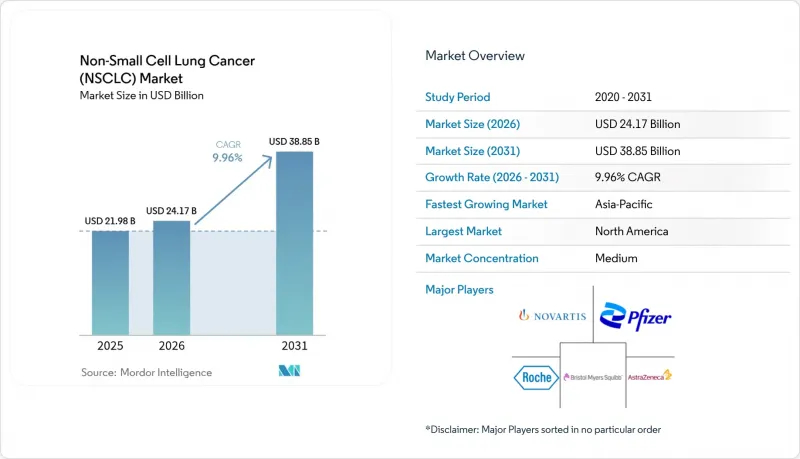
This report is Segmented by Histology (Squamous Cell Carcinoma, Adenocarcinoma and More), by Treatment Modality (Surgery, Radiation Therapy and More), by Drug Class (EGFR TKIs, ALK/ROS1/RET Inhibitors and More) and Geography (North America, Europe, Asia-Pacific and More ). The Report Offers the Value (in USD Million) for the Above Segments.
Global Non-Small Cell Lung Cancer (NSCLC) Market Trends and Insights
Check-point Inhibitor Dominance in First-Line Metastatic Setting
Checkpoint blockade regimens have displaced platinum doublets in first-line metastatic disease across major markets, reshaping clinical guidelines and payer policies. China's National Medical Products Administration approval of pembrolizumab plus chemotherapy for resectable stage II-IIIA NSCLC illustrates the class's expansion into curative-intent settings. Emerging bispecifics such as ivonescimab have shown a 49% reduction in progression risk versus pembrolizumab in PD-L1-high tumors, signaling future erosion of incumbent share. To secure reimbursement, manufacturers now embrace value-based contracts pegged to real-world progression-free survival, while clinicians rely on biomarker-driven selection to maximize benefit-risk ratios. These trends collectively reinforce the growth trajectory of the Non-Small Cell Lung Cancer market while increasing competitive churn among checkpoint brands.
Rapid Uptake of EGFR/ALK Targeted Therapies in Resectable Early-Stage NSCLC
Osimertinib's 39.1-month median progression-free survival in unresectable stage III EGFR-mutated disease has redefined standards by shifting targeted therapy earlier in the continuum of care. Combination regimens such as amivantamab plus lazertinib cut death risk by 25% versus osimertinib monotherapy, accelerating substitution in first-line adjuvant settings. Surgeons increasingly integrate genomic profiling preoperatively, and Asia-Pacific health systems are scaling next-generation sequencing labs to serve high EGFR-mutation prevalence populations. These advances shorten treatment initiation and increase uptake, cementing precision therapy as a catalyst for the Non-Small Cell Lung Cancer market.
Price Caps & HTA Push-backs in Europe
European health technology assessment agencies have tightened cost-effectiveness thresholds, challenging premium immuno-oncology pricing. Germany's IQWiG rejected several checkpoint combinations for insufficient incremental survival over standards of care, forcing manufacturers to adopt risk-sharing schemes. Parallel reference pricing in France and Italy cascades reimbursement pressure globally, tempering top-line growth for the Non-Small Cell Lung Cancer market. Managed-entry agreements, however, still create footholds for innovative agents willing to align reimbursement with real-world evidence.
Other drivers and restraints analyzed in the detailed report include:
- Liquid-Biopsy Companion Diagnostics Adoption
- Radiopharmaceutical Pipeline Breakthroughs
- Diagnostic Biomarker Testing Capacity Gaps in Emerging Asia
For complete list of drivers and restraints, kindly check the Table Of Contents.
Segment Analysis
Adenocarcinoma captured 45.10% of Non-Small Cell Lung Cancer market share in 2025 owing to its high prevalence among never-smokers and its responsiveness to EGFR and ALK inhibitors. Osimertinib's move into unresectable stage III disease has expanded the treated adenocarcinoma population, while bispecifics and ADCs promise further gains. Squamous cell carcinoma, limited by fewer actionable mutations, is beginning to benefit from FGFR inhibitors and chemo-immunotherapy pairings that extend survival. Large-cell carcinoma holds a smaller baseline but is projected to grow at 11.05% CAGR as AI-enhanced pathology improves subtype recognition and clinical trial enrollment.
The Non-Small Cell Lung Cancer market size for adenocarcinoma is forecast to rise in tandem with global expansion of comprehensive genomic profiling labs. Early-stage molecular testing has increased the eligible pool for neoadjuvant targeted therapy, improving resectability rates. Pharmaceutical pipelines now routinely stratify trials by histology, ensuring alignment between mechanism of action and tumor biology. Consequently, investors regard histology-specific assets as a competitive advantage in the broader Non-Small Cell Lung Cancer market.
Complete Report Scope:
- By Histology
- Adenocarcinoma
- Squamous Cell Carcinoma
- Large Cell Carcinoma
- By Treatment Modality
- Surgery
- Radiation Therapy
- Chemotherapy
- Targeted Therapy
- Immunotherapy
- Radiopharmaceuticals
- By Drug Class
- EGFR TKIs
- ALK/ROS1/RET Inhibitors
- PD-1 / PD-L1 Inhibitors
- CTLA-4 & LAG-3 Inhibitors
- Antibody-Drug Conjugates (ADC)
- By Region
- North America
- United States
- Canada
- Mexico
- Europe
- Germany
- United Kingdom
- France
- Spain
- Italy
- Rest of Europe
- Asia-Pacific
- China
- India
- Japan
- South Korea
- Australia
- Rest of Asia Pacific
- Middle East and Africa
- GCC
- South Africa
- Rest of Middle East and africa
- South America
- Brazil
- Argentina
- Rest of South America
- North America
Geography Analysis
North America accounted for 41.95% of the Non-Small Cell Lung Cancer market in 2025 thanks to rapid regulatory approvals, advanced insurance coverage, and concentrated research infrastructure. Six new lung cancer therapies gained FDA clearance in 2024 alone, including two ADCs and one bispecific antibody, underscoring regulatory agility. The region is investing in domestic ADC payload production to mitigate supply bottlenecks, a move expected to stabilize future pricing and ensure consistent drug availability.
Asia-Pacific is projected to register a 12.23% CAGR through 2031, making it the fastest-growing component of the Non-Small Cell Lung Cancer market. Rising healthcare expenditures, improved diagnostic coverage, and high EGFR-mutation prevalence underpin demand. China has accelerated local approvals of imported checkpoint inhibitors and ADCs, shrinking the lag against FDA decisions. Nonetheless, rural testing gaps constrain equitable access, prompting expansion of tele-pathology and public-private genomic testing partnerships.
Europe combines sophisticated molecular medicine uptake with price-containment discipline. Stringent HTA assessments produce managed-entry agreements that permit early access while collecting post-marketing evidence. Brexit-related logistics disruptions have increased lead times for certain biologics, but the European Medicines Agency's centralized process continues to streamline multistate approvals. Middle East & Africa and South America represent nascent opportunities; initiatives such as Brazil's public oncology partnerships and Gulf states' cancer center expansions could gradually enlarge the regional Non-Small Cell Lung Cancer market as infrastructure matures.
- AstraZeneca
- Merck
- Roche
- Bristol-Myers Squibb
- Novartis
- Pfizer
- Eli Lilly and Company
- Amgen
- BeiGene
- Takeda Pharmaceuticals
- Regeneron
- Sanofi
- Daiichi Sankyo
- Johnson & Johnson
- Boehringer Ingelheim
- Innovent Biologics
- Exelixis
- Mirati Therapeutics
- Blueprint Medicines
- Zai Lab
Additional Benefits:
- The market estimate (ME) sheet in Excel format
- 3 months of analyst support
TABLE OF CONTENTS
1 Introduction
- 1.1 Study Assumptions & Market Definition
- 1.2 Scope of the Study
2 Research Methodology
3 Executive Summary
4 Market Landscape
- 4.1 Market Overview
- 4.2 Market Drivers
- 4.2.1 Check-point inhibitor dominance in 1L metastatic setting
- 4.2.2 Rapid uptake of EGFR/ALK targeted therapies in resectable early-stage NSCLC
- 4.2.3 Liquid-biopsy companion diagnostics adoption
- 4.2.4 Radiopharmaceutical pipeline breakthroughs
- 4.2.5 AI-guided trial design & faster FDA approvals
- 4.3 Market Restraints
- 4.3.1 Price caps & HTA push-backs in Europe
- 4.3.2 Diagnostic biomarker testing capacity gaps in emerging Asia
- 4.3.3 PD-(L)1 class saturation & payer rebate squeeze
- 4.3.4 Manufacturing bottlenecks for ADC payloads
- 4.4 Value / Supply-Chain Analysis
- 4.5 Regulatory Landscape
- 4.6 Technological Outlook
- 4.7 Porter's Five Forces
- 4.7.1 Threat of New Entrants
- 4.7.2 Bargaining Power of Suppliers
- 4.7.3 Bargaining Power of Buyers
- 4.7.4 Threat of Substitutes
- 4.7.5 Competitive Rivalry
5 Market Size & Growth Forecasts (Value)
- 5.1 By Histology
- 5.1.1 Adenocarcinoma
- 5.1.2 Squamous Cell Carcinoma
- 5.1.3 Large Cell Carcinoma
- 5.2 By Treatment Modality
- 5.2.1 Surgery
- 5.2.2 Radiation Therapy
- 5.2.3 Chemotherapy
- 5.2.4 Targeted Therapy
- 5.2.5 Immunotherapy
- 5.2.6 Radiopharmaceuticals
- 5.3 By Drug Class
- 5.3.1 EGFR TKIs
- 5.3.2 ALK/ROS1/RET Inhibitors
- 5.3.3 PD-1 / PD-L1 Inhibitors
- 5.3.4 CTLA-4 & LAG-3 Inhibitors
- 5.3.5 Antibody-Drug Conjugates (ADC)
- 5.4 By Region
- 5.4.1 North America
- 5.4.1.1 United States
- 5.4.1.2 Canada
- 5.4.1.3 Mexico
- 5.4.2 Europe
- 5.4.2.1 Germany
- 5.4.2.2 United Kingdom
- 5.4.2.3 France
- 5.4.2.4 Spain
- 5.4.2.5 Italy
- 5.4.2.6 Rest of Europe
- 5.4.3 Asia-Pacific
- 5.4.3.1 China
- 5.4.3.2 India
- 5.4.3.3 Japan
- 5.4.3.4 South Korea
- 5.4.3.5 Australia
- 5.4.3.6 Rest of Asia Pacific
- 5.4.4 Middle East and Africa
- 5.4.4.1 GCC
- 5.4.4.2 South Africa
- 5.4.4.3 Rest of Middle East and africa
- 5.4.5 South America
- 5.4.5.1 Brazil
- 5.4.5.2 Argentina
- 5.4.5.3 Rest of South America
- 5.4.1 North America
6 Competitive Landscape
- 6.1 Market Concentration
- 6.2 Market Share Analysis
- 6.3 Company Profiles (includes Global level Overview, Market level overview, Core Segments, Financials as available, Strategic Information, Market Rank/Share for key companies, Products & Services, and Recent Developments)
- 6.3.1 AstraZeneca
- 6.3.2 Merck & Co.
- 6.3.3 F. Hoffmann-La Roche
- 6.3.4 Bristol Myers Squibb
- 6.3.5 Novartis
- 6.3.6 Pfizer
- 6.3.7 Eli Lilly
- 6.3.8 Amgen
- 6.3.9 BeiGene
- 6.3.10 Takeda
- 6.3.11 Regeneron
- 6.3.12 Sanofi
- 6.3.13 Daiichi Sankyo
- 6.3.14 Johnson & Johnson
- 6.3.15 Boehringer Ingelheim
- 6.3.16 Innovent Biologics
- 6.3.17 Exelixis
- 6.3.18 Mirati Therapeutics
- 6.3.19 Blueprint Medicines
- 6.3.20 Zai Lab
7 Market Opportunities & Future Outlook
- 7.1 White-space & Unmet-Need Assessment

