PUBLISHER: Mordor Intelligence | PRODUCT CODE: 2097214

PUBLISHER: Mordor Intelligence | PRODUCT CODE: 2097214
Anxiety Disorders and Depression Treatment - Market Share Analysis, Industry Trends & Statistics, Growth Forecasts (2026 - 2031)
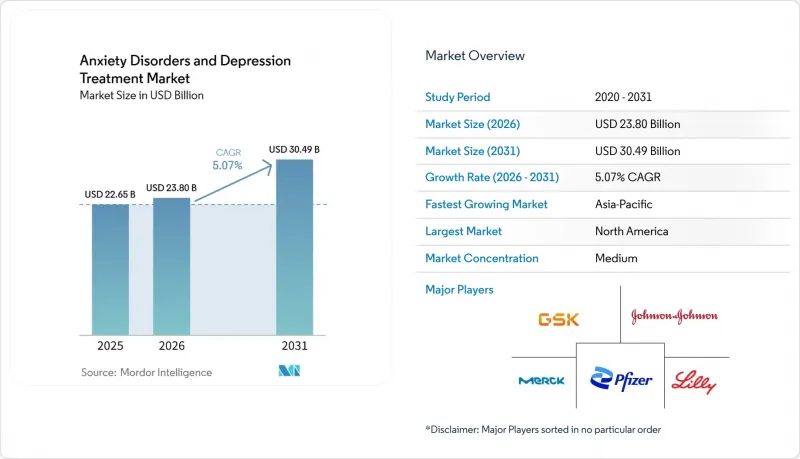
According to Mordor Intelligence, the anxiety disorder and depression treatment market size is expected to grow from USD 22.65 billion in 2025 to USD 23.80 billion in 2026 and is forecast to reach USD 30.49 billion by 2031 at 5.07% CAGR over 2026-2031.
This report Segments the Industry Into by Drug Class (Selective Serotonin Reuptake Inhibitors (SSRIs), Serotonin-norepinephrine Reuptake Inhibitors (SNRIs) and More), by Indication (Major Depressive Disorder and More), by Therapy (Pharmacotherapy, Psychotherapy and More) and Geography (North America and More). The Market Forecasts are Provided in Terms of Value (USD).
Global Anxiety Disorders and Depression Treatment Market Trends and Insights
Rising Prevalence of Anxiety & Depression
A post-pandemic surge in mental-health diagnoses increases demand, with depressive disorders representing 37.2% and anxiety 21.5% of mental-health DALYs in Asian nations. Younger adults adopt digital-first interventions, pushing firms to offer rapid-onset and personalized options. Payers are shifting to value-based reimbursement frameworks that emphasize measurable outcome improvement, compelling manufacturers to prove durability and speed of response beyond today's SSRIs.
Growing Geriatric Population Prone to Mental Disorders
Ageing societies give rise to late-onset mood disorders and polypharmacy risks, intensifying need for drugs with cleaner interaction profiles. Gepirone's approval as the first oral selective 5-HT1A agonist highlights opportunities in elderly-friendly mechanisms. Digital monitoring tools are gaining traction for early detection of cognitive decline, reinforcing care-at-home models and stimulating hardware-software ecosystems around established pills.
Patent Expirations & Generic Erosion of Blockbusters
Exclusivity cliffs remain sharp, with generics seizing as much as 90% of prescriptions inside a year of expiry. Branded players seek defense through reformulations and license deals such as Axsome's settlement on Auvelity, yet economics favor cheaper substitutes unless brands deliver clear differentiation.
Other drivers and restraints analyzed in the detailed report include:
- Pipeline Approvals of Novel Antidepressant & Anxiolytic Agents
- Increased Awareness & Stigma Reduction Toward Mental Health
- Value-Based Pricing & Parity Laws Squeezing Margins
For complete list of drivers and restraints, kindly check the Table Of Contents.
Segment Analysis
SSRIs controlled 41.02% revenue in 2025, underpinning the Anxiety disorder and depression treatment market with extensive safety records. Atypical antipsychotics, however, climb at a 6.74% CAGR as adjunctive options in major depression. Expansion stems from lumateperone's broader label prospects and brexpiprazole's PTSD nod. Meanwhile, 5-HT1A agonists, glutamate modulators, and psychedelics populate the "others" bucket that investors view as white-space categories capable of altering first-line prescribing.
Competition intensifies as agents that avoid weight gain, sexual dysfunction, or sedation draw preference among working-age users. Manufacturers respond with precision-dose kits and co-packaged digital-support apps that track adherence in real time and flag side-effect profiles for clinician review. Benzodiazepine utilization contracts as payers restrict long-term scripts, opening space for non-sedating anxiolytics and GABA-positive allosteric modulators with safer abuse profiles.
Major depressive disorder generated 38.22% of 2025 revenue, reinforcing the Anxiety disorder and depression treatment market. PTSD, however, expands fastest at 6.89% CAGR, aided by FDA's first approval of brexpiprazole plus sertraline and renewed interest in MDMA-assisted therapy despite Lykos's recent setback.
Growing recognition of trauma across civilian life and veterans' health policies widen the patient pool. Expanded diagnostic criteria for generalized anxiety disorder and social anxiety also unlock incremental volume, while obsessive-compulsive disorder remains underserved, thereby attracting pipeline focus on glutamatergic compounds and nasal sprays that promise rapid relief.
Complete Report Scope:
- By Drug Class (Value)
- Selective Serotonin Reuptake Inhibitors (SSRIs)
- Serotonin-Norepinephrine Reuptake Inhibitors (SNRIs)
- Tricyclic Antidepressants (TCAs)
- Monoamine Oxidase Inhibitors (MAOIs)
- Atypical Antipsychotics
- Benzodiazepines
- Others
- By Indication (Value)
- Major Depressive Disorder
- Generalized Anxiety Disorder
- Panic Disorder
- Social Anxiety Disorder
- Obsessive-Compulsive Disorder
- Others
- By Therapy Type (Value)
- Pharmacotherapy
- Psychotherapy (e.g., CBT)
- Neuromodulation & Device-based Therapies
- Digital Therapeutics
- By End User (Value)
- Hospitals & Clinics
- Specialty Mental-Health Centers
- Homecare Settings
- Others
- By Geography (Value)
- North America
- United States
- Canada
- Mexico
- South America
- Brazil
- Argentina
- Rest of South America
- Europe
- Germany
- United Kingdom
- France
- Italy
- Spain
- Rest of Europe
- Asia-Pacific
- China
- Japan
- India
- South Korea
- Australia
- Rest of Asia-Pacific
- Middle East and Africa
- GCC
- South Africa
- Rest of Middle East and Africa
- North America
Geography Analysis
North America retained leadership with 37.20% revenue in 2025, underpinned by robust insurance coverage, rapid uptake of new modalities, and favorable FDA policies. Breakthrough designations for psilocybin analogs and the OTC switch pathway illustrate regulatory flexibility that accelerates launch cycles. U.S. parity laws expand access but compress margins, compelling firms to defend value through outcomes contracts.Asia-Pacific is set to be the growth engine with an 7.76% CAGR out to 2031. China's NMPA approval of Ruoxinlin, a triple monoamine reuptake inhibitor, exemplifies regulatory modernization. Urbanization, social-media campaigns, and employer-led wellness programs reduce stigma, while price-sensitive segments favor generics. Japan, South Korea, and Australia spearhead digital-therapeutic adoption, whereas India's large underserved population drives volume for low-cost SSRIs.Europe posts steady mid-single-digit gains as EMA's revised antidepressant guideline promotes personalized endpoints and cross-border trial efficiencies. Universal coverage across Germany, France, and the Nordics sustains demand for innovative products once cost-utility criteria are satisfied. South America and the Middle East & Africa remain nascent but promising as telehealth infrastructure spreads and government stigma-reduction campaigns take hold.
- Eli Lilly and Company
- Pfizer
- GlaxoSmithKline
- Johnson & Johnson
- AstraZeneca
- Lundbeck A/S
- Abbvie
- Takeda Pharmaceutical Co.
- Otsuka Pharmaceutical Co.
- Bausch Health
- Teva Pharmaceutical Industries
- Sun Pharma Industries Ltd.
- Novartis
- Merck
- Boehringer Ingelheim
- Alkermes plc
- Sage Therapeutics Inc.
- Biogen
- MindMed Inc.
- Compass Pathways plc
Additional Benefits:
- The market estimate (ME) sheet in Excel format
- 3 months of analyst support
TABLE OF CONTENTS
1 Introduction
- 1.1 Study Assumptions & Market Definition
- 1.2 Scope of the Study
2 Research Methodology
3 Executive Summary
4 Market Landscape
- 4.1 Market Overview
- 4.2 Market Drivers
- 4.2.1 Rising Prevalence of Anxiety & Depression
- 4.2.2 Growing Geriatric Population Prone to Mental Disorders
- 4.2.3 Pipeline Approvals of Novel Antidepressant & Anxiolytic Agents
- 4.2.4 Increased Awareness & Stigma Reduction Toward Mental Health
- 4.2.5 OTC Switch Momentum for Selected SSRIs
- 4.2.6 AI-Enabled Digital Therapeutics Boosting Adherence
- 4.3 Market Restraints
- 4.3.1 Patent Expirations & Generic Erosion of Blockbusters
- 4.3.2 Adverse Effects Limiting Long-Term Adherence
- 4.3.3 Psychedelic-Assisted Therapy Siphoning Demand
- 4.3.4 Value-Based Pricing & Parity Laws Squeezing Margins
- 4.4 Value / Supply-Chain Analysis
- 4.5 Regulatory Landscape
- 4.6 Technological Outlook
- 4.7 Porter's Five Forces
- 4.7.1 Threat of New Entrants
- 4.7.2 Bargaining Power of Suppliers
- 4.7.3 Bargaining Power of Buyers
- 4.7.4 Threat of Substitute Products
- 4.7.5 Competitive Rivalry
5 Market Size & Growth Forecasts
- 5.1 By Drug Class (Value)
- 5.1.1 Selective Serotonin Reuptake Inhibitors (SSRIs)
- 5.1.2 Serotonin-Norepinephrine Reuptake Inhibitors (SNRIs)
- 5.1.3 Tricyclic Antidepressants (TCAs)
- 5.1.4 Monoamine Oxidase Inhibitors (MAOIs)
- 5.1.5 Atypical Antipsychotics
- 5.1.6 Benzodiazepines
- 5.1.7 Others
- 5.2 By Indication (Value)
- 5.2.1 Major Depressive Disorder
- 5.2.2 Generalized Anxiety Disorder
- 5.2.3 Panic Disorder
- 5.2.4 Social Anxiety Disorder
- 5.2.5 Obsessive-Compulsive Disorder
- 5.2.6 Others
- 5.3 By Therapy Type (Value)
- 5.3.1 Pharmacotherapy
- 5.3.2 Psychotherapy (e.g., CBT)
- 5.3.3 Neuromodulation & Device-based Therapies
- 5.3.4 Digital Therapeutics
- 5.4 By End User (Value)
- 5.4.1 Hospitals & Clinics
- 5.4.2 Specialty Mental-Health Centers
- 5.4.3 Homecare Settings
- 5.4.4 Others
- 5.5 By Geography (Value)
- 5.5.1 North America
- 5.5.1.1 United States
- 5.5.1.2 Canada
- 5.5.1.3 Mexico
- 5.5.2 South America
- 5.5.2.1 Brazil
- 5.5.2.2 Argentina
- 5.5.2.3 Rest of South America
- 5.5.3 Europe
- 5.5.3.1 Germany
- 5.5.3.2 United Kingdom
- 5.5.3.3 France
- 5.5.3.4 Italy
- 5.5.3.5 Spain
- 5.5.3.6 Rest of Europe
- 5.5.4 Asia-Pacific
- 5.5.4.1 China
- 5.5.4.2 Japan
- 5.5.4.3 India
- 5.5.4.4 South Korea
- 5.5.4.5 Australia
- 5.5.4.6 Rest of Asia-Pacific
- 5.5.5 Middle East and Africa
- 5.5.5.1 GCC
- 5.5.5.2 South Africa
- 5.5.5.3 Rest of Middle East and Africa
- 5.5.1 North America
6 Competitive Landscape
- 6.1 Market Concentration
- 6.2 Market Share Analysis
- 6.3 Company Profiles (includes Global level Overview, Market level overview, Core Segments, Financials as available, Strategic Information, Market Rank/Share for key companies, Products & Services, and Recent Developments)
- 6.3.1 Eli Lilly and Company
- 6.3.2 Pfizer Inc.
- 6.3.3 GlaxoSmithKline plc
- 6.3.4 Johnson & Johnson (Janssen)
- 6.3.5 AstraZeneca plc
- 6.3.6 Lundbeck A/S
- 6.3.7 AbbVie (Allergan)
- 6.3.8 Takeda Pharmaceutical Co.
- 6.3.9 Otsuka Pharmaceutical Co.
- 6.3.10 Bausch Health Companies Inc.
- 6.3.11 Teva Pharmaceutical Industries Ltd.
- 6.3.12 Sun Pharma Industries Ltd.
- 6.3.13 Novartis AG
- 6.3.14 Merck & Co., Inc.
- 6.3.15 Boehringer Ingelheim GmbH
- 6.3.16 Alkermes plc
- 6.3.17 Sage Therapeutics Inc.
- 6.3.18 Biogen Inc.
- 6.3.19 MindMed Inc.
- 6.3.20 Compass Pathways plc
7 Market Opportunities & Future Outlook
- 7.1 White-space & Unmet-Need Assessment

