PUBLISHER: Mordor Intelligence | PRODUCT CODE: 2097216

PUBLISHER: Mordor Intelligence | PRODUCT CODE: 2097216
Cancer Registry Software - Market Share Analysis, Industry Trends & Statistics, Growth Forecasts (2026 - 2031)
According to Mordor Intelligence, cancer registry software market size in 2026 is estimated at USD 109.94 million, growing from 2025 value of USD 99.06 million with 2031 projections showing USD 185.09 million, growing at 10.98% CAGR over 2026-2031.
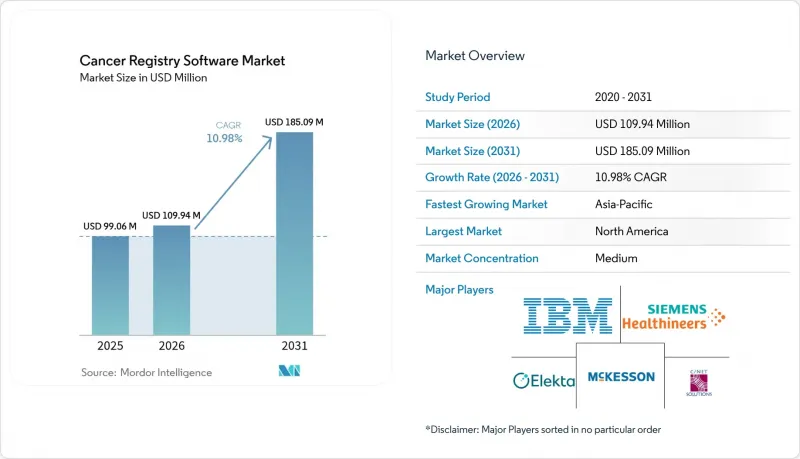
This report is Segmented by Deployment Model (On-Premise, and Cloud-Based), Database Type (Commercial Database, and Public Database), End Use (Government and Third Party, Private Payers, Hospital and Medical Practice, and Others), and Geography (North America, Europe, Asia-Pacific, and More). The Market Forecasts are Provided in Terms of Value (USD).
Global Cancer Registry Software Market Trends and Insights
Increasing Prevalence of Cancer
Global oncology incidence is climbing, with Western Pacific cases expected to move from 4.5 million in 2012 to 6.4 million by 2025, pressuring health systems to adopt scalable registry infrastructure. Aging populations drive particularly complex survivorship tracking needs, prompting vendors to embed longitudinal data models that accept genomics and biomarker inputs. Demand rises in low- and middle-income countries where population-based registries are newly funded, creating openings for cloud providers that deliver cost-effective modules. Advanced software increasingly supports personalized-medicine workflows, documenting targeted therapies and multi-modal regimens. Collectively, higher caseloads and intricate treatment protocols sustain long-run demand for the Cancer registry software market.
Government Mandates for Cancer-Data Reporting
The CDC mandates 95% case completeness with no more than 3% death-certificate-only cases, driving universal adoption of NAACCR-formatted electronic submissions in the United States. Several states, such as Washington, now require providers to transmit HL7-formatted records through Health Information Exchanges, accelerating real-time surveillance. Similar directives emerge across Europe, while Asia-Pacific governments launch pilot registries to align with international standards. Vendors integrate automated edit checks and ICD-O-3 coding tools to help customers comply without adding staff. As regulators emphasize same-year reporting, cloud-hosted analytics and interoperability functions become indispensable, underpinning steady gains in the Cancer registry software market.
Privacy & Security Concerns Over PHI
Healthcare breaches climbed past 40 million records in 2024, elevating scrutiny of oncology registries that hold highly sensitive genomic and treatment data. Registries must comply with HIPAA yet still expedite public-health reporting, forcing adoption of multifactor authentication, granular role-based access, and field-level encryption. Cloud vendors respond with dedicated healthcare instances that undergo SOC 2 and HITRUST audits, but implementation complexity raises costs and elongates deployment timelines. European installations face stringent GDPR transfer rules, complicating cross-border clinical-trial registries. These factors temper near-term uptake, narrowing budgets for prospective Cancer registry software market buyers.
Other drivers and restraints analyzed in the detailed report include:
- Shift Toward Cloud Deployment for Cost & Accessibility
- AI-Driven Auto-Abstraction Cuts Registry Backlog
- High Implementation Cost for Smaller Providers
For complete list of drivers and restraints, kindly check the Table Of Contents.
Segment Analysis
Cloud platforms captured 60.62% of 2025 revenue, supported by providers' preference for elastic storage and remote user access. This share translates into the single largest slice of the Cancer registry software market size, and the segment will sustain a 12.23% CAGR through 2031. Academic health centers still favor on-premise for data-sovereignty reasons, but even these institutions pilot hybrid architectures to leverage AI micro-services.
Continuous software updates, integrated NLP toolkits, and automated quality checks attract community hospitals that once lacked IT talent. Public-cloud security certifications now encompass HITRUST, ISO 27001, and FedRAMP levels, easing board-level concerns. Taken together, these advantages explain why cloud adoption is now the most visible hallmark of the Cancer registry software market.
Complete Report Scope:
- By Deployment Model
- On-Premise
- Cloud-based
- By Database Type
- Commercial Database
- Public Database
- By End Use
- Government & Third-Party
- Private Payers
- Hospital & Medical Practice
- Others
- By Geography
- North America
- United States
- Canada
- Mexico
- Europe
- Germany
- United Kingdom
- France
- Italy
- Spain
- Rest of Europe
- Asia-pacific
- China
- Japan
- India
- Australia
- South Korea
- Rest of Asia-pacific
- Rest of the World
- North America
Geography Analysis
North America led the Cancer registry software market with 44.20% revenue in 2025, reflecting mature IT infrastructure and mandatory reporting under state cancer laws. The CDC funds 46 jurisdictions to operate registries that cover 97% of the U.S. population, and Canada maintains provincial programs aligned through NAACCR standards. Continued cloud migration and electronic case-finding reinforce regional dominance.
Europe forms the second-largest cluster, characterized by harmonized EU data-sharing projects and robust funding for population-based registries. GDPR compliance adds complexity but also drives adoption of advanced encryption and consent-management modules, spurring steady albeit moderate growth across Germany, France, and the Nordics. Cross-border research collaborations foster demand for interoperable solutions capable of multi-language coding and pan-European analytics.
Asia-Pacific posts the highest 11.74% CAGR through 2031. China, India, and Australia expand registry networks to counter rising incidence rates, guided by the Asia Cohort Consortium's interoperability frameworks. Governments channel capital into cloud-hosted platforms because they sidestep constrained local IT resources. Vendors tailoring low-bandwidth modules and multilingual interfaces secure early contracts, positioning the region as the next frontier for the Cancer registry software market.
- C/NET Solutions
- Conduent Inc
- Electronic Registry Systems Inc.
- Elekta
- himagine Solutions
- IBM
- Mckesson
- NeuralFrame Inc
- Onco Inc
- Ordinal Data Inc
- Rocky Mountain Biologicals
- Siemens Healthineers
- Azra AI
- Oncora Medical
- Oracle
- Dacima Software
- IARC (CanReg5)
- ImageTrend Inc
- CDC - Registry Plus
Additional Benefits:
- The market estimate (ME) sheet in Excel format
- 3 months of analyst support
TABLE OF CONTENTS
1 Introduction
- 1.1 Study Assumptions & Market Definition
- 1.2 Scope of the Study
2 Research Methodology
3 Executive Summary
4 Market Landscape
- 4.1 Market Overview
- 4.2 Market Drivers
- 4.2.1 Increasing Prevalence of Cancer
- 4.2.2 Government Mandates for Cancer-data Reporting
- 4.2.3 Shift toward Cloud Deployment for Cost & Accessibility
- 4.2.4 AI-driven Auto-abstraction Cuts Registry Backlog
- 4.2.5 Wearable-device Data Expands Registry Scope
- 4.2.6 Blockchain-enabled Cross-border Data Sharing
- 4.3 Market Restraints
- 4.3.1 Privacy & Security Concerns Over PHI
- 4.3.2 High Implementation Cost for Smaller Providers
- 4.3.3 Shortage of Certified Tumor Registrars
- 4.3.4 Inconsistent International Data Standards
- 4.4 Value / Supply-Chain Analysis
- 4.5 Regulatory Landscape
- 4.6 Technological Outlook
- 4.7 Porter's Five Forces Analysis
- 4.7.1 Threat of New Entrants
- 4.7.2 Bargaining Power of Buyers
- 4.7.3 Bargaining Power of Suppliers
- 4.7.4 Threat of Substitutes
- 4.7.5 Intensity of Rivalry
5 Market Size & Growth Forecasts (Value in USD)
- 5.1 By Deployment Model
- 5.1.1 On-Premise
- 5.1.2 Cloud-based
- 5.2 By Database Type
- 5.2.1 Commercial Database
- 5.2.2 Public Database
- 5.3 By End Use
- 5.3.1 Government & Third-Party
- 5.3.2 Private Payers
- 5.3.3 Hospital & Medical Practice
- 5.3.4 Others
- 5.4 By Geography
- 5.4.1 North America
- 5.4.1.1 United States
- 5.4.1.2 Canada
- 5.4.1.3 Mexico
- 5.4.2 Europe
- 5.4.2.1 Germany
- 5.4.2.2 United Kingdom
- 5.4.2.3 France
- 5.4.2.4 Italy
- 5.4.2.5 Spain
- 5.4.2.6 Rest of Europe
- 5.4.3 Asia-pacific
- 5.4.3.1 China
- 5.4.3.2 Japan
- 5.4.3.3 India
- 5.4.3.4 Australia
- 5.4.3.5 South Korea
- 5.4.3.6 Rest of Asia-pacific
- 5.4.4 Rest of the World
- 5.4.1 North America
6 Competitive Landscape
- 6.1 Market Concentration
- 6.2 Market Share Analysis
- 6.3 Company Profiles
- 6.3.1 C/NET Solutions
- 6.3.2 Conduent Inc
- 6.3.3 Electronic Registry Systems Inc.
- 6.3.4 Elekta AB
- 6.3.5 himagine Solutions
- 6.3.6 IBM Corporation
- 6.3.7 McKesson Corporation
- 6.3.8 NeuralFrame Inc
- 6.3.9 Onco Inc
- 6.3.10 Ordinal Data Inc
- 6.3.11 Rocky Mountain Cancer Data Systems
- 6.3.12 Siemens Healthineers
- 6.3.13 Azra AI
- 6.3.14 Oncora Medical
- 6.3.15 Oracle Cerner
- 6.3.16 Dacima Software
- 6.3.17 IARC (CanReg5)
- 6.3.18 ImageTrend Inc
- 6.3.19 CDC - Registry Plus
7 Market Opportunities & Future Outlook
- 7.1 White-space & Unmet-Need Assessment

