PUBLISHER: Mordor Intelligence | PRODUCT CODE: 2097218

PUBLISHER: Mordor Intelligence | PRODUCT CODE: 2097218
Automotive Leaf Spring - Market Share Analysis, Industry Trends & Statistics, Growth Forecasts (2026 - 2031)
According to Mordor Intelligence, the automotive leaf spring market size in 2026 is USD 14.09 billion, up from USD 13.01 billion in 2025, projected to reach USD 20.96 billion in 2031, growing at an 8.28% CAGR over 2026-2031.
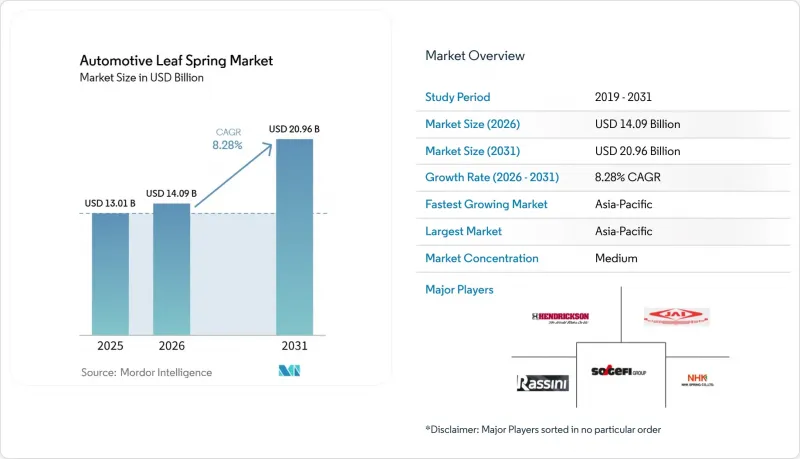
This report is Segmented by Type (Semi-Elliptic, Elliptic, Parabolic, and Other Types), Material (Steel and Composite), Vehicle Type (Passenger Cars, Light Commercial Vehicle, Medium and Heavy Commercial Vehicle), Sales Channel (OEM and Aftermarket), and Geography. The Market Forecasts are Provided in Terms of Value (USD) and Volume (Units).
Global Automotive Leaf Spring Market Trends and Insights
Growth in Global Commercial-Vehicle Production and Sales
Global commercial-vehicle sales are rising despite macro headwinds, expanding the installed base that sustains the leaf springs market. Electric medium- and heavy-duty truck registrations surpassed 90,000 units in 2024, an 80% jump that tilts specification sheets toward custom spring geometries suited for heavy battery packs. Daimler Truck shipped 460,409 vehicles in 2024, underscoring a resilient production pipeline. As the total cost of ownership between diesel and electric drivelines approaches parity, fleets accelerate replacement intervals, lifting new-build demand for durable yet lightweight suspension components. The net effect is a sustained pull on leaf-spring orders through 2030
Rising Demand for Lightweight Suspension Components for Fuel Economy
Regulators in North America and Europe continue to tighten fuel-economy norms, prompting OEM engineers to remove every non-essential kilogram from chassis architectures. Composite leaf springs cut up to 92% mass compared with steel, yet retain equivalent stiffness. Ford's F-150 hybrid steel-composite rear spring trims 16 kg per vehicle, illustrating a viable pathway to aggressive lightweight targets. Advanced high-pressure resin-transfer molding now produces 900,000 units annually, providing the scale needed for mainstream adoption. Longer fatigue life and inherent corrosion resistance improve lifecycle economics, positioning composites as a core enabler of electrified last-mile fleets.
Shift Toward Air and Multi-Link Suspensions in Premium Segments
Premium pickups, SUVs, and certain medium trucks increasingly prefer multi-link and electronically controlled air systems that yield superior ride-handling balance. EU safety mandates for active suspension under the General Safety Regulation amplify this tilt by linking compliance to dynamic ride interventions . The migration diverts a slice of high-margin unit demand away from conventional springs, challenging manufacturers to defend their share by adding smart capabilities or hybridizing designs.
Other drivers and restraints analyzed in the detailed report include:
- Cost Advantage and Durability of Leaf Springs vs. Air Suspension
- Retrofit Programs for Last-Mile Electric Delivery Vans (Parabolic Packages)
- Structural Sagging and Fatigue Over Service Life
For complete list of drivers and restraints, kindly check the Table Of Contents.
Segment Analysis
Semi-elliptical configurations captured 63.58% of the leaf springs market share in 2025, due to decades of proven reliability across heavy trucks, trailers, and off-highway equipment. They anchor the leaf springs market size at USD 13.01 billion in 2025 and continue to defend applications needing maximum load density. The design's layered architecture distributes stress effectively, supports straightforward maintenance, and benefits from well-amortized tooling.
Although only 23% of 2025 sales are in parabolic springs, they are expanding at a 7.05% CAGR, the fastest within the leaf springs market. The single-leaf, tapered profile eliminates inter-leaf friction and lowers unsprung mass, a desirable trait for battery-electric vans seeking extra range. OEM endorsements from Ford and Daimler signal mainstream acceptance. Variable-rate and progressive-thickness subtypes occupy niche roles in performance pickups and military transports, illustrating design diversity poised to capture specialized use cases through the forecast window.
Steel held 74.68% of global demand in 2025, undergirding the baseline leaf springs market with cost advantages and robust global supply chains. Mature metallurgical grades deliver predictable modulus values and straightforward recyclability, which are key for fleet operators wedded to standardized maintenance practices. Current overcapacity projections from the OECD indicate a mild downtrend in steel prices, potentially bolstering the material's cost competitiveness.
Composite alternatives, chiefly glass-fiber-reinforced polymer, are surging at an 8.19% CAGR and could command a double-digit slice of the leaf springs market size by 2031. Rassini's 900,000-unit capacity line for Ford F-150 rear springs showcases process repeatability at scale. Inherent corrosion immunity, 75-92% mass savings, and longer fatigue life reinforce the value proposition for electric and light-payload vehicles. Hybrid steel-composite packages further blur the line, balancing cost and performance while opening room for embedded sensor arrays that convert passive springs into smart structural members.
Complete Report Scope:
- By Type
- Semi-Elliptic
- Elliptic
- Parabolic
- Other Types
- By Material
- Steel
- Composite
- By Vehicle Type
- Passenger Cars
- Light Commercial Vehicles (LCV)
- Medium & Heavy Commercial Vehicles (MHCV)
- By Sales Channel
- OEMs
- Aftermarket
- By Geography
- North America
- United States
- Canada
- Rest of North America
- South America
- Brazil
- Argentina
- Rest of South America
- Europe
- Germany
- United Kingdom
- France
- Spain
- Russia
- Rest of Europe
- Asia-Pacific
- China
- India
- Japan
- South Korea
- Rest of Asia-Pacific
- Middle East and Africa
- Middle East
- Saudi Arabia
- United Arab Emirates
- Rest of Middle East
- Africa
- South Africa
- Egypt
- Rest of Africa
- Middle East
- North America
Geography Analysis
Asia-Pacific anchors the leaf springs market at 44.83% in 2025 revenue and is forecast to grow 6.18% through 2031. China's status as the world's largest producer of electric heavy-duty trucks, with 80% of 2024 global volume, aligns perfectly with parabolic and composite spring adoption trajectories. Government Production-Linked Incentive schemes and Make-in-India programs spur domestic forging and composite lay-up capacity, enhancing regional self-sufficiency across the leaf springs market.
North America forms the second-largest cluster, energized by a nearshoring push that channels USD 81.2 billion in Mexican auto-parts exports into United States assembly plants. Ten manufacturing megaprojects announced in Tennessee alone since 2019 promise localized demand streams. Electrified-fleet adoption by parcel and grocery chains fuels specialized retrofit programs featuring parabolic glass-fiber assemblies that reduce downtime compared with air conversions. U.S. tariffs on aluminum and selected steel grades raise near-term uncertainty but concurrently accelerate composite substitution trends.
Europe shows a mixed landscape. Light-vehicle sales rose to 74.6 million units in 2024, yet EU production slipped 6.2% as manufacturers repositioned their footprints. GSR legislation intensifies the pivot toward active-chassis technologies, challenging traditional spring makers to either embed sensors or collaborate on smart systems. Suppliers such as ZF, are investing in Asia-Pacific and North America to offset regional softness. OEM consolidation and platform rationalization may restrain volume upside but elevate the value per unit by favoring advanced composite designs
- Hendrickson USA LLC
- Jamna Auto Industries Ltd.
- Rassini
- Sogefi S.p.A.
- NHK Spring Co., Ltd.
- Mitsubishi Steel Mfg. Co., Ltd.
- EATON Detroit Spring, Inc.
- Dongfeng Motor Suspension Spring Co., Ltd.
- Fangda Special Steel Technology Co., Ltd.
- EMCO Industries
- Mack Springs Pvt. Ltd.
- IFC Composite GmbH
- Dendoff Springs Ltd.
- Roc Springs
- Betts Spring Manufacturing
- Shandong Fuhua Axle Co., Ltd.
- Zhejiang Shuanghui Automotive Spring Co., Ltd.
- Anhui Ankai Auto Suspension Co., Ltd.
- Lesjofors AB
Additional Benefits:
- The market estimate (ME) sheet in Excel format
- 3 months of analyst support
TABLE OF CONTENTS
1 Introduction
- 1.1 Study Assumptions and Market Definition
- 1.2 Scope of the Study
2 Research Methodology
3 Executive Summary
4 Market Landscape
- 4.1 Market Overview
- 4.2 Market Drivers
- 4.2.1 Growth in global commercial vehicle production and sales
- 4.2.2 Rising demand for lightweight suspension components for fuel economy
- 4.2.3 Cost advantage and durability of leaf springs vs. air suspension
- 4.2.4 Retrofit programs for last-mile electric delivery vans (parabolic packages)
- 4.2.5 Near-shoring of chassis component supply chains in North America
- 4.2.6 Smart leaf springs with embedded load sensors for predictive maintenance
- 4.3 Market Restraints
- 4.3.1 Structural sagging and fatigue over service life
- 4.3.2 Shift toward air and multi-link suspensions in premium segments
- 4.3.3 Volatility in spring-steel alloy prices
- 4.3.4 EU Phase-2 GSR push for active suspension systems
- 4.4 Value / Supply-Chain Analysis
- 4.5 Regulatory Landscape
- 4.6 Technological Outlook
- 4.7 Porter's Five Forces Analysis
- 4.7.1 Bargaining Power of Suppliers
- 4.7.2 Bargaining Power of Buyers/Consumers
- 4.7.3 Threat of New Entrants
- 4.7.4 Threat of Substitute Products
- 4.7.5 Intensity of Competitive Rivalry
5 Market Size and Growth Forecasts (Value (USD) and Volume (Units))
- 5.1 By Type
- 5.1.1 Semi-Elliptic
- 5.1.2 Elliptic
- 5.1.3 Parabolic
- 5.1.4 Other Types
- 5.2 By Material
- 5.2.1 Steel
- 5.2.2 Composite
- 5.3 By Vehicle Type
- 5.3.1 Passenger Cars
- 5.3.2 Light Commercial Vehicles (LCV)
- 5.3.3 Medium & Heavy Commercial Vehicles (MHCV)
- 5.4 By Sales Channel
- 5.4.1 OEMs
- 5.4.2 Aftermarket
- 5.5 By Geography
- 5.5.1 North America
- 5.5.1.1 United States
- 5.5.1.2 Canada
- 5.5.1.3 Rest of North America
- 5.5.2 South America
- 5.5.2.1 Brazil
- 5.5.2.2 Argentina
- 5.5.2.3 Rest of South America
- 5.5.3 Europe
- 5.5.3.1 Germany
- 5.5.3.2 United Kingdom
- 5.5.3.3 France
- 5.5.3.4 Spain
- 5.5.3.5 Russia
- 5.5.3.6 Rest of Europe
- 5.5.4 Asia-Pacific
- 5.5.4.1 China
- 5.5.4.2 India
- 5.5.4.3 Japan
- 5.5.4.4 South Korea
- 5.5.4.5 Rest of Asia-Pacific
- 5.5.5 Middle East and Africa
- 5.5.5.1 Middle East
- 5.5.5.1.1 Saudi Arabia
- 5.5.5.1.2 United Arab Emirates
- 5.5.5.1.3 Rest of Middle East
- 5.5.5.2 Africa
- 5.5.5.2.1 South Africa
- 5.5.5.2.2 Egypt
- 5.5.5.2.3 Rest of Africa
- 5.5.5.1 Middle East
- 5.5.1 North America
6 Competitive Landscape
- 6.1 Market Concentration
- 6.2 Strategic Moves
- 6.3 Market Share Analysis
- 6.4 Company Profiles (Includes Global level Overview, Market level overview, Core Segments, Financials as available, Strategic Information, Market Rank/Share, Products & Services, Recent Developments)
- 6.4.1 Hendrickson USA LLC
- 6.4.2 Jamna Auto Industries Ltd.
- 6.4.3 Rassini
- 6.4.4 Sogefi S.p.A.
- 6.4.5 NHK Spring Co., Ltd.
- 6.4.6 Mitsubishi Steel Mfg. Co., Ltd.
- 6.4.7 EATON Detroit Spring, Inc.
- 6.4.8 Dongfeng Motor Suspension Spring Co., Ltd.
- 6.4.9 Fangda Special Steel Technology Co., Ltd.
- 6.4.10 EMCO Industries
- 6.4.11 Mack Springs Pvt. Ltd.
- 6.4.12 IFC Composite GmbH
- 6.4.13 Dendoff Springs Ltd.
- 6.4.14 Roc Springs
- 6.4.15 Betts Spring Manufacturing
- 6.4.16 Shandong Fuhua Axle Co., Ltd.
- 6.4.17 Zhejiang Shuanghui Automotive Spring Co., Ltd.
- 6.4.18 Anhui Ankai Auto Suspension Co., Ltd.
- 6.4.19 Lesjofors AB
7 Market Opportunities and Future Outlook
- 7.1 White-space and Unmet-Need Assessment

