PUBLISHER: Mordor Intelligence | PRODUCT CODE: 2097221

PUBLISHER: Mordor Intelligence | PRODUCT CODE: 2097221
Asthma Spacers - Market Share Analysis, Industry Trends & Statistics, Growth Forecasts (2026 - 2031)
According to Mordor Intelligence, the asthma spacers market size was valued at USD 2.11 billion in 2025 and estimated to grow from USD 2.26 billion in 2026 to reach USD 3.18 billion by 2031, at a CAGR of 7.11% during the forecast period (2026-2031).
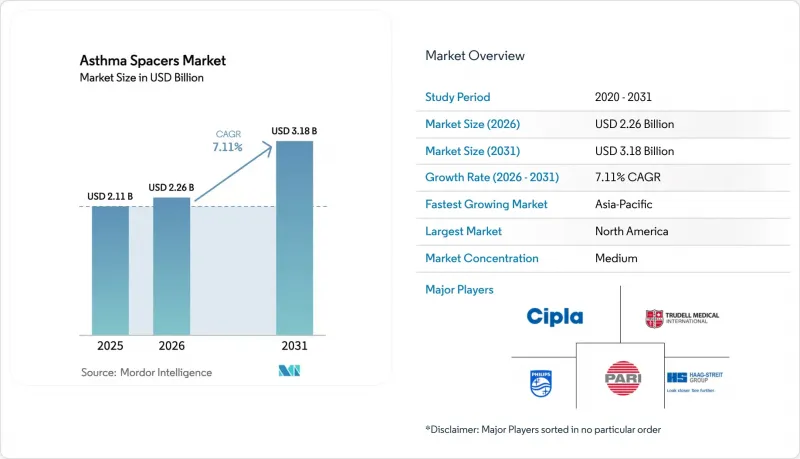
This report is Segmented by Product Type (Aerochamber, Optichamber, and More), Material (Polycarbonate, Metal, and More), Age Group (Paediatric, Adult, and Geriatric), Distribution Channel (Hospital Pharmacy, Retail Pharmacy, and More), and Geography (North America, Europe, Asia-Pacific, Middle East and Africa, and South America). The Market and Forecasts are Provided in Terms of Value (USD).
Global Asthma Spacers Market Trends and Insights
Rising prevalence of chronic respiratory diseases
Asthma cases are projected to rise from 260 million in 2021 to 275 million by 2050, with modifiable factors responsible for nearly 30% of the disease burden The increase sustains long-term demand for spacers as healthcare systems seek cost-effective ways to enhance inhaled therapy outcomes. Asia-Pacific faces distinct pressure, with only 7.6% of patients achieving well-controlled asthma across nine countries, signaling substantial upside for devices that support adherence. Although China's incidence rate fell over three decades, demographic shifts imply absolute case numbers could reach 4.5 million by 2046 . Globally, chronic respiratory diseases remain the third leading cause of death, underscoring the need for optimized inhaler technology.
Growing awareness of spacer-assisted inhalation
Clinical studies report 21-25% better bronchodilator response when anti-static chambers are used during nocturnal bronchospasm episodes. Education campaigns now emphasize correct inhaler technique, particularly for children, leading to fewer errors and longer inhalation time. Professional guidelines recommend spacers for all children using pressurized metered-dose inhalers and for patients prescribed high-dose corticosteroids. Reimbursement frameworks in developed markets increasingly prefer proven, cost-effective accessories, turning guidelines into standardized purchase drivers.
Premium pricing of branded anti-static chambers
Advanced anti-static spacers cost 40-60% more than basic models, limiting affordability in price-sensitive markets where out-of-pocket health expenses dominate. The differential keeps high-end devices concentrated in developed economies, while conventional spacer formats prevail elsewhere. As manufacturing volumes rise and patents expire, generic competitors could narrow the price gap and reduce this constraint.
Other drivers and restraints analyzed in the detailed report include:
- Intensifying R&D in anti-static & smart spacers
- Eco-friendly inhaler initiatives favoring spacers
- Limited reimbursement & user awareness in LMICs
For complete list of drivers and restraints, kindly check the Table Of Contents.
Segment Analysis
Volumatic devices generated 33.10% of revenue in 2025, anchoring the asthma spacers market through clinician familiarity and broad hospital adoption. Optichamber's 7.88% CAGR underscores preference for anti-static performance, particularly in outpatient and home settings where self-administered accuracy matters most. Aerochamber maintains strong pediatric positioning, while Inspirease targets users needing breath-actuated support. Product diversification limits direct price competition and encourages targeted marketing strategies.
Second-generation smart spacers integrate acoustic or pressure sensors to verify patient technique, expanding therapy adherence data. Manufacturers that bundle analytics with consumables aim to secure recurring revenue streams beyond initial device sales. Hospitals increasingly embed device selection into formularies, weighing real-world outcomes evidence over legacy brand loyalty. As reimbursement frameworks reward proven effectiveness, premium products with clinical validation capture higher margins despite cost-constrained procurement climates.
Polycarbonate accounted for 40.85% of 2025 revenue, reflecting cost-effective manufacturing, transparency for visual dose confirmation, and acceptable anti-static coatings. Metal spacers, though representing a smaller base, post an 8.01% CAGR as hospitals and regulators champion reusable solutions with lower environmental footprint. The asthma spacers market size for metal formats is forecast to widen as lifecycle value analyses favor durable devices within green procurement policies.
Innovations in composite and specialty plastics occupy a transitional space, offering enhanced chemical resistance or ergonomic comfort. Suppliers experiment with antimicrobial treatments to reduce infection risk in reusable units. European tenders increasingly score bids on sustainability metrics, driving material choices. In the United States, hospital groups weigh long-run cost savings from fewer replacements against higher upfront acquisition prices for metal designs.
Complete Report Scope:
- By Product Type
- Aerochamber
- Optichamber
- Volumatic
- Inspirease
- By Material
- Polycarbonate
- Metal
- Others
- By Age Group
- Paediatric
- Adult
- Geriatric
- By Distribution Channel
- Hospital Pharmacy
- Retail Pharmacy
- E-Commerce
- By Geography
- North America
- United States
- Canada
- Mexico
- Europe
- Germany
- United Kingdom
- France
- Italy
- Spain
- Rest of Europe
- Asia-Pacific
- China
- Japan
- India
- Australia
- South Korea
- Rest of Asia-Pacific
- Middle East and Africa
- GCC
- South Africa
- Rest of Middle East and Africa
- South America
- Brazil
- Argentina
- Rest of South America
- North America
Geography Analysis
North America generated 40.80% of global sales in 2025, buoyed by widespread insurance coverage, strong clinician awareness, and the FDA's clear regulatory pathway that shortens innovation cycles. Supply chain disruptions in 2024 exposed inhaler vulnerabilities, elevating spacers as a conservation tool that maximizes existing inventory efficacy. Adoption of smart devices is highest in the United States, where adherence analytics feed directly into tele-respiratory platforms, enhancing reimbursement prospects.
Asia-Pacific is the fastest-growing territory with an 8.11% CAGR to 2031. Rising asthma prevalence, rapid urbanization, and improved medical infrastructure stimulate demand. Economic burden studies reveal per-patient costs spanning USD 108 to USD 1,010, highlighting a wide affordability range that manufacturers must navigate. Governments in China, India, and Indonesia launch awareness drives, creating fertile ground for pediatric spacer programs. Nonetheless, cultural resistance to chronic disease labeling persists, requiring localized educational content and community-based training.
Europe presents a stable yet dynamically regulated environment. The EU's incoming recyclable packaging mandate favors reusable spacers and pressures single-use plastic components. The European Medicines Agency's 2024 guidance streamlines approval for devices that contain ancillary medicinal substances, accelerating next-generation spacer entries. Temporary salbutamol shortages across several member states reaffirmed the importance of efficient drug delivery, thereby maintaining spacer demand through supply shocks.
South America and the Middle East & Africa register moderate adoption, constrained by reimbursement gaps and lower clinician familiarity. Pilot projects in Brazil and Saudi Arabia demonstrate that targeted training improves inhaler technique and lowers emergency visits, foreshadowing incremental penetration as payer systems mature. Donor-funded health programs increasingly bundle spacers with inhaled corticosteroids, leveraging device efficacy to stretch limited medicine budgets.
- Trudell Medical International
- Cipla
- PARI Pharma
- Koninklijke Philips
- GlaxoSmithKline
- Monaghan Medical
- Teleflex
- Rossmax
- Thayer Medical Corp.
- AstraZeneca
- Merck
- Koo Medical Equipment
- HAAG-Streit
- Laboratoire ProtecSom
- AGP-Med
- Visiomed Group
- Intersurgical Ltd.
- SunMed LLC
- Besmed Health Business
- Apex Medical
Additional Benefits:
- The market estimate (ME) sheet in Excel format
- 3 months of analyst support
TABLE OF CONTENTS
1 Introduction
- 1.1 Study Assumptions & Market Definition
- 1.2 Scope of the Study
2 Research Methodology
3 Executive Summary
4 Market Landscape
- 4.1 Market Overview
- 4.2 Market Drivers
- 4.2.1 Rising prevalence of chronic respiratory diseases
- 4.2.2 Growing awareness of spacer?assisted inhalation
- 4.2.3 Intensifying R&D in anti-static & smart spacers
- 4.2.4 Eco-friendly inhaler initiatives favouring spacers
- 4.2.5 Tele-respiratory care & digital adherence tools
- 4.2.6 Home-based respiratory therapy expansion
- 4.3 Market Restraints
- 4.3.1 Premium pricing of branded anti-static chambers
- 4.3.2 Limited reimbursement & user awareness in LMICs
- 4.3.3 Sustainability regulations on single-use plastics
- 4.3.4 'For-children' perception curbing adult uptake
- 4.4 Regulatory Landscape
- 4.5 Technological Outlook
- 4.6 Porters Five Forces Analysis
- 4.6.1 Threat of New Entrants
- 4.6.2 Bargaining Power of Buyers/Consumers
- 4.6.3 Bargaining Power of Suppliers
- 4.6.4 Threat of Substitute Products
- 4.6.5 Intensity of Competitive Rivalry
5 Market Size & Growth Forecasts (Value, USD)
- 5.1 By Product Type
- 5.1.1 Aerochamber
- 5.1.2 Optichamber
- 5.1.3 Volumatic
- 5.1.4 Inspirease
- 5.2 By Material
- 5.2.1 Polycarbonate
- 5.2.2 Metal
- 5.2.3 Others
- 5.3 By Age Group
- 5.3.1 Paediatric
- 5.3.2 Adult
- 5.3.3 Geriatric
- 5.4 By Distribution Channel
- 5.4.1 Hospital Pharmacy
- 5.4.2 Retail Pharmacy
- 5.4.3 E-Commerce
- 5.5 By Geography
- 5.5.1 North America
- 5.5.1.1 United States
- 5.5.1.2 Canada
- 5.5.1.3 Mexico
- 5.5.2 Europe
- 5.5.2.1 Germany
- 5.5.2.2 United Kingdom
- 5.5.2.3 France
- 5.5.2.4 Italy
- 5.5.2.5 Spain
- 5.5.2.6 Rest of Europe
- 5.5.3 Asia-Pacific
- 5.5.3.1 China
- 5.5.3.2 Japan
- 5.5.3.3 India
- 5.5.3.4 Australia
- 5.5.3.5 South Korea
- 5.5.3.6 Rest of Asia-Pacific
- 5.5.4 Middle East and Africa
- 5.5.4.1 GCC
- 5.5.4.2 South Africa
- 5.5.4.3 Rest of Middle East and Africa
- 5.5.5 South America
- 5.5.5.1 Brazil
- 5.5.5.2 Argentina
- 5.5.5.3 Rest of South America
- 5.5.1 North America
6 Competitive Landscape
- 6.1 Market Concentration
- 6.2 Market Share Analysis
- 6.3 Company Profiles (includes Global level Overview, Market level overview, Core Segments, Financials as available, Strategic Information, Market Rank/Share for key companies, Products & Services, and Recent Developments)
- 6.3.1 Trudell Medical International
- 6.3.2 Cipla Inc.
- 6.3.3 PARI GmbH
- 6.3.4 Koninklijke Philips N.V.
- 6.3.5 GSK plc
- 6.3.6 Monaghan Medical Corporation
- 6.3.7 Teleflex Inc.
- 6.3.8 Rossmax International Ltd.
- 6.3.9 Thayer Medical Corp.
- 6.3.10 AstraZeneca plc
- 6.3.11 Merck & Co., Inc.
- 6.3.12 Koo Medical Equipment
- 6.3.13 HAAG-STREIT GROUP
- 6.3.14 Laboratoire ProtecSom
- 6.3.15 AGP-Med
- 6.3.16 Visiomed Group
- 6.3.17 Intersurgical Ltd.
- 6.3.18 SunMed LLC
- 6.3.19 Besmed Health Business Corp.
- 6.3.20 Apex Medical Corp.
7 Market Opportunities & Future Outlook
- 7.1 White-space & Unmet-Need Assessment

