PUBLISHER: Mordor Intelligence | PRODUCT CODE: 2097227

PUBLISHER: Mordor Intelligence | PRODUCT CODE: 2097227
Dipping Sauces - Market Share Analysis, Industry Trends & Statistics, Growth Forecasts (2026 - 2031)
According to Mordor Intelligence, dipping sauces market size in 2026 is estimated at USD 24.99 billion, growing from 2025 value of USD 23.54 billion with 2031 projections showing USD 33.71 billion, growing at 6.17% CAGR over 2026-2031.
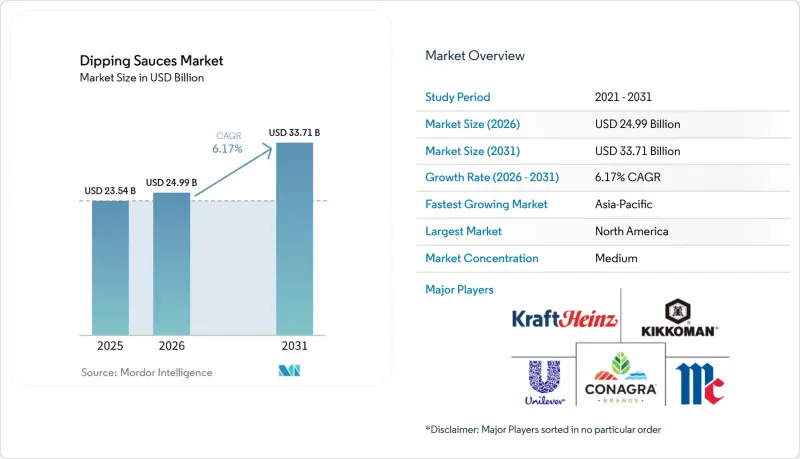
This report is Segmented by Product Type (Tomato Sauce, Mustard Sauce, Soy Sauce, Barbecue Sauce, and More), by Category (Conventional and Organic), by Packaging Type (Bottles, Jars, and Sachets), by Distribution Channel (Foodservice and Retail(Supermarkets/Hypermarkets, Convenience Stores, Online Retail, and More)), and by Geography. The Market Forecasts are Provided in Terms of Value (USD).
Global Dipping Sauces Market Trends and Insights
Innovation in Flavors and Formats
Market expansion is being driven by flavor innovation, with manufacturers introducing variants like Korean BBQ, General Tso, and Mango Habanero to cater to evolving palates. Frank's RedHot exemplifies this trend with its April 2025 launch of six new sauces, specifically targeting younger demographics in search of Instagram-worthy food experiences. The rise of single-serve packaging and squeeze bottles caters to on-the-go consumption. Meanwhile, fermentation technologies are making it possible to achieve authentic, shelf-stable flavors that were once only available in fresh preparations. This cycle of innovation is especially advantageous for Asian-inspired sauces. With 82% of consumers showing a preference for hot and spicy flavors, there's a burgeoning market for sriracha variants, gochujang blends, and sambal-inspired formulations.
Expansion of Fast-Food and Quick-Service Restaurants
As quick-service restaurants (QSRs) expand, they're not just boosting their own sales; they're also fueling a growing appetite for sauces. This surge is evident both in foodservice procurement and in the retail sector, as consumers increasingly buy sauces to replicate dining experiences at home. Take, for example, the data from the U.S. Securities and Exchange Commission: In 2024, the U.S. and Canada boasted 7,082 Burger King outlets. Meanwhile, McDonald's, with a global footprint, expanded its reach to 43,477 restaurants, up from 41,822 the prior year. The UK's QSR market is on an upswing, with the burger segment leading the charge and boosting condiment sales. Asian markets, especially with the rise of Japanese restaurants beyond Japan, are witnessing a QSR boom. This growth not only drives bulk purchases for foodservice but also sees consumers turning to retail, eager to recreate their favorite dining moments at home.
Counterfeiting and Quality Concerns
Food fraud detection has unveiled notable adulteration threats within the spice and condiment supply chains. Surveys from the EU highlight suspicious rates of adulteration, with paprika products at 6% and oregano-based seasonings soaring to 48%. In 2024, the FDA intensified its scrutiny, taking enforcement actions against sauce manufacturers for violations related to process filing and labeling. Such actions underscore the growing regulatory oversight in the industry. Official food fraud reports globally rank processed foods second, posing challenges to consumer trust. This issue is particularly pronounced in the premium and organic sauce segments. While authentication technologies, such as qPCR testing methods from the EU Joint Research Centre, offer detection capabilities, their implementation costs pose a challenge for smaller manufacturers. This financial burden inadvertently grants larger producers, equipped with advanced quality control systems, a competitive edge.
Other drivers and restraints analyzed in the detailed report include:
- Growing Appetite for International Cuisines
- Rise of Plant-Based and Vegan Diets
- High Sugar and Salt Content Concerns
For complete list of drivers and restraints, kindly check the Table Of Contents.
Segment Analysis
In 2025, tomato sauce holds a commanding 34.71% share of the market, underscoring its culinary versatility and deep-rooted consumer familiarity. Meanwhile, soy sauce is making waves as the fastest-growing segment, boasting a 6.81% CAGR projected through 2031. Tomato sauce's prominence is anchored in its foundational role in Western cuisines, its seamless adaptability to fusion dishes, and the backing of robust supply chains and cost-effective production. Soy sauce's ascent is fueled by the global embrace of Asian cuisine, notably with a surge in Japanese restaurants popping up beyond Japan's borders. While mustard sauce enjoys consistent demand in Europe and North America, barbecue sauce's popularity shifts, influenced by regional taste preferences and the expanding grilling culture.
The "Other Product Types" segment is a melting pot of emerging fusion sauces and ethnic specialties. This includes everything from sriracha variants and gochujang blends to tahini-based concoctions, all echoing the cultural diversification of urban dining. Manufacturers are increasingly tapping into traditional fermentation techniques, not just for authenticity but to craft shelf-stable flavors that emphasize umami. While tomato-based products benefit from established agricultural networks in the supply chain, specialty Asian sauces grapple with ingredient sourcing challenges. These complexities not only pose barriers to entry but also present opportunities for premium positioning, especially for those seeking authentic formulations.
In 2025, conventional sauces hold an 81.10% market share, while organic alternatives grow at a 6.69% CAGR through 2031, reflecting a shift toward clean-label products despite premium pricing. The conventional segment benefits from production economies, extensive distribution, and competitive pricing, appealing to diverse economic groups. Organic growth is driven by health consciousness, environmental awareness, and USDA organic certification, which boosts consumer trust. Premium positioning enables organic manufacturers to secure higher margins and target affluent urban consumers willing to pay for health and environmental benefits.
Conventional manufacturers counter organic competition by reformulating products to reduce artificial additives while maintaining costs, creating "natural" lines that bridge conventional and organic. The organic segment faces supply chain issues, including limited certified ingredients and seasonal production, complicating inventory management. Regulatory compliance costs burden smaller organic producers, while large conventional manufacturers leverage scale to enter the organic market through acquisitions or dedicated production lines serving both categories.
Complete Report Scope:
- By Product Type
- Tomato Sauce
- Mustard Sauce
- Soy Sauce
- Barbecue Sauce
- Other Product Types
- By Category
- Conventional
- Organic
- By Packaging Type
- Bottles
- Jars
- Sachets
- By Distribution Channel
- Foodservice
- Retail
- Supermarkets/Hypermarkets
- Convenience Stores
- Online Retail
- Other Distribution Channels
- By Geography
- North America
- United States
- Canada
- Mexico
- Rest of North America
- South America
- Brazil
- Argentina
- Colombia
- Chile
- Rest of South America
- Europe
- United Kingdom
- Germany
- France
- Italy
- Spain
- Russia
- Sweden
- Belgium
- Poland
- Netherlands
- Rest of Europe
- Asia-Pacific
- China
- Japan
- India
- Thailand
- Singapore
- Indonesia
- South Korea
- Australia
- New Zealand
- Rest of Asia Pacific
- Middle East and Africa
- United Arab Emirates
- South Africa
- Saudi Arabia
- Nigeria
- Egypt
- Morocco
- Turkey
- Rest of Middle East and Africa
- North America
Geography Analysis
North America, with a mature QSR landscape and a diverse, immigrant-driven palate, commands a dominant 44.86% market share. The region's robust cold-chain infrastructure supports a wide variety of refrigerated dips, while omnichannel retail strategies ensure these products maintain a strong shelf presence. Innovations are increasingly centered around sodium-reduced and non-GMO offerings, catering to the discerning, label-conscious consumer. In Canada, there's a noticeable uptick in the popularity of plant-based sauces. Meanwhile, in Mexico, the NOM-051 labeling regulation has prompted local producers to reduce salt content.
Asia-Pacific is on an impressive trajectory, projected to grow at a 7.51% CAGR through 2031, driven by urbanization and a burgeoning middle class. China's advanced e-commerce platforms ensure imported gourmet sauces are just a day away, while India's expanding organized retail sector provides a platform for foreign brands, especially those tweaking their heat levels. Southeast Asia, with its swift smartphone adoption and a culture that embraces adventurous street food, sees a surge in demand for chili-infused dips, especially in convenient sachet formats. For foreign brands, localizing offerings, be it through spice adjustments, halal certifications, or region-specific packaging, is crucial.
Europe showcases steady volume growth, yet leans towards premium products, underscoring its commitment to stringent food quality and sustainability. While German consumers are gravitating towards biodynamic tomato ketchup and French households remain loyal to traditional Dijon mustard, there's a growing curiosity for Japanese yuzu miso sauces. In the wake of Brexit-induced customs challenges, U.K. retailers are diversifying their sourcing strategies, inadvertently paving the way for U.S. and Asian exporters. While Latin America and the Middle East and Africa (MEA) present long-term growth potential, challenges like currency fluctuations and fragmented logistics temper immediate market entry enthusiasm.
- Dr. Oetker GmbH
- Unilever plc
- McCormick & Company Inc.
- Del Monte Foods Inc.
- Campbell Soup Company
- Kraft Heinz Company
- Conagra Brands Inc.
- Greendot Health Foods Pvt Ltd
- Renfro Foods Inc.
- Yihai International Holding Ltd
- Kikkoman Corporation
- General Mills Inc.
- PepsiCo Inc. (Tostitos & Doritos Dips)
- Nestle S.A. (Maggi)
- Hormel Foods Corp.
- AB World Foods Ltd (Blue Dragon)
- Lee Kum Kee Co. Ltd.
- Mizkan Holdings Co. Ltd.
- Clorox Co. (Hidden Valley)
- McIlhenny Co. (Tabasco)
Additional Benefits:
- The market estimate (ME) sheet in Excel format
- 3 months of analyst support
TABLE OF CONTENTS
1 INTRODUCTION
- 1.1 Study Assumptions and Market Definition
- 1.2 Scope of the Study
2 RESEARCH METHODOLOGY
3 EXECUTIVE SUMMARY
4 MARKET LANDSCAPE
- 4.1 Market Overview
- 4.2 Market Drivers
- 4.2.1 Innovation in flavors and formats
- 4.2.2 Expansion of fast-food and quick-service restaurants (QSRs)
- 4.2.3 Growing appetite for international cuisines
- 4.2.4 Rise of plant-based and vegan diets
- 4.2.5 Advancements in packaging
- 4.2.6 Rise in snacking and convenience foods
- 4.3 Market Restraints
- 4.3.1 Counterfeiting and quality concerns
- 4.3.2 High sugar and salt content concerns
- 4.3.3 Varying and strict regulatory standards
- 4.3.4 Consumer skepticism towards additives
- 4.4 Consumer Demand Analysis
- 4.5 Regulatory Landscape
- 4.6 Technological Outlook
- 4.7 Porter's Five Forces
- 4.7.1 Threat of New Entrants
- 4.7.2 Bargaining Power of Buyers
- 4.7.3 Bargaining Power of Suppliers
- 4.7.4 Threat of Substitutes
- 4.7.5 Competitive Rivalry
5 MARKET SIZE AND GROWTH FORECASTS (VALUE)
- 5.1 By Product Type
- 5.1.1 Tomato Sauce
- 5.1.2 Mustard Sauce
- 5.1.3 Soy Sauce
- 5.1.4 Barbecue Sauce
- 5.1.5 Other Product Types
- 5.2 By Category
- 5.2.1 Conventional
- 5.2.2 Organic
- 5.3 By Packaging Type
- 5.3.1 Bottles
- 5.3.2 Jars
- 5.3.3 Sachets
- 5.4 By Distribution Channel
- 5.4.1 Foodservice
- 5.4.2 Retail
- 5.4.2.1 Supermarkets/Hypermarkets
- 5.4.2.2 Convenience Stores
- 5.4.2.3 Online Retail
- 5.4.2.4 Other Distribution Channels
- 5.5 By Geography
- 5.5.1 North America
- 5.5.1.1 United States
- 5.5.1.2 Canada
- 5.5.1.3 Mexico
- 5.5.1.4 Rest of North America
- 5.5.2 South America
- 5.5.2.1 Brazil
- 5.5.2.2 Argentina
- 5.5.2.3 Colombia
- 5.5.2.4 Chile
- 5.5.2.5 Rest of South America
- 5.5.3 Europe
- 5.5.3.1 United Kingdom
- 5.5.3.2 Germany
- 5.5.3.3 France
- 5.5.3.4 Italy
- 5.5.3.5 Spain
- 5.5.3.6 Russia
- 5.5.3.7 Sweden
- 5.5.3.8 Belgium
- 5.5.3.9 Poland
- 5.5.3.10 Netherlands
- 5.5.3.11 Rest of Europe
- 5.5.4 Asia-Pacific
- 5.5.4.1 China
- 5.5.4.2 Japan
- 5.5.4.3 India
- 5.5.4.4 Thailand
- 5.5.4.5 Singapore
- 5.5.4.6 Indonesia
- 5.5.4.7 South Korea
- 5.5.4.8 Australia
- 5.5.4.9 New Zealand
- 5.5.4.10 Rest of Asia Pacific
- 5.5.5 Middle East and Africa
- 5.5.5.1 United Arab Emirates
- 5.5.5.2 South Africa
- 5.5.5.3 Saudi Arabia
- 5.5.5.4 Nigeria
- 5.5.5.5 Egypt
- 5.5.5.6 Morocco
- 5.5.5.7 Turkey
- 5.5.5.8 Rest of Middle East and Africa
- 5.5.1 North America
6 COMPETITIVE LANDSCAPE
- 6.1 Market Concentration
- 6.2 Strategic Moves
- 6.3 Market Share Analysis
- 6.4 Company Profiles (includes Global level Overview, Market level overview, Core Segments, Financials as available, Strategic Information, Market Rank/Share for key companies, Products and Services, and Recent Developments)
- 6.4.1 Dr. Oetker GmbH
- 6.4.2 Unilever plc
- 6.4.3 McCormick & Company Inc.
- 6.4.4 Del Monte Foods Inc.
- 6.4.5 Campbell Soup Company
- 6.4.6 Kraft Heinz Company
- 6.4.7 Conagra Brands Inc.
- 6.4.8 Greendot Health Foods Pvt Ltd
- 6.4.9 Renfro Foods Inc.
- 6.4.10 Yihai International Holding Ltd
- 6.4.11 Kikkoman Corporation
- 6.4.12 General Mills Inc.
- 6.4.13 PepsiCo Inc. (Tostitos & Doritos Dips)
- 6.4.14 Nestle S.A. (Maggi)
- 6.4.15 Hormel Foods Corp.
- 6.4.16 AB World Foods Ltd (Blue Dragon)
- 6.4.17 Lee Kum Kee Co. Ltd.
- 6.4.18 Mizkan Holdings Co. Ltd.
- 6.4.19 Clorox Co. (Hidden Valley)
- 6.4.20 McIlhenny Co. (Tabasco)
7 MARKET OPPORTUNITIES AND FUTURE OUTLOOK

