PUBLISHER: Mordor Intelligence | PRODUCT CODE: 2097233

PUBLISHER: Mordor Intelligence | PRODUCT CODE: 2097233
Irish Whiskey - Market Share Analysis, Industry Trends & Statistics, Growth Forecasts (2026 - 2031)
According to Mordor Intelligence, the irish whiskey market size is expected to grow from USD 19.38 billion in 2025 to USD 20.27 billion in 2026 and is forecast to reach USD 25.41 billion by 2031 at 4.62% CAGR over 2026-2031.
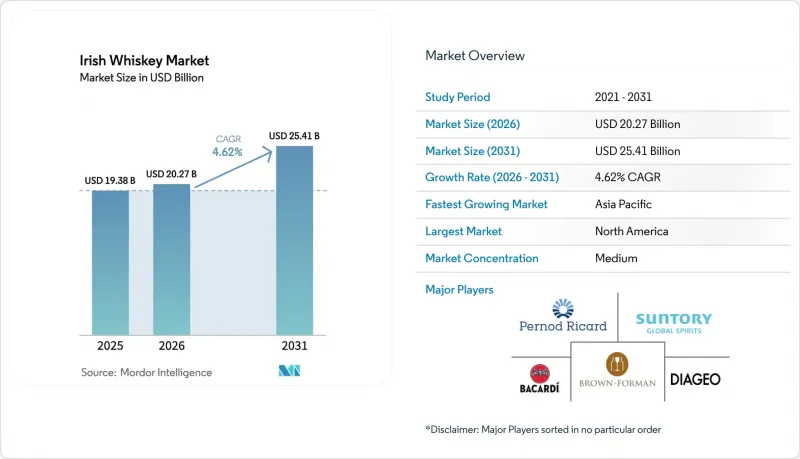
This report is Segmented by Product Type (Single-Malt, Single Pot Still, and More), by End User (Men and Women), by Category (Mass and Premium), by Distribution Channels (On-Trade and Off-Trade), and by Geography (North America, Europe, Asia-Pacific, South America, and Middle East and Africa). The Market Forecasts are Provided in Value (USD).
Global Irish Whiskey Market Trends and Insights
Growing popularity of premium, aged, and craft Irish whiskeys
The global Irish whiskey market is experiencing strong growth, driven by increasing demand for premium, aged, and craft whiskey varieties. Consumers are showing a growing preference for single pot still and single malt options due to their rich heritage and unique flavors created through innovative cask finishes. For example, the premium segment's growth is supported by record-breaking auction sales, such as a 30-year-old single malt selling for EUR 2.55 million in 2024, showcasing the strong brand value in the luxury category. As global alcohol consumption recovers after the pandemic, particularly in premium segments, Irish whiskey is benefiting from a shift in consumer preferences toward quality over quantity. According to the World Population Review, as of 2025, Russia leads in alcohol consumption at 16.8 liters per year, followed by Greece at 14.4 liters per year . With more than 40 active distilleries across Ireland, producers are focusing on using locally sourced ingredients and emphasizing regional stories to justify higher prices.
Expansion of hospitality and on-trade collaborations
The growth of the hospitality industry and partnerships with bars and restaurants are playing a major role in increasing the global popularity of Irish whiskey. Bars and restaurants are important places where people get introduced to premium spirits, and Irish whiskey brands are making efforts to strengthen their presence in these spaces. They are focusing on training bartenders, creating special drink menus, and sponsoring popular events, such as the Jameson-Major League Soccer partnership, to boost brand visibility and connect with customers. Collaborations with famous chefs and mixologists, like Teeling Whiskey's co-branded menu with Dublin's Bang Restaurant, are helping to position Irish whiskey as a premium choice by incorporating it into fine dining and cocktail culture. Many distilleries are also enhancing their visitor centers. For example, the Jameson Distillery Bow St. in Dublin, which welcomed nearly 350,000 visitors in 2024, according to the Irish Tourism Industry Confederation, provides immersive tasting sessions, cocktail-making classes, and distillery-exclusive bottlings .
Stringent government regulations and tariff challenges
Strict government regulations and trade tariffs are creating significant challenges for the Irish whiskey industry, particularly for smaller producers. This additional cost makes Irish whiskey less competitive in the United States, which is a crucial market, accounting for nearly majority of Irish whiskey exports. Meanwhile, producers in Northern Ireland benefit from a lower tariff rate due to post-Brexit trade agreements, giving them an advantage over Irish producers. Ireland plans to implement mandatory health warning labels on whiskey bottles by 2026, as reported by World Cancer Research Fund International . This regulation will require producers to redesign their packaging, which can be especially expensive for smaller distilleries with limited production runs. These challenges not only increase compliance costs but also reduce profit margins, making it harder for producers to compete in international markets.
Other drivers and restraints analyzed in the detailed report include:
- Rising popularity of whiskey-based cocktails and mixology
- Tourism and whiskey trail experiences
- Consumers' inclination towards healthy beverages
For complete list of drivers and restraints, kindly check the Table Of Contents.
Segment Analysis
Blended Irish whiskey continues to dominate the market, accounting for 61.05% of revenue in 2025. Its consistent flavor profile and versatility make it a popular choice for cocktails and mainstream retail consumers. However, single pot still whiskey is expected to grow at a faster rate of 4.93% CAGR as consumers increasingly seek unique, craft-oriented options. Limited-edition releases, such as Gold Spot Generations, are driving interest in this category, with their exclusivity and heritage appeal commanding higher prices. The growing demand for single pot still whiskey highlights a shift toward premiumization and authenticity in the Irish whiskey market.
The premium segment is further bolstered by record-breaking auction prices, showcasing the value collectors and enthusiasts place on rare bottles. Single malt and single grain whiskies are also carving out their niches, appealing to Scotch whiskey drinkers and those who prefer lighter flavor profiles. While blended whiskey remains the backbone of the market in terms of volume, premium extensions within this category are helping to cater to a broader range of consumers. These offerings span from entry-level to ultra-luxury price points, ensuring a balanced value mix and supporting long-term growth in the Irish whiskey market.
In 2025, men accounted for 69.20% of Irish whiskey consumption, reflecting a traditional gender preference. However, women are emerging as the fastest-growing consumer group, with a projected growth rate of 5.21% CAGR. This shift is driven by factors such as the rising popularity of cocktail culture, experiential tourism, and premium gifting, which appeal to women who often prioritize quality over quantity. These trends are gradually reshaping the demographic landscape of the Irish whiskey market, creating opportunities for brands to engage a more diverse audience.
To attract female consumers, brands are focusing on inclusive marketing strategies that emphasize lifestyle interests rather than outdated gender stereotypes. Tasting programs, digital campaigns, and storytelling around heritage and craftsmanship are designed to resonate with this growing segment. Distillery tours are seeing increased participation from women, which helps generate positive word-of-mouth and strengthens brand loyalty. By fostering inclusivity, the Irish whiskey market not only expands its consumer base but also benefits from higher average price points and increased premium product sales.
Complete Report Scope:
- By Product Type
- Single Malt
- Single Pot Still
- Single Grain
- Blended Irish Whiskies
- By End User
- Men
- Women
- By Category
- Mass
- Premium
- By Distribution Channel
- On-Trade
- Off-Trade
- Specialty/Liquor Stores
- Others Off Trade Channels
- By Geography
- North America
- United States
- Canada
- Mexico
- Rest of North America
- Europe
- Germany
- France
- United Kingdom
- Spain
- Netherlands
- Italy
- Sweden
- Norway
- Rest of Europe
- Asia-Pacific
- China
- India
- Japan
- Australia
- South Korea
- Vietnam
- Indonesia
- Rest of Asia-Pacific
- South America
- Brazil
- Argentina
- Chile
- Rest of South America
- Middle East and Africa
- South Africa
- Nigeria
- Rest of Middle East and Africa
- North America
Geography Analysis
North America accounted for 43.10% of the revenue share in 2025. The region's strong cocktail culture, well-established distribution networks, and the popularity of iconic brands like Jameson continue to drive demand. Additionally, smaller craft whiskey producers are gaining attention by emphasizing unique production methods and local ingredients. However, rising costs may push price-sensitive consumers toward more affordable domestic options, such as bourbon, which could impact the market's growth in this region.
Asia-Pacific is the fastest-growing region, with a projected CAGR of 5.68% through 2031, driven by increasing interest in whiskey, particularly in China. Major investments, such as Pernod Ricard's USD 140 million Emeishan malt facility and Diageo's USD 120 million YunTuo project, are fueling growth in the region. In India, the establishment of a new INR 1,785 crore facility is helping to meet the demands of a growing middle class that is adopting Western lifestyle trends. These developments are expected to significantly expand the Irish whiskey market in Asia-Pacific, gradually narrowing the gap with more established markets like North America and Europe.
Europe continues to show steady growth, supported by heritage tourism and strong geographical-indication protections for Irish whiskey. In 2024, visitor centers attracted over a million guests, turning tourism experiences into direct sales and creating brand ambassadors for exports. Brexit has also provided Northern Ireland distillers with a tariff advantage when exporting to the United States, intensifying competition within the island. Despite these challenges, the overall Irish whiskey market in Europe remains vibrant, with a focus on leveraging its rich history and cultural appeal to sustain growth.
- Pernod Ricard SA
- Diageo PLC
- William Grant & Sons Ltd
- Brown-Forman Corp.
- Suntory Global Spirits Inc
- The Shed Distillery of PJ Rigney
- West Cork Distillers Ltd
- Bacardi Limited
- The Old Bushmills Distillery Co.
- Terroirs Distillers
- The Craft Irish Distilling Co.
- Dingle Whiskey Distillery
- Amber Beverage Group (ABG)
- Mark Anthony Brands International
- Renegade Spirits Ireland Limited
- Powerscourt Distillery
- Clonakilty Distillery
- W.D. O'Connell Whiskey Merchants
- Ballykeefe Distillery
- Cooley Distillery
Additional Benefits:
- The market estimate (ME) sheet in Excel format
- 3 months of analyst support
TABLE OF CONTENTS
1 INTRODUCTION
- 1.1 Study Assumptions and Market Definition
- 1.2 Scope of the Study
2 RESEARCH METHODOLOGY
3 EXECUTIVE SUMMARY
4 MARKET LANDSCAPE
- 4.1 Market Overview
- 4.2 Market Drivers
- 4.2.1 Growing Popularity of Premium, Aged, and Craft Irish Whiskeys
- 4.2.2 Expansion of Hospitality and On-Trade Collaborations
- 4.2.3 Rising Popularity of Whiskey-Based Cocktails and Mixology
- 4.2.4 Sustainability and Premium Packaging Trends
- 4.2.5 Tourism and Whiskey Trail Experiences
- 4.2.6 Celebrity and Pop Culture Endorsements
- 4.3 Market Restraints
- 4.3.1 Stringent Government Regulations and Tariff Challenges
- 4.3.2 Consumers' Inclination Towards Healthy Beverages
- 4.3.3 High Production and Maturation Costs
- 4.3.4 Sustainability and Environmental Pressures
- 4.4 Consumer Behaviour Analysis
- 4.5 Regulatory Outlook
- 4.6 Porter's Five Forces Analysis
- 4.6.1 Bargaining Power of Suppliers
- 4.6.2 Bargaining Power of Buyers
- 4.6.3 Threat of New Entrants
- 4.6.4 Threat of Substitutes
- 4.6.5 Degree of Competition
5 MARKET SIZE AND GROWTH FORECASTS (VALUE)
- 5.1 By Product Type
- 5.1.1 Single Malt
- 5.1.2 Single Pot Still
- 5.1.3 Single Grain
- 5.1.4 Blended Irish Whiskies
- 5.2 By End User
- 5.2.1 Men
- 5.2.2 Women
- 5.3 By Category
- 5.3.1 Mass
- 5.3.2 Premium
- 5.4 By Distribution Channel
- 5.4.1 On-Trade
- 5.4.2 Off-Trade
- 5.4.2.1 Specialty/Liquor Stores
- 5.4.2.2 Others Off Trade Channels
- 5.5 By Geography
- 5.5.1 North America
- 5.5.1.1 United States
- 5.5.1.2 Canada
- 5.5.1.3 Mexico
- 5.5.1.4 Rest of North America
- 5.5.2 Europe
- 5.5.2.1 Germany
- 5.5.2.2 France
- 5.5.2.3 United Kingdom
- 5.5.2.4 Spain
- 5.5.2.5 Netherlands
- 5.5.2.6 Italy
- 5.5.2.7 Sweden
- 5.5.2.8 Norway
- 5.5.2.9 Rest of Europe
- 5.5.3 Asia-Pacific
- 5.5.3.1 China
- 5.5.3.2 India
- 5.5.3.3 Japan
- 5.5.3.4 Australia
- 5.5.3.5 South Korea
- 5.5.3.6 Vietnam
- 5.5.3.7 Indonesia
- 5.5.3.8 Rest of Asia-Pacific
- 5.5.4 South America
- 5.5.4.1 Brazil
- 5.5.4.2 Argentina
- 5.5.4.3 Chile
- 5.5.4.4 Rest of South America
- 5.5.5 Middle East and Africa
- 5.5.5.1 South Africa
- 5.5.5.2 Nigeria
- 5.5.5.3 Rest of Middle East and Africa
- 5.5.1 North America
6 COMPETITIVE LANDSCAPE
- 6.1 Market Concentration
- 6.2 Strategic Moves
- 6.3 Market Share Analysis
- 6.4 Company Profiles (Includes Global-level Overview, Market-level Overview, Core Segments, Financials, Strategic Info, Market Rank/Share, Products and Services, Recent Developments)
- 6.4.1 Pernod Ricard SA
- 6.4.2 Diageo PLC
- 6.4.3 William Grant & Sons Ltd
- 6.4.4 Brown-Forman Corp.
- 6.4.5 Suntory Global Spirits Inc
- 6.4.6 The Shed Distillery of PJ Rigney
- 6.4.7 West Cork Distillers Ltd
- 6.4.8 Bacardi Limited
- 6.4.9 The Old Bushmills Distillery Co.
- 6.4.10 Terroirs Distillers
- 6.4.11 The Craft Irish Distilling Co.
- 6.4.12 Dingle Whiskey Distillery
- 6.4.13 Amber Beverage Group (ABG)
- 6.4.14 Mark Anthony Brands International
- 6.4.15 Renegade Spirits Ireland Limited
- 6.4.16 Powerscourt Distillery
- 6.4.17 Clonakilty Distillery
- 6.4.18 W.D. O'Connell Whiskey Merchants
- 6.4.19 Ballykeefe Distillery
- 6.4.20 Cooley Distillery
7 MARKET OPPORTUNITIES AND FUTURE OUTLOOK

