PUBLISHER: Mordor Intelligence | PRODUCT CODE: 2097236

PUBLISHER: Mordor Intelligence | PRODUCT CODE: 2097236
C5ISR - Market Share Analysis, Industry Trends & Statistics, Growth Forecasts (2026 - 2031)
According to Mordor Intelligence, the C5ISR market size was valued at USD 9.76 billion in 2025 and estimated to grow from USD 10.95 billion in 2026 to reach USD 19.51 billion by 2031, at a CAGR of 12.23% during the forecast period (2026-2031).
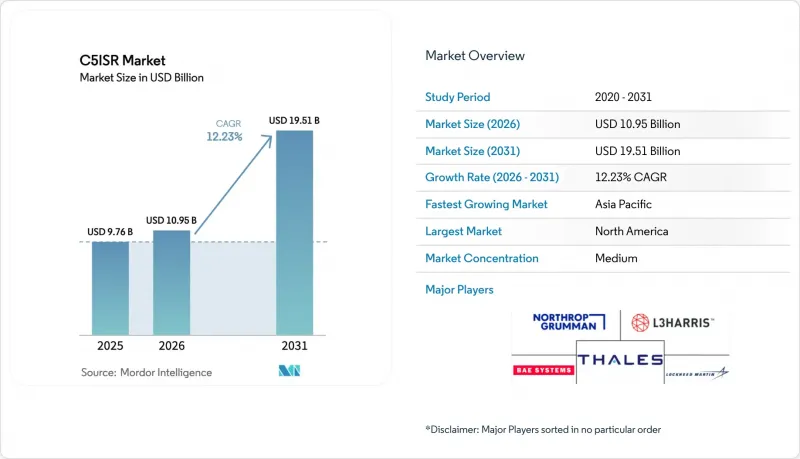
This report is Segmented by Platform (Land Systems, Naval Systems, Airborne Systems, and Space-Based Assets), Component (Hardware, Software, and Services), Application (Electronic Warfare, Command and Control, Communications, Cyber, and More), End-User (Army, Navy, Air Force, and More), and Geography (North America, Europe, Asia-Pacific, and More). The Market Forecasts are Provided in Terms of Value (USD).
Global C5ISR Market Trends and Insights
Rapid Field-Deployable Tactical Networks Drive Operational Agility
Secure, rapidly erectable networks now arrive in theater within minutes, as demonstrated by the US Army's USD 6.1 billion Integrated Tactical Network rollout. Rugged private 5G base stations from Thales and General Dynamics furnish low-latency links for autonomous weapons, while mesh protocols embedded in software-defined radios sustain connectivity when fixed infrastructure collapses. The capability allows dispersed formations to synchronize fires without exposing command nodes, a critical advantage visible during Project Convergence field tests.
Convergence of Electronic Warfare and Cyber Creates a New Battlespace Domain
Programs like the US Air Force Next Generation Jammer pair electromagnetic jamming with embedded malware payloads, enabling simultaneous disruption and exploitation of adversary networks. Raytheon and L3Harris integrate EW antennas, cyber toolkits, and SIGINT receivers into single air-pod architectures, setting a procurement precedent for multi-mission payloads.
Interoperability Gaps Constrain Coalition Operations
NATO's Steadfast Dart 2025 exercise highlighted that aircraft and ground stations from different nations could not exchange full-motion video or targeting data in real time because each service used proprietary message formats and frequency plans. The after-action review pointed out that crews resorted to voice relays and thumb-drive transfers, adding minutes to sensor-to-shooter cycles and increasing fratricide risk. Program managers are now mandating zero-trust data fabrics that treat every user and device untrusted until authenticated. Still, these platforms require cryptographic modules that many legacy radios cannot host. Nations have agreed to adopt a common data model for ISR metadata by 2028. Yet, funding shortfalls and export-license hurdles mean older waveforms will stay in service well into the next decade. As a result, coalition commanders expect only incremental gains before 2030, leaving adversaries windows to exploit the remaining seams in allied sensor networks.
Other drivers and restraints analyzed in the detailed report include:
- Miniaturized Multi-INT Sensor Payloads Transform Unmanned Operations
- Defense Cloud and Edge AI Enable Real-Time Decision Superiority
- Export Control Bottlenecks Limit Technology Sharing
For complete list of drivers and restraints, kindly check the Table Of Contents.
Segment Analysis
Space-based assets represent the fastest-growing platform at a 13.02% CAGR, enlarging their contribution to the C5ISR market as commercial LEO constellations mesh with government satellites. The US Space Force's integration contracts with SpaceX and OneWeb validate the trend, spotlighting resilient beyond-line-of-sight communication during kinetic disruptions. Airborne systems, however, maintain the largest 40.78% slice of the C5ISR market size in 2025 as manned ISR aircraft and HALE drones remain indispensable for high-capacity data collection.
Boosted by AUKUS Virginia-class acquisitions, naval procurement demands submarine-borne mast sensors and secure VLF communications, broadening the maritime revenue pool. Land Systems modernization pushes mobile command posts in GPS-denied theaters, leveraging anti-jam PNT and secondary celestial navigation. Collectively, these dynamics illustrate how the C5ISR market must support seamless cross-domain orchestration under Joint All-Domain Command and Control (JADC2) constructs.
Software exhibits an 11.74% CAGR, eclipsing hardware growth as AI-enabled decision tools dominate modernization blueprints. OpenAI's USD 200 million contract to craft war-fighting large-language models exemplifies commercial entrants penetrating defense workflows. Hardware still posting 43.10% of 2025 revenue reflects steady sensor and rugged compute refreshes required to host new code.
Service contracts shift toward outcome-based logistics, with vendors guaranteeing system availability rather than merely supplying parts. Emergent neuromorphic chips from KAIST foreshadow next-stage edge inference that slashes latency and power draw. These developments emphasize how the C5ISR market must marry agile software pipelines with sustainment ecosystems to preserve tactical overmatch.
Complete Report Scope:
- By Platform
- Land Systems
- Naval Systems
- Airborne Systems
- Space-based Assets
- By Component
- Hardware
- Software
- Services
- By Application
- Electronic Warfare (EW)
- Intelligence, Reconnaissance, and Surveillance (ISR)
- Command and Control (C2)
- Communications
- Cyber
- By End-User
- Army
- Navy
- Air Force
- Joint and Special Operations
- Homeland Security Agencies
- By Geography
- North America
- United States
- Canada
- Mexico
- Europe
- Germany
- United Kingdom
- France
- Russia
- Rest of Europe
- Asia-Pacific
- China
- India
- Japan
- South Korea
- Rest of Asia-Pacific
- South America
- Brazil
- Rest of South America
- Middle East and Africa
- Middle East
- Saudi Arabia
- United Arab Emirates
- Turkey
- Rest of Middle East
- Africa
- South Africa
- Rest of Africa
- Middle East
- North America
Geography Analysis
North America sustained 33.10% of the global C5ISR market share in 2025 on the back of the USD 961.6 billion FY2025 US defense budget. Programs like Project Convergence, JADC2, and the Navy's Project Overmatch drive procurement of cloud-native C2 and resilient network transport. Canada's interest in GCAP demonstrates a diversification of the supplier base beyond traditional US prime reliance, whereas Mexico's border-security partnership sparks demand for integrated sensor towers and aerial ISR. The American technology ecosystem also injects commercial AI prowess; OpenAI's defense award captures this civilian-military convergence.
Europe registers escalating outlays driven by the Ukraine war. Germany's 28% budget prioritizes Leopard 3 tanks equipped with open-architecture vetronics and Active Protection System (APS) sensors. The UK's Strategic Defence Review 2025 champions hybrid carrier air wings blending F-35B and autonomous platforms, requiring unified air-tasking networks. Arrow 3's USD 3.5 billion sale to Germany frames Israel's strategic entry into European missile-defense value chains. France's involvement in SCAF and the UK-Italy-Japan GCAP venture illustrates a continental pivot toward indigenous sixth-generation fighter ecosystems that rely on interoperable, exportable C5ISR middleware.
Asia-Pacific is the fastest limb of the C5ISR market, advancing 13.48% annually through 2031. China's USD 245 billion budget and nuclear deterrent modernization drive satellite-enabled C4 and strategic early-warning radars. Japan lifted defense allocations by 21%, channeling funds into F-35 expansion, ballistic-missile defense, and space-situational-awareness ground stations. Australia's AUKUS timeline underscores submarine-specific C5ISR packages, from integrated combat systems to secure VLF comms. South Korea's Hanwha Ocean yard servicing US Navy vessels amplifies industrial collaboration. India's Tiger Triumph 2025 joint exercise showcased network-enabled amphibious operations, underscoring sub-continental focus on cross-domain interoperability.
- BAE Systems plc
- Airbus SE
- Cubic Corporation
- Elbit Systems Ltd.
- General Dynamics Corporation
- CACI International Inc.
- RTX Corporation
- L3Harris Technologies, Inc.
- Northrop Grumman Corporation
- Thales Group
- Lockheed Martin Corporation
- Leonardo S.p.A
- Saab AB
- HENSOLDT AG
- Israel Aerospace Industries Ltd.
- Mercury Systems, Inc.
- Ultra Electronics Group
- Kratos Defense & Security Solutions, Inc.
- Leidos, Inc.
- Indra Sistemas, S.A.
Additional Benefits:
- The market estimate (ME) sheet in Excel format
- 3 months of analyst support
TABLE OF CONTENTS
1 INTRODUCTION
- 1.1 Study Assumptions and Market Definition
- 1.2 Scope of the Study
2 RESEARCH METHODOLOGY
3 EXECUTIVE SUMMARY
4 MARKET LANDSCAPE
- 4.1 Market Overview
- 4.2 Market Drivers
- 4.2.1 Rapid field-deployable tactical networks
- 4.2.2 Convergence of EW and cyber for spectrum dominance
- 4.2.3 Miniaturised multi-INT sensor payloads for UxVs
- 4.2.4 Defence cloud/edge AI for real-time ISR fusion
- 4.2.5 Budget spikes from geopolitical flashpoints
- 4.2.6 Commercial LEO satcom integration
- 4.3 Market Restraints
- 4.3.1 Interoperability gaps in legacy platforms
- 4.3.2 Export-control and ITAR bottlenecks
- 4.3.3 Skilled talent shortage in RF and SIGINT analytics
- 4.3.4 Cyber-supply-chain vulnerabilities
- 4.4 Value Chain Analysis
- 4.5 Regulatory Landscape
- 4.6 Technological Outlook
- 4.7 Porter's Five Forces Analysis
- 4.7.1 Threat of New Entrants
- 4.7.2 Bargaining Power of Buyers
- 4.7.3 Bargaining Power of Suppliers
- 4.7.4 Threat of Substitutes
- 4.7.5 Intensity of Competitive Rivalry
5 MARKET SIZE AND GROWTH FORECASTS (VALUE)
- 5.1 By Platform
- 5.1.1 Land Systems
- 5.1.2 Naval Systems
- 5.1.3 Airborne Systems
- 5.1.4 Space-based Assets
- 5.2 By Component
- 5.2.1 Hardware
- 5.2.2 Software
- 5.2.3 Services
- 5.3 By Application
- 5.3.1 Electronic Warfare (EW)
- 5.3.2 Intelligence, Reconnaissance, and Surveillance (ISR)
- 5.3.3 Command and Control (C2)
- 5.3.4 Communications
- 5.3.5 Cyber
- 5.4 By End-User
- 5.4.1 Army
- 5.4.2 Navy
- 5.4.3 Air Force
- 5.4.4 Joint and Special Operations
- 5.4.5 Homeland Security Agencies
- 5.5 By Geography
- 5.5.1 North America
- 5.5.1.1 United States
- 5.5.1.2 Canada
- 5.5.1.3 Mexico
- 5.5.2 Europe
- 5.5.2.1 Germany
- 5.5.2.2 United Kingdom
- 5.5.2.3 France
- 5.5.2.4 Russia
- 5.5.2.5 Rest of Europe
- 5.5.3 Asia-Pacific
- 5.5.3.1 China
- 5.5.3.2 India
- 5.5.3.3 Japan
- 5.5.3.4 South Korea
- 5.5.3.5 Rest of Asia-Pacific
- 5.5.4 South America
- 5.5.4.1 Brazil
- 5.5.4.2 Rest of South America
- 5.5.5 Middle East and Africa
- 5.5.5.1 Middle East
- 5.5.5.1.1 Saudi Arabia
- 5.5.5.1.2 United Arab Emirates
- 5.5.5.1.3 Turkey
- 5.5.5.1.4 Rest of Middle East
- 5.5.5.2 Africa
- 5.5.5.2.1 South Africa
- 5.5.5.2.2 Rest of Africa
- 5.5.5.1 Middle East
- 5.5.1 North America
6 COMPETITIVE LANDSCAPE
- 6.1 Market Concentration
- 6.2 Strategic Moves
- 6.3 Market Share Analysis
- 6.4 Company Profiles (includes Global level Overview, Market level overview, Core Segments, Financials as available, Strategic Information, Market Rank/Share for key companies, Products and Services, and Recent Developments)
- 6.4.1 BAE Systems plc
- 6.4.2 Airbus SE
- 6.4.3 Cubic Corporation
- 6.4.4 Elbit Systems Ltd.
- 6.4.5 General Dynamics Corporation
- 6.4.6 CACI International Inc.
- 6.4.7 RTX Corporation
- 6.4.8 L3Harris Technologies, Inc.
- 6.4.9 Northrop Grumman Corporation
- 6.4.10 Thales Group
- 6.4.11 Lockheed Martin Corporation
- 6.4.12 Leonardo S.p.A
- 6.4.13 Saab AB
- 6.4.14 HENSOLDT AG
- 6.4.15 Israel Aerospace Industries Ltd.
- 6.4.16 Mercury Systems, Inc.
- 6.4.17 Ultra Electronics Group
- 6.4.18 Kratos Defense & Security Solutions, Inc.
- 6.4.19 Leidos, Inc.
- 6.4.20 Indra Sistemas, S.A.
7 MARKET OPPORTUNITIES AND FUTURE OUTLOOK
- 7.1 White-space and Unmet-need Assessment

