PUBLISHER: Mordor Intelligence | PRODUCT CODE: 2097237

PUBLISHER: Mordor Intelligence | PRODUCT CODE: 2097237
Urgent Care Apps - Market Share Analysis, Industry Trends & Statistics, Growth Forecasts (2026 - 2031)
According to Mordor Intelligence, the urgent care apps market size is expected to grow from USD 4.30 billion in 2025 to USD 5.90 billion in 2026 and is forecast to reach USD 28.84 billion by 2031 at 37.32% CAGR over 2026-2031.
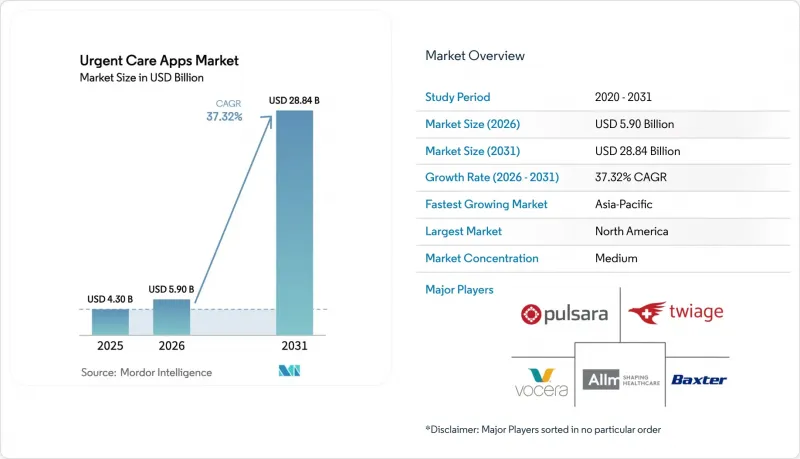
This report is Segmented by App Category (Pre-Hospital Emergency & Triage Apps, In-Hospital Communication & Collaboration Apps, and More), Platform (iOS, Android, Web-Based), Clinical Area (Trauma, Stroke, and More), End-User (Hospitals & Clinics, Urgent Care Centers, and More), Business Model (B2B, and More), and Geography (North America, and More). The Market Forecasts are Provided in Terms of Value (USD).
Global Urgent Care Apps Market Trends and Insights
Accelerating Payer Reimbursement Parity for Virtual Visits
Forty-three states now enforce some form of payment parity, eliminating the revenue gap that previously hindered the urgent care apps market. UnitedHealthcare revised commercial policies in 2024 to reimburse e-visits, virtual check-ins, and remote monitoring, boosting provider adoption of urgent care apps market solutions. CMS extended telehealth waivers through December 2024, offering economic predictability that encourages permanent integration of urgent care apps market workflows. Hospital groups consequently fast-track chatbot triage modules that link directly to billing systems, reducing uncompensated encounters in the urgent care apps market. As payment certainty rises, competitive focus shifts toward user experience and clinical depth across the urgent care apps market.
Explosion of "Digital Front Door" Investments by Health Systems
ThedaCare's Ripple app recorded a 312% download surge within ten months, proving that patients now expect mobile first access routes into urgent care workflows. Sturdy Health automated intake and scheduling through an AI-powered front door, cutting manual touches per encounter by one-third and redirecting staff time toward clinical tasks. Fabric Health secured USD 20 million to fuse ED check-ins with post-discharge follow-ups, confirming investor belief that unified patient journeys lower churn across urgent care apps. CIO surveys show 74% of U.S. hospital executives now rank digital front doors as a top-three capital priority, rivaling imaging equipment for budget share. The momentum forces late-stage telehealth vendors to embed seamless onboarding flows or risk losing high-value encounters to health-system branded urgent care apps.
Fragmented State-Level Telehealth Licensure in the U.S.
Only 36 states offer limited waivers, so clinicians still purchase multiple licenses to treat traveling patients, inflating compliance costs for urgent care apps. Providers can spend up to USD 10,000 yearly on renewals and jurisprudence exams, a burden that deters small practices from joining national urgent care platforms. Compact membership accelerates approval but requires physicians to maintain home-state licenses plus fees in each additional state, preserving administrative drag inside the urgent care apps market. Some vendors hire clinicians as 1099 contractors under employer-of-record entities, yet legal uncertainty around cross-state practice persists and limits venture investment confidence. National legislation remains stalled, meaning licensure complexity will continue to temper adoption curves for the urgent care apps market through 2028.
Other drivers and restraints analyzed in the detailed report include:
- Integration of AI-Triage into EMS Workflows Cuts Hand-Off Time
- Smartphone-Based Clinician Collaboration Tools Replacing Pagers
- Limited 5G/Broadband in Rural & Low-Income Areas
For complete list of drivers and restraints, kindly check the Table Of Contents.
Segment Analysis
Post-hospital apps captured 48.30% of urgent care apps market share in 2025 by bundling discharge summaries, medication reminders, and vitals logging that cut 30-day readmissions by up to 18% among heart-failure cohorts. Payers reimburse these remote-monitoring bundles, giving vendors predictable revenue streams and hospitals shared-savings upside within the urgent care apps market. Pre-hospital emergency and triage tools are set to grow at a 37.85% CAGR as consumers seek AI-guided symptom checks before selecting care settings, easing ED overload. In-hospital collaboration apps hold smaller share yet anchor vendor stickiness by embedding secure chat and lab alerts into clinician workflows, making switching costly for enterprise buyers inside the urgent care apps market. Competitive data show churn below 6% for top post-hospital vendors, highlighting defensible network effects around longitudinal patient datasets.
Segment momentum illustrates a strategic pivot whereby post-acute platforms extend into chronic-care coaching, while triage specialists court employer contracts that monetize avoided ER claims in the urgent care apps market. Interoperability upgrades further secure post-hospital leads because automatic FHIR data exchange makes vendor replacement disruptive to clinical governance. New entrants now carve niches in pediatric follow-up and peri-operative orthopedic care, supported by CPT codes that reimburse specific specialty monitoring inside the urgent care apps market. As employers broaden virtual benefits, post-hospital apps integrate back-to-work certifications, expanding revenue beyond payer contracts. Together these factors sustain double-digit growth across all care-coordination subsegments of the urgent care apps market.
iOS devices represented 53.45% of urgent care apps market size in 2025 because enterprise security officers prefer Apple's hardware encryption and App Store vetting for HIPAA compliance. Hospital BYOD policies therefore lean iPhone-first, driving clinician usage habits that reinforce iOS dominance in the urgent care apps market. Android downloads, however, are forecast to climb at a 38.40% CAGR as low-cost handsets penetrate APAC and Latin America, expanding total addressable users for urgent care apps. Progressive Web App frameworks now deliver near-native speed across both platforms, letting developers achieve feature parity without doubling code bases inside the urgent care apps market. Web-based portals sustain relevance for older adults who prefer desktops, preserving omnichannel touchpoints even as mobile remains primary for urgent care apps.
Cross-platform biometric sensor parity narrows historic functionality gaps because mid-tier Android phones now ship with FDA-cleared SpO2 and single-lead ECG chips useful for urgent care triage. Cyber-liability insurers increasingly mandate multi-factor authentication regardless of operating system, further evening the security playing field for urgent care apps. Developers thus reallocate budgets from OS-specific hardening toward AI personalization engines that improve engagement metrics inside the urgent care apps market. As handset prices fall below USD 150 in India and Indonesia, Android adoption is set to accelerate equitable access to urgent care apps, supporting global expansion goals.
Complete Report Scope:
- By App Category
- Pre-hospital Emergency & Triage Apps
- In-hospital Communication & Collaboration Apps
- Post-hospital Care-coordination Apps
- By Platform
- iOS
- Android
- Web-based
- By Clinical Area
- Trauma
- Stroke
- Cardiac Conditions
- Other Clinical Areas
- By End-User
- Hospitals & Clinics
- Urgent Care Centers
- Emergency Medical Services (EMS)
- Patients / Consumers
- By Business Model
- B2B
- B2C
- Hybrid
- By Geography
- North America
- United States
- Canada
- Mexico
- Europe
- United Kingdom
- Germany
- France
- Italy
- Spain
- Rest of Europe
- Asia-Pacific
- China
- India
- Japan
- South Korea
- Australia
- Rest of Asia-Pacific
- South America
- Brazil
- Argentina
- Rest of South America
- Middle East and Africa
- GCC
- South Africa
- Rest of Middle East & Africa
- North America
Geography Analysis
North America held 41.70% of the urgent care apps market share in 2025, benefiting from payment-parity statutes, 5G rollout across 83% of populated areas, and employer-sponsored telehealth benefits adoption topping 64%. The urgent care apps market size in the United States is forecast to keep expanding in double digits, although growth moderates as penetration among insured adults plateaus. Canada boosts regional totals by leveraging a single-payer model that reimburses virtual visits nationwide, offsetting shortages of rural clinicians. Mexico's IMSS digital strategy indicates early momentum yet faces fragmentation across private insurers.
Asia-Pacific will post a 40.60% CAGR through 2031, driven by India's Ayushman Bharat Digital Mission and China's 5G-enabled hospital networks. Smartphone ownership exceeds 70% in urban India, translating to wider addressable bases for Android-first urgent care apps. Japan and South Korea enact regulatory sandboxes that streamline device approval, accelerating integration of wearables with triage software. However, linguistic diversity and physician-shortage clusters complicate unified deployment; thus, localization partnerships remain critical.
Europe grows steadily on back of NHS England's Long Term Plan, which earmarks GBP 2.8 billion for digital urgent and emergency pathways. Germany's DiGA Act allows reimbursement for certified health apps, spurring German-language triage tools. Scandinavia achieves near-universal broadband and leads on 112-app tie-ins that route emergency calls with video feeds. Southern Europe lags due to fragmented private-public payment systems but shows upside in expatriate populations demanding English-language telehealth.
South America and the Middle East & Africa contribute smaller shares but feature compelling pockets: Brazil's SUS-supported tele-emergency program triples encounter volume annually, while Gulf Cooperation Council states subsidize 5G to attract medical tourists. Infrastructure gaps persist-4G coverage remains below 50% in Sub-Saharan Africa-but satellite broadband trials by low-Earth-orbit constellations may compress timelines.
- Teladoc Health
- American Well
- MDLIVE Inc.
- K Health
- Pulsara (CommuniCare Technology Inc.)
- Allm
- TigerConnect Inc.
- Ada Health GmbH
- Buoy Health Inc.
- CVS Health
- DexCare Inc.
- HealthTap Inc.
- Accolade Inc. (PlushCare)
- Anthem Inc. (Elevance Health)
- Transcarent Inc.
- MDAnywhere.com LLC
Additional Benefits:
- The market estimate (ME) sheet in Excel format
- 3 months of analyst support
TABLE OF CONTENTS
1 Introduction
- 1.1 Study Assumptions & Market Definition
- 1.2 Scope of the Study
2 Research Methodology
3 Executive Summary
4 Market Landscape
- 4.1 Market Overview
- 4.2 Market Drivers
- 4.2.1 Accelerating Payer Reimbursement Parity for Virtual Visits
- 4.2.2 Explosion of "Digital Front-Door" Investments by Health Systems
- 4.2.3 Integration of AI-Triage into EMS Workflows Cuts Hand-Off Time
- 4.2.4 Smartphone-Based Clinician Collaboration Tools Replacing Pagers
- 4.2.5 Government Mandates for EHR-to-App Interoperability (FHIR APIs)
- 4.3 Market Restraints
- 4.3.1 Fragmented State-Level Telehealth Licensure in the U.S.
- 4.3.2 Limited 5G/Broadband in Rural & Low-Income Areas
- 4.3.3 Rising Patient Privacy-Breach Litigation Costs
- 4.4 Value / Supply-Chain Analysis
- 4.5 Regulatory Landscape
- 4.6 Technological Outlook
- 4.7 Porter's Five Forces
- 4.7.1 Threat of New Entrants
- 4.7.2 Bargaining Power of Suppliers
- 4.7.3 Bargaining Power of Buyers
- 4.7.4 Threat of Substitutes
- 4.7.5 Competitive Rivalry
5 Market Size & Growth Forecasts (Value, USD)
- 5.1 By App Category
- 5.1.1 Pre-hospital Emergency & Triage Apps
- 5.1.2 In-hospital Communication & Collaboration Apps
- 5.1.3 Post-hospital Care-coordination Apps
- 5.2 By Platform
- 5.2.1 iOS
- 5.2.2 Android
- 5.2.3 Web-based
- 5.3 By Clinical Area
- 5.3.1 Trauma
- 5.3.2 Stroke
- 5.3.3 Cardiac Conditions
- 5.3.4 Other Clinical Areas
- 5.4 By End-User
- 5.4.1 Hospitals & Clinics
- 5.4.2 Urgent Care Centers
- 5.4.3 Emergency Medical Services (EMS)
- 5.4.4 Patients / Consumers
- 5.5 By Business Model
- 5.5.1 B2B
- 5.5.2 B2C
- 5.5.3 Hybrid
- 5.6 By Geography
- 5.6.1 North America
- 5.6.1.1 United States
- 5.6.1.2 Canada
- 5.6.1.3 Mexico
- 5.6.2 Europe
- 5.6.2.1 United Kingdom
- 5.6.2.2 Germany
- 5.6.2.3 France
- 5.6.2.4 Italy
- 5.6.2.5 Spain
- 5.6.2.6 Rest of Europe
- 5.6.3 Asia-Pacific
- 5.6.3.1 China
- 5.6.3.2 India
- 5.6.3.3 Japan
- 5.6.3.4 South Korea
- 5.6.3.5 Australia
- 5.6.3.6 Rest of Asia-Pacific
- 5.6.4 South America
- 5.6.4.1 Brazil
- 5.6.4.2 Argentina
- 5.6.4.3 Rest of South America
- 5.6.5 Middle East and Africa
- 5.6.5.1 GCC
- 5.6.5.2 South Africa
- 5.6.5.3 Rest of Middle East & Africa
- 5.6.1 North America
6 Competitive Landscape
- 6.1 Market Concentration
- 6.2 Market Share Analysis
- 6.3 Company Profiles (includes Global level Overview, Market level overview, Core Segments, Financials as available, Strategic Information, Market Rank/Share, Products & Services, Recent Developments)
- 6.3.1 Teladoc Health Inc.
- 6.3.2 American Well Corporation
- 6.3.3 MDLIVE Inc.
- 6.3.4 K Health Inc.
- 6.3.5 Pulsara (CommuniCare Technology Inc.)
- 6.3.6 Allm Inc.
- 6.3.7 TigerConnect Inc.
- 6.3.8 Ada Health GmbH
- 6.3.9 Buoy Health Inc.
- 6.3.10 CVS Health Corporation
- 6.3.11 DexCare Inc.
- 6.3.12 HealthTap Inc.
- 6.3.13 Accolade Inc. (PlushCare)
- 6.3.14 Anthem Inc. (Elevance Health)
- 6.3.15 Transcarent Inc.
- 6.3.16 MDAnywhere.com LLC
7 Market Opportunities & Future Outlook
- 7.1 White-space & Unmet-Need Assessment

