PUBLISHER: Mordor Intelligence | PRODUCT CODE: 2097256

PUBLISHER: Mordor Intelligence | PRODUCT CODE: 2097256
Food Allergy - Market Share Analysis, Industry Trends & Statistics, Growth Forecasts (2025 - 2030)
According to Mordor Intelligence, the global food allergy market size stands at USD 41.88 billion in 2025 and is forecast to reach USD 54.68 billion by 2030, expanding at a 5.48% CAGR during 2025-2030.
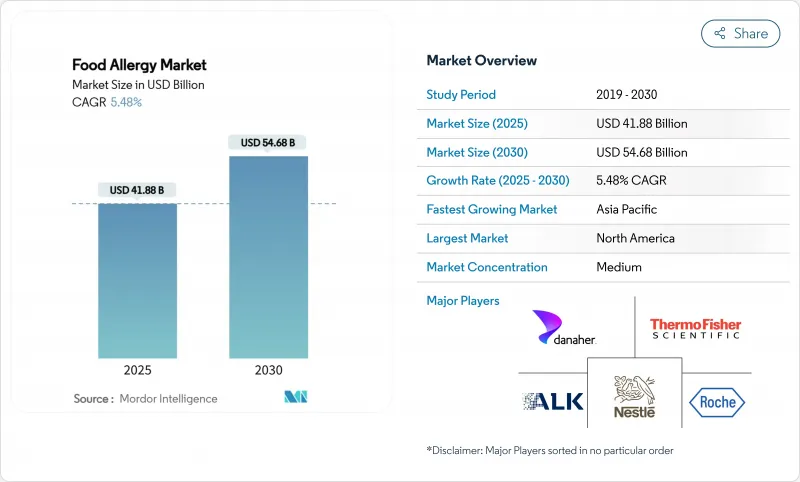
This report is Segmented by Offering (Diagnostics, Therapeutics, Allergen-Free Food Products), Allergen Type (Peanut, Tree Nut, Cow's Milk, Egg, Wheat & Gluten, Soy, Fish, Shellfish, Sesame, Other Emerging Allergens), End User (Hospitals & Clinics, Diagnostic Laboratories, and More), and Geography (North America, Europe and More). The Market Forecasts are Provided in Terms of Value (USD).
Global Food Allergy Market Trends and Insights
Rising Prevalence of Food Allergies in Children & Adults
Hospitalizations for anaphylaxis in England climbed from 12,361 in 2002-03 to 25,721 in 2022-23, and U.S. annual economic burden is now USD 24.8 billion. Urbanization, westernized diets, and microbiome alterations are escalating sensitization rates across Asia-Pacific, where shellfish now ranks as the dominant trigger. Mechanistic research pinpointing Thetis cells confirms a developmental window for establishing oral tolerance, suggesting that prophylactic therapies could emerge for high-risk infants. As prevalence rises, caregivers are shifting from episodic emergency care toward continuous risk-mitigation solutions, a trend that expands total addressable demand for diagnostics, digital coaching, and prophylactic treatments. Consequently, multi-allergen product pipelines and monitoring tools are growing more attractive to venture investors, reinforcing momentum in the food allergy market.
Stricter Global Food-Allergen Labeling Regulations
The U.S. FASTER Act added sesame as the 9th major allergen in 2023, obliging manufacturers to manage cross-contact and reformulate supply chains. Similar expansions are under review in Canada, the United Kingdom, and parts of Asia, yet regulatory lists vary, forcing multinational brands to juggle divergent compliance codes. Some U.S. bakeries opted to deliberately add sesame to avoid cleaning costs, exposing enforcement gaps and re-energizing advocacy groups. These discrepancies raise demand for lab-based protein screening, inline sensors, and enterprise allergen-management software capable of harmonizing region-specific thresholds. Small and midsize food processors, facing cost pressures, increasingly outsource validation testing to third-party labs, reinforcing volumes for diagnostics leaders within the food allergy market.
High Cost & Limited Reimbursement for Biologics/Immunotherapy
Annual omalizumab therapy ranges from USD 5,000-15,000, levels that outstrip many private or public coverage schedules and restrict uptake outside wealthier cohorts.Oral immunotherapy centers report waiting lists of 500 + patients owing to low reimbursement and staffing constraints. Health-economic models price peanut OIT from USD 1,235-6,568 per year but highlight quality-of-life gains that insurers underrecognize. Until multi-year outcome data sway payers, manufacturers deploy patient-assistance programs and explore value-based contracts. Without broader coverage, biologics risk remaining confined to tertiary centers, tempering near-term growth in the food allergy market.
Other drivers and restraints analyzed in the detailed report include:
- Rapid Adoption of Component-Resolved & At-Home Diagnostics
- FDA/EMA Approvals of First-in-Class Biologics & OIT Products
- Patient Drop-Outs Due to Adverse Events & Adherence Concerns
For complete list of drivers and restraints, kindly check the Table Of Contents.
Segment Analysis
Diagnostics held a 44.62% share of the food allergy market in 2024, underpinned by widespread skin-prick tests, serum IgE assays, and the emerging basophil activation test. Volumes are expanding through reference labs, hospital allergy clinics, and retail pharmacies that added drop-off sample services. Adoption of multiplex, component-resolved panels yields richer risk profiles and supports precision dosing. Simultaneously, the therapeutics category is forecast to post an 8.38% CAGR through 2030, accelerating the overall food allergy market size as biologics, epicutaneous patches, and nasal epinephrine spray widen treatment options. Omalizumab's launch provides a blueprint for next-generation candidates, while DBV Technologies' Viaskin patch builds momentum in pediatric desensitization. Portfolio expansion signals a long-term migration toward disease-modifying regimens that could eventually eclipse diagnostic revenue streams.
Therapeutic innovation is also fostering cross-sector collaboration. Pharmaceutical leaders are licensing machine-learning platforms that individualize updosing schedules and predict eosinophilic esophagitis risk. Digital therapeutics firms embed adherence nudges and real-time symptom logs, creating data flows that inform regulatory submissions and payer negotiations. This interplay of hardware, software, and biologics is reshaping competitive positioning, and investors view platform synergies as a route to recurring service revenue. By 2030, integrated care bundles that couple diagnostic monitoring with therapeutic delivery may dominate payer formularies and redefine value capture within the food allergy market.
Complete Report Scope:
- By Offering
- Diagnostics
- In Vivo Tests
- Skin-Prick Test
- Oral Food Challenge
- In Vitro Tests
- Immunoassay (IgE, sIgG)
- Molecular Diagnostics
- In Vivo Tests
- Therapeutics
- Pharmacotherapy
- Antihistamines
- Epinephrine Auto-Injectors
- Immunotherapy
- Oral Immunotherapy (OIT)
- Sublingual Immunotherapy (SLIT)
- Epicutaneous Immunotherapy (EPIT)
- Biologics (anti-IgE, anti-IL-4/13)
- Emerging Therapies (DNA vaccines, nanoparticle-AIT)
- Pharmacotherapy
- Allergen-Free Food Products
- Dairy Alternatives
- Gluten-Free Products
- Plant-Based Protein Alternatives
- Diagnostics
- By Allergen Type
- Peanut
- Tree Nut
- Cow's Milk
- Egg
- Wheat & Gluten
- Soy
- Fish
- Shellfish
- Sesame
- Other Emerging Allergens
- By End User
- Hospitals & Clinics
- Diagnostic Laboratories
- Specialty Allergy Centers
- Home & Self-Testing Consumers
- Research & Academic Institutes
- Food & Beverage Manufacturers
- By Geography
- North America
- United States
- Canada
- Mexico
- Europe
- Germany
- United Kingdom
- France
- Italy
- Spain
- Rest of Europe
- Asia-Pacific
- China
- Japan
- India
- Australia
- South Korea
- Rest of Asia-Pacific
- Middle East and Africa
- GCC
- South Africa
- Rest of Middle East and Africa
- South America
- Brazil
- Argentina
- Rest of South America
- North America
Geography Analysis
North America generated 36.72% of 2024 revenue for the food allergy market. Federal legislation, broad insurance coverage for epinephrine auto-injectors, and early adoption of component-resolved diagnostics anchor leadership. Market expansion is further reinforced by school-based anaphylaxis protocols and active patient advocacy, which collectively sustain high diagnosis rates and spur payer experimentation with biologic coverage.
Europe mirrors North American precision in regulatory frameworks but shows greater heterogeneity in reimbursement. Countries such as Germany and the Netherlands reimburse OIT and biologics more liberally than Southern Europe, where public health budgets remain strained. The European Precautionary Allergen Labeling (PAL) scheme influences global packaging norms and encourages multinational food brands to pilot advanced allergen-control technologies in the region first.
Asia-Pacific registers the fastest CAGR at 7.49% through 2030, propelled by rapid urbanization, dietary westernization, and rising shellfish sensitization. However, limited epinephrine auto-injector availability and scarce subspecialty clinics create treatment gaps. Private insurers in Singapore and urban China are now piloting coverage for omalizumab, signaling an eventual move toward premium therapies. South America, the Middle East, and Africa trail due to lower public awareness and reimbursement hurdles yet represent sizeable white-space opportunities as global players seek untapped demand pools within the food allergy market.
- Roche
- Thermo Fisher Scientific
- Danaher
- Nestle Health Science (Aimmune Therapeutics)
- DBV Technologies
- ALK-Abello A/S
- Stallergenes Greer
- Allergy Therapeutics plc
- Sanofi
- Regeneron Pharmaceuticals
- Alladapt Immunotherapeutics
- BioVaxys Technology Corp.
- Aravax Pty Ltd
- Prota Therapeutics
- Ukko Inc.
- Neogen
- Quest Diagnostics
- Siemens Healthineers
- Omega Diagnostics Group
Additional Benefits:
- The market estimate (ME) sheet in Excel format
- 3 months of analyst support
TABLE OF CONTENTS
1 Introduction
- 1.1 Study Assumptions and Market Definition
- 1.2 Scope of the Study
2 Research Methodology
3 Executive Summary
4 Market Landscape
- 4.1 Market Overview
- 4.2 Market Drivers
- 4.2.1 Rising Prevalence Of Food Allergies In Children & Adults
- 4.2.2 Stricter Global Food-Allergen Labelling Regulations
- 4.2.3 Rapid Adoption Of Component-Resolved & At-Home Diagnostics
- 4.2.4 FDA/EMA Approvals Of First-In-Class Biologics & OIT Products
- 4.2.5 AI-Driven Personalised Immunotherapy Dosing Platforms
- 4.2.6 Food-Processing Tech (Pulsed-Light, Enzymatic) Lowering Allergenicity
- 4.3 Market Restraints
- 4.3.1 High Cost & Limited Reimbursement For Biologics/Immunotherapy
- 4.3.2 Stringent Safety Requirements & Lengthy Regulatory Pathways
- 4.3.3 Scarcity Of Pharma-Grade Allergen Extracts For Therapy Manufacture
- 4.3.4 Patient Drop-Outs Due To Adverse Events & Adherence Concerns
- 4.4 Value / Supply-Chain Analysis
- 4.5 Regulatory Landscape
- 4.6 Technology Outlook
- 4.7 Porter's Five Forces Analysis
- 4.7.1 Bargaining Power of Suppliers
- 4.7.2 Bargaining Power of Buyers
- 4.7.3 Threat of New Entrants
- 4.7.4 Threat of Substitutes
- 4.7.5 Intensity of Competitive Rivalry
5 Market Size and Growth Forecasts (Value-USD)
- 5.1 By Offering
- 5.1.1 Diagnostics
- 5.1.1.1 In Vivo Tests
- 5.1.1.1.1 Skin-Prick Test
- 5.1.1.1.2 Oral Food Challenge
- 5.1.1.2 In Vitro Tests
- 5.1.1.2.1 Immunoassay (IgE, sIgG)
- 5.1.1.2.2 Molecular Diagnostics
- 5.1.1.1 In Vivo Tests
- 5.1.2 Therapeutics
- 5.1.2.1 Pharmacotherapy
- 5.1.2.1.1 Antihistamines
- 5.1.2.1.2 Epinephrine Auto-Injectors
- 5.1.2.2 Immunotherapy
- 5.1.2.2.1 Oral Immunotherapy (OIT)
- 5.1.2.2.2 Sublingual Immunotherapy (SLIT)
- 5.1.2.2.3 Epicutaneous Immunotherapy (EPIT)
- 5.1.2.3 Biologics (anti-IgE, anti-IL-4/13)
- 5.1.2.4 Emerging Therapies (DNA vaccines, nanoparticle-AIT)
- 5.1.2.1 Pharmacotherapy
- 5.1.3 Allergen-Free Food Products
- 5.1.3.1 Dairy Alternatives
- 5.1.3.2 Gluten-Free Products
- 5.1.3.3 Plant-Based Protein Alternatives
- 5.1.1 Diagnostics
- 5.2 By Allergen Type
- 5.2.1 Peanut
- 5.2.2 Tree Nut
- 5.2.3 Cow's Milk
- 5.2.4 Egg
- 5.2.5 Wheat & Gluten
- 5.2.6 Soy
- 5.2.7 Fish
- 5.2.8 Shellfish
- 5.2.9 Sesame
- 5.2.10 Other Emerging Allergens
- 5.3 By End User
- 5.3.1 Hospitals & Clinics
- 5.3.2 Diagnostic Laboratories
- 5.3.3 Specialty Allergy Centers
- 5.3.4 Home & Self-Testing Consumers
- 5.3.5 Research & Academic Institutes
- 5.3.6 Food & Beverage Manufacturers
- 5.4 By Geography
- 5.4.1 North America
- 5.4.1.1 United States
- 5.4.1.2 Canada
- 5.4.1.3 Mexico
- 5.4.2 Europe
- 5.4.2.1 Germany
- 5.4.2.2 United Kingdom
- 5.4.2.3 France
- 5.4.2.4 Italy
- 5.4.2.5 Spain
- 5.4.2.6 Rest of Europe
- 5.4.3 Asia-Pacific
- 5.4.3.1 China
- 5.4.3.2 Japan
- 5.4.3.3 India
- 5.4.3.4 Australia
- 5.4.3.5 South Korea
- 5.4.3.6 Rest of Asia-Pacific
- 5.4.4 Middle East and Africa
- 5.4.4.1 GCC
- 5.4.4.2 South Africa
- 5.4.4.3 Rest of Middle East and Africa
- 5.4.5 South America
- 5.4.5.1 Brazil
- 5.4.5.2 Argentina
- 5.4.5.3 Rest of South America
- 5.4.1 North America
6 Competitive Landscape
- 6.1 Market Concentration
- 6.2 Market Share Analysis
- 6.3 Company profiles (includes Global level Overview, Market level overview, Core Segments, Financials as available, Strategic Information, Market Rank/Share for key companies, Products and Services, and Recent Developments)
- 6.3.1 F. Hoffmann-La Roche Ltd
- 6.3.2 Thermo Fisher Scientific Inc.
- 6.3.3 Danaher Corporation
- 6.3.4 Nestle Health Science (Aimmune Therapeutics)
- 6.3.5 DBV Technologies
- 6.3.6 ALK-Abello A/S
- 6.3.7 Stallergenes Greer
- 6.3.8 Allergy Therapeutics plc
- 6.3.9 Sanofi SA
- 6.3.10 Regeneron Pharmaceuticals Inc.
- 6.3.11 Alladapt Immunotherapeutics
- 6.3.12 BioVaxys Technology Corp.
- 6.3.13 Aravax Pty Ltd
- 6.3.14 Prota Therapeutics
- 6.3.15 Ukko Inc.
- 6.3.16 Neogen Corporation
- 6.3.17 Quest Diagnostics Inc.
- 6.3.18 Siemens Healthineers AG
- 6.3.19 Omega Diagnostics Group Plc
7 Market Opportunities & Future Outlook
- 7.1 White-Space & Unmet-Need Assessment

