PUBLISHER: Mordor Intelligence | PRODUCT CODE: 2097271

PUBLISHER: Mordor Intelligence | PRODUCT CODE: 2097271
Food Processing Ingredients - Market Share Analysis, Industry Trends & Statistics, Growth Forecasts (2026 - 2031)
According to Mordor Intelligence, the food processing ingredients market is projected to grow from USD 137.53 billion in 2025 to USD 145.30 billion in 2026 and reach USD 172.65 billion by 2031, registering a CAGR of 3.51% during 2026-2031.
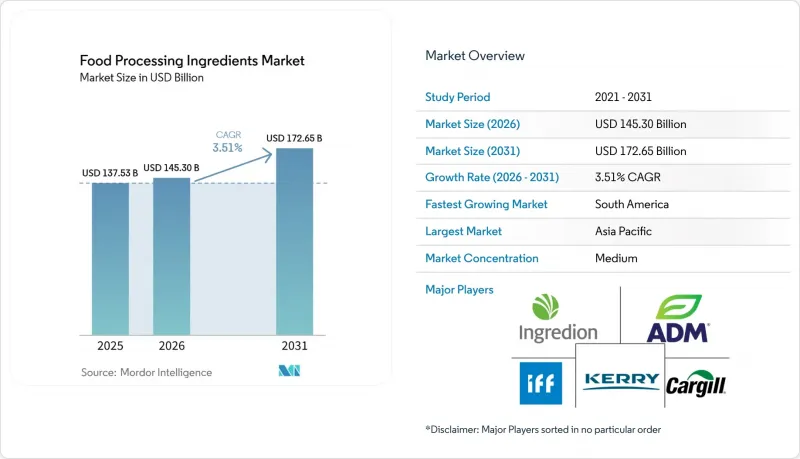
This report is Segmented by Ingredient Type (Starches and Texturizers, Proteins, and More), Source (Natural and Synthetic), Form (Powder and Liquid), Application (Bakery, Confectionery, Meat, and More) and Geography (North America, Europe, Asia-Pacific, and More). The Market Forecasts are Provided in Terms of Value (USD). The Market Forecasts are Provided in Both Value (USD) and Volume (Tons).
Global Food Processing Ingredients Market Trends and Insights
Rising demand for processed and convenience foods
The rising demand for processed and convenience foods is a major driver of the food processing ingredients market. Manufacturers increasingly rely on functional ingredients to enhance product quality, taste, texture, shelf life, and manufacturing efficiency. Rapid urbanization, changing lifestyles, and the growing preference for ready-to-eat and easy-to-prepare food products are accelerating packaged food production, thereby increasing the consumption of enzymes, preservatives, sweeteners, emulsifiers, flavors, and texturizers. According to the United Nations, 68% of the global population is projected to live in urban areas by 2050 . This trend is expected to further increase demand for convenient food options and strengthen the need for food processing ingredients that enable large-scale, consistent, and high-quality food production.
Growing consumer preference for clean-label products
Growing demand for clean-label ingredient solutions is driving the food processing ingredients market as food manufacturers increasingly reformulate products to eliminate artificial additives while maintaining functionality, processing efficiency, and shelf life. This transition is accelerating the adoption of naturally derived enzymes, starches, texturizers, and flavor systems that can deliver equivalent performance to conventional ingredients. Ingredient suppliers are responding by expanding their clean-label portfolios through biotechnology, fermentation, and natural extraction technologies to help manufacturers meet regulatory requirements and product reformulation goals. For instance, Ingredion Incorporated offers the NOVATION range of clean-label functional native starches designed to improve texture, stability, and processing performance in food manufacturing without the use of chemically modified starches.
Stringent food safety and labeling regulations
Stringent food safety and labeling regulations restrain the food processing ingredients market by increasing compliance costs, extending product approval timelines, and requiring continuous reformulation of ingredient portfolios. Ingredient manufacturers must invest significantly in safety assessments, toxicological studies, labeling compliance, and regulatory documentation before introducing new ingredients or modifying existing formulations. Evolving regulatory requirements are particularly challenging for ingredient categories transitioning from synthetic to naturally derived alternatives, as manufacturers must demonstrate equivalent safety, functionality, and product performance. For example, under Regulation (EC) No. 1333/2008, the European Food Safety Authority (EFSA) conducts periodic re-evaluations of approved food additives, which can lead to revised usage limits, additional safety requirements, or withdrawal of authorization based on updated scientific evidence.
Other drivers and restraints analyzed in the detailed report include:
- Growth In plant-based and alternative protein formulations
- Growing emphasis on extending product shelf life
- Fluctuations in the availability of natural and specialty raw materials
For complete list of drivers and restraints, kindly check the Table Of Contents.
Segment Analysis
Sweeteners accounted for 48.23% of the food processing ingredients market by value in 2025, reflecting their widespread use across processed food categories, including industrial baking, beverages, and confectionery. High-fructose corn syrup, sucrose, and glucose/dextrose continue to drive volume in bulk food processing, while high-intensity sweeteners, including stevia, monk fruit extract, and sucralose, are gaining formulation share as manufacturers respond to sugar-reduction mandates. Sugar polyols such as erythritol and xylitol are seeing increased uptake in functional confectionery and dental health applications. The scale of the sweeteners segment creates a structural drag on overall market growth, as traditional sugar volumes grow at a modest pace relative to specialty ingredient categories.
Enzymes represent the fastest-growing ingredient category, forecast to advance at a CAGR of 5.23% over 2026-2031. Growth in this segment is driven by increasing adoption of enzyme-based processing solutions that improve manufacturing efficiency, product consistency, and production sustainability. Enzymes allow food manufacturers to optimize processing conditions by accelerating natural biochemical reactions, resulting in higher production yields, reduced processing times, lower energy consumption, and minimized raw material losses. They also enhance product attributes such as texture, flavor development, moisture retention, and stability, while supporting consistent quality across production batches.
Natural ingredients held 57.35% of the food processing ingredients market by value in 2025 and are forecast to expand at a CAGR of 5.95% during 2026-2031. The segment's growth is driven by the increasing shift toward clean-label food products and the preference for ingredients derived from natural sources, aligned with evolving consumer expectations for transparency and minimal processing. Food manufacturers are increasingly replacing synthetic additives with natural alternatives to maintain functionality such as flavor enhancement, preservation, coloring, and texture improvement, while enhancing product appeal. Natural ingredients also support product differentiation by enabling manufacturers to develop formulations with recognizable ingredient lists and fewer artificial components.
Synthetic ingredients continue to maintain a significant market presence owing to their consistent quality, functional reliability, and cost-effective performance in large-scale food manufacturing. Synthetic ingredients offer precise functionality, enabling manufacturers to achieve standardized taste, texture, color, stability, and shelf-life extension across high-volume production. Their stability under varying processing and storage conditions makes them well suited for complex manufacturing environments where formulation consistency is critical. In addition, synthetic ingredients are often easier to produce at scale, ensuring a dependable supply and reducing variability associated with naturally sourced raw materials. Ongoing innovations in ingredient chemistry are also improving their safety profiles, performance characteristics, and compatibility with modern processing technologies.
Complete Report Scope:
- By Ingredient Type
- Starches and Texturizers
- Proteins
- Enzymes
- Sweeteners
- Traditional Sugar
- Sucrose
- High-Fructose Corn Syrup (HFCS)
- Glucose/Dextrose
- Others
- Sugar Polyols
- Sorbitol
- Maltitol
- Xylitol
- Erythritol
- Others
- High Intensity Sweeteners
- Aspartame
- Sucralose
- Stevia
- Monk Fruit Extract
- Others
- Rare and Novel Sugar
- Others
- Traditional Sugar
- Flavors
- Colorants
- Emulsifiers
- Preservatives
- Others
- By Source
- Natural
- Synthetic
- By Form
- Powder
- Liquid
- By Application
- Bakery
- Confectionery
- Meat, Poultry and Seafood
- Dairy and Frozen Desserts
- Beverages
- Convenience and Ready Meals
- Others
- By Geography
- North America
- United States
- Canada
- Mexico
- Rest of North America
- Europe
- United Kingdom
- Germany
- France
- Italy
- Spain
- Netherlands
- Poland
- Belgium
- Sweden
- Rest of Europe
- Asia-Pacific
- China
- Japan
- India
- Australia
- Indonesia
- South Korea
- Thailand
- Singapore
- Rest of Asia-Pacific
- South America
- Brazil
- Argentina
- Colombia
- Chile
- Peru
- Rest of South America
- Middle East and Africa
- South Africa
- Saudi Arabia
- United Arab Emirates
- Nigeria
- Egypt
- Morocco
- Turkey
- Rest of Middle East and Africa
- North America
Geography Analysis
The Asia-Pacific region demonstrates market leadership with a substantial 36.94% share in 2024. This dominance stems from several key factors, including accelerated industrialization across major economies, significant expansion of middle-class populations, and widespread adoption of processed foods in China, India, and Japan. The region's market position is further strengthened by its robust domestic ingredient production infrastructure, well-established food processing industries, and increasing consumer expenditure on convenience and premium food products. China, in particular, exhibits remarkable growth in its food processing sector, with consumers increasingly gravitating toward healthier and premium food options, which has resulted in enhanced domestic processing capabilities and a growing demand for specialized ingredient imports.
South America has emerged as the most dynamic region in the market, achieving an impressive growth rate of 7.66% CAGR through 2030. This exceptional growth trajectory is underpinned by significant developments in the region's food processing industries, substantial improvements in export capabilities, and a notable increase in domestic consumption of processed foods. The region's rapid advancement reflects its evolving consumer preferences, modernizing food production infrastructure, and increasing integration into global food supply chains.
North America and Europe continue to maintain substantial market positions through their advanced processing technologies, rigorous quality standards, and focus on high-value ingredient segments, despite experiencing moderate growth rates due to market maturity and complex regulatory environments. These regions serve as innovation hubs for premium ingredient development, clean-label solutions, and biotechnology applications, establishing benchmarks that eventually influence emerging markets. The Middle East and Africa regions present emerging opportunities driven by demographic growth, accelerating urbanization, and increased investments in food security initiatives. However, their growth potential remains partially constrained by infrastructure limitations and economic fluctuations in certain markets.
- Cargill, Incorporated
- Archer Daniels Midland Company
- Ingredion Incorporated
- International Flavors & Fragrances Inc.
- Kerry Group plc
- Tate & Lyle PLC
- dsm-firmenich AG
- Corbion N.V.
- Bunge Global SA
- Associated British Foods plc
- Givaudan SA
- Novonesis A/S
- BASF SE
- Roquette Freres
- Symrise AG
- Sensient Technologies Corporation
- Takasago International Corporation
- Carbery Group Ltd
- Merck KGaA
- GNT Group B.V.
Additional Benefits:
- The market estimate (ME) sheet in Excel format
- 3 months of analyst support
TABLE OF CONTENTS
1 INTRODUCTION
- 1.1 Study Assumptions and Market Definition
- 1.2 Scope of the Study
2 RESEARCH METHODOLOGY
3 EXECUTIVE SUMMARY
4 MARKET LANDSCAPE
- 4.1 Market Overview
- 4.2 Market Drivers
- 4.2.1 Rising demand for processed and convenience foods
- 4.2.2 Growing consumer preference for clean-label products
- 4.2.3 Growth In plant-based and alternative protein formulations
- 4.2.4 Growing emphasis on extending product shelf life
- 4.2.5 Advances in food processing technologies
- 4.2.6 Consumer demand for sugar reduction and healthier formulation
- 4.3 Market Restraints
- 4.3.1 Stringent food safety and labeling regulations
- 4.3.2 Fluctuations in the availability of natural and specialty raw materials
- 4.3.3 High formulation and product reformulation costs
- 4.3.4 Ingredient compatibility issues in complex food formulations
- 4.4 Supply Chain Analysis
- 4.5 Regulatory Landscape
- 4.6 Technological Outlook
- 4.7 Porter's Five Forces Analysis
- 4.7.1 Threat of New Entrants
- 4.7.2 Bargaining Power of Buyers
- 4.7.3 Bargaining Power of Suppliers
- 4.7.4 Threat of Substitutes
- 4.7.5 Intensity of Competitive Rivalry
5 MARKET SIZE AND GROWTH FORECASTS (VALUE AND VOLUME)
- 5.1 By Ingredient Type
- 5.1.1 Starches and Texturizers
- 5.1.2 Proteins
- 5.1.3 Enzymes
- 5.1.4 Sweeteners
- 5.1.4.1 Traditional Sugar
- 5.1.4.1.1 Sucrose
- 5.1.4.1.2 High-Fructose Corn Syrup (HFCS)
- 5.1.4.1.3 Glucose/Dextrose
- 5.1.4.1.4 Others
- 5.1.4.2 Sugar Polyols
- 5.1.4.2.1 Sorbitol
- 5.1.4.2.2 Maltitol
- 5.1.4.2.3 Xylitol
- 5.1.4.2.4 Erythritol
- 5.1.4.2.5 Others
- 5.1.4.3 High Intensity Sweeteners
- 5.1.4.3.1 Aspartame
- 5.1.4.3.2 Sucralose
- 5.1.4.3.3 Stevia
- 5.1.4.3.4 Monk Fruit Extract
- 5.1.4.3.5 Others
- 5.1.4.4 Rare and Novel Sugar
- 5.1.4.5 Others
- 5.1.4.1 Traditional Sugar
- 5.1.5 Flavors
- 5.1.6 Colorants
- 5.1.7 Emulsifiers
- 5.1.8 Preservatives
- 5.1.9 Others
- 5.2 By Source
- 5.2.1 Natural
- 5.2.2 Synthetic
- 5.3 By Form
- 5.3.1 Powder
- 5.3.2 Liquid
- 5.4 By Application
- 5.4.1 Bakery
- 5.4.2 Confectionery
- 5.4.3 Meat, Poultry and Seafood
- 5.4.4 Dairy and Frozen Desserts
- 5.4.5 Beverages
- 5.4.6 Convenience and Ready Meals
- 5.4.7 Others
- 5.5 By Geography
- 5.5.1 North America
- 5.5.1.1 United States
- 5.5.1.2 Canada
- 5.5.1.3 Mexico
- 5.5.1.4 Rest of North America
- 5.5.2 Europe
- 5.5.2.1 United Kingdom
- 5.5.2.2 Germany
- 5.5.2.3 France
- 5.5.2.4 Italy
- 5.5.2.5 Spain
- 5.5.2.6 Netherlands
- 5.5.2.7 Poland
- 5.5.2.8 Belgium
- 5.5.2.9 Sweden
- 5.5.2.10 Rest of Europe
- 5.5.3 Asia-Pacific
- 5.5.3.1 China
- 5.5.3.2 Japan
- 5.5.3.3 India
- 5.5.3.4 Australia
- 5.5.3.5 Indonesia
- 5.5.3.6 South Korea
- 5.5.3.7 Thailand
- 5.5.3.8 Singapore
- 5.5.3.9 Rest of Asia-Pacific
- 5.5.4 South America
- 5.5.4.1 Brazil
- 5.5.4.2 Argentina
- 5.5.4.3 Colombia
- 5.5.4.4 Chile
- 5.5.4.5 Peru
- 5.5.4.6 Rest of South America
- 5.5.5 Middle East and Africa
- 5.5.5.1 South Africa
- 5.5.5.2 Saudi Arabia
- 5.5.5.3 United Arab Emirates
- 5.5.5.4 Nigeria
- 5.5.5.5 Egypt
- 5.5.5.6 Morocco
- 5.5.5.7 Turkey
- 5.5.5.8 Rest of Middle East and Africa
- 5.5.1 North America
6 COMPETITIVE LANDSCAPE
- 6.1 Market Concentration
- 6.2 Strategic Moves
- 6.3 Market Positioning Analysis
- 6.4 Company Profiles (includes Global level Overview, Market level overview, Core Segments, Financials as available, Strategic Information, Market Rank/Share for key companies, Products and Services, and Recent Developments)
- 6.4.1 Cargill, Incorporated
- 6.4.2 Archer Daniels Midland Company
- 6.4.3 Ingredion Incorporated
- 6.4.4 International Flavors & Fragrances Inc.
- 6.4.5 Kerry Group plc
- 6.4.6 Tate & Lyle PLC
- 6.4.7 dsm-firmenich AG
- 6.4.8 Corbion N.V.
- 6.4.9 Bunge Global SA
- 6.4.10 Associated British Foods plc
- 6.4.11 Givaudan SA
- 6.4.12 Novonesis A/S
- 6.4.13 BASF SE
- 6.4.14 Roquette Freres
- 6.4.15 Symrise AG
- 6.4.16 Sensient Technologies Corporation
- 6.4.17 Takasago International Corporation
- 6.4.18 Carbery Group Ltd
- 6.4.19 Merck KGaA
- 6.4.20 GNT Group B.V.
7 MARKET OPPORTUNITIES AND FUTURE OUTLOOK

