PUBLISHER: Mordor Intelligence | PRODUCT CODE: 2097296

PUBLISHER: Mordor Intelligence | PRODUCT CODE: 2097296
Breast Cancer Core Needle Biopsy - Market Share Analysis, Industry Trends & Statistics, Growth Forecasts (2025 - 2030)
According to Mordor Intelligence, the breast cancer core needle biopsy market size is USD 0.903 billion in 2025 and is projected to reach USD 1.21 billion by 2030, advancing at a 5.99% CAGR over the period.
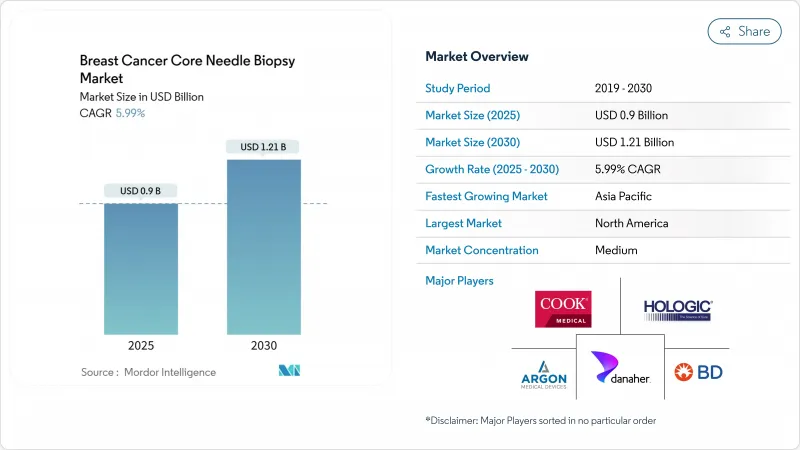
This report is Segmented by Product Type (Spring-Loaded CNB Devices, Vacuum-Assisted CNB Devices, Semi-Automated CNB Devices), Guidance Technology (Ultrasound-Guided, Stereotactic-Guided, MRI-Guided, Tomosynthesis-Guided), Needle Gauge (14-Gauge, and More), End User (Hospitals, Ambulatory Surgical Centers, and More), and Geography. The Market Forecasts are Provided in Terms of Value (USD).
Global Breast Cancer Core Needle Biopsy Market Trends and Insights
Rising Global Breast-Cancer Incidence & Screening Uptake
Rising incidence reshapes the breast cancer core needle biopsy market as screening programs widen. Asia reported 985,400 new cases in 2022 and is projected to reach 1.4 million by 2050, a pattern echoed across emerging economies.U.S. guidelines now advise biennial mammography from age 40, adding roughly 20 million screening-eligible women and lifting biopsy demand. China logged 385,837 new diagnoses in 2024, with peak rates a decade earlier than in Western cohorts, forcing rapid expansion of diagnostic capacity. Demographic aging, growing urban lifestyles, and better awareness make screening uptake outpace population growth. Disparities persist-Black women record 40% higher mortality in the United States-reinforcing the need for equitable, high-accuracy biopsy access.
Shift Toward Minimally Invasive Biopsies vs. Open Surgery
Health-care systems replace surgical excision with core needle approaches to cut costs and improve recovery. Outpatient modified radical mastectomy studies show readmission rates of 1.7% versus 2.5% for inpatient care, while costs fall from USD 113,878 to USD 94,463. Vacuum-assisted devices generate tissue volumes adequate for receptor analysis and spare patients general anesthesia, shortening return-to-work times. Early-stage cryoablation using ProSense has delivered 96.3% local control at five years, hinting at therapeutic biopsy-plus-ablation workflows supported by regulators. Digital breast tomosynthesis guidance halves procedure time and lowers radiation dose, streamlining high-throughput ambulatory centers. Patient surveys consistently rank comfort and scar minimization over surgical completeness, steering physicians toward less invasive tools.
False-Negative Repeat-Biopsy Concerns
Up to 51% of atypical ductal hyperplasia biopsies upgrade to malignancy at excision, eroding clinician and patient trust. European studies cite interpretation errors and subtle lesion characteristics as leading causes of misses. Lesions under 1 cm and those without hypervascularity drive false-negatives on MRI, leading to delayed care. Deep-learning tools lift sensitivity but remain limited in specificity, keeping repeat interventions commonplace. Infrastructure gaps in emerging markets magnify sampling errors, stalling wider adoption of core needle techniques.
Other drivers and restraints analyzed in the detailed report include:
- Advances in Image-Guided Core-Needle Accuracy
- Favorable Reimbursement in Developed Markets
- Procedure-Related Pain & Anxiety in Emerging Regions
For complete list of drivers and restraints, kindly check the Table Of Contents.
Segment Analysis
Vacuum-assisted devices held the largest slice of the breast cancer core needle biopsy market share at 51.37% in 2024 and are scaling at 9.46% CAGR. The segment benefits from single-pass large-volume sampling that satisfies molecular-profile demands, lowering re-biopsy rates. Hospitals value integrated marker placement and automated tissue retrieval, which keep table time under 15 minutes. As reimbursement aligns with procedural complexity, investment shifts from spring-loaded guns to vacuum-assisted consoles. In price-sensitive regions spring-loaded devices remain a fallback, yet pilots show conversion once local payer policies recognize reduced false-negative costs. Semi-automated systems serve niche settings that need more control than spring mechanisms but cannot fund full vacuum platforms. The trajectory indicates gradual consolidation toward vacuum solutions, aided by marker innovations such as hydrogel tags that ease follow-up imaging.
Second-generation vacuum platforms now bundle AI-based depth control and ultrasound-visible tips, driving both efficiency and training ease. Studies report high patient satisfaction despite residual benign lesion tissue, hinting at therapeutic uses like vacuum-assisted excision. Manufacturers are marketing disposable hand-pieces to lower cross-contamination risk and align with infection-control mandates. As health-systems standardize device fleets, servicing contracts and software upgrades become differentiators, reinforcing scale advantages for incumbents and expanding the breast cancer core needle biopsy market size.
Ultrasound guidance retained 53.48% revenue share in 2024, yet MRI-guided procedures post the fastest 10.23% CAGR. MRI offers superior contrast for non-palpable lesions, but cost and access limit volumes primarily to tertiary centers. Fusion imaging that overlays MRI data onto live ultrasound screens bridges the gap, enabling community radiologists to sample occult lesions without full MRI suites, thereby widening addressable procedure counts. Stereotactic mammography remains the standard for calcifications, although upright tomosynthesis guidance improves ergonomics and trims radiation exposure. Tomosynthesis adoption is rising where 3D mammography has already displaced 2D screening, creating workflow continuity. AI-enhanced needle-tracking modules further increase hit rates, reducing the learning curve for newly credentialed operators.
In Japan, regulatory clearance for ultrasound-AI guidance systems accelerates hospital procurement, signaling forthcoming adoption in Korea, Singapore, and urban China. European value-based frameworks tie reimbursement to first-time diagnostic accuracy, favoring centers that bundle MRI simulation with ultrasound execution. Vendors offering multimodality workstations see higher attach rates for their biopsy probes, creating ecosystem lock-in and bolstering the breast cancer core needle biopsy market.
Complete Report Scope:
- By Product Type
- Spring-Loaded CNB Devices
- Vacuum-Assisted CNB Devices
- Semi-Automated CNB Devices
- By Guidance Technology
- Ultrasound-Guided
- Stereotactic (Mammography)-Guided
- MRI-Guided
- Tomosynthesis-Guided
- By Needle Gauge
- 14-Gauge
- 16-Gauge
- <=18-Gauge
- By End User
- Hospitals
- Ambulatory Surgical Centers
- Specialty Breast Clinics
- Diagnostic Imaging Centers
- By Geography
- North America
- United States
- Canada
- Mexico
- Europe
- Germany
- United Kingdom
- France
- Italy
- Spain
- Rest of Europe
- Asia-Pacific
- China
- Japan
- India
- Australia
- South Korea
- Rest of Asia-Pacific
- Middle East and Africa
- GCC
- South Africa
- Rest of Middle East and Africa
- South America
- Brazil
- Argentina
- Rest of South America
- North America
Geography Analysis
North America leads the breast cancer core needle biopsy market with 37.44% revenue in 2024 thanks to entrenched screening programs, favorable reimbursement, and widespread AI pilot studies. Market maturity tempers growth to mid-single digits, yet replacement cycles and cryoablation adjuncts sustain vendor pipelines. Europe follows with steady demand shaped by country-specific DRG structures rewarding high diagnostic accuracy. Western European centers adopt fusion imaging fastest, while Eastern nations catch up via EU funding initiatives.
Asia-Pacific drives volume growth at an 8.21% CAGR as urban populations swell and governments underwrite national screening. China's prevalence surge and earlier disease onset create urgency for scalable biopsy infrastructure. India's mix of public-private partnerships funds regional breast centers, though rural access gaps persist. Japan pioneers AI ultrasound guidance, influencing neighboring health authorities.
The Middle East and Africa remain nascent yet promising; oil-rich Gulf states import cutting-edge suites, whereas Sub-Saharan clinics seek cost-contained spring-loaded options. South America grows gradually; Brazil and Argentina spearhead vacuum-assisted adoption amid economic swings. Overall, geographic diversification cushions suppliers against policy shocks, broadening the breast cancer core needle biopsy market footprint.
- Beckton Dickinson
- Hologic
- Argon Medical Devices
- Cook Group
- Danaher
- Cardinal Health
- B. Braun
- Medtronic
- IZI Medical Products
- DTR Medical Ltd.
- Merit Medical Systems
- INRAD
- Medax S.r.l. (Biopsybell)
- TSK Laboratory (Japan)
- Zamar Care
- Somatex Medical Technologies
- Meril Life Science
- Zamar Care
Additional Benefits:
- The market estimate (ME) sheet in Excel format
- 3 months of analyst support
TABLE OF CONTENTS
1 Introduction
- 1.1 Study Assumptions and Market Definition
- 1.2 Scope of the Study
2 Research Methodology
3 Executive Summary
4 Market Landscape
- 4.1 Market Overview
- 4.2 Market Drivers
- 4.2.1 Rising Global Breast-Cancer Incidence & Screening Uptake
- 4.2.2 Shift Toward Minimally-Invasive Biopsies Vs. Open Surgery
- 4.2.3 Advances In Image-Guided Core-Needle Accuracy
- 4.2.4 Favourable Reimbursement In Developed Markets
- 4.2.5 AI-Driven Lesion-Targeting Enhances Diagnostic Yield
- 4.2.6 Same-Day Ambulatory Diagnosis Demand
- 4.3 Market Restraints
- 4.3.1 False-Negative Repeat-Biopsy Concerns
- 4.3.2 Procedure-Related Pain & Anxiety In Emerging Regions
- 4.3.3 High Device Cost In Low-Income Settings
- 4.3.4 Nickel-Alloy Needle Supply-Chain Disruptions
- 4.4 Value / Supply-Chain Analysis
- 4.5 Regulatory Landscape
- 4.6 Technology Outlook
- 4.7 Porter's Five Forces Analysis
- 4.7.1 Bargaining Power of Suppliers
- 4.7.2 Bargaining Power of Buyers
- 4.7.3 Threat of New Entrants
- 4.7.4 Threat of Substitutes
- 4.7.5 Intensity of Competitive Rivalry
5 Market Size and Growth Forecasts (Value-USD)
- 5.1 By Product Type
- 5.1.1 Spring-Loaded CNB Devices
- 5.1.2 Vacuum-Assisted CNB Devices
- 5.1.3 Semi-Automated CNB Devices
- 5.2 By Guidance Technology
- 5.2.1 Ultrasound-Guided
- 5.2.2 Stereotactic (Mammography)-Guided
- 5.2.3 MRI-Guided
- 5.2.4 Tomosynthesis-Guided
- 5.3 By Needle Gauge
- 5.3.1 14-Gauge
- 5.3.2 16-Gauge
- 5.3.3 <=18-Gauge
- 5.4 By End User
- 5.4.1 Hospitals
- 5.4.2 Ambulatory Surgical Centers
- 5.4.3 Specialty Breast Clinics
- 5.4.4 Diagnostic Imaging Centers
- 5.5 By Geography
- 5.5.1 North America
- 5.5.1.1 United States
- 5.5.1.2 Canada
- 5.5.1.3 Mexico
- 5.5.2 Europe
- 5.5.2.1 Germany
- 5.5.2.2 United Kingdom
- 5.5.2.3 France
- 5.5.2.4 Italy
- 5.5.2.5 Spain
- 5.5.2.6 Rest of Europe
- 5.5.3 Asia-Pacific
- 5.5.3.1 China
- 5.5.3.2 Japan
- 5.5.3.3 India
- 5.5.3.4 Australia
- 5.5.3.5 South Korea
- 5.5.3.6 Rest of Asia-Pacific
- 5.5.4 Middle East and Africa
- 5.5.4.1 GCC
- 5.5.4.2 South Africa
- 5.5.4.3 Rest of Middle East and Africa
- 5.5.5 South America
- 5.5.5.1 Brazil
- 5.5.5.2 Argentina
- 5.5.5.3 Rest of South America
- 5.5.1 North America
6 Competitive Landscape
- 6.1 Market Concentration
- 6.2 Market Share Analysis
- 6.3 Company Profiles (includes Global level Overview, Market level overview, Core Segments, Financials as available, Strategic Information, Market Rank/Share for key companies, Products and Services, and Recent Developments)
- 6.3.1 Becton, Dickinson & Co.
- 6.3.2 Hologic Inc.
- 6.3.3 Argon Medical Devices
- 6.3.4 Cook Medical LLC
- 6.3.5 Danaher
- 6.3.6 Cardinal Health
- 6.3.7 B. Braun Melsungen AG
- 6.3.8 Medtronic plc
- 6.3.9 IZI Medical Products
- 6.3.10 DTR Medical Ltd.
- 6.3.11 Merit Medical Systems
- 6.3.12 INRAD Inc.
- 6.3.13 Medax S.r.l. (Biopsybell)
- 6.3.14 TSK Laboratory (Japan)
- 6.3.15 Zamar Care
- 6.3.16 Somatex Medical Technologies
- 6.3.17 Meril Life Sciences Pvt. Ltd.
- 6.3.18 Zamar Care
7 Market Opportunities & Future Outlook
- 7.1 White-Space & Unmet-Need Assessment

