PUBLISHER: Mordor Intelligence | PRODUCT CODE: 2097302

PUBLISHER: Mordor Intelligence | PRODUCT CODE: 2097302
VTOL UAV - Market Share Analysis, Industry Trends & Statistics, Growth Forecasts (2025 - 2030)
According to Mordor Intelligence, the VTOL UAV market size reached USD 4.36 billion in 2025 and is projected to advance to USD 10.99 billion by 2030, reflecting a 20.33% CAGR.
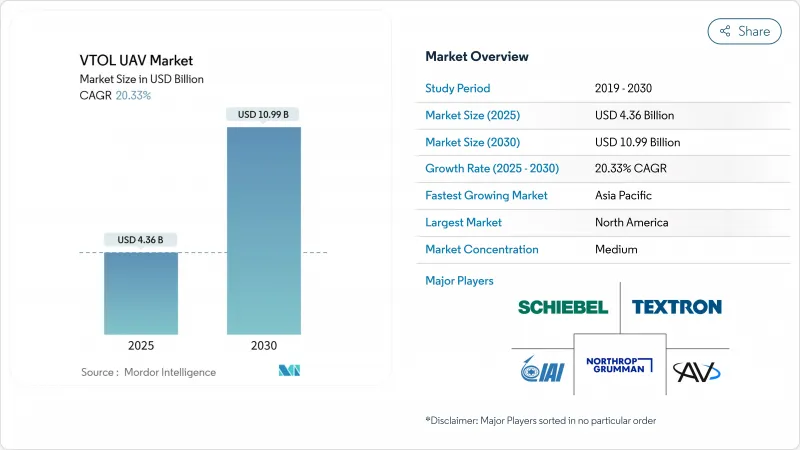
This report is Segmented by Propulsion Type (Electric, Hybrid-Electric, and More), Range (Short-Range, Medium-Range, and More), Application (ISR, Cargo/Resupply, and More), Weight Class (Micro/Nano, Mini, Tactical, and More), Mode of Operation (Autonomous and Remotely Piloted), and Geography (North America, Europe, Asia-Pacific, and More). The Market Forecasts are Provided in Terms of Value (USD).
Global VTOL UAV Market Trends and Insights
Persistent ISR Demand in Contested Environments
Combat theaters with dense electronic-warfare activity favor VTOL UAVs that can hover, maneuver at low altitude, and operate without GPS reliance. Shield AI's V-BAT proved this in Ukraine by detecting Buk systems and relaying coordinates for precision fires even under heavy jamming. The British Army's Project Corvus targets 24-hour endurance to replace vulnerable MALE fixed-wing assets, underscoring how survivability and persistence now outweigh sheer altitude in ISR doctrine.
Demand for Runway-Independent Logistics for Expeditionary Forces
Distributed operations compel militaries to bypass damaged or non-existent runways. VTOL UAVs carry medical supplies, ammunition, and precision loitering munitions directly to forward units. The US Marine Corps Organic Precision Fires-Loitering program funds quad-rotor systems for squad-level resupply and strike, while Heven Drones' hydrogen-powered Raider flies 23 kg payloads for up to 12 hours in silent mode, aligning with NATO calls for resilient supply chains.
Limited Endurance Due to Battery Constraints
Conventional lithium-ion (Li-ion) packs yield 20-35 minute multirotor endurance, forcing payload trade-offs. Solid-state and lithium-sulfur (Li-S) chemistries promise up to 60% more energy, but manufacturing scale and safety certification remain hurdles, keeping hybrid powertrains dominant in the near term.
Other drivers and restraints analyzed in the detailed report include:
- Modernization Programs Replacing Legacy Helicopters with VTOL UAVs
- Increased Defense Spending on Unmanned Combat Systems
- Regulatory Hurdles for BVLOS Operations in Shared Airspace
For complete list of drivers and restraints, kindly check the Table Of Contents.
Segment Analysis
Hybrid-electric aircraft led the VTOL UAV market with a 34.45% share in 2024, reflecting their balance between quiet electric lift and fuel-efficient cruise. This share translates into USD 1.5 billion of the market's size, while hydrogen fuel-cell platforms, though smaller today, are forecasted to post a 23.32% CAGR through 2030.
Hybrid propulsion attracts procurement because it addresses endurance caps that pure electric craft face and reduces acoustic signatures compared with internal-combustion engines. Successful demo flights, including VerdeGo Aero's 60% fuel-saving VH-3, prove feasibility for long-range ISR patrols. Hydrogen propulsion's faster growth owes to its higher energy density; United Therapeutics flew the first piloted hydrogen VTOL in 2025, showcasing zero-emission endurance beyond 600 km, a critical factor for covert cargo runs.
Medium-range models (100 to 500 km) captured 38.87% of the VTOL UAV market share in 2024, anchoring USD 1.7 billion of the market's size. Their supremacy aligns with battalion-level logistics and ISR needs inside the theater.
However, long-range systems above 500 km are clocking a 21.67% CAGR to 2030 as militaries seek standoff ISR and strike beyond adversary A2/AD bubbles. Upgrades such as satellite datalinks on Shield AI's V-BAT extend flight radius without ground stations, shifting procurement toward deeper-reach platforms.
Complete Report Scope:
- By Propulsion Type
- Electric
- Hybrid-Electric
- Internal Combustion
- Hydrogen Fuel-Cell
- By Range
- Short-Range (Less than 100 km)
- Medium-Range (100 to 500 km)
- Long-Range (Greater than 500 km)
- By Application
- Intelligence, Surveillance, and Reconnaissance (ISR)
- Cargo/Resupply
- Anti-Submarine Warfare (ASW)
- Others
- By Weight Class
- Micro/Nano (Less than 20 kg)
- Mini (20 to 150 kg)
- Tactical (150 to 600 kg)
- Medium-Altitude Long-Endurance (MALE) (Greater than 600 kg)
- By Mode of Operation
- Autonomous
- Remotely Piloted
- By Geography
- North America
- United States
- Canada
- Mexico
- Europe
- United Kingdom
- France
- Germany
- Italy
- Russia
- Rest of Europe
- Asia-Pacific
- China
- India
- Japan
- South Korea
- Rest of Asia-Pacific
- South America
- Brazil
- Argentina
- Rest of South America
- Middle East and Africa
- Middle East
- Saudi Arabia
- United Arab Emirates
- Rest of Middle East
- Africa
- South Africa
- Rest of Africa
- Middle East
- North America
Geography Analysis
North America controlled 28.65% of the VTOL UAV market share in 2024, buoyed by sustained R&D funding and regulatory clarity. The new FAA powered-lift rule and Special Federal Aviation Regulation 120 provide pathways for early commercial services, reinforcing regional leadership. However, continued rare-earth supply concerns and Buy-American magnet mandates could temper growth in the decade's second half.
Asia-Pacific is advancing at a 23.47% CAGR to 2030, driven by escalating Indo-Pacific tensions. Taiwan's record order of 48,750 military-grade drones underscores the region's urgency, while Chinese tilt-rotor prototypes hint at future peer-to-peer competitions in vertical lift. Commercial projects in Japan and South Korea further widen the customer base beyond defense.
Europe enjoys steady adoption under a harmonized EASA framework adopted in 2024. Sweden's NATO-aligned swarm program and the UK's BVLOS corridor approvals show that alliance requirements and progressive regulation coexist with comparatively modest defense budgets. Environmental mandates shape European requirements toward hydrogen and hybrid platforms, influencing OEM roadmaps.
- Northrop Grumman Corporation
- Schiebel Corporation
- AeroVironment, Inc.
- Textron Inc.
- Israel Aerospace Industries Ltd.
- Airbus SE
- Lockheed Martin Corporation
- Elbit Systems Ltd.
- Insitu, Inc. (The Boeing Company)
- BAYKAR A.S.
- Saab AB
- Shield AI Inc.
- DeltaQuad
- Ukrspecsystems LLC
- ideaForge Technology Pvt. Ltd.
Additional Benefits:
- The market estimate (ME) sheet in Excel format
- 3 months of analyst support
TABLE OF CONTENTS
1 INTRODUCTION
- 1.1 Study Assumptions and Market Definition
- 1.2 Scope of the Study
2 RESEARCH METHODOLOGY
3 EXECUTIVE SUMMARY
4 MARKET LANDSCAPE
- 4.1 Market Overview
- 4.2 Market Drivers
- 4.2.1 Persistent ISR demand in contested environments
- 4.2.2 Demand for runway-independent logistics for expeditionary forces
- 4.2.3 Modernization programs replacing legacy helicopters with VTOL UAVs
- 4.2.4 Increased defense spending on unmanned combat systems
- 4.2.5 Modular hybrid-electric propulsion enabling acoustic stealth
- 4.2.6 NATO push for organic sensor-to-shooter VTOL swarms
- 4.3 Market Restraints
- 4.3.1 Limited endurance due to battery constraints
- 4.3.2 Regulatory hurdles for BVLOS operations in shared airspace
- 4.3.3 Vulnerability to drone-kill laser systems
- 4.3.4 Supply-chain constraints in rare-earth motors
- 4.4 Value Chain Analysis
- 4.5 Regulatory Landscape
- 4.6 Technological Outlook
- 4.7 Porter's Five Forces Analysis
- 4.7.1 Threat of New Entrants
- 4.7.2 Bargaining Power of Suppliers
- 4.7.3 Bargaining Power of Buyers
- 4.7.4 Threat of Substitutes
- 4.7.5 Intensity of Competitive Rivalry
5 MARKET SIZE AND GROWTH FORECASTS (VALUE)
- 5.1 By Propulsion Type
- 5.1.1 Electric
- 5.1.2 Hybrid-Electric
- 5.1.3 Internal Combustion
- 5.1.4 Hydrogen Fuel-Cell
- 5.2 By Range
- 5.2.1 Short-Range (Less than 100 km)
- 5.2.2 Medium-Range (100 to 500 km)
- 5.2.3 Long-Range (Greater than 500 km)
- 5.3 By Application
- 5.3.1 Intelligence, Surveillance, and Reconnaissance (ISR)
- 5.3.2 Cargo/Resupply
- 5.3.3 Anti-Submarine Warfare (ASW)
- 5.3.4 Others
- 5.4 By Weight Class
- 5.4.1 Micro/Nano (Less than 20 kg)
- 5.4.2 Mini (20 to 150 kg)
- 5.4.3 Tactical (150 to 600 kg)
- 5.4.4 Medium-Altitude Long-Endurance (MALE) (Greater than 600 kg)
- 5.5 By Mode of Operation
- 5.5.1 Autonomous
- 5.5.2 Remotely Piloted
- 5.6 By Geography
- 5.6.1 North America
- 5.6.1.1 United States
- 5.6.1.2 Canada
- 5.6.1.3 Mexico
- 5.6.2 Europe
- 5.6.2.1 United Kingdom
- 5.6.2.2 France
- 5.6.2.3 Germany
- 5.6.2.4 Italy
- 5.6.2.5 Russia
- 5.6.2.6 Rest of Europe
- 5.6.3 Asia-Pacific
- 5.6.3.1 China
- 5.6.3.2 India
- 5.6.3.3 Japan
- 5.6.3.4 South Korea
- 5.6.3.5 Rest of Asia-Pacific
- 5.6.4 South America
- 5.6.4.1 Brazil
- 5.6.4.2 Argentina
- 5.6.4.3 Rest of South America
- 5.6.5 Middle East and Africa
- 5.6.5.1 Middle East
- 5.6.5.1.1 Saudi Arabia
- 5.6.5.1.2 United Arab Emirates
- 5.6.5.1.3 Rest of Middle East
- 5.6.5.2 Africa
- 5.6.5.2.1 South Africa
- 5.6.5.2.2 Rest of Africa
- 5.6.5.1 Middle East
- 5.6.1 North America
6 COMPETITIVE LANDSCAPE
- 6.1 Market Concentration
- 6.2 Strategic Moves
- 6.3 Market Share Analysis
- 6.4 Company Profiles (includes Global level Overview, Market level overview, Core Segments, Financials as available, Strategic Information, Market Rank/Share for key companies, Products and Services, and Recent Developments)
- 6.4.1 Northrop Grumman Corporation
- 6.4.2 Schiebel Corporation
- 6.4.3 AeroVironment, Inc.
- 6.4.4 Textron Inc.
- 6.4.5 Israel Aerospace Industries Ltd.
- 6.4.6 Airbus SE
- 6.4.7 Lockheed Martin Corporation
- 6.4.8 Elbit Systems Ltd.
- 6.4.9 Insitu, Inc. (The Boeing Company)
- 6.4.10 BAYKAR A.S.
- 6.4.11 Saab AB
- 6.4.12 Shield AI Inc.
- 6.4.13 DeltaQuad
- 6.4.14 Ukrspecsystems LLC
- 6.4.15 ideaForge Technology Pvt. Ltd.
7 MARKET OPPORTUNITIES AND FUTURE OUTLOOK
- 7.1 White-Space and Unmet-Need Assessment

