
PUBLISHER: Mordor Intelligence | PRODUCT CODE: 2097307

PUBLISHER: Mordor Intelligence | PRODUCT CODE: 2097307
Mid and High-Level Precision GPS Receiver - Market Share Analysis, Industry Trends & Statistics, Growth Forecasts (2026 - 2031)
According to Mordor Intelligence, the mid and High-Level Precision GPS Receiver market size is projected to expand from USD 3.53 billion in 2025 and USD 3.89 billion in 2026 to USD 6.26 billion by 2031, registering a CAGR of 9.98% between 2026 and 2031.
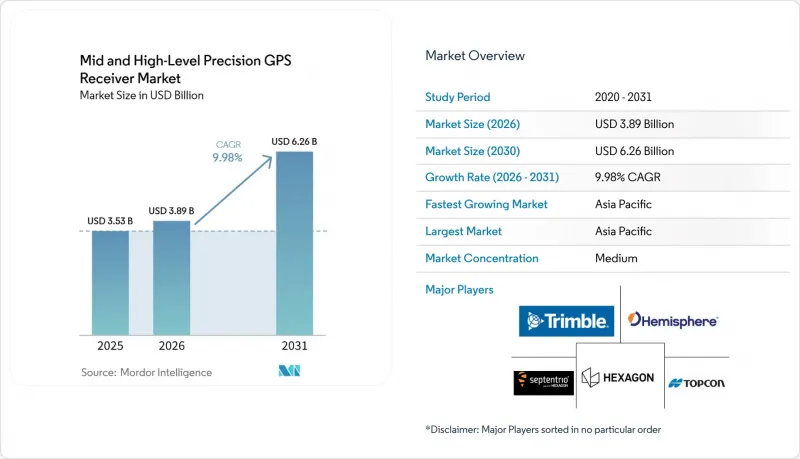
This report is Segmented by Correction Technique (RTK, PPP-RTK Hybrid, and More), Frequency Capability (Single-Frequency L1, Dual-Frequency L1/L2, and More), Form Factor (Modular OEM Boards, and More), End-Use Industry (Surveying and Mapping, Precision Agriculture, and More), and Geography (North America, Europe, and More). The Market Forecasts are Provided in Terms of Value (USD).
Global Mid and High-Level Precision GPS Receiver Market Trends and Insights
Surge in Precision Agriculture Automation
Large growers are embedding real-time kinematic receivers into variable-rate planters and boom-mounted cameras that identify individual weeds, reducing herbicide use by up to 80%. Brazilian soybean operations now maintain 15-centimeter row spacing that enables mechanical cultivation and lowers chemical outlays. Argentinian grain producers synchronize autonomous carts with combines to extend harvest windows by two to three hours. Convergence below 100 milliseconds supports tractors traveling faster than 12 kilometers per hour. Collectively, these improvements increase yield consistency and shorten payback cycles, keeping the Mid and High-Level Precision GPS Receiver market on a steep adoption curve.
Uptake of Construction and Mining Machine Control Systems
Autonomous haul trucks in Australian and Chilean mines maintain 10-centimeter accuracy at 60 kilometers per hour through multi-frequency receivers paired with inertial units. Dozers equipped with intelligent machine control cut material waste by 30% and reduce fuel consumption. Highway contractors in the United States automate paving depths within 2 centimeters, trimming project schedules 10% to 15%. Building information modeling mandates across Europe and Singapore compel contractors to verify as-built data against digital files, driving receiver upgrades. Falling antenna prices and wider RTK coverage extend these systems to mid-tier contractors, widening the Mid and High-Level Precision GPS Receiver market footprint.
High Capital Expenditure for Centimeter-Grade Receivers
Survey-grade devices cost USD 5,000 to USD 25,000, a hurdle for small farms and emerging-market surveyors. Multi-band chipsets, precision oscillators, and adaptive antennas push bill-of-material costs high enough to slow replacement cycles. u-blox unveiled the ZED-X20P module, claiming 90% lower total ownership, yet pricing still targets industrial buyers. Open-source options from Emlid and ArduSimple lower entry prices, but lack enterprise warranty and support. Absent volume price erosion, the Mid and High-Level Precision GPS Receiver market loses momentum among cost-sensitive users.
Other drivers and restraints analyzed in the detailed report include:
- Rising Demand for Autonomous Vehicle Validation and Testing
- Roll-out of Low Earth Orbit PPP-RTK Correction Services
- Limited Coverage and Subscription Cost of Correction Services
For complete list of drivers and restraints, kindly check the Table Of Contents.
Segment Analysis
Real-time kinematic solutions dominated 2025 with 48.84% of the Mid and High-Level Precision GPS Receiver market share, reflecting their use in surveying, construction, and row-crop farming. PPP-RTK hybrids now grow at 10.67% annually because they remove base-station dependencies and reduce convergence to under 1 minute. Differential GNSS and SBAS methods linger in aviation and maritime sectors that accept 20-centimeter accuracy. Precise point positioning, once limited by long convergence, gains relevance as Galileo offers free corrections via E6 signals. Trimble's PULSAR integration exemplifies the pivot toward global, low-latency corrections.
Hybrid services rewrite procurement economics by blending PPP coverage with RTK speed. Operators in offshore wind projects and remote mining choose these links to avoid building costly terrestrial networks. Correction providers bundle cloud analytics, enabling predictive maintenance and fleet-wide performance dashboards. As a result, service revenue overtakes hardware margin inside the Mid and High-Level Precision GPS Receiver market. Regulatory bodies welcome authenticated signals that embed integrity flags, reinforcing trust in safety-critical workflows.
Dual-frequency units accounted for 46.39% of the Mid and High-Level Precision GPS Receiver market in 2025, thanks to a balanced cost-to-performance ratio. Multi-band boards expand at 11.06% per year as they resolve ambiguities faster, resist jamming, and exploit new Galileo E6 and BeiDou B2b signals. Single-band devices remain a low-cost option, but volumes slide as chip prices for dual-frequency modules drop below USD 50.
Septentrio's mosaic-G5 shrank its footprint by 60% and reduced power by 40%, removing past barriers to dense sensor fusion in robotics. Automotive designers favor L1-L5 configurations because L5's pilot component improves urban canyon resilience. Authentication data embedded in E6 enables position integrity checks essential for automated driving. These advantages funnel premium spending into multi-band lines, extending the runway for the Mid and High-Level Precision GPS Receiver market.
Complete Report Scope:
- By Correction Technique
- Real-Time Kinematic (RTK)
- Precise Point Positioning (PPP)
- PPP-RTK Hybrid
- Differential GNSS / SBAS
- By Frequency Capability
- Single-Frequency (L1)
- Dual-Frequency (L1/L2)
- Dual-Frequency (L1/L5)
- Multi-Frequency (?3 Bands)
- By Form Factor
- Modular OEM Boards
- Integrated Smart Antennas
- Rugged Handhelds and Controllers
- Backpack / Pole-Mounted Rovers
- By End-Use Industry
- Surveying and Mapping
- Precision Agriculture
- Construction and Mining
- Marine and Dredging
- Autonomous Ground and Aerial Vehicles
- By Geography
- North America
- United States
- Canada
- Mexico
- Europe
- Germany
- United Kingdom
- France
- Italy
- Rest of Europe
- Asia-Pacific
- China
- Japan
- India
- South Korea
- Australia
- Rest of Asia-Pacific
- South America
- Middle East and Africa
- North America
Geography Analysis
Asia-Pacific led with 42.42% revenue in 2025 and is projected to retain a 10.83% CAGR through 2031. China mandates BeiDou integration across smartphones and connected cars, effectively guaranteeing baseline shipment volumes. India is rolling out 1,500 reference stations that cut project setup costs by 30% and encourage small survey firms to upgrade equipment. Japan's QZSS augmentation service underpins rice transplanters that raise yields 8%, confirming return on investment for growers.
North America and Europe together contributed nearly 45% of the 2025 turnover. The U.S. aviation sector is upgrading WAAS for dual-frequency use to allow precision approaches at secondary airports. Germany's contractors fit multi-band receivers onto excavators to comply with digital twin validation at a 2-centimeter tolerance. The United Kingdom's expanded OS Net improves mapping accuracy for flood management, boosting receiver sales among civil engineers.
The Middle East, Africa, and South America together held 13% share in 2025, yet show strong upside. Saudi Arabia's NEOM project establishes new geodetic networks to guide mega-infrastructure layouts. Brazil's soybean growers automate grain handling with dual-band boards that coordinate harvest logistics. South Africa's deep mines add multi-band receivers to track ore removal in GPS-denied shafts, while Egypt's Suez Canal Authority maintains dredged depths using hydrographic kits. Collective demand from these initiatives keeps the Mid and High-Level Precision GPS Receiver market expanding worldwide.
- Trimble Inc.
- Hexagon AB (Leica Geosystems Division)
- Topcon Positioning Systems Inc.
- Hemisphere GNSS Inc.
- Septentrio NV
- CHC Navigation (Shanghai) Co., Ltd.
- ComNav Technology Ltd.
- Swift Navigation Inc.
- SingularXYZ Intelligent Technology Ltd.
- NavCom Technology Inc.
- u-blox Holding AG
- Hemisphere (Stonex) Srl
- Carlson Software Inc.
- Emlid Ltd.
- Geneq Inc.
- ArduSimple SL
- SBG Systems SAS
- Outset Navigation Ltd.
- Harxon Corporation
- Topcon (Sokkia Co., Ltd.)
- Antcom Corporation
- Hi-Target Surveying Instrument Co., Ltd.
- Eos Positioning Systems Inc.
Additional Benefits:
- The market estimate (ME) sheet in Excel format
- 3 months of analyst support
TABLE OF CONTENTS
1 INTRODUCTION
- 1.1 Study Assumptions and Market Definition
- 1.2 Scope of the Study
2 RESEARCH METHODOLOGY
3 EXECUTIVE SUMMARY
4 MARKET LANDSCAPE
- 4.1 Market Overview
- 4.2 Market Drivers
- 4.2.1 Surge in Precision Agriculture Automation
- 4.2.2 Uptake of Construction and Mining Machine-Control Systems
- 4.2.3 Rising Demand for Autonomous Vehicle Validation and Testing
- 4.2.4 Roll-out of Low Earth Orbit PPP-RTK Correction Services
- 4.2.5 Proliferation of Digital Twin Infrastructure Programs
- 4.2.6 Integration of GNSS with 5G NTN for Centimeter-Level Indoor Positioning
- 4.3 Market Restraints
- 4.3.1 High Capital Expenditure for Centimeter-Grade Receivers
- 4.3.2 Limited Coverage and Subscription Cost of Correction Services
- 4.3.3 Export Control and ITAR Restrictions on Multi-Constellation Boards
- 4.3.4 Adjacent-Band RF Interference from 5G and Ligado Deployments
- 4.4 Impact of Macroeconomic Factors on the Market
- 4.5 Industry Supply-Chain Analysis
- 4.6 Regulatory Landscape
- 4.7 Technological Outlook
- 4.8 Porter's Five Forces Analysis
- 4.8.1 Threat of New Entrants
- 4.8.2 Bargaining Power of Suppliers
- 4.8.3 Bargaining Power of Buyers
- 4.8.4 Threat of Substitutes
- 4.8.5 Intensity of Competitive Rivalry
5 MARKET SIZE AND GROWTH FORECASTS (VALUE)
- 5.1 By Correction Technique
- 5.1.1 Real-Time Kinematic (RTK)
- 5.1.2 Precise Point Positioning (PPP)
- 5.1.3 PPP-RTK Hybrid
- 5.1.4 Differential GNSS / SBAS
- 5.2 By Frequency Capability
- 5.2.1 Single-Frequency (L1)
- 5.2.2 Dual-Frequency (L1/L2)
- 5.2.3 Dual-Frequency (L1/L5)
- 5.2.4 Multi-Frequency (?3 Bands)
- 5.3 By Form Factor
- 5.3.1 Modular OEM Boards
- 5.3.2 Integrated Smart Antennas
- 5.3.3 Rugged Handhelds and Controllers
- 5.3.4 Backpack / Pole-Mounted Rovers
- 5.4 By End-Use Industry
- 5.4.1 Surveying and Mapping
- 5.4.2 Precision Agriculture
- 5.4.3 Construction and Mining
- 5.4.4 Marine and Dredging
- 5.4.5 Autonomous Ground and Aerial Vehicles
- 5.5 By Geography
- 5.5.1 North America
- 5.5.1.1 United States
- 5.5.1.2 Canada
- 5.5.1.3 Mexico
- 5.5.2 Europe
- 5.5.2.1 Germany
- 5.5.2.2 United Kingdom
- 5.5.2.3 France
- 5.5.2.4 Italy
- 5.5.2.5 Rest of Europe
- 5.5.3 Asia-Pacific
- 5.5.3.1 China
- 5.5.3.2 Japan
- 5.5.3.3 India
- 5.5.3.4 South Korea
- 5.5.3.5 Australia
- 5.5.3.6 Rest of Asia-Pacific
- 5.5.4 South America
- 5.5.5 Middle East and Africa
- 5.5.1 North America
6 COMPETITIVE LANDSCAPE
- 6.1 Market Concentration
- 6.2 Strategic Moves
- 6.3 Market Share Analysis
- 6.4 Company Profiles (includes Global Level Overview, Market Level Overview, Core Segments, Financials as available, Strategic Information, Market Rank/Share, Products and Services, Recent Developments)
- 6.4.1 Trimble Inc.
- 6.4.2 Hexagon AB (Leica Geosystems Division)
- 6.4.3 Topcon Positioning Systems Inc.
- 6.4.4 Hemisphere GNSS Inc.
- 6.4.5 Septentrio NV
- 6.4.6 CHC Navigation (Shanghai) Co., Ltd.
- 6.4.7 ComNav Technology Ltd.
- 6.4.8 Swift Navigation Inc.
- 6.4.9 SingularXYZ Intelligent Technology Ltd.
- 6.4.10 NavCom Technology Inc.
- 6.4.11 u-blox Holding AG
- 6.4.12 Hemisphere (Stonex) Srl
- 6.4.13 Carlson Software Inc.
- 6.4.14 Emlid Ltd.
- 6.4.15 Geneq Inc.
- 6.4.16 ArduSimple SL
- 6.4.17 SBG Systems SAS
- 6.4.18 Outset Navigation Ltd.
- 6.4.19 Harxon Corporation
- 6.4.20 Topcon (Sokkia Co., Ltd.)
- 6.4.21 Antcom Corporation
- 6.4.22 Hi-Target Surveying Instrument Co., Ltd.
- 6.4.23 Eos Positioning Systems Inc.
7 MARKET OPPORTUNITIES AND FUTURE OUTLOOK
- 7.1 White-Space and Unmet Need Assessment

