PUBLISHER: Mordor Intelligence | PRODUCT CODE: 2097331

PUBLISHER: Mordor Intelligence | PRODUCT CODE: 2097331
5G PCB - Market Share Analysis, Industry Trends & Statistics, Growth Forecasts (2025 - 2030)
According to Mordor Intelligence, the 5G PCB market size stands at USD 20.25 billion in 2025 and is forecast to reach USD 36.18 billion by 2030, expanding at a 12.31% CAGR.
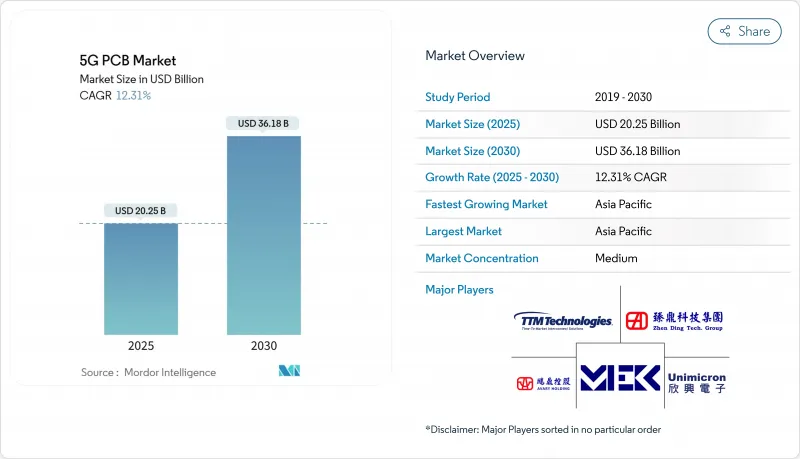
This report is Segmented by Product Type (Rigid PCB, Flexible PCB, Rigid-Flex PCB, and More), Application (5G Base Stations, Small Cells, Smartphones, Iot Devices, Automotive, Industrial), Frequency Band (Sub-6 GHz, Mid-Band, Mmwave), Substrate Material (FR-4, PTFE, LCP, Ceramic, Metal-Core), End-User (Telecom, Consumer Electronics, and More), and Geography. The Market Forecasts are Provided in Terms of Value (USD).
Global 5G PCB Market Trends and Insights
Rapid densification of 5G mid-band and mmWave base stations
Operators continue to deploy compact radios and small cells to close coverage gaps, raising demand for PCBs that blend fine-line geometry with robust thermal paths. Component vendors targeting C-band networks specify insertion-loss budgets that only ceramic-PTFE hybrids can meet, steering procurement away from legacy FR-4. Manufacturers able to guarantee Class 3 reliability win preference because outdoor radios face accelerated thermal cycling. These stringent specifications elevate average selling prices and lock in high-frequency specialists.
Miniaturization and antenna-in-package design in 5G smartphones
Phone OEMs integrate antennas directly onto rigid-flex stacks to free space for larger batteries. This shift forces ultra-tight dielectric-constant control across hybrid stack-ups combining LCP and modified polyimide layers. Yield risk climbs because a micron-level lamination void can detune multiband arrays, so suppliers invest heavily in inline X-ray and optical metrology. The trend accelerates the adoption of SiP platforms where the board doubles as an RF module carrier.
Supply-chain volatility of copper-clad laminates
Capacity curbs and environmental audits in China pushed laminate prices up 18% in 2024, eroding gross margins across mid-tier fabs. Large players neutralize shocks via multi-sourcing contracts, yet smaller shops often carry under one-month raw-stock cover, exposing them to spot-price spikes. Volatility is most acute in high-frequency products because qualified substitutes remain scarce.
Other drivers and restraints analyzed in the detailed report include:
- Adoption of high-frequency laminates for signal integrity
- Automotive V2X migration to 5G telematics
- Thermal-management challenges at mmWave frequencies
For complete list of drivers and restraints, kindly check the Table Of Contents.
Segment Analysis
Rigid boards delivered 33.58% of 2024 revenue, anchoring bread-and-butter macro-cell contracts. RF/Microwave boards, though smaller in volume, outpaced all peers with a 12.54% CAGR, a clear signal that high-frequency functionality commands disproportionate value in the 5G PCB market. The 5G PCB market share of RF/Microwave designs is set to widen as operators transition to mmWave radios requiring multilayer ceramic-PTFE hybrids. HDI technology complements this shift by enabling finer traces and stacked microvias that cut transmission loss.
Yield complexity escalates sharply above 20 layers, prompting fabs to automate optical-impedance monitoring to sustain profitability. Flexible and rigid-flex boards serve foldable phones and wearable healthcare devices, yet remain niche in revenue terms. Shennan Circuits reported RF board ASPs running nearly 4 X those of standard rigid units, illustrating the premium available to technology leaders.
Macro and micro base stations supplied 42.37% of 2024 demand and bind the 5G PCB market size tightly to operator capex cycles. However, industrial IoT and edge nodes will clock a 12.67% CAGR through 2030, a trajectory fueled by smart-factory private networks that prize ultra-reliable low-latency connections. Small-cell deployments bridge both domains, pairing infrastructure-grade RF sections with consumer-priced enclosures.
Automotive telematics emerges as another bright spot as V2X mandates crystallize in China and Europe. Smartphone volume growth is plateauing, yet SKU complexity keeps PCB layer counts rising: flagship devices now integrate more than six antenna arrays within a single rigid-flex stack. Healthcare devices exploit miniaturized 5G transceivers for continuous patient monitoring, expanding the addressable base for designs prioritizing biocompatible laminates.
Complete Report Scope:
- By Product Type
- Rigid PCB
- Flexible PCB
- Rigid-Flex PCB
- High-Density Interconnect (HDI) PCB
- RF / Microwave PCB
- By Application
- 5G Macro/Micro Base Stations
- 5G Small Cells and CPE
- 5G Smartphones and Tablets
- IoT and Edge Devices
- Automotive and V2X Modules
- Industrial and Enterprise Equipment
- By Frequency Band
- Sub-6 GHz
- Mid-Band (2-6 GHz)
- mmWave (>24 GHz)
- By Substrate Material
- Standard FR-4
- High-Frequency PTFE
- Liquid-Crystal Polymer (LCP)
- Ceramic and Hybrid
- Metal-Core
- By End-User
- Telecom Infrastructure Vendors
- Consumer Electronics OEMs
- Automotive OEMs
- Industrial Manufacturers
- Other End-User
- By Geography
- North America
- United States
- Canada
- Mexico
- Europe
- Germany
- United Kingdom
- France
- Russia
- Rest of Europe
- Asia-Pacific
- China
- Japan
- India
- South Korea
- Australia
- Rest of Asia-Pacific
- Middle East and Africa
- Middle East
- Saudi Arabia
- United Arab Emirates
- Rest of Middle East
- Africa
- South Africa
- Egypt
- Rest of Africa
- Middle East
- South America
- Brazil
- Argentina
- Rest of South America
- North America
Geography Analysis
Asia-Pacific controlled 63.84% of 2024 revenue and is expected to grow 13.23% CAGR to 2030. China anchors volume, South Korea and Japan contribute material science depth, and Taiwan meshes PCB and advanced packaging capacity. Governments co-sponsor 5G factory deployments, reinforcing domestic pull for high-frequency boards. Yet dependence on a narrow set of copper-clad laminate vendors exposes the region to raw-material shocks.
North America ranks second, propelled by the defense and aerospace appetite for mission-critical communications. TTM Technologies reported USD 3.2 billion 2024 revenue with aerospace and defense accounting for 47%-a proxy for the region's premium-grade demand. Federal subsidies targeting on-shore substrate production aim to temper over-reliance on Asian supply.
Europe centers on automotive and industrial automation. Regional directives encouraging private-network licenses stimulate OEM-fabricator partnerships. Environmental regulations push fabs toward closed-loop copper recovery and VOC-free lamination, giving EU suppliers an edge in sustainability-weighted RFQs. Middle East and Africa and South America are early-stage, leaning on imported high-frequency boards but showing investment upticks as telecom operators accelerate 5G rollouts.
- Avary Holding (Shenzhen) Co., Ltd.
- Zhen Ding Technology Holding Limited
- Nippon Mektron, Ltd.
- Unimicron Technology Corporation
- TTM Technologies, Inc.
- AT&S Austria Technologie & Systemtechnik AG
- Compeq Manufacturing Co., Ltd.
- Tripod Technology Corporation
- Ibiden Co., Ltd.
- Meiko Electronics Co., Ltd.
- Dongshan Precision Manufacturing Co., Ltd. (DSBJ)
- WUS Printed Circuit Co., Ltd.
- Flexium Interconnect, Inc.
- Shennan Circuits Co., Ltd.
- Kinwong Electronic Co., Ltd.
- HannStar Board Corporation
- Kinsus Interconnect Technology Corp.
- Victory Giant Technology (HuiZhou) Co., Ltd.
- China Circuit Technology Co., Ltd. (CCTC)
- CMK Corporation
- NCAB Group AB
Additional Benefits:
- The market estimate (ME) sheet in Excel format
- 3 months of analyst support
TABLE OF CONTENTS
1 INTRODUCTION
- 1.1 Study Assumptions and Market Definition
- 1.2 Scope of the Study
2 RESEARCH METHODOLOGY
3 EXECUTIVE SUMMARY
4 MARKET LANDSCAPE
- 4.1 Market Overview
- 4.2 Market Drivers
- 4.2.1 Rapid densification of 5G mid-band and mmWave base-stations
- 4.2.2 Miniaturization and antenna-in-package design in 5G smartphones
- 4.2.3 Adoption of high-frequency laminates for signal integrity
- 4.2.4 Automotive V2X migration to 5G telematics
- 4.2.5 Private 5G networks for Industry 4.0 driving rugged PCB demand
- 4.2.6 5.5G / 6G R&D investment in advanced substrates
- 4.3 Market Restraints
- 4.3.1 Supply-chain volatility of copper-clad laminates
- 4.3.2 High cost and lower yields of ultra-high multilayer RF PCBs
- 4.3.3 Trade restrictions on advanced PCB exports (US-China)
- 4.3.4 Thermal-management challenges at mmWave frequencies
- 4.4 Industry Value / Supply-Chain Analysis
- 4.5 Regulatory Landscape
- 4.6 Technological Outlook
- 4.7 Porter's Five Forces Analysis
- 4.7.1 Threat of New Entrants
- 4.7.2 Bargaining Power of Suppliers
- 4.7.3 Bargaining Power of Buyers
- 4.7.4 Threat of Substitutes
- 4.7.5 Industry Rivalry
5 MARKET SIZE AND GROWTH FORECASTS (VALUE)
- 5.1 By Product Type
- 5.1.1 Rigid PCB
- 5.1.2 Flexible PCB
- 5.1.3 Rigid-Flex PCB
- 5.1.4 High-Density Interconnect (HDI) PCB
- 5.1.5 RF / Microwave PCB
- 5.2 By Application
- 5.2.1 5G Macro/Micro Base Stations
- 5.2.2 5G Small Cells and CPE
- 5.2.3 5G Smartphones and Tablets
- 5.2.4 IoT and Edge Devices
- 5.2.5 Automotive and V2X Modules
- 5.2.6 Industrial and Enterprise Equipment
- 5.3 By Frequency Band
- 5.3.1 Sub-6 GHz
- 5.3.2 Mid-Band (2-6 GHz)
- 5.3.3 mmWave (>24 GHz)
- 5.4 By Substrate Material
- 5.4.1 Standard FR-4
- 5.4.2 High-Frequency PTFE
- 5.4.3 Liquid-Crystal Polymer (LCP)
- 5.4.4 Ceramic and Hybrid
- 5.4.5 Metal-Core
- 5.5 By End-User
- 5.5.1 Telecom Infrastructure Vendors
- 5.5.2 Consumer Electronics OEMs
- 5.5.3 Automotive OEMs
- 5.5.4 Industrial Manufacturers
- 5.5.5 Other End-User
- 5.6 By Geography
- 5.6.1 North America
- 5.6.1.1 United States
- 5.6.1.2 Canada
- 5.6.1.3 Mexico
- 5.6.2 Europe
- 5.6.2.1 Germany
- 5.6.2.2 United Kingdom
- 5.6.2.3 France
- 5.6.2.4 Russia
- 5.6.2.5 Rest of Europe
- 5.6.3 Asia-Pacific
- 5.6.3.1 China
- 5.6.3.2 Japan
- 5.6.3.3 India
- 5.6.3.4 South Korea
- 5.6.3.5 Australia
- 5.6.3.6 Rest of Asia-Pacific
- 5.6.4 Middle East and Africa
- 5.6.4.1 Middle East
- 5.6.4.1.1 Saudi Arabia
- 5.6.4.1.2 United Arab Emirates
- 5.6.4.1.3 Rest of Middle East
- 5.6.4.2 Africa
- 5.6.4.2.1 South Africa
- 5.6.4.2.2 Egypt
- 5.6.4.2.3 Rest of Africa
- 5.6.4.1 Middle East
- 5.6.5 South America
- 5.6.5.1 Brazil
- 5.6.5.2 Argentina
- 5.6.5.3 Rest of South America
- 5.6.1 North America
6 COMPETITIVE LANDSCAPE
- 6.1 Market Concentration
- 6.2 Strategic Moves
- 6.3 Market Share Analysis
- 6.4 Company Profiles (includes Global level Overview, Market level overview, Core Segments, Financials as available, Strategic Information, Market Rank/Share for key companies, Products and Services, and Recent Developments)
- 6.4.1 Avary Holding (Shenzhen) Co., Ltd.
- 6.4.2 Zhen Ding Technology Holding Limited
- 6.4.3 Nippon Mektron, Ltd.
- 6.4.4 Unimicron Technology Corporation
- 6.4.5 TTM Technologies, Inc.
- 6.4.6 AT&S Austria Technologie & Systemtechnik AG
- 6.4.7 Compeq Manufacturing Co., Ltd.
- 6.4.8 Tripod Technology Corporation
- 6.4.9 Ibiden Co., Ltd.
- 6.4.10 Meiko Electronics Co., Ltd.
- 6.4.11 Dongshan Precision Manufacturing Co., Ltd. (DSBJ)
- 6.4.12 WUS Printed Circuit Co., Ltd.
- 6.4.13 Flexium Interconnect, Inc.
- 6.4.14 Shennan Circuits Co., Ltd.
- 6.4.15 Kinwong Electronic Co., Ltd.
- 6.4.16 HannStar Board Corporation
- 6.4.17 Kinsus Interconnect Technology Corp.
- 6.4.18 Victory Giant Technology (HuiZhou) Co., Ltd.
- 6.4.19 China Circuit Technology Co., Ltd. (CCTC)
- 6.4.20 CMK Corporation
- 6.4.21 NCAB Group AB
7 MARKET OPPORTUNITIES AND FUTURE OUTLOOK
- 7.1 White-space and Unmet-Need Assessment

