PUBLISHER: Mordor Intelligence | PRODUCT CODE: 2097358

PUBLISHER: Mordor Intelligence | PRODUCT CODE: 2097358
Automotive Exhaust System - Market Share Analysis, Industry Trends & Statistics, Growth Forecasts (2026 - 2031)
According to Mordor Intelligence, the automotive exhaust systems market size is expected to grow from USD 59.18 billion in 2025 to USD 62.51 billion in 2025 and is forecast to reach USD 82.11 billion by 2031 at 5.61% CAGR over 2025-2031.
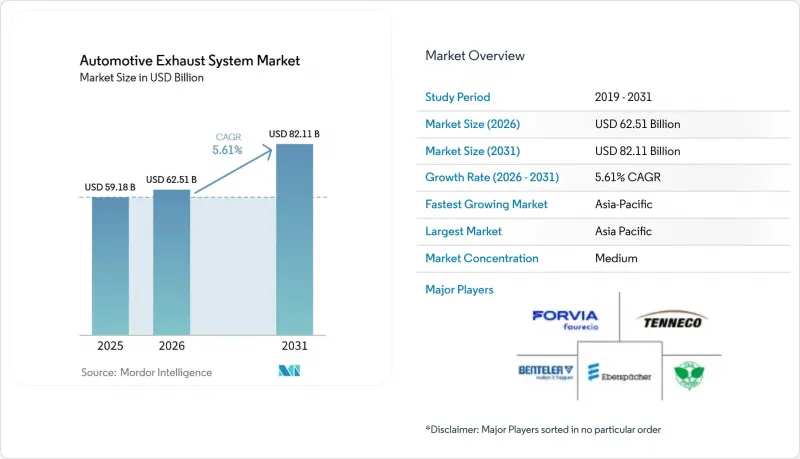
This report is Segmented by Component (Exhaust Manifold and More), Fuel Type (Gasoline and More), Vehicle Type (Two-Wheeler and More), System Type (Single and More), Sales Channel (OEM and Aftermarket), and Geography. The Market Forecasts are Provided in Value (USD) and Volume (Units).
Global Automotive Exhaust System Market Trends and Insights
Stricter Euro 7 / China VII Emission Norms
Starting in mid-2027, Euro 7 will enforce light-duty regulations, followed by heavy-duty rules in mid-2029. These regulations introduce the PN10 measurement, targeting particles as small as nanometer-scale sizes. Additionally, they mandate continuous on-board monitoring. As a result, catalytic converters and particulate filters must now operate efficiently in a wide range of ambient conditions. Meanwhile, China's "China VII" standards, anticipated in the near future and set for a phased rollout over several years, aim to significantly tighten NOx limits. This shift is nudging OEMs towards adopting dual-SCR layouts and integrating multi-gas oxygen sensors.
Rapid Growth in Turbo-Gasoline Passenger Cars
In recent years, a significant majority of vehicles with combustion engines have been equipped with turbocharged direct-injection gasoline engines. These engines, with their heightened exhaust enthalpy, necessitate the use of stainless manifolds, ceramic coatings, and catalysts that activate in a very short time. Recently, Futaba commenced mass production of stainless manifolds specifically for Toyota and Lexus. Concurrently, NGK secured a contract to supply cordierite Gasoline Particulate Filters (GPF) in India, aligning with the country's upcoming emission regulations. Additionally, wideband lambda sensors, now standard for transient air-fuel control, can withstand extremely high temperatures.
Accelerating BEV Power-Train Penetration
In recent years, battery electric vehicles (BEVs) have gained significant traction in global light-vehicle sales, with China leading the market in new-energy vehicle adoption. While demand for BEVs in the U.S. experienced a slight decline following the expiration of a federal tax credit, California remains committed to its ambitious zero-tailpipe emissions target for the future. Suppliers, such as Futaba, are anticipating a substantial revenue shortfall in the coming years. In response, they are shifting their investments towards battery cooling plates and thermal modules for electric vehicles.
Other drivers and restraints analyzed in the detailed report include:
- Urban Low-Emission Zones Expansion
- OEM Shift to Lightweight Stainless & Titanium Alloys
- Raw-Material Price Volatility (Ni, Mo)
For complete list of drivers and restraints, kindly check the Table Of Contents.
Segment Analysis
In 2025, catalytic converters accounted for 34.46% of total revenue, highlighting their dominance in emissions control. Driven by Euro 7 and China VII mandates emphasizing continuous lambda and NOx monitoring, oxygen sensors are projected to spearhead growth with a 5.63% CAGR. Bosch's wideband units, designed to endure extreme temperatures, achieve ignition in mere seconds. As dual-SCR layouts expand their sensing points, the demand for oxygen sensors in automotive exhaust systems is on a steady rise. Stricter limits on particulate numbers are paving the way for wider adoption of gasoline particulate filters in turbo-gasoline fleets. While mufflers and pipes trend towards commoditization, premium brands are distinguishing themselves with titanium tailpipes.
Stainless manifolds are now taking the place of cast iron to meet the thermal demands of turbo-gasoline. In a significant development, Futaba's latest launches for Toyota and Lexus are realizing notable weight reductions per vehicle. Although modular mufflers under development promise tooling savings, their durability remains unproven. Tailpipes, often viewed as low-value, are being upgraded to titanium for supercar trims, commanding impressive premiums. With a regulatory shift towards real-time compliance, catalysts and sensors stand to gain added value, while stamped components face shrinking margins.
Gasoline vehicles delivered 58.71% of 2025 revenue, aided by 70% turbo-DI adoption. Mandatory gasoline particulate filters reinforce catalyst pull-through. Alternate fuels-CNG, LPG, and biomethane-will post the highest CAGR of 5.73%. India's CNG fleet is experiencing significant annual growth, driving the market forward. Key enablers include three-way catalysts fine-tuned for methane oxidation and adaptive lambda sensors.
While diesel's share in the automotive exhaust systems market is declining due to LEZ bans, it still holds a notable position in off-highway and heavy vehicles. These vehicles require advanced architectures, specifically the dual-dosing SCR combined with DPF. As hybrids are expected to account for a substantial portion of global sales in the near future, the relevance of combustion persists. This trend bolsters the demand for solutions that are low in heat mass and quick to light off, effectively mitigating cold-start spikes.
Complete Report Scope:
- By Component
- Exhaust Manifold
- Muffler
- Catalytic Converter
- Exhaust Pipes
- Oxygen Sensor
- Tailpipe
- By Fuel Type
- Gasoline
- Diesel
- Alternate Fuels (Biofuels, CNG, LPG)
- By Vehicle Type
- Two-Wheeler
- Passenger Cars
- Light Commercial Vehicles (LCVs)
- Medium and Heavy Commercial Vehicles (HCVs)
- Buses and Coaches
- Off-highway Vehicles
- By System Type
- Single Exhaust System
- Dual Exhaust System
- Cat-Back Exhaust System
- Header Exhaust System
- By Sales Channel
- OEM
- Aftermarket
- By Geography
- North America
- United States
- Canada
- Rest of North America
- South America
- Brazil
- Argentina
- Rest of South America
- Europe
- Germany
- United Kingdom
- France
- Italy
- Spain
- Russia
- Rest of Europe
- Asia-Pacific
- China
- Japan
- India
- South Korea
- Rest of Asia-Pacific
- Middle East and Africa
- Saudi Arabia
- United Arab Emirates
- Turkey
- South Africa
- Egypt
- Rest of Middle East and Africa
- North America
Geography Analysis
Asia-Pacific generated 36.75% of 2025 revenue and will post a 5.71% regional CAGR to 2031. China's significant light-vehicle production, India's growing adoption of CNG, and strong off-highway sales indicate positive near-term growth. The introduction of China's new emission standards will increase the need for catalysts and sensors, while India's upcoming regulations will expand pollutant coverage to include ammonia and nitrous oxide. Japan's strong presence in the hybrid vehicle market ensures steady demand for intermittent-duty exhaust systems. In South Korea, the alignment with European emission standards and the hybrid vehicle initiatives by Hyundai and Kia support regional market stability.
Europe continues to play a pivotal role in global sales. The forthcoming Euro 7 standards, set to roll out later this decade, will enforce stricter measures like advanced particulate counting and continuous monitoring. This shift is poised to boost the demand for cutting-edge catalysts and particulate filters. With the rise of numerous low-emission zones, there's a swift push to replace older vehicles, opening doors for retrofitting opportunities. While battery electric vehicles are on the rise, hybrids still hold a crucial position as manufacturers navigate challenges like range limitations and profitability. Germany's prominence is further highlighted by its hosting of major suppliers like Eberspacher, Benteler, and Faurecia, showcasing the region's robust integration capabilities.
North America stands out as a major revenue source, even as production sees a slight dip. Federal policy shifts have led to fluctuations in the demand for battery electric vehicles. Yet, California's steadfast zero-emission mandate charts a clear long-term course. Noteworthy investments, including Tenneco's valve production expansion in Mexico and Benteler's exhaust manufacturing upgrades in South Carolina, underscore manufacturers' dedication to internal combustion engine platforms. While there's been a decline in catalytic-converter thefts, the financial outlay on replacements remains significant.
- Faurecia (FORVIA)
- Tenneco
- Eberspacher Group
- Benteler International
- Futaba Industrial
- Bosal
- Yutaka Giken
- Sejong Industrial
- Magna International
- Sango Co.
- Friedrich Boysen
- Katcon
- Marelli
- Klarius Group
- AP Exhaust Technologies
- Akrapovic
- Scorpion Exhausts
- Vibrant Performance
- Jetex Exhausts
- Walker Emission Control
Additional Benefits:
- The market estimate (ME) sheet in Excel format
- 3 months of analyst support
TABLE OF CONTENTS
1 Introduction
- 1.1 Study Assumptions and Market Definition
- 1.2 Scope of the Study
2 Research Methodology
3 Executive Summary
4 Market Landscape
- 4.1 Market Overview
- 4.2 Market Drivers
- 4.2.1 Stricter Euro 7 / China VII Emission Norms
- 4.2.2 Rapid Growth In Turbo-Gasoline Passenger Cars
- 4.2.3 Urban Low-Emission Zones (Lez) Expansion
- 4.2.4 OEM Shift To Lightweight Stainless & TI Alloys
- 4.2.5 Rising Demand For Aftermarket Performance Kits
- 4.2.6 Heat-Energy Recovery Integration With Hybrids
- 4.3 Market Restraints
- 4.3.1 Accelerating Bev Power-Train Penetration
- 4.3.2 Raw-Material Price Volatility (Ni, Mo)
- 4.3.3 Catalytic-Metals Theft Risk (Pt, Pd, Rh)
- 4.3.4 Euro-7 Acoustic Caps Limiting Sport Exhausts
- 4.4 Value Chain and Supply-Chain Analysis
- 4.5 Regulatory Landscape
- 4.6 Technological Outlook
- 4.7 Porter's Five Forces
- 4.7.1 Threat of New Entrants
- 4.7.2 Bargaining Power of Buyers
- 4.7.3 Bargaining Power of Suppliers
- 4.7.4 Threat of Substitutes
- 4.7.5 Competitive Rivalry
5 Market Size & Growth Forecasts (Value (USD))
- 5.1 By Component
- 5.1.1 Exhaust Manifold
- 5.1.2 Muffler
- 5.1.3 Catalytic Converter
- 5.1.4 Exhaust Pipes
- 5.1.5 Oxygen Sensor
- 5.1.6 Tailpipe
- 5.2 By Fuel Type
- 5.2.1 Gasoline
- 5.2.2 Diesel
- 5.2.3 Alternate Fuels (Biofuels, CNG, LPG)
- 5.3 By Vehicle Type
- 5.3.1 Two-Wheeler
- 5.3.2 Passenger Cars
- 5.3.3 Light Commercial Vehicles (LCVs)
- 5.3.4 Medium and Heavy Commercial Vehicles (HCVs)
- 5.3.5 Buses and Coaches
- 5.3.6 Off-highway Vehicles
- 5.4 By System Type
- 5.4.1 Single Exhaust System
- 5.4.2 Dual Exhaust System
- 5.4.3 Cat-Back Exhaust System
- 5.4.4 Header Exhaust System
- 5.5 By Sales Channel
- 5.5.1 OEM
- 5.5.2 Aftermarket
- 5.6 By Geography
- 5.6.1 North America
- 5.6.1.1 United States
- 5.6.1.2 Canada
- 5.6.1.3 Rest of North America
- 5.6.2 South America
- 5.6.2.1 Brazil
- 5.6.2.2 Argentina
- 5.6.2.3 Rest of South America
- 5.6.3 Europe
- 5.6.3.1 Germany
- 5.6.3.2 United Kingdom
- 5.6.3.3 France
- 5.6.3.4 Italy
- 5.6.3.5 Spain
- 5.6.3.6 Russia
- 5.6.3.7 Rest of Europe
- 5.6.4 Asia-Pacific
- 5.6.4.1 China
- 5.6.4.2 Japan
- 5.6.4.3 India
- 5.6.4.4 South Korea
- 5.6.4.5 Rest of Asia-Pacific
- 5.6.5 Middle East and Africa
- 5.6.5.1 Saudi Arabia
- 5.6.5.2 United Arab Emirates
- 5.6.5.3 Turkey
- 5.6.5.4 South Africa
- 5.6.5.5 Egypt
- 5.6.5.6 Rest of Middle East and Africa
- 5.6.1 North America
6 Competitive Landscape
- 6.1 Market Concentration
- 6.2 Strategic Moves
- 6.3 Market Share Analysis
- 6.4 Company Profiles (includes Global Level Overview, Market Level Overview, Core Segments, Financials as Available, Strategic Information, Market Rank/Share for Key Companies, Products and Services, SWOT Analysis, and Recent Developments)
- 6.4.1 Faurecia (FORVIA)
- 6.4.2 Tenneco
- 6.4.3 Eberspacher Group
- 6.4.4 Benteler International
- 6.4.5 Futaba Industrial
- 6.4.6 Bosal
- 6.4.7 Yutaka Giken
- 6.4.8 Sejong Industrial
- 6.4.9 Magna International
- 6.4.10 Sango Co.
- 6.4.11 Friedrich Boysen
- 6.4.12 Katcon
- 6.4.13 Marelli
- 6.4.14 Klarius Group
- 6.4.15 AP Exhaust Technologies
- 6.4.16 Akrapovic
- 6.4.17 Scorpion Exhausts
- 6.4.18 Vibrant Performance
- 6.4.19 Jetex Exhausts
- 6.4.20 Walker Emission Control
7 Market Opportunities & Future Outlook
- 7.1 White-space and Unmet-Need Assessment

