PUBLISHER: Mordor Intelligence | PRODUCT CODE: 2097375

PUBLISHER: Mordor Intelligence | PRODUCT CODE: 2097375
Patient Monitoring Devices - Market Share Analysis, Industry Trends & Statistics, Growth Forecasts (2026 - 2031)
According to Mordor Intelligence, the patient monitoring systems market size is valued at USD 50.53 billion in 2025 and is forecast to reach USD 77.50 billion by 2030, reflecting a 7.39% CAGR throughout the period.
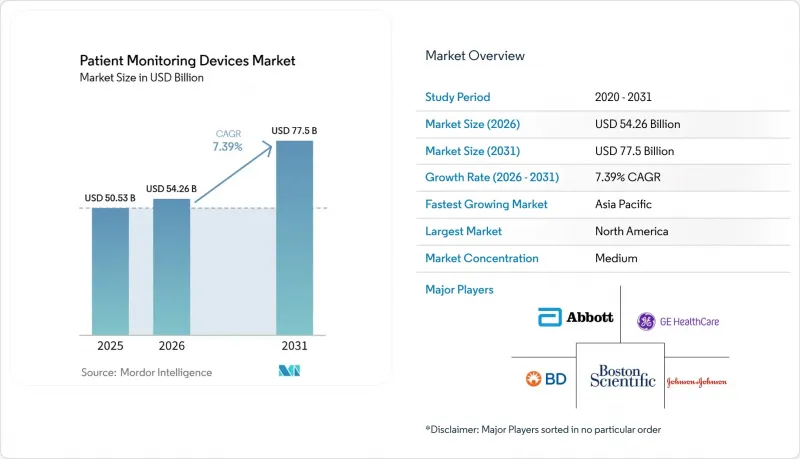
This report Segments the Industry Into by Type of Device (Hemodynamic Monitoring Devices, Neuromonitoring Devices, Cardiac Monitoring Devices, Multi-Parameter Monitors, and More), by Application (Cardiology, Neurology, Respiratory, and More), by End-User (Home Healthcare, Hospitals and Clinics, and More), and Geography (North America, and More).
Global Patient Monitoring Devices Market Trends and Insights
Aging Population & Home-Care Shift
Long-term demographic changes increase the proportion of adults aged 65 years and older, sustaining demand for systems that allow seniors to remain at home without compromising clinical oversight. Mayo Clinic has treated more than 2,000 patients through its Advanced Care at Home initiative, proving that 24/7 monitoring can replicate hospital-level supervision in residential settings. User-friendly interfaces and simplified device maintenance now accompany Medicare reimbursement frameworks, such as the Acute Hospital Care at Home program, which lay the economic foundation for durable growth. These shifts oblige manufacturers to refine sensor accuracy while reducing setup complexity so elderly users can manage devices independently. As a result, the patient monitoring systems market sees stronger demand for voice-guided onboarding, automatic software updates, and fail-safe connectivity that safeguard continuity of care.
Rising Chronic Disease Burden
Cardiovascular illness, diabetes, and chronic respiratory disorders collectively account for nearly 90% of health-care expenditure, spotlighting the cost advantage of continuous surveillance over episodic treatment. Frederick Health achieved a 38% reduction in hospital readmissions after adopting remote patient monitoring, illustrating quantifiable savings and better outcomes. AI-equipped monitors spot early decompensation, as seen in Masimo's partnership with UCHealth to apply predictive analytics across virtual care networks. Integration of continuous glucose monitors with automated insulin pumps also showcases how sensing and therapy are converging into closed-loop solutions, further embedding monitoring into chronic-care pathways.
Data-Privacy & Cybersecurity Vulnerabilities
Connected devices widen attack surfaces, as reflected in FDA safety communications on vulnerabilities in Contec and Epsimed monitors that permit unauthorized remote control. The Food and Drug Omnibus Reform Act now obliges manufacturers to document patching capabilities and post-market surveillance plans, elevating compliance expenditure. Cyber risks heighten purchasing hesitancy among providers already contending with ransomware, driving preference for vendors offering end-to-end encryption and zero-trust architectures.
Other drivers and restraints analyzed in the detailed report include:
- Telehealth and Remote Monitoring Uptake
- Tech Advances in Multi-Parameter & Wearables
- High Capital & Operating Costs
For complete list of drivers and restraints, kindly check the Table Of Contents.
Segment Analysis
Multi-parameter vital-signs monitors generated 34.78% of 2025 revenue, underscoring provider demand for single consoles that consolidate ECG, SpO2, NIBP, and temperature readings in unified dashboards. The patient monitoring systems market size for multi-parameter devices is projected to maintain steady expansion as hospitals replace legacy units with cloud-ready models that enable analytics overlays. Neuro-monitoring devices show the highest 7.65% CAGR through 2031, propelled by AI-enhanced EEG and cerebral oximetry that detect neurological events earlier.
Cardiac monitors, respiratory monitors, and fetal-neonatal systems retain critical roles yet increasingly converge within modular platforms rather than operating as stand-alone units. Advanced hemodynamic modules now pair with algorithmic trend analysis that forecasts hypotension minutes before onset, as seen in BD's HemoSphere Alta launch. This integration minimizes alarm fatigue and simplifies nursing workflows, driving hospitals to favor vendors offering configurable parameter suites over single-purpose tools. As a result, the patient monitoring systems market continues to transition toward platform-based procurement strategies.
Bedside monitors still control 46.98% share because ICUs require hard-wired reliability and compatibility with EHR middleware. However, wearable and patch monitors, expanding at 7.92% CAGR, anchor the fastest-growing segment as consumers accept wrist- and chest-based devices for everything from arrhythmia detection to sleep staging. Companies capitalize on smartphone pairing and cloud dashboards to give clinicians granular insights while allowing patients full mobility.
Disposable patches like VitalPatch or Philips BioTel Heart simplify logistics by negating disinfection needs. Battery life improvements and low-power Bluetooth extend continuous operation to seven days or more, boosting adherence. Portable transport monitors fill intra-facility gaps-ambulances, imaging suites, step-down units-maintaining continuous data streams during patient transfers. Collectively, these shifts steer the patient monitoring systems market toward form factors that blur lines between medical-grade and consumer-grade hardware without sacrificing accuracy.
Complete Report Scope:
- By Product Type
- Multi-parameter vital-signs monitors
- Cardiac monitoring devices
- Hemodynamic monitors
- Respiratory monitors
- Fetal & neonatal monitors
- Neuro-monitoring devices
- Temperature & weight monitors
- By Portability
- Bedside / fixed monitors
- Portable / transport monitors
- Wearable / patch monitors
- By End User
- Hospitals
- Ambulatory Surgical Centers
- Home-care Settings
- Long-term Care Facilities
- By Application
- Cardiology
- Respiratory
- Neurology
- Critical Care
- Diabetes & Metabolic
- Other Applications
- By Geography
- North America
- United States
- Canada
- Mexico
- Europe
- Germany
- United Kingdom
- France
- Italy
- Spain
- Rest of Europe
- Asia-Pacific
- China
- India
- Japan
- South Korea
- Australia
- Rest of Asia-Pacific
- South America
- Brazil
- Argentina
- Rest of South America
- Middle East and Africa
- GCC
- South Africa
- Rest of Middle East and Africa
- North America
Geography Analysis
North America leads with 42.23% share, supported by reimbursement parity for remote vitals, FDA fast lanes, and enterprise IT funding that earmarks 41% of budgets for monitoring upgrades. Mayo Clinic's program proves clinical equivalence for hospital-at-home, influencing regional insurers to authorize wider deployments.
Asia-Pacific, forecast at 7.56% CAGR, benefits from telehealth pilots in China where government mandates aim to address rural access gaps and accelerate the patient monitoring systems market. India's digital-health roadmap targets USD 25 billion by 2025, underpinning broad sensor rollouts in primary-care outposts. Geriatric health spending topping USD 20 trillion between 2015-2030 underscores long-run demand.
Europe experiences steady adoption through EU cybersecurity harmonization and value-based procurement short-listing vendors with predictive-analytics proof. South America and the Middle East & Africa remain nascent but attractive; as macroeconomic stability improves, public-private partnerships seed first-wave installations in tertiary hospitals.
- Koninklijke Philips
- GE HealthCare Technologies Inc.
- Medtronic
- Nihon Kohden
- Mindray
- Masimo
- Dragerwerk
- Baxter International Inc. (Hillrom)
- Abbott Laboratories
- Dexcom
- OMRON
- Zoll Medical Corporation (Asahi Kasei Group)
- Schiller
- Honeywell International Inc. (Life Care Solutions)
- BIOTRONIK
- Contec Medical Systems
- AliveCor
- Welch Allyn (Baxter)
- Garmin
- Capsule Technologies (Philips)
Additional Benefits:
- The market estimate (ME) sheet in Excel format
- 3 months of analyst support
TABLE OF CONTENTS
1 Introduction
- 1.1 Study Assumptions & Market Definition
- 1.2 Scope of the Study
2 Research Methodology
3 Executive Summary
4 Market Landscape
- 4.1 Market Overview
- 4.2 Market Drivers
- 4.2.1 Ageing Population & Home-care Shift
- 4.2.2 Rising Chronic Disease Burden
- 4.2.3 Tele-health and Remote Monitoring Uptake
- 4.2.4 Tech Advances in Multi-parameter & Wearables
- 4.2.5 AI-driven Predictive Analytics Cuts Alarm Fatigue
- 4.2.6 Hospital-at-home Pilots & Disposable Biosensor Patches
- 4.3 Market Restraints
- 4.3.1 Data-privacy & Cybersecurity Vulnerabilities
- 4.3.2 High Capital & Operating Costs
- 4.3.3 Interoperability Gaps with EHR Ecosystems
- 4.3.4 Semiconductor-sensor Supply-chain Volatility
- 4.4 Value / Supply-Chain Analysis
- 4.5 Regulatory Landscape
- 4.6 Technological Outlook
- 4.7 Porter's Five Forces
- 4.7.1 Threat of New Entrants
- 4.7.2 Bargaining Power of Suppliers
- 4.7.3 Bargaining Power of Buyers
- 4.7.4 Threat of Substitutes
- 4.7.5 Competitive Rivalry
5 Market Size & Growth Forecasts (Value, in USD)
- 5.1 By Product Type
- 5.1.1 Multi-parameter vital-signs monitors
- 5.1.2 Cardiac monitoring devices
- 5.1.3 Hemodynamic monitors
- 5.1.4 Respiratory monitors
- 5.1.5 Fetal & neonatal monitors
- 5.1.6 Neuro-monitoring devices
- 5.1.7 Temperature & weight monitors
- 5.2 By Portability
- 5.2.1 Bedside / fixed monitors
- 5.2.2 Portable / transport monitors
- 5.2.3 Wearable / patch monitors
- 5.3 By End User
- 5.3.1 Hospitals
- 5.3.2 Ambulatory Surgical Centers
- 5.3.3 Home-care Settings
- 5.3.4 Long-term Care Facilities
- 5.4 By Application
- 5.4.1 Cardiology
- 5.4.2 Respiratory
- 5.4.3 Neurology
- 5.4.4 Critical Care
- 5.4.5 Diabetes & Metabolic
- 5.4.6 Other Applications
- 5.5 By Geography
- 5.5.1 North America
- 5.5.1.1 United States
- 5.5.1.2 Canada
- 5.5.1.3 Mexico
- 5.5.2 Europe
- 5.5.2.1 Germany
- 5.5.2.2 United Kingdom
- 5.5.2.3 France
- 5.5.2.4 Italy
- 5.5.2.5 Spain
- 5.5.2.6 Rest of Europe
- 5.5.3 Asia-Pacific
- 5.5.3.1 China
- 5.5.3.2 India
- 5.5.3.3 Japan
- 5.5.3.4 South Korea
- 5.5.3.5 Australia
- 5.5.3.6 Rest of Asia-Pacific
- 5.5.4 South America
- 5.5.4.1 Brazil
- 5.5.4.2 Argentina
- 5.5.4.3 Rest of South America
- 5.5.5 Middle East and Africa
- 5.5.5.1 GCC
- 5.5.5.2 South Africa
- 5.5.5.3 Rest of Middle East and Africa
- 5.5.1 North America
6 Competitive Landscape
- 6.1 Market Concentration
- 6.2 Market Share Analysis
- 6.3 Company Profiles (includes Global level Overview, Market level overview, Core Segments, Financials as available, Strategic Information, Market Rank/Share for key companies, Products & Services, and Recent Developments)
- 6.3.1 Koninklijke Philips N.V.
- 6.3.2 GE HealthCare Technologies Inc.
- 6.3.3 Medtronic plc
- 6.3.4 Nihon Kohden Corporation
- 6.3.5 Shenzhen Mindray Bio-Medical Electronics Co., Ltd.
- 6.3.6 Masimo Corporation
- 6.3.7 Dragerwerk AG & Co. KGaA
- 6.3.8 Baxter International Inc. (Hillrom)
- 6.3.9 Abbott Laboratories
- 6.3.10 Dexcom, Inc.
- 6.3.11 OMRON Corporation
- 6.3.12 Zoll Medical Corporation (Asahi Kasei Group)
- 6.3.13 Schiller AG
- 6.3.14 Honeywell International Inc. (Life Care Solutions)
- 6.3.15 Biotronik SE & Co. KG
- 6.3.16 Contec Medical Systems Co., Ltd.
- 6.3.17 AliveCor, Inc.
- 6.3.18 Welch Allyn (Baxter)
- 6.3.19 Garmin Ltd.
- 6.3.20 Capsule Technologies (Philips)
7 Market Opportunities & Future Outlook
- 7.1 White-space & unmet-need assessment

