PUBLISHER: Mordor Intelligence | PRODUCT CODE: 2097387

PUBLISHER: Mordor Intelligence | PRODUCT CODE: 2097387
Lung Cancer Liquid Biopsy - Market Share Analysis, Industry Trends & Statistics, Growth Forecasts (2026 - 2031)
According to Mordor Intelligence, the lung cancer liquid biopsy market size is anticipated to reach USD 1.27 billion in 2026 and USD 2.32 billion by 2031, at a 12.79% CAGR, underscoring how regulatory clarity, broader reimbursement, and robust clinical validation have made blood-based genomic profiling a frontline diagnostic option.
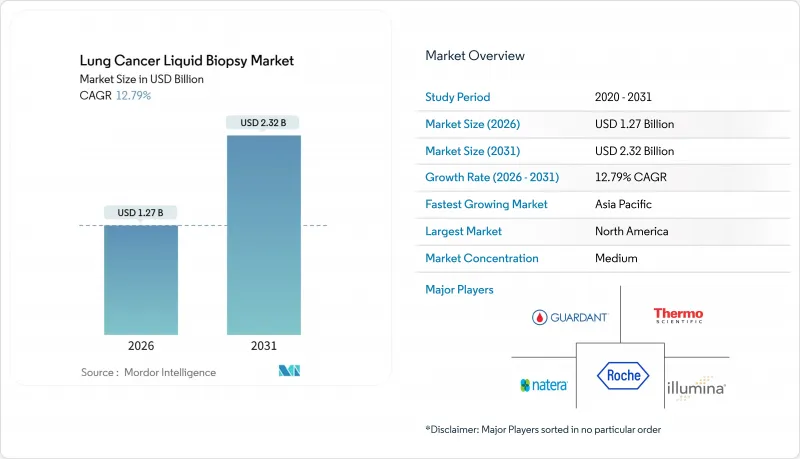
This report is Segmented by Analyte/Biomarker (ctDNA, and More), Technology/Method (NGS-Based CGP, and More), Clinical Use Case (Therapy Selection, and More), Cancer Subtype (NSCLC and SCLC), End User (Independent Reference Laboratories, and More), Specimen Type (Plasma, and More), and Geography (North America, and More). The Market Forecasts are Provided in Terms of Value (USD).
Global Lung Cancer Liquid Biopsy Market Trends and Insights
Regulatory and Clinical Guideline Endorsements for Liquid Biopsy in Lung Cancer
Publication of the FDA draft guidance in November 2024 set explicit analytic validity thresholds for circulating tumor DNA minimal residual disease assays, catalyzing investment in ultra-deep sequencing platforms. ASCO's 2024 living guideline and NCCN's version 4.2024 now recommend comprehensive blood-based genomic profiling when tissue is inadequate, expanding the eligible patient pool by 20-30%. ESMO's 2024 consensus statements added plasma testing for resistance-mechanism identification after targeted therapy failure, reinforcing payer confidence across Europe. Collectively, these endorsements normalize liquid biopsy as standard of care, reduce payer push-back, and shorten hospital committee approval cycles.
Expansion of Reimbursement Coverage for Liquid Biopsy-Based Genomic Profiling
CMS in 2025 placed Guardant360 CDx at USD 5,000, FoundationOne Liquid CDx at USD 3,500, and Signatera at USD 3,500 on its Advanced Diagnostic Laboratory Test list, instantly setting a de facto national floor for commercial insurers. Germany, the United Kingdom, and France followed with procedure codes that reimburse plasma testing when tissue biopsy is contraindicated, raising European access by 10-15% in one year. Japan's health insurance system began covering liquid biopsy for high-risk tissue sampling, boosting domestic uptake despite historically conservative coverage policies. These moves improve vendor cash flow visibility and prompt hospital laboratories to invest in on-site sequencing infrastructure.
Analytical Sensitivity Limitations in Early-Stage Disease and Low Tumor Shedding
Stage I detection rates hover at 50-70%, well below those of radiologic modalities, due to variant-allele fractions below the 0.05% assay threshold. Shedding heterogeneity, clonal hematopoiesis artifacts, and pre-analytical inconsistencies further erode accuracy, so clinicians still prioritize tissue confirmation to avoid false reassurance. Vendors are countering with molecular barcoding chemistries that reduce limits of detection to 0.01%, but broad validation remains a work in progress.
Other drivers and restraints analyzed in the detailed report include:
- Rising Incidence of Lung Cancer and Growing Preference for Minimally Invasive Diagnostics
- Continued Launch of Targeted and Immuno-Oncology Therapies Requiring Molecular Monitoring
- Inconsistent Global Reimbursement Policies for Screening and MRD Applications
For complete list of drivers and restraints, kindly check the Table Of Contents.
Segment Analysis
The lung cancer liquid biopsy market size for circulating tumor DNA commands the lion's share, but exosome-based assays are expanding the fastest, growing at a 14.54% CAGR as investigators leverage cell-free RNA and protein cargo to illuminate resistance mechanisms. Vendors such as Exosome Diagnostics and academic spin-outs are aligning with pharma partners to validate exosomal programmed death-ligand 1 expression, addressing the tissue-complementary gap. Although exosome workflows require ultracentrifugation or immuno-capture steps that lengthen processing, automated microfluidic kits launched in 2026 promise to cut hands-on time by half, encouraging hospital adoption. The lung cancer liquid biopsy market is therefore likely to evolve toward dual-analyte panels that couple ctDNA mutations with exosomal RNA for a richer biological context.
Next-generation sequencing dominated 54.32% of 2025 revenue, yet fragmentomics and methylation analytics are surging at a 14.22% CAGR. These low-coverage assays trim sequencing depth by 20x, enabling 80-90% cost cuts and same-week turnaround, appealing to budget-sensitive health systems in Latin America and Southeast Asia. Illumina's NovaSeq X compatibility has prompted tertiary hospitals to internalize 500-gene ctDNA panels and retain billing margin. Conversely, the polymerase chain reaction and droplet-digital polymerase chain reaction segments continue to shrink as clinical guidelines shift away from single-gene reflex testing.
Complete Report Scope:
- By Analyte / Biomarker
- ctDNA
- cfDNA
- CTCs
- Exosomes / Extracellular Vesicles / cfRNA
- Methylation / Fragmentomics Signatures
- By Technology / Method
- NGS-based CGP
- PCR / ddPCR
- BEAMing / hybrid methods
- Fragmentomics / methylation analytics
- By Clinical Use Case
- Therapy Selection
- Treatment-response Monitoring
- MRD / Recurrence Surveillance
- Early Detection / Screening
- By Cancer Subtype
- NSCLC
- Adenocarcinoma
- Squamous Cell Carcinoma
- SCLC
- NSCLC
- By End User
- Independent Reference Laboratories
- Hospital
- Oncology Clinics
- By Specimen Type
- Plasma
- Serum
- Other Specimen Types
- By Geography
- North America
- United States
- Canada
- Mexico
- Europe
- Germany
- France
- United Kingdom
- Italy
- Spain
- Rest of Europe
- Asia-Pacific
- China
- India
- Japan
- South Korea
- Australia
- Rest of Asia-Pacific
- Middle East and Africa
- GCC
- South Africa
- Rest of Middle East and Africa
- South America
- Brazil
- Argentina
- Rest of South America
- North America
Geography Analysis
North America led the lung cancer liquid biopsy market with a 43.56% revenue contribution in 2025 as Medicare payment cemented commercial price floors and fifteen of the top twenty vendors based their operations in the United States. Vendor-pharma collaborations, a mature clinical-trial ecosystem, and hospital investment in onsite sequencing sustain double-digit domestic growth despite payer limits on screening coverage.
Europe exhibits mixed momentum; Germany, the United Kingdom, and France now reimburse plasma testing for advanced disease, but divergent coding policies fragment adoption across other member states. The lung cancer liquid biopsy market size for leading European laboratories remains tethered to therapy-selection cases while IVDR compliance costs delay the launch of innovative assays.
Asia-Pacific is the fastest-growing region at a 13.45% CAGR to 2031. China's National Medical Products Administration approval of multiple ctDNA panels and provincial pilot reimbursement boost domestic uptake, while Japan's insurers cover liquid biopsy when tissue sampling risks complications. Local champions Burning Rock and Singlera replicate Guardant's and Natera's business models at lower price points, accelerating penetration into tier-2 Chinese hospitals.
- Agilent Technologies (Resolution CtDx FIRST)
- Bio-Rad Laboratories (DdPCR)
- Biocept
- Burning Rock Biotech
- Circulogene
- Exact Sciences
- GRAIL
- Guardant Health
- Illumina
- LabCorp
- Menarini
- Natera
- NeoGenomics (Inivata)
- Personalis
- QIAGEN
- Roche
- Singlera Genomics
- Tempus
- Thermo Fisher Scientific
Additional Benefits:
- The market estimate (ME) sheet in Excel format
- 3 months of analyst support
TABLE OF CONTENTS
1 Introduction
- 1.1 Study Assumptions & Market Definition
- 1.2 Scope of the Study
2 Research Methodology
3 Executive Summary
4 Market Landscape
- 4.1 Market Overview
- 4.2 Market Drivers
- 4.2.1 Regulatory And Clinical Guideline Endorsements For Liquid Biopsy In Lung Cancer
- 4.2.2 Expansion Of Reimbursement Coverage For Liquid Biopsy-Based Genomic Profiling
- 4.2.3 Rising Incidence Of Lung Cancer And Growing Preference For Minimally Invasive Diagnostics
- 4.2.4 Continued Launch Of Targeted And Immuno-Oncology Therapies Requiring Molecular Monitoring
- 4.2.5 Integration Of Liquid Biopsy Into Multicancer Early Detection Pilots
- 4.2.6 Adoption Of Ultra-Sensitive Minimal Residual Disease Assays In Surgical Lung Cancer Pathways
- 4.3 Market Restraints
- 4.3.1 Analytical Sensitivity Limitations In Early-Stage Disease And Low Tumor Shedding
- 4.3.2 Inconsistent Global Reimbursement Policies For Screening And MRD Applications
- 4.3.3 Need For Complementary Tissue Biopsy To Capture Non-DNA Biomarkers
- 4.3.4 Emerging Laboratory Regulation Increasing Compliance Costs For Smaller Service Providers
- 4.4 Value / Supply-Chain Analysis
- 4.5 Regulatory Landscape
- 4.6 Technological Outlook
- 4.7 Porter's Five Forces Analysis
- 4.7.1 Threat of New Entrants
- 4.7.2 Bargaining Power of Suppliers
- 4.7.3 Bargaining Power of Buyers
- 4.7.4 Threat of Substitutes
- 4.7.5 Competitive Rivalry
5 Market Size & Growth Forecasts (Value, USD)
- 5.1 By Analyte / Biomarker
- 5.1.1 ctDNA
- 5.1.2 cfDNA
- 5.1.3 CTCs
- 5.1.4 Exosomes / Extracellular Vesicles / cfRNA
- 5.1.5 Methylation / Fragmentomics Signatures
- 5.2 By Technology / Method
- 5.2.1 NGS-based CGP
- 5.2.2 PCR / ddPCR
- 5.2.3 BEAMing / hybrid methods
- 5.2.4 Fragmentomics / methylation analytics
- 5.3 By Clinical Use Case
- 5.3.1 Therapy Selection
- 5.3.2 Treatment-response Monitoring
- 5.3.3 MRD / Recurrence Surveillance
- 5.3.4 Early Detection / Screening
- 5.4 By Cancer Subtype
- 5.4.1 NSCLC
- 5.4.1.1 Adenocarcinoma
- 5.4.1.2 Squamous Cell Carcinoma
- 5.4.2 SCLC
- 5.4.1 NSCLC
- 5.5 By End User
- 5.5.1 Independent Reference Laboratories
- 5.5.2 Hospital
- 5.5.3 Oncology Clinics
- 5.6 By Specimen Type
- 5.6.1 Plasma
- 5.6.2 Serum
- 5.6.3 Other Specimen Types
- 5.7 By Geography
- 5.7.1 North America
- 5.7.1.1 United States
- 5.7.1.2 Canada
- 5.7.1.3 Mexico
- 5.7.2 Europe
- 5.7.2.1 Germany
- 5.7.2.2 France
- 5.7.2.3 United Kingdom
- 5.7.2.4 Italy
- 5.7.2.5 Spain
- 5.7.2.6 Rest of Europe
- 5.7.3 Asia-Pacific
- 5.7.3.1 China
- 5.7.3.2 India
- 5.7.3.3 Japan
- 5.7.3.4 South Korea
- 5.7.3.5 Australia
- 5.7.3.6 Rest of Asia-Pacific
- 5.7.4 Middle East and Africa
- 5.7.4.1 GCC
- 5.7.4.2 South Africa
- 5.7.4.3 Rest of Middle East and Africa
- 5.7.5 South America
- 5.7.5.1 Brazil
- 5.7.5.2 Argentina
- 5.7.5.3 Rest of South America
- 5.7.1 North America
6 Competitive Landscape
- 6.1 Market Concentration
- 6.2 Market Share Analysis
- 6.3 Company Profiles {(includes Global level Overview, Market level overview, Core Segments, Financials as available, Strategic Information, Market Rank/Share for key companies, Products & Services, and Recent Developments)}
- 6.3.1 Agilent Technologies (Resolution CtDx FIRST)
- 6.3.2 Bio-Rad Laboratories (DdPCR)
- 6.3.3 Biocept
- 6.3.4 Burning Rock Biotech
- 6.3.5 Circulogene
- 6.3.6 Exact Sciences
- 6.3.7 GRAIL
- 6.3.8 Guardant Health
- 6.3.9 Illumina, Inc.
- 6.3.10 Labcorp
- 6.3.11 Menarini Silicon Biosystems
- 6.3.12 Natera
- 6.3.13 NeoGenomics (Inivata)
- 6.3.14 Personalis
- 6.3.15 QIAGEN
- 6.3.16 F. Hoffmann-La Roche AG
- 6.3.17 Singlera Genomics
- 6.3.18 Tempus
- 6.3.19 Thermo Fisher Scientific
7 Market Opportunities & Future Outlook
- 7.1 White-space & unmet-need assessment

