PUBLISHER: Mordor Intelligence | PRODUCT CODE: 2097391

PUBLISHER: Mordor Intelligence | PRODUCT CODE: 2097391
Barium - Market Share Analysis, Industry Trends & Statistics, Growth Forecasts (2026 - 2031)
According to Mordor Intelligence, the barium market size is estimated at 1.10 million tons in 2026 and is expected to reach 1.46 million tons by 2031, at a CAGR of 5.86% during the forecast period (2026-2031).
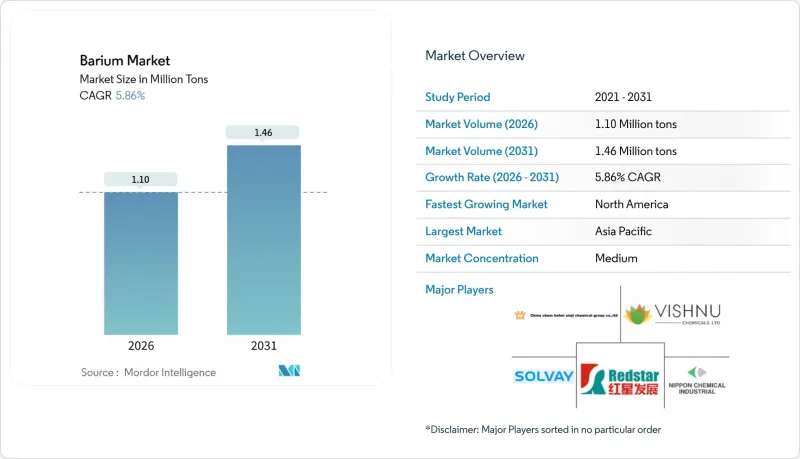
This report is Segmented by Compound Type (Precipitated Barium Sulfate, Barium Chloride, Barium Nitrate, Barium Titanate, Barium Oxide, Barium Carbonate, and Other Barium Compounds), End-User Industry (Construction, Electronics, Metal and Alloys, Mining, Medical, Glass and Ceramics, and Other End-User Industries), and Geography (Asia-Pacific, and More). Market Forecasts are Provided in Terms of Volume (Tons).
Global Barium Market Trends and Insights
Expanding Use of Barium Compounds in Construction Materials and Specialty Coatings
In a bid to adhere to sulfate-resistant and low-toxicity standards, construction specifications are increasingly replacing lead additives with barium carbonate and barium sulfate. Research published in 2024 highlighted that barium carbonate nanoparticles can improve mortar compressive strength while simultaneously reducing water absorption. These high-performance concretes, tailored for extreme heat conditions, are being utilized in megaprojects under Saudi Vision 2030 and the UAE's Expo City expansions. Additionally, precipitated barium sulfate has been found to diminish titanium dioxide loading in anticorrosive coatings. This reduction not only cuts formulation costs but also maintains opacity. As the industry shifts its focus from raw minerals to engineered fillers with precise particle-size control, producers investing in surface-modification technologies stand to gain significantly.
Structural Growth in Electronics and Advanced Ceramics (Barium Titanate)
Ferroelectric barium titanate plays a pivotal role in MLCC dielectrics, ensuring stable power delivery for AI servers, 5G base stations, and electric vehicles. Murata forecasts a surge in MLCC demand for AI infrastructure in the coming years. In a significant move, Samsung clinched a U.S. patent in April 2025 for a groundbreaking formula that maintains capacitance beyond 150 °C, effectively addressing thermal throttling challenges in compact server racks. Hosokawa Micron boasts milling lines adept at producing 100-nanometer powders, essential for crafting ultrathin dielectric layers. Moreover, beyond its capacitor applications, this compound enhances ionic conductivity in solid-state batteries. As computing and energy storage evolve, the barium market is outpacing the growth of conventional ceramics.
Concentrated Barite Supply Base and Raw-Material Disruption Risk
In 2024, China and India accounted for the majority of global barite production. Starting July 2025, China's revamped Mineral Resources Law will impose export quotas on strategic minerals. An earlier embargo on antimony led to a significant drop in U.S. supplies, causing prices to rise sharply. Given that the U.S. imports most of its barite, a similar embargo could either halt operations on rigs or necessitate expensive alternatives. While Morocco and Mexico contribute to the market, they fall short of matching the tonnage from Asia. This concentration of supply stands out as the most significant challenge for the barium market.
Other drivers and restraints analyzed in the detailed report include:
- Rising Oil and Gas Drilling Activity Boosting Demand for Drilling-Grade Barite
- Emerging Adoption of Barium-Based Cool-Paint Technologies for Urban Heat Mitigation
- Stringent Environmental and Toxic-Emission Regulations on Barium Processing
For complete list of drivers and restraints, kindly check the Table Of Contents.
Segment Analysis
Barium carbonate captured 41.04% of the barium market share in 2025 and is forecast to post 6.74% growth to 2031, comfortably outpacing the broader 5.86% trajectory. Producers are reaping the rewards of regulatory shifts that phase out lead fluxes in glass and ceramic glazes, leading to a pivot towards barium-based alternatives. This trend is also driving heightened interest in barium carbonate for optical glass, where its enhanced refractive index justifies a premium price. While barium titanate commands a smaller tonnage, its growth is swift; a rise in MLCC unit density translates to a surge in demand. Notably, Samsung's 2025 patent on high-temperature formulations highlights the sector's ongoing research and development commitment.
Precipitated barium sulfate finds its niche in coatings, plastics, and medical imaging, where its brightness and inertness command a price premium. Venator's establishment of additive plants underscores the scale needed to thrive in the engineered filler market. Meanwhile, barium chloride and barium nitrate play minor roles in heat treatment and pyrotechnics. Although barium oxide has seen a downturn in cathode-ray tubes, this decline is somewhat balanced by its use in catalysts and ferrite magnets. Other compounds, like barium hydroxide, serve as specialty intermediates with limited capacity expansions. This fragmentation among compound types is prompting integrated miners to ascend the value chain, bolstering their position in the Barium market.
Complete Report Scope:
- By Compound Type
- Precipitated Barium Sulfate
- Barium Chloride
- Barium Nitrate
- Barium Titanate
- Barium Oxide
- Barium Carbonate
- Other Barium Compounds
- By End-user Industry
- Construction
- Electronics
- Metal and Alloys
- Mining
- Medical
- Glass and Ceramics
- Other End-user Industries
- By Geography
- Asia-Pacific
- China
- India
- Japan
- South Korea
- Rest of Asia-Pacific
- North America
- United States
- Canada
- Mexico
- Europe
- Germany
- United Kingdom
- France
- Italy
- Spain
- Rest of Europe
- South America
- Brazil
- Argentina
- Rest of South America
- Middle-East and Africa
- Saudi Arabia
- South Africa
- Rest of Middle-East and Africa
- Asia-Pacific
Geography Analysis
Asia-Pacific accounted for 67.61% of the 2025 volume, driven by significant output from China and India, catering to both domestic industries and U.S. imports. China's updated Mineral Resources Law promotes stockpiling and capacity growth, pushing for added domestic value before exports. Guizhou Redstar pivoted from commodity chemicals to electronics-grade salts, achieving notable revenue in 2024. Hebei Xinji Chemical, with its plants and numerous patents, underscores the rising capital demands for environmental standards. Meanwhile, Japan's Nippon Chemical Industrial and Sakai Chemical are supplying high-purity titanate, solidifying Asia's lead from raw minerals to precision powders.
North America, while smaller, posts the fastest regional CAGR at 6.90%. Operators are actively maintaining Permian rigs and lengthening laterals, boosting barite usage per well. The U.S. leans heavily on imports, making buyers vulnerable to freight fluctuations and geopolitical tensions. Europe, while growing at a slower pace, holds strategic significance. Kandelium Group dominates, accounting for the entirety of the EU's barium carbonate output. However, even with anti-dumping duties on imports from China, the EU's dependence on this supply remains intact. In the Middle East and Africa, as well as South America, demand is closely linked to oil-field advancements and infrastructure initiatives, notably Saudi Vision 2030.
- Chemical Products Corporation
- CIMBAR PERFORMANCE MINERALS
- Divjyot Chemicals Private Limited
- Guizhou Redstar Co., Ltd.
- Hebei Xinji Chemical Group Co., Ltd.
- Hubei Jingshan Chutian Barium Salt Corp. Ltd
- Nippon Chemical Industrial Co., Ltd.
- SAKAI CHEMICAL INDUSTRY CO., LTD.
- Solvay
- Venator Materials PLC
- Vishnu Chemicals
Additional Benefits:
- The market estimate (ME) sheet in Excel format
- 3 months of analyst support
TABLE OF CONTENTS
1 Introduction
- 1.1 Study Assumptions and Market Definition
- 1.2 Scope of the Study
2 Research Methodology
3 Executive Summary
4 Market Landscape
- 4.1 Market Overview
- 4.2 Market Drivers
- 4.2.1 Expanding use of barium compounds in construction materials and specialty coatings
- 4.2.2 Structural growth in electronics and advanced ceramics (barium titanate)
- 4.2.3 Rising oil and gas drilling activity boosting demand for drilling-grade barite
- 4.2.4 Emerging adoption of barium-based cool-paint technologies for urban heat mitigation
- 4.2.5 Nano-barium fillers for lightweight EV battery casings and radiation shielding
- 4.3 Market Restraints
- 4.3.1 Concentrated barite supply base and raw-material disruption risk
- 4.3.2 Stringent environmental and toxic-emission regulations on barium processing
- 4.3.3 Escalating bulk-freight and container costs inflating delivered barite prices
- 4.4 Value Chain Analysis
- 4.5 Supply-Chain Analysis
- 4.6 Regulatory Policy Analysis
- 4.7 Trade Analysis
- 4.8 Price Trend Analysis
- 4.9 Production Cost Analysis
- 4.10 Porter's Five Forces
- 4.10.1 Threat of New Entrants
- 4.10.2 Bargaining Power of Suppliers
- 4.10.3 Bargaining Power of Buyers
- 4.10.4 Threat of Substitutes
- 4.10.5 Competitive Rivalry
5 Market Size and Growth Forecasts (Volume)
- 5.1 By Compound Type
- 5.1.1 Precipitated Barium Sulfate
- 5.1.2 Barium Chloride
- 5.1.3 Barium Nitrate
- 5.1.4 Barium Titanate
- 5.1.5 Barium Oxide
- 5.1.6 Barium Carbonate
- 5.1.7 Other Barium Compounds
- 5.2 By End-user Industry
- 5.2.1 Construction
- 5.2.2 Electronics
- 5.2.3 Metal and Alloys
- 5.2.4 Mining
- 5.2.5 Medical
- 5.2.6 Glass and Ceramics
- 5.2.7 Other End-user Industries
- 5.3 By Geography
- 5.3.1 Asia-Pacific
- 5.3.1.1 China
- 5.3.1.2 India
- 5.3.1.3 Japan
- 5.3.1.4 South Korea
- 5.3.1.5 Rest of Asia-Pacific
- 5.3.2 North America
- 5.3.2.1 United States
- 5.3.2.2 Canada
- 5.3.2.3 Mexico
- 5.3.3 Europe
- 5.3.3.1 Germany
- 5.3.3.2 United Kingdom
- 5.3.3.3 France
- 5.3.3.4 Italy
- 5.3.3.5 Spain
- 5.3.3.6 Rest of Europe
- 5.3.4 South America
- 5.3.4.1 Brazil
- 5.3.4.2 Argentina
- 5.3.4.3 Rest of South America
- 5.3.5 Middle-East and Africa
- 5.3.5.1 Saudi Arabia
- 5.3.5.2 South Africa
- 5.3.5.3 Rest of Middle-East and Africa
- 5.3.1 Asia-Pacific
6 Competitive Landscape
- 6.1 Market Concentration
- 6.2 Strategic Moves
- 6.3 Market Share/Ranking Analysis
- 6.4 Company Profiles (includes Global-level Overview, Market-level Overview, Core Segments, Financials, Strategic Information, Products and Services, Recent Developments)
- 6.4.1 Chemical Products Corporation
- 6.4.2 CIMBAR PERFORMANCE MINERALS
- 6.4.3 Divjyot Chemicals Private Limited
- 6.4.4 Guizhou Redstar Co., Ltd.
- 6.4.5 Hebei Xinji Chemical Group Co., Ltd.
- 6.4.6 Hubei Jingshan Chutian Barium Salt Corp. Ltd
- 6.4.7 Nippon Chemical Industrial Co., Ltd.
- 6.4.8 SAKAI CHEMICAL INDUSTRY CO., LTD.
- 6.4.9 Solvay
- 6.4.10 Venator Materials PLC
- 6.4.11 Vishnu Chemicals
7 Market Opportunities and Future Outlook
- 7.1 White-space and Unmet-Need Assessment

