PUBLISHER: Mordor Intelligence | PRODUCT CODE: 2097409

PUBLISHER: Mordor Intelligence | PRODUCT CODE: 2097409
United States Dental 3D Printing - Market Share Analysis, Industry Trends & Statistics, Growth Forecasts (2026 - 2031)
According to Mordor Intelligence, the United States dental 3D printing market size is projected to expand from USD 1.35 billion in 2025 and USD 1.48 billion in 2026 to USD 2.48 billion by 2031, registering a CAGR of 10.85% between 2026 to 2031.
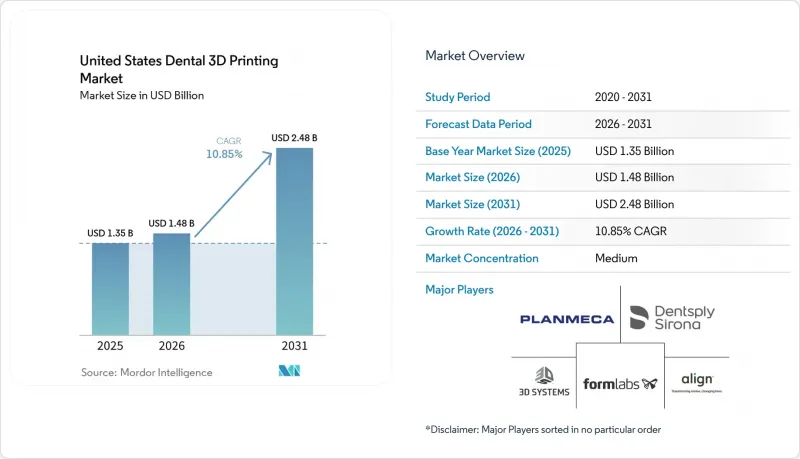
This report is Segmented by Product and Service (Equipment, Materials, Services), Technology (Vat Photopolymerization, Polyjet, SLS, FDM, Others), Material (Photopolymer/Resin, Metals, Ceramics, Others), Application (Orthodontics, Prosthodontics, and More), and End User (Dental Labs, Dental Clinics, Academic Institutes). The Market Forecasts are Provided in Terms of Value (USD).
United States Dental 3D Printing Market Trends and Insights
Customized Same-Day Appliances and Restorations Driving Chairside Adoption
Same-day dentistry is becoming a more practical operating model for practices that invest in chairside 3D printing. SprintRay stated that its Midas Digital Press can produce up to 10 restorations in under 10 minutes, and its February 2026 Chicago Midwinter preview showed multi-unit molar capability, which signals a wider clinical scope than earlier chairside systems offered. That matters because the United States dental 3D printing market is moving beyond simple front-tooth use cases toward broader restorative workflows. Early adoption is still concentrated in DSO networks that can spread capital spending and training across many locations. Independent practices remain less represented, which means the next stage of expansion depends on making validated chairside workflows easier to adopt at smaller scale.
Clear Aligner and Orthodontic Workflow Expansion
Orthodontics remains one of the strongest demand engines in the United States dental 3D printing market because treatment planning requires high print volumes and repeatable digital workflows. Align Technology reported 2.6 million case starts in fiscal 2025, including 935,800 teen and pediatric starts, which confirms that case flow in orthodontics remains strong. LuxCreo secured FDA clearance for a direct-print clear aligner resin, which moves the workflow closer to full in-office production and reduces dependence on the conventional thermoforming path. A 2025 study in Progress in Orthodontics found that certain direct-printed aligner materials delivered optical and microbiological performance comparable with thermoformed alternatives. As this model scales, resin demand will shift away from mold production and toward flexible direct-print polymers designed for active wear.
High Capital Cost and Training Burden
The shrinking technician base is becoming a structural support for automation across the United States dental 3D printing market. State labor market data showed only 33,920 dental laboratory technicians nationally in 2024, and long-term employment is projected to decline through 2032. This staffing pressure is especially significant for smaller metros and lower-density markets where recruiting replacement talent is more difficult. As a result, labs and clinics are leaning more heavily on repeatable digital processes that reduce dependence on scarce manual skills. The labor shortage does not remove the need for training, but it strengthens the payback case for automated models, guides, and restorative production.
Other drivers and restraints analyzed in the detailed report include:
- Broader FDA-Cleared Printable Material Portfolio
- Turnaround-Time and Per-Part Cost Reduction
- Limited Long-Term Evidence for Long-Wear Direct-Printed Appliances
For complete list of drivers and restraints, kindly check the Table Of Contents.
Segment Analysis
Materials captured 54.23% of the United States dental 3D printing market in 2025, which reflects how strongly both chairside and lab workflows depend on recurring resin use. Each new printer placement can create a long tail of consumable demand, so suppliers have focused on expanding validated resin libraries rather than relying only on hardware sales. That pattern helps explain why materials remained the largest segment even as new printer launches continued across the market. Equipment still matters because it is the entry point that determines which software, resins, and post-processing steps a customer is most likely to keep using.
Services are forecast to grow at an 11.91% CAGR through 2031, which makes them the fastest-moving layer inside this segmentation. The shift matters because the United States dental 3D printing industry is moving toward recurring software, workflow support, and managed production relationships rather than one-time hardware transactions alone. Vendors are reinforcing that model through integrated workflows, training programs, and partnership-led material validation that keep users inside a preferred ecosystem. As adoption widens, services should capture more value from onboarding, design support, workflow optimization, and maintenance around installed systems.
Vat photopolymerization held 32.38% of the United States dental 3D printing market size in 2025, which kept it at the center of orthodontic models, surgical guides, and crown provisional workflows. The technology remains entrenched because high-resolution output is still critical in dental use cases where fit, detail, and repeatability directly affect clinical acceptance. That position is reinforced by the breadth of cleared resin options now available on photopolymer-based systems. PolyJet and material jetting remain more specialized, but 3D Systems expanded its commercial relevance in 2026 by scaling its jetted denture platform through the NextDent 300 MultiJet printer.
Fused deposition modelling is projected to grow at a 12.73% CAGR through 2031, which makes it the fastest-growing technology segment in the United States dental 3D printing market. Its role is less about displacing vat systems and more about opening cost-conscious use cases such as educational models, custom trays, splints, and simple fabrication tasks. That matters for institutions and practices that need digital capability but do not always need the highest-end restorative resolution. Selective laser sintering keeps a place in the market for metal and nylon frameworks, though adoption remains concentrated in specialized laboratories with the process depth to manage it. The result is a technology mix where photopolymerization remains the clinical core, while FDM broadens the reachable base of users.
Complete Report Scope:
- By Product & Service
- Equipment
- Materials
- Services
- By Technology
- Vat Photopolymerization
- Stereolithography
- Digital Light Processing
- PolyJet / Material Jetting
- Selective Laser Sintering
- Fused Deposition Modelling
- Other Technologies
- Vat Photopolymerization
- By Material
- Photopolymer / Resin
- Model Resins
- Guide and Tray Resins
- Splint and Guard Resins
- Denture Base and Tooth Resins
- Crown, Bridge, and Restorative Resins
- Metals
- Cobalt Chrome
- Titanium
- Ceramics
- Other Materials
- Photopolymer / Resin
- By Application
- Orthodontics
- Aligner Models
- Direct-Printed Aligners
- Retainers
- Indirect Bonding Trays
- Prosthodontics
- Crowns and Bridges
- Denture Bases
- Denture Teeth
- Try-In Dentures
- All-on-X and Full-Arch Restorations
- Wax-Ups
- Implantology
- Surgical Guides
- Implant Models
- Custom Abutment and Restorative Workflows
- Oral and Maxillofacial Surgery
- Other Dental Applications
- Splints and Night Guards
- Custom Impression Trays
- Gingiva Masks
- Orthodontics
- By End User
- Dental Laboratories
- Dental Clinics
- Academic and Research Institutes
List of Companies Covered in this Report:
- Align Technology
- Argen
- Asiga
- Carbon, Inc.
- Dentsply Sirona
- Desktop Health
- EOS GmbH
- Formlabs
- Keystone Industries
- LuxCreo
- Pac-Dent, Inc.
- Planmeca
- Prodways Group
- Rapid Shape
- Renishaw plc
- SprintRay
- Stratasys
- Straumann Group
- 3D Systems
- Whip Mix Corporation
Additional Benefits:
- The market estimate (ME) sheet in Excel format
- 3 months of analyst support
TABLE OF CONTENTS
1 Introduction
- 1.1 Study Assumptions & Market Definition
- 1.2 Scope of the Study
2 Research Methodology
3 Executive Summary
4 Market Landscape
- 4.1 Market Overview
- 4.2 Market Drivers
- 4.2.1 Customized Same-Day Appliances and Restorations
- 4.2.2 Clear Aligner and Orthodontic Workflow Expansion
- 4.2.3 Broader FDA-Cleared Printable Material Portfolio
- 4.2.4 Turnaround-Time and Per-Part Cost Reduction
- 4.2.5 Dental Lab Technician Shortages Accelerating Automation ROI
- 4.2.6 Direct-Print Appliance Workflows Reducing Thermoforming Steps
- 4.3 Market Restraints
- 4.3.1 High Capital Cost and Training Burden
- 4.3.2 Regulatory And Material-Validation Requirements
- 4.3.3 Limited Long-Term Evidence for Long-Wear Direct-Printed Appliances
- 4.3.4 External Lab Dependence Slowing Chairside Printer Conversion
- 4.4 Value / Supply-Chain Analysis
- 4.5 Regulatory Landscape
- 4.6 Technological Outlook
- 4.7 Porter's Five Forces Analysis
- 4.7.1 Threat of New Entrants
- 4.7.2 Bargaining Power of Suppliers
- 4.7.3 Bargaining Power of Buyers
- 4.7.4 Threat of Substitutes
- 4.7.5 Industry Rivalry
5 Market Size & Growth Forecasts
- 5.1 By Product & Service
- 5.1.1 Equipment
- 5.1.2 Materials
- 5.1.3 Services
- 5.2 By Technology
- 5.2.1 Vat Photopolymerization
- 5.2.1.1 Stereolithography
- 5.2.1.2 Digital Light Processing
- 5.2.2 PolyJet / Material Jetting
- 5.2.3 Selective Laser Sintering
- 5.2.4 Fused Deposition Modelling
- 5.2.5 Other Technologies
- 5.2.1 Vat Photopolymerization
- 5.3 By Material
- 5.3.1 Photopolymer / Resin
- 5.3.1.1 Model Resins
- 5.3.1.2 Guide and Tray Resins
- 5.3.1.3 Splint and Guard Resins
- 5.3.1.4 Denture Base and Tooth Resins
- 5.3.1.5 Crown, Bridge, and Restorative Resins
- 5.3.2 Metals
- 5.3.2.1 Cobalt Chrome
- 5.3.2.2 Titanium
- 5.3.3 Ceramics
- 5.3.4 Other Materials
- 5.3.1 Photopolymer / Resin
- 5.4 By Application
- 5.4.1 Orthodontics
- 5.4.1.1 Aligner Models
- 5.4.1.2 Direct-Printed Aligners
- 5.4.1.3 Retainers
- 5.4.1.4 Indirect Bonding Trays
- 5.4.2 Prosthodontics
- 5.4.2.1 Crowns and Bridges
- 5.4.2.2 Denture Bases
- 5.4.2.3 Denture Teeth
- 5.4.2.4 Try-In Dentures
- 5.4.2.5 All-on-X and Full-Arch Restorations
- 5.4.2.6 Wax-Ups
- 5.4.3 Implantology
- 5.4.3.1 Surgical Guides
- 5.4.3.2 Implant Models
- 5.4.3.3 Custom Abutment and Restorative Workflows
- 5.4.4 Oral and Maxillofacial Surgery
- 5.4.5 Other Dental Applications
- 5.4.5.1 Splints and Night Guards
- 5.4.5.2 Custom Impression Trays
- 5.4.5.3 Gingiva Masks
- 5.4.1 Orthodontics
- 5.5 By End User
- 5.5.1 Dental Laboratories
- 5.5.2 Dental Clinics
- 5.5.3 Academic and Research Institutes
6 Competitive Landscape
- 6.1 Market Concentration
- 6.2 Market Share Analysis
- 6.3 Company Profiles (includes Global level Overview, Market-level Overview, Core Segments, Financials, Strategic Information, Market Rank/Share, Products & Services, Recent Developments)
- 6.3.1 Align Technology, Inc.
- 6.3.2 Argen Corporation
- 6.3.3 Asiga
- 6.3.4 Carbon, Inc.
- 6.3.5 Dentsply Sirona
- 6.3.6 Desktop Health
- 6.3.7 EOS GmbH
- 6.3.8 Formlabs
- 6.3.9 Keystone Industries
- 6.3.10 LuxCreo
- 6.3.11 Pac-Dent, Inc.
- 6.3.12 Planmeca Oy
- 6.3.13 Prodways Group
- 6.3.14 Rapid Shape GmbH
- 6.3.15 Renishaw plc
- 6.3.16 SprintRay
- 6.3.17 Stratasys Ltd.
- 6.3.18 Straumann Group
- 6.3.19 3D Systems
- 6.3.20 Whip Mix Corporation
7 Market Opportunities & Future Outlook
- 7.1 White-space & Unmet-need Assessment

