PUBLISHER: Mordor Intelligence | PRODUCT CODE: 2097410

PUBLISHER: Mordor Intelligence | PRODUCT CODE: 2097410
US Prostate Laser Surgery - Market Share Analysis, Industry Trends & Statistics, Growth Forecasts (2026 - 2031)
According to Mordor Intelligence, the US prostate laser surgery market size is projected to be USD 0.75 billion in 2025, USD 0.8 billion in 2026, and reach USD 1.17 billion by 2031, growing at a CAGR of 7.75% from 2026 to 2031.
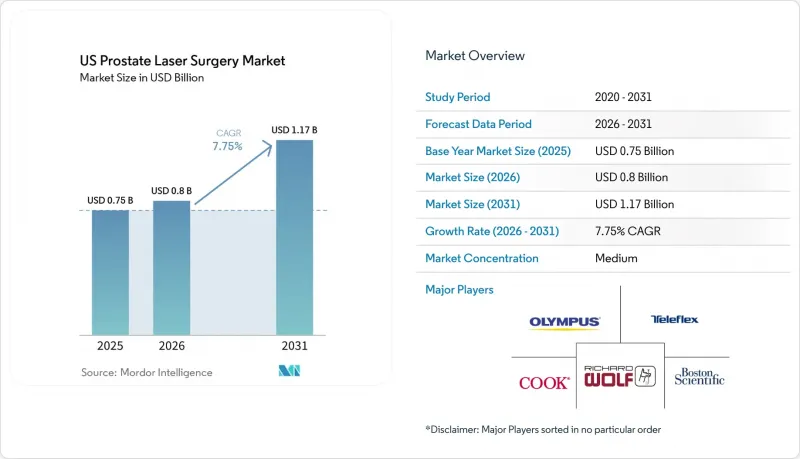
This report is Segmented by Offering (Capital Laser Systems, Laser Fibers and Consumables, Morcellators, Service and Software), Procedure Type (PVP, and More, Laser Technology (532 Nm KTP, Ho:yag, Thulium Fiber, Tm:yag, Diode)), Site of Care (Inpatient, Outpatient, ASC, Office-Based), and Prostate Size ( 150 G). Value (USD).
US Prostate Laser Surgery Market Trends and Insights
Aging US BPH Burden and Rising Surgical Complexity
The aging male population in the United States, particularly those with BPH and LUTS, is driving the prostate laser surgery market. BPH prevalence among men aged 65 and older ranged from 29% to 35% annually in Medicare populations, with 600,000 new cases identified each year. This group, burdened with comorbidities like hypertension (81%), coronary artery disease (39%), and diabetes (35%), increasingly prefers procedures offering better hemostasis and simpler perioperative management. Despite this, only 2% of BPH surgeries involved enucleation from 2014 to 2023, indicating significant growth potential as referrals shift to high-volume laser centers equipped for complex cases.
Guideline-Backed Shift Toward Size-Independent Laser Procedures
The United States prostate laser surgery market gained momentum when the AUA recommended HoLEP and ThuLEP as size-independent solutions for LUTS and BPH, alongside GreenLight PVP for patients at higher bleeding risk. This guidance removed the perception that enucleation is only for large glands. Academic centers have already seen laser enucleation rise from 13.7% of BPH surgeries 27.7% in early 2024, with annual utilization increasing by 52%. Community practices are also aligning with these guidelines, ensuring evidence-based case selection over outdated practices.
HoLEP and ThuLEP Training Bottleneck
The United States prostate laser surgery market faces a significant challenge in surgeon training. As of 2024, only 12% of endourology fellowships in the country included formal HoLEP training, and 25% of surveyed HoLEP surgeons reported not teaching the technique. Achieving proficiency in HoLEP and ThuLEP typically requires 40 to 60 supervised cases, a hurdle for community hospitals with limited procedure volumes. This has created a divide where academic and regional centers advance enucleation expertise, while community practices focus on PVP or non-laser MIST. Without scalable training pathways, growth in the United States prostate laser surgery market will remain uneven across regions and facility types.
Other drivers and restraints analyzed in the detailed report include:
- Outpatient Migration and Bleeding-Risk Advantages
- Wait-List Pressure for Catheter-Dependent BPH Patients
- Non-Laser BPH Alternatives Divert Capital and Case Volume
For complete list of drivers and restraints, kindly check the Table Of Contents.
Segment Analysis
In 2025, Laser Fibers and Disposable Consumables contributed 46.21% of the revenue, making them the largest offering in the United States prostate laser surgery market. This reflects the recurring revenue model, as each HoLEP or ThuFLEP procedure requires single-use fibers and related items. With case volumes expected to rise from 2026 to 2031, this category will remain a reliable revenue stream, scaling directly with procedure counts.
Capital Laser Systems held a smaller share but are critical for driving future disposable demand. Each new platform placed in an ASC or community hospital secures long-term accessory and fiber usage. Morcellators and Accessory Instruments, growing at 8.12% CAGR through 2031, are driven by the increasing adoption of enucleation procedures, where morcellation is essential post-adenoma separation.
Photoselective Vaporization of the Prostate (PVP) accounted for 40.45% of procedure-type revenue in 2025, maintaining its lead in the United States prostate laser surgery market. Its dominance stems from widespread adoption, familiarity with the GreenLight platform, and suitability for lower-complexity cases in outpatient settings. However, enucleation procedures are steadily gaining traction, reshaping the procedural mix.
Laser enucleation increased from 13.7% of BPH surgical procedures in 2018 to 24.4% in 2021-2022 across academic centers. Thulium Fiber Laser Enucleation of the Prostate, growing at 7.12% CAGR through 2031, is supported by FDA clearances and clinical evidence. This shift creates a balanced procedure mix, with PVP retaining its broad base and enucleation expanding in complex cases.
Complete Report Scope:
- By Offering
- Capital Laser Systems
- Laser Fibers and Disposable Consumables
- Morcellators and Accessory Instruments
- Service, Maintenance and Software
- By Procedure Type
- Photoselective Vaporization of the Prostate
- Holmium Laser Enucleation of the Prostate
- Thulium Laser Enucleation of the Prostate
- Thulium Fiber Laser Enucleation of the Prostate
- Thulium Laser Vaporization and Vaporesection
- Diode Laser Vaporization
- By Laser Technology
- 532 nm KTP and Green Laser
- Holmium:YAG Laser
- Thulium Fiber Laser
- Thulium:YAG Laser
- Diode Laser
- By Site of Care
- Hospital Inpatient
- Hospital Outpatient Department
- Ambulatory Surgery Center
- Office-Based Urology Suite
- By Prostate Size Treated
- Less than 30 g
- 30 g to 80 g
- More than 80 g to 150 g
- More than 150 g
List of Companies Covered in this Report:
- Allengers
- B. Braun
- Biolitec
- Boston Scientific
- Cook Group
- Dornier MedTech Systems GmbH
- InnoVoyce, Inc.
- Karl Storz
- Laborie
- LISA Laser Products GmbH
- Medline Industries
- Olympus
- OmniGuide Holdings, Inc.
- Quanta System S.p.A.
- Richard Wolf
- Teleflex
Additional Benefits:
- The market estimate (ME) sheet in Excel format
- 3 months of analyst support
TABLE OF CONTENTS
1 Introduction
- 1.1 Study Assumptions & Market Definition
- 1.2 Scope of the Study
2 Research Methodology
3 Executive Summary
4 Market Landscape
- 4.1 Market Overview
- 4.2 Market Drivers
- 4.2.1 Aging US BPH Burden and Rising Surgical Complexity
- 4.2.2 Guideline-Backed Shift Toward Size-Independent Laser Surgery
- 4.2.3 Outpatient Migration and Bleeding-Risk Advantage
- 4.2.4 Wait-List Pressure for Catheter-Dependent BPH Patients
- 4.2.5 Compact Plug-and-Play Platforms Expand Multi-Site Deployment
- 4.3 Market Restraints
- 4.3.1 Holep and Thulep Training Bottleneck
- 4.3.2 Non-Laser BPH Alternatives Divert Capital and Cases
- 4.3.3 Tissue-Free Vaporization Reduces Incidental Pathology Yield
- 4.4 Supply/Value Chain Analysis
- 4.5 Regulatory Landscape
- 4.6 Technological Outlook
- 4.7 Porter's Five Forces Analysis
- 4.7.1 Threat of New Entrants
- 4.7.2 Bargaining Power of Suppliers
- 4.7.3 Bargaining Power of Buyers
- 4.7.4 Threat of Substitutes
- 4.7.5 Industry Rivalry
5 Market Size & Growth Forecasts (Value, USD)
- 5.1 By Offering
- 5.1.1 Capital Laser Systems
- 5.1.2 Laser Fibers and Disposable Consumables
- 5.1.3 Morcellators and Accessory Instruments
- 5.1.4 Service, Maintenance and Software
- 5.2 By Procedure Type
- 5.2.1 Photoselective Vaporization of the Prostate
- 5.2.2 Holmium Laser Enucleation of the Prostate
- 5.2.3 Thulium Laser Enucleation of the Prostate
- 5.2.4 Thulium Fiber Laser Enucleation of the Prostate
- 5.2.5 Thulium Laser Vaporization and Vaporesection
- 5.2.6 Diode Laser Vaporization
- 5.3 By Laser Technology
- 5.3.1 532 nm KTP and Green Laser
- 5.3.2 Holmium:YAG Laser
- 5.3.3 Thulium Fiber Laser
- 5.3.4 Thulium:YAG Laser
- 5.3.5 Diode Laser
- 5.4 By Site of Care
- 5.4.1 Hospital Inpatient
- 5.4.2 Hospital Outpatient Department
- 5.4.3 Ambulatory Surgery Center
- 5.4.4 Office-Based Urology Suite
- 5.5 By Prostate Size Treated
- 5.5.1 Less than 30 g
- 5.5.2 30 g to 80 g
- 5.5.3 More than 80 g to 150 g
- 5.5.4 More than 150 g
6 Competitive Landscape
- 6.1 Market Concentration
- 6.2 Market Share Analysis
- 6.3 Company Profiles (includes Global level Overview, Market level overview, Core Segments, Financials as available, Strategic Information, Market Rank/Share for key companies, Products & Services, and Recent Developments)
- 6.3.1 Allengers Medical Systems Limited
- 6.3.2 B. Braun Melsungen AG
- 6.3.3 biolitec AG
- 6.3.4 Boston Scientific Corporation
- 6.3.5 Cook Medical LLC
- 6.3.6 Dornier MedTech Systems GmbH
- 6.3.7 InnoVoyce, Inc.
- 6.3.8 KARL STORZ SE & Co. KG
- 6.3.9 Laborie Medical Technologies Corp.
- 6.3.10 LISA Laser Products GmbH
- 6.3.11 Medline Industries, LP
- 6.3.12 Olympus Corporation
- 6.3.13 OmniGuide Holdings, Inc.
- 6.3.14 Quanta System S.p.A.
- 6.3.15 Richard Wolf GmbH
- 6.3.16 Teleflex Incorporated
7 Market Opportunities & Future Outlook
- 7.1 White-space & Unmet-Need Assessment

