PUBLISHER: Mordor Intelligence | PRODUCT CODE: 2097497

PUBLISHER: Mordor Intelligence | PRODUCT CODE: 2097497
Black Seed Oil - Market Share Analysis, Industry Trends & Statistics, Growth Forecasts (2026 - 2031)
According to Mordor Intelligence, the black seed oil market size was USD 104.83 million in 2025 and is projected to reach USD 169.50 million by 2031, growing at a CAGR of 8.57% during 2026 to 2031.
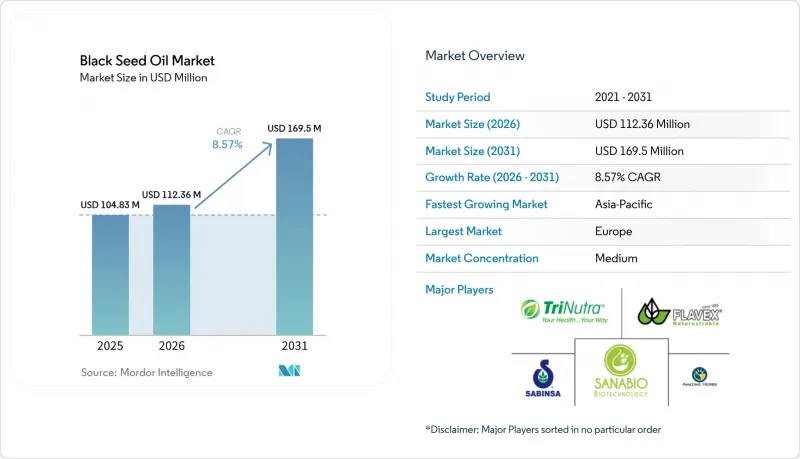
This report is Segmented by Category (Conventional and Organic), End Use (Industrial: Supplements, Cosmetics and Personal Care, Food and Beverages, and Other Industrial Uses; Retail: Offline Retail and Online Retail), and Geography (North America, Europe, Asia-Pacific, and Rest of the World). The Market Forecasts are Provided in Terms of Value (USD).
Global Black Seed Oil Market Trends and Insights
Rising demand for clean-label botanical supplements
Globally, consumer demand is shifting towards ingredients that are traceable, minimally processed, and devoid of synthetic additives, reshaping the landscape of supplement procurement. Black seed oil, traditionally revered and composed of a single ingredient, resonates perfectly with this evolving preference. A systematic review and meta-analysis, set for 2025, scrutinized 82 randomized controlled trials with over 5,000 participants. Published in a peer-reviewed journal, the findings highlighted that supplementation with Nigella sativa notably enhanced cardiometabolic markers. These included blood pressure, LDL cholesterol, fasting blood sugar, HbA1c, and inflammatory markers like CRP and IL-6. Notably, oil-based supplements outshone their powder counterparts. Such robust clinical evidence is now steering procurement choices. Formulators are increasingly designating Nigella sativa as a favored botanical, placing it alongside established names like turmeric and ashwagandha. This push for clean-label products is especially pronounced in Europe. Here, the EU's Regulation (EU) No. 2019/1381, part of the General Food Law, mandates traceability and risk analysis. This regulation effectively narrows the field to suppliers with certified and credentialed origins.
Expanded use in standardized supplement formulations
Black seed oil is transitioning from a traditional remedy to a clinically standardized ingredient, carving out a premium niche in the nutraceuticals sector. Buyers in North America and Europe are increasingly demanding specific thymoquinone content: typically 1.0-2.5% for nutraceutical-grade nigella sativa oil and over 3% for pharmaceutical-grade uses. Moreover, third-party testing has become a norm for private-label contracts. By early 2026, over 40 active clinical trials globally were probing thymoquinone's potential benefits for conditions like type 2 diabetes, hypertension, asthma, and non-alcoholic fatty liver disease. This push for standardization is reshaping the industry landscape: while it's elevating capital demands for extraction and quality testing, putting smaller commodity producers at a disadvantage, it's simultaneously fortifying the position of vertically integrated ingredient firms. This trend has garnered validation from Health Canada. In March 2024, the agency greenlit six structure-function claims for a standardized black seed oil ingredient, underscoring a regulatory tilt towards evidence-backed botanical assertions.
Intense commercial competition from alternative functional plant oils
Black seed oil finds itself vying for shelf space and formulation budgets with an expanding array of functional botanicals. These include sea buckthorn, moringa seed oil, hemp seed oil, and black raspberry seed oil, all touting similar antioxidant and anti-inflammatory benefits. While black seed oil stands out, many of its competitors enjoy advantages: they boast larger cultivation bases, offer a lower price-per-unit, and have established supply chains. This gives procurement teams a strong incentive to pivot to these alternatives, especially when prices for Nigella sativa rise. The challenge is even more pronounced in the cosmetics and personal care arena. Here, formulators frequently test ingredients side-by-side and aren't tied to any single botanical. An often-overlooked competitive angle comes from functional plant oil blends. These blends, marketed under proprietary names, mask their individual ingredients and challenge pure black seed oil, focusing on product claims rather than ingredient clarity.
Other drivers and restraints analyzed in the detailed report include:
- Premiumization through thymoquinone standardization
- Growth of D2C and marketplace distribution
- Supply risk from climate-linked nigella sativa crop variability
For complete list of drivers and restraints, kindly check the Table Of Contents.
Segment Analysis
In 2025, conventional black seed oil dominated the market, claiming a 73.62% share. Its stronghold is evident across bulk industrial channels and mainstream retail outlets, where price sensitivity drives purchasing decisions. Meanwhile, the organic segment is set to outpace the overall market, with a projected growth rate of 9.11% CAGR from 2026 to 2031, surpassing the market's 8.57% rate. This surge is attributed to organic-certified Nigella sativa supplies from Egypt and India, which are gradually bridging the price gap with their conventional counterparts. In 2024, India's exports of Nigella sativa oil to Europe hit EUR 23 million, despite a slight growth plateau. Concurrently, Egypt's exports to Europe, valued at EUR 2.3 million, featured suppliers offering cold-pressed oil derived from organically farmed seeds, boasting a thymoquinone content of 6-7%.
For conventional producers, the rising organic share signals more than just a market shift; it's a clear indication that organic certification is becoming crucial for accessing premium channels in the EU and North America. The only commercially viable methods for extracting organically certified black seed oil are cold-pressed and supercritical CO2 extraction. This reality amplifies value creation for processors equipped with the necessary capital-intensive extraction infrastructure. Take FLAVEX Naturextrakte GmbH, for example. They produce a certified-organic black cumin CO2 extract, boasting a thymoquinone content of over 3% and holding the DE-OKO-013 certification. Their primary targets are European nutraceutical and cosmetics formulators, a strategic positioning that shields them from the volatility of commodity price competition. In Turkey's Bucak district, Nigella sativa cultivation has surged by 120%. These oils, containing up to 8% thymoquinone, double the global average, are now eyeing geographical indication certification. This move could carve out a premium sub-tier within the conventional category.
Complete Report Scope:
- Category
- Conventional
- Organic
- End Use
- Industrial
- Supplements
- Cosmetics and Personal Care
- Food and Beverages
- Other Industrial Uses
- Retail
- Offline Retail
- Online Retail
- Industrial
- Geography
- North America
- Europe
- Asia-Pacific
- Rest of the World
Geography Analysis
In 2025, Europe commanded a dominant 34.4% share of the market, solidifying its top regional position. Major consumer economies in the region bolster demand for herbal supplements, clean-beauty products, and specialty food ingredients. Germany emerges as a key player, boasting robust end-market demand and processing capabilities, notably with FLAVEX Naturextrakte GmbH's supercritical CO2 extraction. The region's stringent compliance standards directly influence supplier selection. Notably, the EU Rapid Alert System for Food and Feed flagged multiple black seed oil shipments in 2024 and 2025, citing contaminants and residue issues. This has nudged buyers towards suppliers with certified origins and documented testing. Thus, Europe's share in the black seed oil market underscores both its demand strength and a regulatory landscape favoring qualified suppliers.
Asia-Pacific is set to outpace others, with a projected 9.4% CAGR from 2026 to 2031, marking it as the fastest-growing regional segment. Unlike Europe, its growth marries traditional cultural use with a modern supplement surge. Demand from the South Asian, Southeast Asian, and Middle Eastern diasporas sustains baseline consumption. Meanwhile, urban wellness trends are gaining traction in Australia, Singapore, and India. India's dual role as a major consumption hub and a pivotal production base shapes the region's black seed oil landscape. India's FSSAI standards for cold-pressed seed oils, effective December 2026, could standardize domestic quality and impact export grades. This regulatory move might enhance quality consistency in the Asia-Pacific black seed oil market, especially for suppliers eyeing premium cross-border sales.
While North America didn't lead in market share, it remains a hotbed for innovation in the black seed oil arena. Growth is driven more by direct-to-consumer sales, clinical endorsements, and ingredient standardization than by traditional usage. Health Canada's March 2024 nod to six structure-function claims for a standardized ingredient bolsters the credibility of evidence-based products on regional shelves. The "Rest of the World," encompassing the Middle East, Latin America, and Africa, showcases a blend of entrenched consumption habits and an underdeveloped value-added product landscape. This scenario paves the way for premium brands and ingredient specialists to penetrate the market, especially through digital channels where trust, education, and clear packaging often outweigh the need for extensive physical distribution. As the black seed oil market diversifies across regions, success hinges on suppliers' ability to align with local regulatory standards, sourcing strategies, and distribution channels.
- TriNutra Ltd
- Sabinsa Corporation
- FLAVEX Naturextrakte GmbH
- Safa Honey Co.
- ConnOils LLC
- SanaBio GmbH
- Amazing Herbs
- The Kerfoot Group
- Z-Company BV
- OPW Ingredients GmbH
- Manish Agro
- Nature's Blends
- The Black Seed Oil Co.
- Medikonda Nutrients
- Naturoil GIda ve Kimya San Tic. Ltd. Sti.
- A.G. Organica
- Herbal Wind
- Nutritunes
- Nature's Way
- Blackmores
Additional Benefits:
- The market estimate (ME) sheet in Excel format
- 3 months of analyst support
TABLE OF CONTENTS
1 INTRODUCTION
- 1.1 Study Assumptions and Market Definition
- 1.2 Scope of the Study
2 RESEARCH METHODOLOGY
3 EXECUTIVE SUMMARY
4 MARKET LANDSCAPE
- 4.1 Market Overview
- 4.2 Market Drivers
- 4.2.1 Rising Demand for Clean Label Botanical Supplements
- 4.2.2 Expanded Use in Standardized Supplement Formulations
- 4.2.3 Premiumization Through Thymoquinone Standardization
- 4.2.4 Growth of D2C and Marketplace Distribution
- 4.2.5 Strategic Shift from Synthetic Ingredients to Organic Botanical Alternatives
- 4.2.6 Advancements in Cold-Pressed and Supercritical CO2 Extraction Technologies
- 4.3 Market Restraints
- 4.3.1 Intense Commercial Competition from Alternative Functional Plant Oils
- 4.3.2 Supply Risk from Climate-Linked Nigella Sativa Crop Variability
- 4.3.3 Regulatory Sensitivity for Botanical Claims and Labeling
- 4.3.4 Product Adulteration, Contamination, and Mislabelling Eroding Consumer Trust
- 4.4 Supply Chain Analysis
- 4.5 Regulatory Landscape
- 4.6 Porter's Five Forces
- 4.6.1 Threat of New Entrants
- 4.6.2 Bargaining Power of Buyers
- 4.6.3 Bargaining Power of Suppliers
- 4.6.4 Threat of Substitutes
- 4.6.5 Intensity of Competitive Rivalry
5 MARKET SIZE AND GROWTH FORECASTS (VALUE)
- 5.1 Category
- 5.1.1 Conventional
- 5.1.2 Organic
- 5.2 End Use
- 5.2.1 Industrial
- 5.2.1.1 Supplements
- 5.2.1.2 Cosmetics and Personal Care
- 5.2.1.3 Food and Beverages
- 5.2.1.4 Other Industrial Uses
- 5.2.2 Retail
- 5.2.2.1 Offline Retail
- 5.2.2.2 Online Retail
- 5.2.1 Industrial
- 5.3 Geography
- 5.3.1 North America
- 5.3.2 Europe
- 5.3.3 Asia-Pacific
- 5.3.4 Rest of the World
6 COMPETITIVE LANDSCAPE
- 6.1 Market Concentration
- 6.2 Strategic Moves
- 6.3 Market Ranking Analysis
- 6.4 Company Profiles
- 6.4.1 TriNutra Ltd
- 6.4.2 Sabinsa Corporation
- 6.4.3 FLAVEX Naturextrakte GmbH
- 6.4.4 Safa Honey Co.
- 6.4.5 ConnOils LLC
- 6.4.6 SanaBio GmbH
- 6.4.7 Amazing Herbs
- 6.4.8 The Kerfoot Group
- 6.4.9 Z-Company BV
- 6.4.10 OPW Ingredients GmbH
- 6.4.11 Manish Agro
- 6.4.12 Nature's Blends
- 6.4.13 The Black Seed Oil Co.
- 6.4.14 Medikonda Nutrients
- 6.4.15 Naturoil GIda ve Kimya San Tic. Ltd. Sti.
- 6.4.16 A.G. Organica
- 6.4.17 Herbal Wind
- 6.4.18 Nutritunes
- 6.4.19 Nature's Way
- 6.4.20 Blackmores
7 MARKET OPPORTUNITIES AND FUTURE OUTLOOK

