PUBLISHER: Mordor Intelligence | PRODUCT CODE: 2097499

PUBLISHER: Mordor Intelligence | PRODUCT CODE: 2097499
China Vitamins - Market Share Analysis, Industry Trends & Statistics, Growth Forecasts (2026 - 2031)
According to Mordor Intelligence, the China vitamins market size was valued at USD 521.77 million in 2025 and estimated to grow from USD 551.17 million in 2026 to reach USD 729.41 million by 2031, at a CAGR of 5.76% during the forecast period (2026-2031).
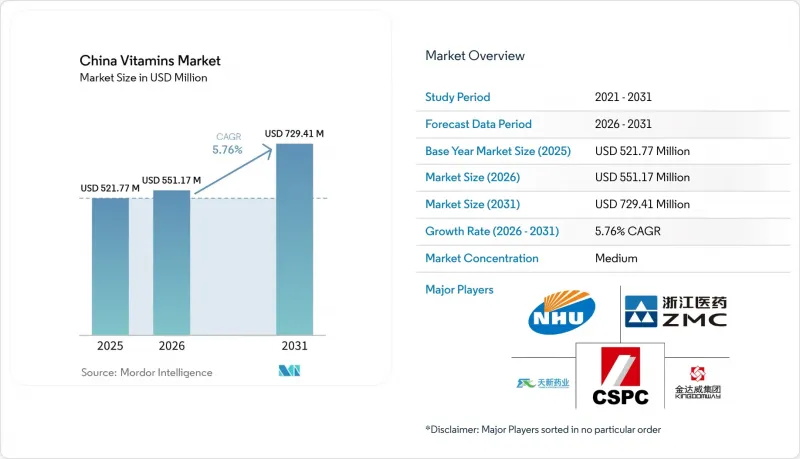
This report is Segmented by Type (Vitamin A, B-Complex, C, D, E, K, Others), Source (Synthetic, Natural), Product Type (Single Vitamin Ingredients, Vitamin Premixes and Blends), Form (Powders, Liquids, Others), and Application (Food and Beverages, Dietary Supplements, Animal Feed and Pet Nutrition, Pharmaceuticals, Cosmetics and Personal Care). The Market Forecasts are Provided in Terms of Value (USD).
China Vitamins Market Trends and Insights
Rising preventive nutrition adoption among urban consumers
Urban consumers are treating vitamin intake less as an occasional remedy and more as part of a daily health routine, and that shift is giving the China vitamins market a broader and more stable demand base. Purchase behavior is becoming more consistent because immunity, energy, bone strength, and overall wellness are now more closely tied to work pace, family care, and long-term aging concerns than before. This pattern is strongest in large cities, where consumers are more likely to compare formats, look for targeted use cases, and return for repeat purchases when a product fits a simple daily routine. The policy tone of the 2025 Food and Nutrition Development Guideline also supports this change, as it places greater emphasis on improved nutrient intake, better diet quality, and more active management of deficiency risk across population groups. As a result, the China vitamins market is gaining not only more users, but also a more disciplined purchase cycle that favors reliable supply, quality assurance, and product formats that feel easy to use every day.
Premium demand shift toward specialized vitamin formulations
Consumers are trading up from low-cost single-nutrient tablets to high-absorption, synergistic, and clinically positioned vitamin formulations, pulling average unit values upward faster than volume growth alone would suggest. The natural vitamin E premium, with natural-source products priced roughly 2X higher than synthetic equivalents, exemplifies this bifurcation, as high-end wellness buyers treat the natural/synthetic distinction as a quality signal even when bioequivalence differences are modest. The China Nutrition Society's bone nutrition division published the 2025 New Era Bone Health and Nutritional White Paper in August 2025, formally endorsing the Ca + Vitamin D + Vitamin K2 synergy protocol for children, pregnant women, and adults over 45, directly catalyzing a wave of premium multi-nutrient bone-health product launches. This clinical endorsement is migrating consumer preference from basic calcium tablets toward liquid calcium formulations with Vitamin D3 and K2 combinations, products that BY-HEALTH launched in September 2025 exclusively on JD Health, debuting at the top of JD's all-category sales ranking on launch day.
Regulatory complexity for health food and supplement claims
China's dual-track registration and filing system for health foods, administered by the National Medical Products Administration (NMPA) and the SAMR, imposes compliance costs that small- and mid-tier vitamin brands struggle to absorb, effectively concentrating market power among larger players with dedicated regulatory teams. The 2025 version of the China Pharmacopeia (effective October 2025) introduced more stringent quality specifications for pharmaceutical-grade vitamins, requiring costly process validations that disadvantage manufacturers without GMP-compliant facilities. SAMR's 2024 enforcement data showed a 30% year-on-year increase in penalty cases related to false health claims and non-compliant product labeling, raising legal risk for brands that rely on ambiguous functional language. The second-order constraint is time-to-market: the 5-year transition window for non-nutrient supplement health foods to comply with the 2023 permissible health function directory is forcing formulators to choose between costly reformulation and product discontinuation, disrupting product pipelines across the mid-market segment.
Other drivers and restraints analyzed in the detailed report include:
- Government focus on nutrition deficiency reduction
- Expansion of functional food and beverage fortification
- Supply chain volatility in imported specialty inputs
For complete list of drivers and restraints, kindly check the Table Of Contents.
Segment Analysis
Vitamin B-complex accounted for 38.73% of the value in 2025, making it the largest type segment in the China vitamins market, while Vitamin D is projected to grow fastest at a 6.67% CAGR through 2031. B-complex has retained its lead because it serves several stable demand pools simultaneously, including pharmaceutical formulations, functional beverages, and routine nutritional products that require widely accepted, cost-effective ingredients. Its position is supported by practical use across daily wellness formats and industrial applications, which gives it broader resilience than more narrowly positioned vitamin categories. The China vitamins industry also continues to rely on B-complex as a familiar and scalable ingredient cluster, which helps explain why it remains large even as newer premium themes gain attention. At the same time, the strongest momentum is moving toward Vitamin D, driven by deficiency awareness, aging concerns, and a stronger consumer focus on bone and immune support.
Vitamin D is gaining ground because clinical evidence of deficiency provides brands and healthcare-linked channels with a clearer basis for recommendations, making the category more actionable for both families and older consumers. The China CDC study cited in the source material showed 41.2% insufficiency and 23.9% deficiency among children aged 3 to 17 across 14 provincial divisions, reinforcing the view that demand growth is tied to a real nutritional gap rather than a passing wellness theme. Vitamins C and E remain important because they continue to serve pharmaceutical, food, and personal care uses, while Vitamin A is becoming more divided between lower-margin commodity grades and more defensible high-purity uses. Vitamin K also benefits indirectly because it is increasingly discussed alongside Vitamin D in bone-support routines, which helps blended products rather than single nutrients alone. Overall, type-level competition in the China vitamins market is no longer defined only by volume scale, because the fastest growth is now moving toward vitamins linked to clear deficiency correction and targeted health outcomes.
Synthetic vitamins accounted for 71.56% of the value in 2025, which shows how strongly the China vitamins market still depends on scalable, cost-efficient manufacturing for mainstream supply. This dominance is consistent with China's global production role, as synthetic routes are easier to scale and standardize, and more suitable for large-volume applications in food, feed, pharmaceutical, and supplement manufacturing. Synthetic products also remain central to categories where buyers prioritize consistent specification, price discipline, and reliable industrial output over origin-based positioning. For that reason, synthetic supply should remain the foundation of the China vitamins market through the forecast period, especially in categories tied to mass-market use and export-linked capacity. Even so, the growth pattern is shifting because natural vitamins are expected to expand at a 6.75% CAGR through 2031, which is faster than the market average.
Natural-source vitamins are gaining attention because premium consumers often read source claims as markers of quality, safety, and perceived effectiveness, even when technical differences are not always the main purchase driver. This creates a better pricing environment for companies that can prove traceability, manage natural feedstocks, and keep product consistency high enough for regulated applications and premium finished products. It also supports more value creation in the China vitamins industry because natural-source claims are easier to connect with wellness, beauty, and higher-end nutrition positioning than purely synthetic commodity output. In practice, this means natural vitamins may remain smaller in scale, but they are likely to play a larger role in margins, brand differentiation, and premium product development. The source split therefore shows a China vitamins market that still rests on synthetic scale, while increasingly rewarding natural-origin offerings where consumers are willing to pay more for a stronger quality signal.
Complete Report Scope:
- By Type
- Vitamin A
- Vitamin B-complex
- Vitamin C
- Vitamin D
- Vitamin E
- Vitamin K
- Others
- By Source
- Synthetic
- Natural
- Plant Derived
- Animal Derived
- By Product Type
- Single Vitamin Ingredients
- Vitamin Premixes and Blends
- By Form
- Powders
- Liquids
- Others
- By Application
- Food and Beverages
- Dietary Supplements
- Animal Feed and Pet Nutrition
- Pharmaceuticals
- Cosmetics and Personal Care
List of Companies Covered in this Report:
- Zhejiang NHU Co., Ltd.
- Zhejiang Medicine Co., Ltd. / ZMC
- Xiamen Kingdomway Group Co., Ltd.
- CSPC Weisheng Pharmaceutical / CSPC Pharmaceutical Group
- Jiangsu Jiangshan Pharmaceutical Co., Ltd.
- Shandong Luwei Pharmaceutical Group Co., Ltd.
- Anhui Tiger Biotech Co., Ltd. / China BBCA Group
- Jiangxi Tianxin Pharmaceutical Co., Ltd.
- Xinfa Pharmaceutical Co., Ltd.
- Huazhong Pharmaceutical Co., Ltd.
- DSM-Firmenich AG
- BASF SE
- Brenntag SE / Zhongbai Xingye Food Technology
- DKSH Holding AG
- Zhejiang Garden Biopharmaceutical Co., Ltd.
- Zhejiang Hisun Pharmaceutical Co., Ltd.
- Jilin Beisha Pharmaceutical Co., Ltd.
- Sinochem Health Company Ltd.
- Sinobright Import & Export Co., Ltd.
- Beyron Ltd.
Additional Benefits:
- The market estimate (ME) sheet in Excel format
- 3 months of analyst support
TABLE OF CONTENTS
1 INTRODUCTION
- 1.1 Study Assumptions and Market Definition
- 1.2 Scope of the Study
2 RESEARCH METHODOLOGY
3 EXECUTIVE SUMMARY
4 MARKET DYNAMICS
- 4.1 Market Overview
- 4.2 Market Drivers
- 4.2.1 Rising Preventive Nutrition Adoption Among Urban Consumers
- 4.2.2 Premium Demand Shift Toward Specialized Vitamin Formulations
- 4.2.3 Rapid E-Commerce Penetration for Daily Supplement Purchases
- 4.2.4 Government Focus on Nutrition Deficiency Reduction
- 4.2.5 Growth in Beauty-From-Within and Bone-Health Use Cases
- 4.2.6 Expansion of Functional Food and Beverage Fortification
- 4.3 Market Restraints
- 4.3.1 Regulatory Complexity for Health Food and Supplement Claims
- 4.3.2 Price Pressure in Commodity Vitamin Ingredients
- 4.3.3 Consumer Skepticism Toward Homogenized Vitamin Products
- 4.3.4 Supply Chain Volatility in Imported Specialty Inputs
- 4.4 Supply Chain Analysis
- 4.5 Regulatory Landscape
- 4.6 Technological Outlook
- 4.7 Porter's Five Forces
- 4.7.1 Threat of New Entrants
- 4.7.2 Bargaining Power of Buyers/Consumers
- 4.7.3 Bargaining Power of Suppliers
- 4.7.4 Threat of Substitute Products
- 4.7.5 Intensity of Competitive Rivalry
5 MARKET SIZE AND GROWTH FORECASTS (VALUE)
- 5.1 By Type
- 5.1.1 Vitamin A
- 5.1.2 Vitamin B-complex
- 5.1.3 Vitamin C
- 5.1.4 Vitamin D
- 5.1.5 Vitamin E
- 5.1.6 Vitamin K
- 5.1.7 Others
- 5.2 By Source
- 5.2.1 Synthetic
- 5.2.2 Natural
- 5.2.2.1 Plant Derived
- 5.2.2.2 Animal Derived
- 5.3 By Product Type
- 5.3.1 Single Vitamin Ingredients
- 5.3.2 Vitamin Premixes and Blends
- 5.4 By Form
- 5.4.1 Powders
- 5.4.2 Liquids
- 5.4.3 Others
- 5.5 By Application
- 5.5.1 Food and Beverages
- 5.5.2 Dietary Supplements
- 5.5.3 Animal Feed and Pet Nutrition
- 5.5.4 Pharmaceuticals
- 5.5.5 Cosmetics and Personal Care
6 COMPETITIVE LANDSCAPE
- 6.1 Market Concentration
- 6.2 Strategic Moves
- 6.3 Market Ranking Analysis
- 6.4 Company Profiles (includes Global level Overview, Market level overview, Core Segments, Financials, Strategic Information, Market Rank/Share, Products and Services, Recent Developments)
- 6.4.1 Zhejiang NHU Co., Ltd.
- 6.4.2 Zhejiang Medicine Co., Ltd. / ZMC
- 6.4.3 Xiamen Kingdomway Group Co., Ltd.
- 6.4.4 CSPC Weisheng Pharmaceutical / CSPC Pharmaceutical Group
- 6.4.5 Jiangsu Jiangshan Pharmaceutical Co., Ltd.
- 6.4.6 Shandong Luwei Pharmaceutical Group Co., Ltd.
- 6.4.7 Anhui Tiger Biotech Co., Ltd. / China BBCA Group
- 6.4.8 Jiangxi Tianxin Pharmaceutical Co., Ltd.
- 6.4.9 Xinfa Pharmaceutical Co., Ltd.
- 6.4.10 Huazhong Pharmaceutical Co., Ltd.
- 6.4.11 DSM-Firmenich AG
- 6.4.12 BASF SE
- 6.4.13 Brenntag SE / Zhongbai Xingye Food Technology
- 6.4.14 DKSH Holding AG
- 6.4.15 Zhejiang Garden Biopharmaceutical Co., Ltd.
- 6.4.16 Zhejiang Hisun Pharmaceutical Co., Ltd.
- 6.4.17 Jilin Beisha Pharmaceutical Co., Ltd.
- 6.4.18 Sinochem Health Company Ltd.
- 6.4.19 Sinobright Import & Export Co., Ltd.
- 6.4.20 Beyron Ltd.
7 MARKET OPPORTUNITIES AND FUTURE TRENDS

