PUBLISHER: Mordor Intelligence | PRODUCT CODE: 2098467

PUBLISHER: Mordor Intelligence | PRODUCT CODE: 2098467
Digital Workplace In Manufacturing - Market Share Analysis, Industry Trends & Statistics, Growth Forecasts (2026 - 2031)
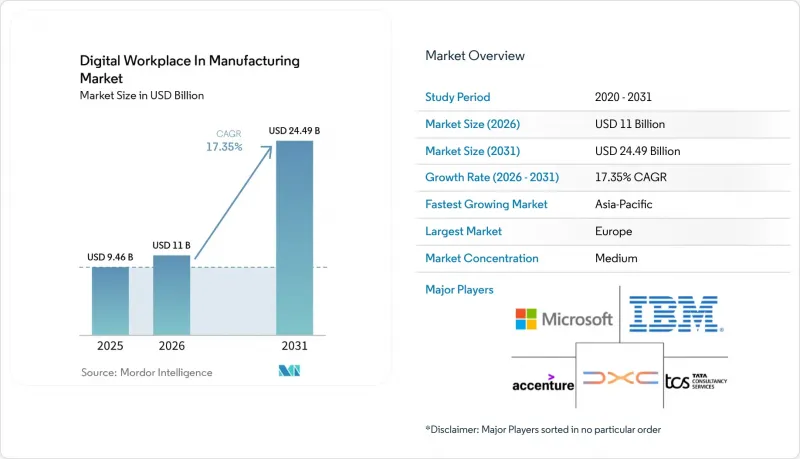
According to Mordor Intelligence, the digital workplace in manufacturing market size is projected to be USD 9.46 billion in 2025, USD 11.00 billion in 2026, and reach USD 24.49 billion by 2031, growing at a CAGR of 17.35% from 2026 to 2031.
This report is Segmented by Component (Solutions [Unified Communication and Collaboration, Unified Endpoint Management, Employee Experience Platforms and Intranet, and More] and Services), Deployment Mode (Cloud, On-Premises, and Hybrid), Organization Size (Large Enterprises and Small and Medium-Sized Enterprises), and Geography. The Market Forecasts are Provided in Terms of Value (USD).
Global Digital Workplace In Manufacturing Market Trends and Insights
Generative AI and Copilot-Led Productivity Gains for Manufacturing Teams
Generative AI is becoming a working layer inside the digital workplace in manufacturing market, because manufacturers are using it to speed up decisions that once depended on manual coordination across teams and shifts. Google Cloud reported in 2025 that 75% of manufacturing executives said generative AI improved productivity, and 65% said it improved non-IT business process efficiency. The Manufacturing Leadership Council found that nearly 90% of manufacturers planned to increase generative AI usage over the next 2 years, and 49% expected a substantial increase, up from 35% in 2024. Microsoft reinforced this direction at Hannover Messe 2026 with WorkIQ, Fabric IQ, and Foundry IQ, which place collaboration analytics, asset visibility, and institutional knowledge into a unified industrial stack. This is changing the basis of competition in the digital workplace in manufacturing market, because buyers are increasingly comparing AI-ready platforms rather than standalone productivity tools. It also creates room for higher-value contracts, since vendors that can link AI assistance to daily plant routines are in a stronger position to deepen long-term account control.
Rapid Adoption of Connected Worker and Frontline Collaboration Platforms
Connected worker systems are emerging as one of the most active growth areas inside the digital workplace in manufacturing market, because they address the gap between enterprise systems and plant-floor execution. Rockwell Automation reported in 2026 that 95% of manufacturers in Asia-Pacific viewed digital transformation as essential to competitiveness, and more than 71% planned AI and machine learning investments in the next 12 months. Ebara Manufacturing launched a knowledge-driven DX project in March 2026 that used AI agents to capture shop-floor tacit knowledge and place it into live workflows. ServiceNow added to that direction in April 2026 with Industrial Connected Workforce, which digitizes procedures, assigns role-based tasks, and preserves knowledge through AI-assisted workflows. In the digital workplace in manufacturing market, this trend matters because workforce digitization is now tied to continuity, safety, and training quality, not only to message sharing. It also helps manufacturers reduce the risk that critical know-how leaves the factory faster than new workers can absorb it.
Legacy MES, ERP, and OT Integration Complexity
Legacy system complexity remains one of the clearest brakes on the digital workplace in manufacturing market, because collaboration platforms must still connect with older plant systems that were not built for modern interoperability. The user-supplied material shows that integration pressure is centered on MES, ERP, and OT environments, where modernization often has to happen without disrupting live production. NIST's manufacturing cybersecurity profile supports that view by treating onboarding, device management, and secure integration as structured requirements rather than optional upgrades. The CyberArk and Device Authority launch in 2025 also reflects how much effort is now going into making connected manufacturing environments trusted enough for broader workflow automation. In practice, the digital workplace in manufacturing market advances more slowly when plant teams must work around undocumented interfaces, strict uptime requirements, and staged migration paths. This keeps implementation quality and industrial integration depth near the center of vendor selection.
Other drivers and restraints analyzed in the detailed report include:
- Expansion of Cloud-First Digital Workplace Architectures in Manufacturing
- OT-IT Convergence Creating Demand for Unified Identity and Access Controls
- Cybersecurity Exposure Across Distributed Plants and Mobile Devices
For complete list of drivers and restraints, kindly check the Table Of Contents.
Segment Analysis
Solutions held 63.34% of the digital workplace in manufacturing market share in 2025, which kept software and platform layers at the center of spending decisions. That position reflects demand for unified communication and collaboration tools, employee experience platforms, and workflow automation systems that support both office-based teams and plant workers. Within the solutions mix, collaboration-led offerings remain the largest revenue concentration because they sit close to enterprise productivity ecosystems already used by manufacturers. The digital workplace in manufacturing market continues to reward solution vendors that can connect communication, knowledge capture, and operational follow-through in a single environment.
That pattern is also shaping the services outlook, even though services remained the smaller component in 2025. Manufacturers are increasingly buying implementation, migration, and managed support as part of multi-year transformation contracts rather than as isolated projects. Rootstock said in 2026 that outcome-based implementation models are becoming more common, which suggests service value is being tied more directly to plant results and adoption depth. In the digital workplace in manufacturing industry, that makes services strategically important even when current revenue share trails solutions. It also supports longer vendor relationships, because workflow redesign, governance setup, and user adoption often continue well after the first software rollout.
Complete Report Scope:
- By Component
- Solutions
- Unified Communication and Collaboration
- Unified Endpoint Management
- Enterprise Mobility and Management
- Employee Experience Platforms and Intranet
- Workflow Automation and Knowledge Management
- Virtual Desktop Infrastructure and Cloud PC
- Services
- Solutions
- By Deployment Mode
- Cloud
- On-Premises
- Hybrid
- By Organization Size
- Large Enterprises
- Small and Medium-Sized Enterprises
- By Geography
- North America
- United States
- Canada
- Mexico
- South America
- Brazil
- Argentina
- Chile
- Colombia
- Rest of South America
- Europe
- Germany
- United Kingdom
- France
- Italy
- Spain
- Netherlands
- Nordics
- Russia
- Rest of Europe
- Asia-Pacific
- China
- Japan
- India
- South Korea
- Australia and New Zealand
- Southeast Asia
- Rest of Asia-Pacific
- Middle East
- Saudi Arabia
- United Arab Emirates
- Turkey
- Israel
- Rest of Middle East
- Africa
- South Africa
- Egypt
- Nigeria
- Kenya
- Rest of Africa
- North America
Geography Analysis
Europe held 33.56% share of the digital workplace in manufacturing market size in 2025, which kept it in the leading regional position. Germany remained central to this demand base because of its concentration of automotive, engineering, and industrial production networks. SAP said Factory-X had moved into a stable operational phase by mid-2026 with 47 industrial partners, which shows how data exchange and coordinated digital production are becoming more institutionalized in the region. The region also benefits from manufacturers that are already accustomed to Industry 4.0 investment and governed process change. Siemens' smart factory investment in Amberg highlights the scale of European commitment to integrated AI-based production environments.
North America remains a major market for the digital workplace in manufacturing market because near-shoring, enterprise software consolidation, and industrial AI adoption continue to support spending. Cyber risk also has a direct effect on regional buying behavior, as Dragos and Marsh McLennan identified North America as the highest concentration of OT cyber risk globally, especially in manufacturing. Asia-Pacific is projected to expand at an 18.45% CAGR, giving it the fastest growth profile in the digital workplace in manufacturing market. Rockwell Automation's 2026 study points to strong regional urgency around digital transformation, especially in competitive manufacturing environments. Country-level demand is being shaped by China's smart manufacturing push, India's industrial modernization agenda, South Korea's smart factory program, and Japan's Society 5.0 framework. The region is also benefiting from newer factories that can adopt cloud-native and connected worker models without the same legacy burden found in older industrial bases.
South America, the Middle East, and Africa remain smaller in current revenue, but they are becoming more active parts of the digital workplace in manufacturing market. South America is seeing traction in Brazil and Colombia, while Argentina and Chile are drawing interest in manufacturing linked to agribusiness and mining. The Middle East is moving faster where industrial diversification programs and new manufacturing zones are being built with stronger digital foundations. Africa is still at an earlier stage, with adoption centered more heavily in multinational-operated facilities and cloud-based delivery models that can work around infrastructure gaps.
- Microsoft Corporation
- IBM Corporation
- Accenture plc
- DXC Technology Company
- Citrix Systems, Inc.
- VMware, Inc.
- NTT DATA Corporation
- Tata Consultancy Services Limited
- Wipro Limited
- Infosys Limited
- HCL Technologies Limited
- Capgemini SE
- Atos SE
- Unisys Corporation
- Fujitsu Limited
- SAP SE
- Oracle Corporation
- Google LLC
- Cisco Systems, Inc.
- ServiceNow, Inc.
Additional Benefits:
- The market estimate (ME) sheet in Excel format
- 3 months of analyst support
TABLE OF CONTENTS
1 INTRODUCTION
- 1.1 Study Assumptions and Market Definition
- 1.2 Scope of the Study
2 RESEARCH METHODOLOGY
3 EXECUTIVE SUMMARY
4 MARKET LANDSCAPE
- 4.1 Market Overview
- 4.2 Market Drivers
- 4.2.1 Rapid Adoption of Connected Worker and Frontline Collaboration Platforms
- 4.2.2 Expansion of Cloud-First Digital Workplace Architectures in Manufacturing
- 4.2.3 Increasing Need for Shop-Floor to Office-Stack Visibility and Collaboration
- 4.2.4 Generative AI and Copilot-Led Productivity Gains for Manufacturing Teams
- 4.2.5 OT-IT Convergence Creating Demand for Unified Identity and Access Controls
- 4.2.6 Resilience Planning After Supply Chain and Plant Disruption Events
- 4.3 Market Restraints
- 4.3.1 Legacy MES, ERP, and OT Integration Complexity
- 4.3.2 Cybersecurity Exposure Across Distributed Plants and Mobile Devices
- 4.3.3 Workforce Change Resistance and Low Digital Adoption in Plants
- 4.3.4 Industrial Data Governance and Cross-Border Compliance Constraints
- 4.4 Industry Value Chain Analysis
- 4.5 Supply-Chain Analysis
- 4.6 Regulatory Landscape
- 4.7 Technological Outlook
- 4.8 Porter's Five Forces Analysis
- 4.8.1 Bargaining Power of Suppliers
- 4.8.2 Bargaining Power of Buyers
- 4.8.3 Threat of New Entrants
- 4.8.4 Threat of Substitutes
- 4.8.5 Competitive Rivalry
- 4.9 Impact of Macroeconomic Factors on the Market
5 MARKET SIZE AND GROWTH FORECASTS (VALUE)
- 5.1 By Component
- 5.1.1 Solutions
- 5.1.1.1 Unified Communication and Collaboration
- 5.1.1.2 Unified Endpoint Management
- 5.1.1.3 Enterprise Mobility and Management
- 5.1.1.4 Employee Experience Platforms and Intranet
- 5.1.1.5 Workflow Automation and Knowledge Management
- 5.1.1.6 Virtual Desktop Infrastructure and Cloud PC
- 5.1.2 Services
- 5.1.1 Solutions
- 5.2 By Deployment Mode
- 5.2.1 Cloud
- 5.2.2 On-Premises
- 5.2.3 Hybrid
- 5.3 By Organization Size
- 5.3.1 Large Enterprises
- 5.3.2 Small and Medium-Sized Enterprises
- 5.4 By Geography
- 5.4.1 North America
- 5.4.1.1 United States
- 5.4.1.2 Canada
- 5.4.1.3 Mexico
- 5.4.2 South America
- 5.4.2.1 Brazil
- 5.4.2.2 Argentina
- 5.4.2.3 Chile
- 5.4.2.4 Colombia
- 5.4.2.5 Rest of South America
- 5.4.3 Europe
- 5.4.3.1 Germany
- 5.4.3.2 United Kingdom
- 5.4.3.3 France
- 5.4.3.4 Italy
- 5.4.3.5 Spain
- 5.4.3.6 Netherlands
- 5.4.3.7 Nordics
- 5.4.3.8 Russia
- 5.4.3.9 Rest of Europe
- 5.4.4 Asia-Pacific
- 5.4.4.1 China
- 5.4.4.2 Japan
- 5.4.4.3 India
- 5.4.4.4 South Korea
- 5.4.4.5 Australia and New Zealand
- 5.4.4.6 Southeast Asia
- 5.4.4.7 Rest of Asia-Pacific
- 5.4.5 Middle East
- 5.4.5.1 Saudi Arabia
- 5.4.5.2 United Arab Emirates
- 5.4.5.3 Turkey
- 5.4.5.4 Israel
- 5.4.5.5 Rest of Middle East
- 5.4.6 Africa
- 5.4.6.1 South Africa
- 5.4.6.2 Egypt
- 5.4.6.3 Nigeria
- 5.4.6.4 Kenya
- 5.4.6.5 Rest of Africa
- 5.4.1 North America
6 COMPETITIVE LANDSCAPE
- 6.1 Market Concentration
- 6.2 Strategic Moves
- 6.3 Market Share Analysis
- 6.4 Company Profiles (includes Global Level Overview, Market Level Overview, Core Segments, Financials as available, Strategic Information, Market Rank/Share, Products and Services, Recent Developments)
- 6.4.1 Microsoft Corporation
- 6.4.2 IBM Corporation
- 6.4.3 Accenture plc
- 6.4.4 DXC Technology Company
- 6.4.5 Citrix Systems, Inc.
- 6.4.6 VMware, Inc.
- 6.4.7 NTT DATA Corporation
- 6.4.8 Tata Consultancy Services Limited
- 6.4.9 Wipro Limited
- 6.4.10 Infosys Limited
- 6.4.11 HCL Technologies Limited
- 6.4.12 Capgemini SE
- 6.4.13 Atos SE
- 6.4.14 Unisys Corporation
- 6.4.15 Fujitsu Limited
- 6.4.16 SAP SE
- 6.4.17 Oracle Corporation
- 6.4.18 Google LLC
- 6.4.19 Cisco Systems, Inc.
- 6.4.20 ServiceNow, Inc.
7 MARKET OPPORTUNITIES AND FUTURE OUTLOOK
- 7.1 White-Space and Unmet-Need Assessment

