PUBLISHER: Mordor Intelligence | PRODUCT CODE: 2098485

PUBLISHER: Mordor Intelligence | PRODUCT CODE: 2098485
Africa Feed Minerals - Market Share Analysis, Industry Trends & Statistics, Growth Forecasts (2026 - 2031)
According to Mordor Intelligence, the Africa feed minerals market size is projected to expand from USD 205.10 million in 2025 and USD 212 million in 2026 to USD 250.20 million by 2031, registering a CAGR of 3.40% between 2026 and 2031.
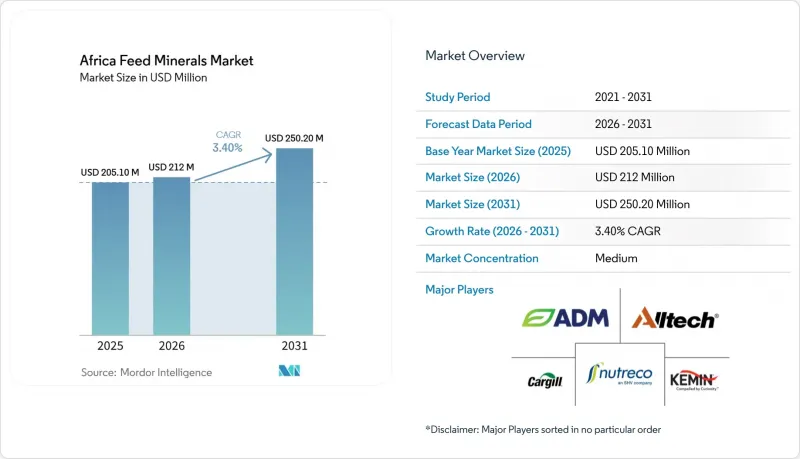
This report is Segmented by Sub Additive (Macrominerals and Microminerals), by Animal (Aquaculture, Poultry, Ruminants, Swine, and Other Animals), and by Geography (South Africa, Egypt, Nigeria, Kenya, and the Rest of Africa). The Market Forecasts are Provided in Terms of Value (USD) and Volume (Metric Tons).
Africa Feed Minerals Market Trends and Insights
Rising Commercial Poultry and Ruminant Feed Demand Across Africa
According to the Alltech Agri-Food Outlook 2025, Africa added 40 new feed mills in 2024, bringing the total number of facilities to 2,228 and expanding the recurring procurement base for mineral in the Africa feed minerals market. The same report showed that cattle feed production in Africa increased by 32.2% in 2024, while dairy feed volumes grew by 25.7%, indicating stronger adoption of commercial feed practices within ruminant production systems. The OECD-FAO Agricultural Outlook 2025-2034 also projects continued gains in livestock productivity and output over the coming decade, increasing the importance of balanced mineral nutrition for commercial producers seeking higher efficiency and animal performance. As a result, the Africa feed minerals market is gaining support from both poultry and ruminant sectors rather than depending solely on poultry demand. This broadens the customer base for mineral suppliers and reduces the risk of growth being concentrated in a single livestock category.
Expansion of Precision Mineral Nutrition in High-Performing Farms
Commercial broiler and dairy operations across parts of Africa are increasingly emphasizing nutrition programs that support breed performance targets, creating opportunities for bioavailability-assured mineral products in the Africa feed minerals market. A 2025 meta-analysis published in Animals found that replacing inorganic trace minerals with proteinate trace minerals at 50% to 80% substitution reduced feed intake by 7 g per bird, improved average daily gain by 1.67 g, reduced feed conversion ratio by 4.5%, and lowered copper, iron, manganese, and zinc excretion by 14% to 21%. These performance improvements are particularly relevant in commercial production systems, where better feed efficiency can help offset the higher cost of chelated and proteinate mineral forms when feed grain prices are elevated. As more integrated producers focus on productivity, consistency, and nutrient utilization, the Africa feed minerals market is becoming increasingly receptive to premium trace mineral formats, suggesting a value opportunity beyond simple volume growth.
Limited Penetration of Commercial Feed Milling in Smallholder-Dominated Markets
A large share of Africa's livestock population still operates outside the commercial feed system, limiting direct access to minerals-based nutrition and constraining volume growth in the Africa feed minerals market. According to the Malabo Montpellier Panel's 2025 report on aquaculture and livestock, as cited by Hatchery FM, poor feed quality and limited physical access to commercial inputs remain major constraints on smallholder productivity. Kenya's 2025 feed sector reform announcement, reported by Science Africa, also noted that feed accounts for 60% to 70% of livestock production costs, while producers outside major commercial zones continue to face inconsistent product quality and fragmented supply channels. Smaller farms often lack the scale and purchasing power needed to justify regular use of premium mineral, resulting in stronger demand from larger commercial production systems. Until aggregation mechanisms, cooperative feed models, and policy support expand commercial feed access to wider rural markets, growth in the Africa feed minerals market is likely to remain uneven across countries and livestock sectors.
Other drivers and restraints analyzed in the detailed report include:
- Wider Shift from Bulk Raw Materials to Formulated Feed Inputs
- Rising Demand for Chelated and Organic Trace Minerals in Hot Climate Production Systems
- High Cost Premium of Chelated and Specialty Mineral Products
For complete list of drivers and restraints, kindly check the Table Of Contents.
Segment Analysis
Macrominerals held 58% of the Africa feed minerals market share in 2025, making them the largest sub-additive category across poultry, ruminant, and aquaculture feed. Calcium, phosphorus, and magnesium remain essential nutritional inputs in commercial formulations, and demand for these products is closely linked to overall feed production rather than optional performance enhancements. South Africa's feed regulatory framework requires commercial feed products to comply with labeling and composition requirements, supporting demand for certified macromineral inputs with verifiable quality. In addition, Solevo Group's 2024 partnership with Phosphea to distribute monocalcium phosphate, monodicalcium phosphate, and dicalcium phosphate across Africa highlights ongoing efforts to strengthen commercial supply channels within the Africa feed minerals industry. As a result, macrominerals remain central to volume growth because they constitute a fundamental component of most commercial feed formulations.
Microminerals are projected to register the fastest CAGR of 6.8% during 2026-2031 in the Africa feed minerals market, reflecting the gradual shift toward performance-oriented nutrition in formal feed channels. According to a 2025 meta-analysis published in Animals, partial substitution of inorganic trace minerals with proteinate trace minerals reduced the excretion of copper, iron, manganese, and zinc by 14% to 21% while improving bird performance, supporting the value proposition of advanced trace mineral products. Zinc, copper, manganese, and selenium remain the principal commercial trace mineral categories, with selenium being particularly important in regions where soil mineral deficiencies affect livestock health. As aquaculture production expands and commercial feed formulations become increasingly standardized across Africa, demand for consistent trace mineral profiles is projected to increase. This should enable microminerals to remain the fastest-growing segment of the Africa feed minerals market, even as conventional inorganic salts continue to dominate lower-cost feed systems.
Complete Report Scope:
- By Sub Additive
- Macrominerals
- Microminerals
- By Animal
- Aquaculture
- Fish
- Shrimp
- Other Aquaculture Species
- Poultry
- Broiler
- Layer
- Other Poultry Birds
- Ruminants
- Beef Cattle
- Dairy Cattle
- Other Ruminants
- Swine
- Other Animals
- Aquaculture
- By Country
- South Africa
- Egypt
- Nigeria
- Kenya
- Rest of Africa
List of Companies Covered in this Report:
- Archer Daniels Midland Company
- Alltech, Inc.
- Agri-Vet
- BASF SE
- Bluestone Metals and Chemicals
- Biochem Zusatzstoffe Handels- und Produktionsgesellschaft mbH
- Cargill, Incorporated
- De Heus
- Elanco Animal Health Incorporated
- Kemin Industries, Inc.
- Kimleigh Chemicals SA
- Novus International, Inc.
- SHV Holdings N.V.
- Phibro Animal Health Corporation
- U-MIX
Additional Benefits:
- The market estimate (ME) sheet in Excel format
- 3 months of analyst support
TABLE OF CONTENTS
1 INTRODUCTION
- 1.1 Study Assumptions and Market Definition
- 1.2 Scope of the Study
2 RESEARCH METHODOLOGY
3 EXECUTIVE SUMMARY
4 MARKET LANDSCAPE
- 4.1 Market Overview
- 4.2 Market Drivers
- 4.2.1 Rising Commercial Poultry and Ruminant Feed Demand Across Africa
- 4.2.2 Rapid Expansion of Commercial Feed Mill Infrastructure Across Africa
- 4.2.3 Expansion of Precision Mineral Nutrition in High-Performing Farms
- 4.2.4 Wider Shift from Bulk Raw Materials to Formulated Feed Inputs
- 4.2.5 Rising Demand for Chelated and Organic Trace Minerals in Hot Climate Production Systems
- 4.2.6 Increasing Need for Feed Efficiency Under Volatile Ingredient Costs
- 4.3 Market Restraints
- 4.3.1 Limited Penetration of Commercial Feed Milling in Smallholder-Dominated Markets
- 4.3.2 High Cost Premium of Chelated and Specialty Mineral Products
- 4.3.3 Inconsistent Quality Control and Counterfeit Product Risk in Fragmented Trade Channels
- 4.3.4 Weak Cold Chain and Distribution Infrastructure in Several Inland Markets
- 4.4 Technological Outlook
- 4.5 Regulatory Landscape
- 4.6 Porter's Five Forces Analysis
- 4.6.1 Bargaining Power of Suppliers
- 4.6.2 Bargaining Power of Buyers
- 4.6.3 Threat of New Entrants
- 4.6.4 Threat of Substitutes
- 4.6.5 Intensity of Competitive Rivalry
5 MARKET SIZE AND GROWTH FORECASTS (VALUE AND VOLUME)
- 5.1 By Sub Additive
- 5.1.1 Macrominerals
- 5.1.2 Microminerals
- 5.2 By Animal
- 5.2.1 Aquaculture
- 5.2.1.1 Fish
- 5.2.1.2 Shrimp
- 5.2.1.3 Other Aquaculture Species
- 5.2.2 Poultry
- 5.2.2.1 Broiler
- 5.2.2.2 Layer
- 5.2.2.3 Other Poultry Birds
- 5.2.3 Ruminants
- 5.2.3.1 Beef Cattle
- 5.2.3.2 Dairy Cattle
- 5.2.3.3 Other Ruminants
- 5.2.4 Swine
- 5.2.5 Other Animals
- 5.2.1 Aquaculture
- 5.3 By Country
- 5.3.1 South Africa
- 5.3.2 Egypt
- 5.3.3 Nigeria
- 5.3.4 Kenya
- 5.3.5 Rest of Africa
6 COMPETITIVE LANDSCAPE
- 6.1 Market Concentration
- 6.2 Strategic Moves
- 6.3 Market Share Analysis
- 6.4 Company Profiles (Includes Global Level Overview, Market Level Overview, Core Segments, Financials as Available, Strategic Information, Market Rank/Share, Products and Services, Recent Developments)
- 6.4.1 Archer Daniels Midland Company
- 6.4.2 Alltech, Inc.
- 6.4.3 Agri-Vet
- 6.4.4 BASF SE
- 6.4.5 Bluestone Metals and Chemicals
- 6.4.6 Biochem Zusatzstoffe Handels- und Produktionsgesellschaft mbH
- 6.4.7 Cargill, Incorporated
- 6.4.8 De Heus
- 6.4.9 Elanco Animal Health Incorporated
- 6.4.10 Kemin Industries, Inc.
- 6.4.11 Kimleigh Chemicals SA
- 6.4.12 Novus International, Inc.
- 6.4.13 SHV Holdings N.V.
- 6.4.14 Phibro Animal Health Corporation
- 6.4.15 U-MIX
7 MARKET OPPORTUNITIES AND FUTURE OUTLOOK

