PUBLISHER: Mordor Intelligence | PRODUCT CODE: 2098519

PUBLISHER: Mordor Intelligence | PRODUCT CODE: 2098519
GCC UEM - Market Share Analysis, Industry Trends & Statistics, Growth Forecasts (2026 - 2031)
According to Mordor Intelligence, the GCC UEM market size is expected to increase from USD 0.27 billion in 2025 to USD 0.34 billion in 2026 and reach USD 1.14 billion by 2031, growing at a CAGR of 27.21% over 2026-2031.
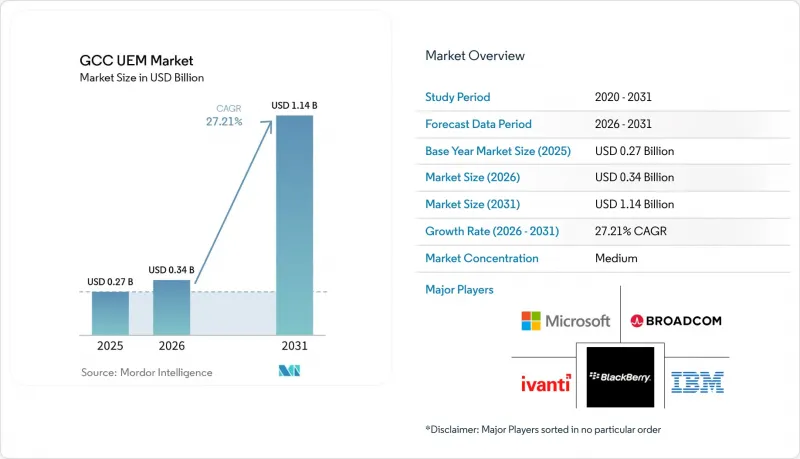
This report is Segmented by Component (Solutions, and Services), Deployment Mode (Cloud-Based, On-Premise, and Hybrid), Organization Size (Large Enterprises, and Small and Medium Enterprises), End-User Industry (IT and Telecommunication, Manufacturing, Healthcare and Life Sciences, Retail and E-Commerce, Energy and Utilities, Government and Defense, and More). The Market Forecasts are Provided in Terms of Value (USD).
GCC UEM Market Trends and Insights
Accelerating Remote And Hybrid Work Device Sprawl
Hybrid and remote work patterns continue to leave many GCC organizations managing laptops, phones, tablets, and shared devices across several operating systems and usage models. That mix raises the cost of relying on separate tools for enrollment, patching, policy enforcement, application control, and access decisions across the same employee base. The GCC UEM market is gaining from this pressure because enterprises increasingly want one console that can apply consistent rules across Windows, iOS, Android, macOS, and shared field devices. The issue is sharper in regulated sectors because unmanaged endpoints can create direct exposure around access control, auditability, and policy enforcement. As device fleets stretch across office, home, branch, and field settings, procurement is moving toward platforms that can handle both corporate and personal devices without disconnected workflows or duplicate administration. That pattern is also aligning day-to-day IT needs with stricter endpoint governance expectations in Saudi Arabia and the UAE.
Rising Zero Trust And Identity-Centric Control Requirements
Zero trust adoption is turning endpoint management into a core part of access control rather than a separate IT administration task. Organizations now need device posture checks at the time of access, not only at the moment of enrollment or periodic compliance review. That requirement is pushing the GCC UEM market toward platforms that can connect device status, identity, privilege, and policy enforcement within one operating model. Large banks, ministries, and regulated enterprises are also trying to reduce the number of point tools they maintain for compliance reporting and day-to-day operations. The practical result is a stronger demand for platforms that can support continuous control over patch levels, privilege settings, configuration drift, and application usage. This direction fits the endpoint security baseline reflected in Saudi Arabia's Essential Cybersecurity Controls and Endpoint Detection and Response Standard.
Legacy IT And Endpoint Toolchain Migration Complexity
Many large GCC organizations still run endpoint estates that were built around older Windows-focused tooling and layered administrative processes. Moving those estates to a modern platform often requires device reenrollment, policy redesign, role remapping, and retraining across security, infrastructure, and support teams. That work does not stop adoption, but it delays contract timing and pushes part of the GCC unified endpoint management (UEM) market growth toward later years of the forecast period. The challenge is greater in hybrid environments where older and newer policy engines must operate together during long transition phases. Conflicts between legacy controls and modern configuration models can lead to enrollment problems, inconsistent posture checks, and slower rollouts across large fleets. For regulated institutions, those operational risks make phased deployment more attractive than full replacement at once, even when the long-term business case for modernization is clear.
Other drivers and restraints analyzed in the detailed report include:
- Government-Backed Cloud-First And Digital Sovereignty Programs
- Fast Growth In Managed Mobility For Frontline And Field Workers
- Data Residency And Sectoral Compliance Constraints
For complete list of drivers and restraints, kindly check the Table Of Contents.
Segment Analysis
Solutions held 71.46% of GCC UEM market size in 2025 and are projected to grow at 27.66% CAGR through 2031. That lead reflects strong demand for device management and security and compliance management across ministries, banks, healthcare systems, and other regulated organizations that need consistent policy enforcement. Buyers are moving from reactive device administration toward broader governance models that combine enrollment, policy control, analytics, automation, and reporting within the same platform. This shift is raising the value of software-led control because endpoint teams increasingly need visibility across mixed fleets rather than isolated oversight by operating system or device category. Analytics and automation are drawing forward investment because self-healing capabilities can reduce manual workload in teams facing skills shortages and rising policy complexity. Application management and content management are also gaining relevance as organizations try to contain corporate data more carefully on both managed and personal devices. The GCC unified endpoint management (UEM) market is therefore rewarding platforms that can tie compliance, app control, and device health into a single operating layer rather than into separate administrative products.
Services are growing from a smaller base, but they remain important to the GCC unified endpoint management market because many deployments require integration, migration, policy design, and ongoing administrative support. Regional system integrators are expanding UEM-specific practices as customers ask for rollout planning, operating model design, and managed operations support across mixed endpoint fleets. This need is stronger in mid-market accounts that want zero trust alignment and stronger security controls without building large in-house endpoint teams. It is also visible in regulated enterprises where migration must happen in stages and where audit readiness matters as much as technical functionality. Managed and professional services can therefore act as an indirect multiplier for software demand by helping organizations move from pilot use into broader policy coverage. Over time, these service relationships also help sustain platform usage after initial deployment because customers tend to extend contracts when integrations, reporting processes, and operational playbooks are already in place.
Cloud-based deployment accounted for 67.21% of the GCC UEM market share in 2025 and is projected to expand at 27.99% CAGR through 2031. The lead comes from the ease of scaling one management console across distributed device fleets without new server investment at each location or business unit. For many buyers, cloud deployment also shortens rollout time and improves visibility across branch sites, hybrid users, and shared-device environments that would otherwise require several local tools. In the Gulf, however, cloud deployment increasingly means locally aligned or sovereign hosting rather than a generic offshore instance. That distinction matters because regulated buyers want cloud efficiency without weakening control over audit trails, policy records, and device telemetry. The GCC unified endpoint management market is therefore not moving away from cloud, but it is becoming more selective about where and how cloud-based management can be delivered. This is reshaping vendor positioning because deployment flexibility is becoming part of the value proposition rather than a back-end technical detail.
On-premises deployment keeps a protected role in defense, intelligence, and critical infrastructure accounts that cannot route management paths through external networks. Hybrid deployment is also gaining support because it lets large organizations manage classified and unclassified fleets under a more coordinated model while still respecting internal control boundaries. The GCC unified endpoint management (UEM) market continues to need these non-cloud options because migration rarely happens in one step and many enterprises run overlapping environments for several years. BlackBerry's June 2026 release, which added on-premises macOS management and post-quantum tools, shows that sovereign endpoint control remains a live procurement requirement in regulated environments. Hybrid architectures also help organizations preserve earlier investments while moving selected workloads into compliant cloud models over time. This makes deployment mode less of a binary choice and more of a staged operating decision shaped by regulation, infrastructure maturity, and migration risk.
Complete Report Scope:
- By Component
- Solutions
- Device Management
- Application Management
- Content Management
- Security and Compliance Management
- Analytics and Automation
- Services
- Solutions
- By Deployment Mode
- Cloud-Based
- On-Premise
- Hybrid
- By Organization Size
- Large Enterprises
- Small and Medium Enterprises
- By End-User Industry
- IT and Telecommunications
- BFSI
- Government and Defense
- Healthcare and Life Sciences
- Manufacturing
- Retail and E-Commerce
- Education
- Transportation and Logistics
- Energy and Utilities
- Other End-User Industries
- By Country
- Saudi Arabia
- United Arab Emirates
- Qatar
- Rest of GCC
List of Companies Covered in this Report:
- Microsoft Corporation
- Broadcom Inc.
- International Business Machines Corporation
- Ivanti, Inc.
- BlackBerry Limited
- Citrix Systems, Inc.
- Zoho Corporation Pvt. Ltd.
- Sophos Ltd.
- 42Gears Mobility Systems Pvt Ltd.
- SOTI Inc.
- Matrix42 AG
- Jamf Holding Corp.
- JumpCloud, Inc.
- Tanium Inc.
- Cisco Systems, Inc.
- ManageEngine
- OpenText Corporation
- NinjaOne, LLC
- Automox, Inc.
- Quest Software Inc.
Additional Benefits:
- The market estimate (ME) sheet in Excel format
- 3 months of analyst support
TABLE OF CONTENTS
1 INTRODUCTION
- 1.1 Study Assumptions and Market Definition
- 1.2 Scope of the Study
2 RESEARCH METHODOLOGY
3 EXECUTIVE SUMMARY
4 MARKET LANDSCAPE
- 4.1 Market Overview
- 4.2 Market Drivers
- 4.2.1 Accelerating Remote and Hybrid Work Device Sprawl
- 4.2.2 Rising Zero Trust and Identity-Centric Control Requirements
- 4.2.3 Government-Backed Cloud-First and Digital Sovereignty Programs
- 4.2.4 Fast Growth in Managed Mobility for Frontline and Field Workers
- 4.2.5 AI-Driven Device Health and Self-Healing Automation Demand
- 4.2.6 Expanding IoT and Rugged Device Orchestration in Smart Infrastructure
- 4.3 Market Restraints
- 4.3.1 Legacy IT and Endpoint Toolchain Migration Complexity
- 4.3.2 Data Residency and Sectoral Compliance Constraints
- 4.3.3 Shortage of UEM Implementation and Automation Skills
- 4.3.4 Procurement Friction from Vendor Lock-In Concerns
- 4.4 Industry Value Chain Analysis
- 4.5 Value Chain Analysis
- 4.6 Impact of Macroeconomic Factors on the Market
- 4.7 Regulatory Landscape
- 4.8 Technological Outlook
- 4.9 Porter's Five Forces Analysis
- 4.9.1 Bargaining Power of Buyers
- 4.9.2 Bargaining Power of Suppliers
- 4.9.3 Threat of New Entrants
- 4.9.4 Threat of Substitutes
- 4.9.5 Industry Rivalry
5 MARKET SIZE AND GROWTH FORECASTS (VALUE)
- 5.1 By Component
- 5.1.1 Solutions
- 5.1.1.1 Device Management
- 5.1.1.2 Application Management
- 5.1.1.3 Content Management
- 5.1.1.4 Security and Compliance Management
- 5.1.1.5 Analytics and Automation
- 5.1.2 Services
- 5.1.1 Solutions
- 5.2 By Deployment Mode
- 5.2.1 Cloud-Based
- 5.2.2 On-Premise
- 5.2.3 Hybrid
- 5.3 By Organization Size
- 5.3.1 Large Enterprises
- 5.3.2 Small and Medium Enterprises
- 5.4 By End-User Industry
- 5.4.1 IT and Telecommunications
- 5.4.2 BFSI
- 5.4.3 Government and Defense
- 5.4.4 Healthcare and Life Sciences
- 5.4.5 Manufacturing
- 5.4.6 Retail and E-Commerce
- 5.4.7 Education
- 5.4.8 Transportation and Logistics
- 5.4.9 Energy and Utilities
- 5.4.10 Other End-User Industries
- 5.5 By Country
- 5.5.1 Saudi Arabia
- 5.5.2 United Arab Emirates
- 5.5.3 Qatar
- 5.5.4 Rest of GCC
6 COMPETITIVE LANDSCAPE
- 6.1 Market Concentration
- 6.2 Strategic Moves
- 6.3 Market Share Analysis
- 6.4 Company Profiles (includes Global Level Overview, Market Level Overview, Core Segments, Financials as available, Strategic Information, Market Rank/Share, Products and Services, Recent Developments)
- 6.4.1 Microsoft Corporation
- 6.4.2 Broadcom Inc.
- 6.4.3 International Business Machines Corporation
- 6.4.4 Ivanti, Inc.
- 6.4.5 BlackBerry Limited
- 6.4.6 Citrix Systems, Inc.
- 6.4.7 Zoho Corporation Pvt. Ltd.
- 6.4.8 Sophos Ltd.
- 6.4.9 42Gears Mobility Systems Pvt Ltd.
- 6.4.10 SOTI Inc.
- 6.4.11 Matrix42 AG
- 6.4.12 Jamf Holding Corp.
- 6.4.13 JumpCloud, Inc.
- 6.4.14 Tanium Inc.
- 6.4.15 Cisco Systems, Inc.
- 6.4.16 ManageEngine
- 6.4.17 OpenText Corporation
- 6.4.18 NinjaOne, LLC
- 6.4.19 Automox, Inc.
- 6.4.20 Quest Software Inc.
7 MARKET OPPORTUNITIES AND FUTURE OUTLOOK
- 7.1 White-Space and Unmet-Need Assessment

