PUBLISHER: Mordor Intelligence | PRODUCT CODE: 2098527

PUBLISHER: Mordor Intelligence | PRODUCT CODE: 2098527
China Cutting Machine and Equipment - Market Share Analysis, Industry Trends & Statistics, Growth Forecasts (2026 - 2031)
According to Mordor Intelligence, the China cutting machine and Equipment Market size is expected to grow from USD 10.27 billion in 2025 to USD 10.52 billion in 2026 and is forecast to reach USD 11.90 billion by 2031 at 2.5% CAGR over 2026-2031.
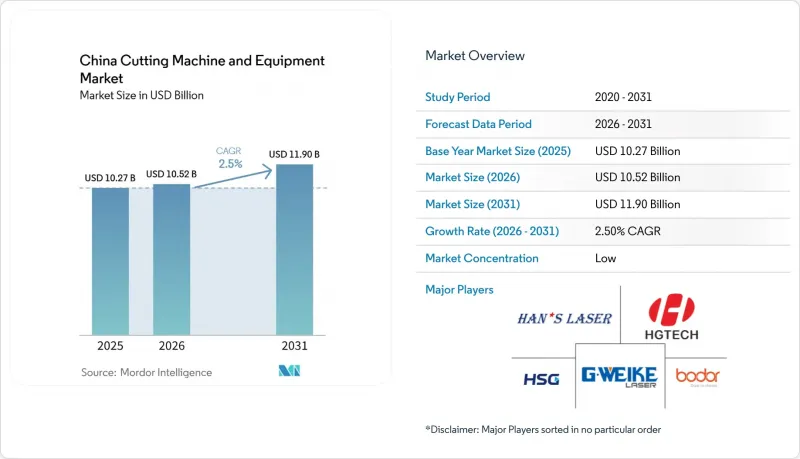
This report is Segmented by Application (Sheet Metal, Plate, Tube & Pipe, Structural Steel, and Others), by Technology (Laser, Plasma, Waterjet, and More), by Automation Level (Manual, Semi-Automated, and Robotic/Fully-automated), and by End-User Industry (Automotive, Aerospace & Defense, and More). The Market Forecasts are Provided in Terms of Value (USD) and Volume (Units).
China Cutting Machine and Equipment Market Trends and Insights
Expansion of Domestic Manufacturing and Industrial Production
China's manufacturing base continued to expand in 2025, with value-added output reaching CNY 34.7 trillion (USD 5.0 trillion) and keeping the country in the top global position for the 16th straight year. Industrial output rose 5.9% in 2025, while equipment manufacturing grew 9.2%, indicating that capital goods demand outpaced the broader industrial trend. Industrial robot output increased 28%, and 3D printing equipment output rose 52.5% in 2025, pointing to a broader upstream investment cycle in factory equipment and tooling. More than 8,200 factories had reached advanced-level smart factory certification by the end of 2025 under MIIT's tiered program, meaning that a larger installed base is now operating with more demanding precision and integration requirements. In practice, this raises replacement demand in the China cutting machine and equipment market, as certified facilities tend to replace older plasma and oxy-fuel lines with fiber laser cells and higher-control CNC systems. This provides a more stable baseline demand for the cutting machine and equipment market.
Growth in Automotive, Electronics, and Machinery Industries
China produced 34.5 million vehicles in 2025, and new energy vehicle sales reached 16.5 million units, up 28.2% year on year, keeping automotive production as one of the largest sources of demand for the China cutting machine and equipment market. Automotive manufacturing value-added rose 11.5% in 2025, while computer, communication, and electronics manufacturing increased 10.6%, both clearly ahead of the broader industrial average. These sectors purchase cutting systems not only for new production lines but also for retrofits within existing plants where tolerance demands have tightened. Battery housings, busbars, motor covers, and power electronics parts require cleaner edges and more repeatable cuts than older plasma systems can usually deliver at scale. Han's Laser reported 197% growth in its automotive electronics segment in 2025, underscoring the strong overlap between automotive and electronics, which is driving equipment demand. As a result, the market is supported by new manufacturing investments and accelerated replacement of older equipment.
High Cost of Advanced Laser Cutting Equipment
Advanced fiber laser systems still require a significant upfront investment when buyers add motion axes, cutting heads, chillers, software, and automation hardware to build a complete production line. This is especially relevant for small and mid-sized fabricators, as many can justify the productivity gains but still struggle to absorb the initial capital burden in a single purchase cycle. The recent wave of domestic innovation, including the production of ultra-high-power laser sources and increased R&D spending by leading firms, improves local capability but does not remove the cost hurdle for the full system. Buyers in the China cutting machine and equipment market, therefore, continue to closely weigh payback periods, especially as they move from semi-automated lines to fully integrated robotic cells. That slows adoption in the broad middle of the market even while large accounts keep upgrading. It also helps explain why plasma and other lower-cost technologies remain relevant across several heavy-fabrication use cases.
Other drivers and restraints analyzed in the detailed report include:
- Increasing Adoption of Automated CNC Cutting Systems
- Rising Demand for Fiber Laser and High-Precision Cutting Technologies
- Dependence on Imported High-End Components
For complete list of drivers and restraints, kindly check the Table Of Contents.
Segment Analysis
Sheet metal accounted for 45.8% of the China cutting machine and equipment market share in 2025, making it the largest application segment. Vehicle production of 34.5 million units and growth in electronics manufacturing sustain this demand, as both sectors rely on thin- and medium-gauge precision cutting. Sheet metal remains the largest application segment due to its extensive use in export-oriented manufacturing and domestic assembly operations. New energy vehicle platforms further support demand, requiring tighter dimensional control for battery housings, motor covers, and charging hardware, favoring fiber laser systems for edge quality and repeatability. Machine upgrades in existing plants highlight the overlap of replacement, automation, and precision demand, focusing capital spending on faster, more efficient machines with lower scrap rates. This also strengthens suppliers' ability to sell software, service, and automation add-ons.
Structural steel is projected to register the fastest 3.2% CAGR through 2031, supported by rising use in public buildings, infrastructure, and heavy fabrication. Structural steel processing, though a smaller revenue share, is gaining importance as public works, industrial buildings, and heavy fabrication demand prepared beams, sections, and plates. Unlike sheet metal, this segment involves heavier workpieces, application-specific tolerances, and throughput tied to material thickness and project timing, keeping plasma and heavy-plate laser systems relevant. Structural steel broadens the customer base to construction fabricators, shipyards, and energy contractors, diversifying demand despite uneven order patterns. Inland industrial expansion supports this segment, complementing the precision fabrication core by driving growth in heavier industrial work. Suppliers benefit by offering broad product lines for both high-volume sheet work and structural applications.
Laser accounted for 47.5% of the China cutting machine and equipment market in 2025 and is also the fastest-growing technology segment, with a projected 4.1% CAGR through 2031. This trend indicates a broader shift toward fiber laser systems, driven by greater energy efficiency, lower operating costs, higher precision, and easier integration into automated production lines. Raycus' April 2026 mass production of a 220 kW industrial continuous fiber laser highlights rising domestic capability in high-power applications. Han's Laser reported strong momentum in high-power equipment sales in 2025, indicating a shift toward advanced platforms over older machines. High-end laser adoption is reshaping competition, favoring suppliers with proprietary sources, controls, and application support, shifting the focus from machine price to total productivity and reliability. Key demand comes from automotive electronics, battery systems, machinery, and premium fabricated components, where repeatability and speed are critical. Fiber lasers are increasingly replacing CO2 systems and driving premium pricing in the upper market segment. Laser technology is the fastest-growing and highest-value segment of the market.
Despite this shift, plasma, waterjet, flame, oxy-fuel, and ultrasonic systems remain relevant, maintaining a diverse technology mix. Plasma is preferred for heavy plate and structural work where high-wattage fiber lasers may not justify the cost. Waterjet is suitable for materials unsuitable for thermal cutting, such as composites and specialty alloys. Flame and oxy-fuel systems are vital for thick heavy fabrication where speed and cost outweigh finish quality. By 2035, premium, precision-driven technologies are expected to gain market share, but older technologies will persist in specific use cases. The China cutting machine and equipment market continues to use multiple technologies depending on material type, thickness, and precision requirements. This ensures technical diversity alongside the growing dominance of laser technology.
Complete Report Scope:
- By Application
- Sheet Metal
- Plate
- Tube & Pipe
- Structural Steel
- Others
- By Technology
- Laser
- Fiber
- CO2
- Others
- Plasma
- High-definition
- Conventional
- Water-Jet
- Abrasive
- Pure
- Flame / Oxy-fuel
- Ultrasonic & Emerging
- Laser
- By Automation Level
- Manual
- Semi-automated
- Robotic / Fully-automated
- By End-User Industry
- Automotive
- Aerospace & Defense
- Electrical & Electronics
- Construction & Infrastructure
- Metal-Fabrication Job Shops
- Shipbuilding
- Energy & Power
- Others
List of Companies Covered in this Report:
- Han's Laser Technology Industry Group Co. Ltd
- HGTECH Co. Ltd
- Bodor Laser Co. Ltd
- HSG Laser Co. Ltd
- Jinan G.Weike Science & Technology Co. Ltd
- Jinan Blue Elephant CNC Machinery Co. Ltd
- Penta Laser (Wenzhou) Co. Ltd
- Shenzhen DNE Laser Science and Technology Co. Ltd
- Farley Laserlab Co. Ltd
- Wuhan Chutian Laser Group Co. Ltd
- Jinan Senfeng Technology Co. Ltd
- Hymson Laser Technology Group Co. Ltd
- Suzhou Tianhong Laser Co. Ltd
- Perfect Laser Co. Ltd
- Wuhan Golden Laser Co. Ltd
- Shandong Oree Laser Technology Co. Ltd
- Jinan DXTECH CNC Machine Co. Ltd
- Suzhou Quick Laser Technology Co. Ltd
- Lead Laser Technology Co. Ltd
- Wuhan Unity Laser Technology Co. Ltd
Additional Benefits:
- The market estimate (ME) sheet in Excel format
- 3 months of analyst support
TABLE OF CONTENTS
1 Introduction
- 1.1 Study Assumptions & Market Definition
- 1.2 Scope of the Study
2 Research Methodology
3 Executive Summary
4 Market Landscape
- 4.1 Market Overview
- 4.2 Market Drivers
- 4.2.1 Expansion of Domestic Manufacturing and Industrial Production
- 4.2.2 Growth in Automotive, Electronics, and Machinery Industries
- 4.2.3 Increasing Adoption of Automated CNC Cutting Systems
- 4.2.4 Rising Demand for Fiber Laser and High-Precision Cutting Technologies
- 4.2.5 Government Support for Advanced Manufacturing and Industry Upgrades
- 4.2.6 Growth in Metal Fabrication and Export-Oriented Production
- 4.3 Market Restraints
- 4.3.1 High Cost of Advanced Laser Cutting Equipment
- 4.3.2 Dependence on Imported High-End Components
- 4.3.3 Intense Competition and Price Pressure Among Domestic Manufacturers
- 4.3.4 Skilled Labor Shortage for Advanced Equipment Operation
- 4.4 Value / Supply-Chain Analysis
- 4.5 Regulatory Landscape
- 4.6 Technological Outlook
- 4.7 Porter's Five Forces
- 4.7.1 Threat of New Entrants
- 4.7.2 Bargaining Power of Suppliers
- 4.7.3 Bargaining Power of Buyers
- 4.7.4 Threat of Substitutes
- 4.7.5 Industry Rivalry
- 4.8 Global Manufacturing-Sector Snapshot
- 4.9 Customer Purchasing Decision Analysis
- 4.10 Impact of Geopolitical Events on the market
5 Market Size & Growth Forecasts
- 5.1 By Application
- 5.1.1 Sheet Metal
- 5.1.2 Plate
- 5.1.3 Tube & Pipe
- 5.1.4 Structural Steel
- 5.1.5 Others
- 5.2 By Technology
- 5.2.1 Laser
- 5.2.1.1 Fiber
- 5.2.1.2 CO2
- 5.2.1.3 Others
- 5.2.2 Plasma
- 5.2.2.1 High-definition
- 5.2.2.2 Conventional
- 5.2.3 Water-Jet
- 5.2.3.1 Abrasive
- 5.2.3.2 Pure
- 5.2.4 Flame / Oxy-fuel
- 5.2.5 Ultrasonic & Emerging
- 5.2.1 Laser
- 5.3 By Automation Level
- 5.3.1 Manual
- 5.3.2 Semi-automated
- 5.3.3 Robotic / Fully-automated
- 5.4 By End-User Industry
- 5.4.1 Automotive
- 5.4.2 Aerospace & Defense
- 5.4.3 Electrical & Electronics
- 5.4.4 Construction & Infrastructure
- 5.4.5 Metal-Fabrication Job Shops
- 5.4.6 Shipbuilding
- 5.4.7 Energy & Power
- 5.4.8 Others
6 Competitive Landscape
- 6.1 Market Concentration
- 6.2 Strategic Moves
- 6.3 Market Share Analysis
- 6.4 Company Profiles (Includes Global Level Overview, Market Level Overview, Core Segments, Financials as Available, Strategic Information, Products & Services, and Recent Developments)
- 6.4.1 Han's Laser Technology Industry Group Co. Ltd
- 6.4.2 HGTECH Co. Ltd
- 6.4.3 Bodor Laser Co. Ltd
- 6.4.4 HSG Laser Co. Ltd
- 6.4.5 Jinan G.Weike Science & Technology Co. Ltd
- 6.4.6 Jinan Blue Elephant CNC Machinery Co. Ltd
- 6.4.7 Penta Laser (Wenzhou) Co. Ltd
- 6.4.8 Shenzhen DNE Laser Science and Technology Co. Ltd
- 6.4.9 Farley Laserlab Co. Ltd
- 6.4.10 Wuhan Chutian Laser Group Co. Ltd
- 6.4.11 Jinan Senfeng Technology Co. Ltd
- 6.4.12 Hymson Laser Technology Group Co. Ltd
- 6.4.13 Suzhou Tianhong Laser Co. Ltd
- 6.4.14 Perfect Laser Co. Ltd
- 6.4.15 Wuhan Golden Laser Co. Ltd
- 6.4.16 Shandong Oree Laser Technology Co. Ltd
- 6.4.17 Jinan DXTECH CNC Machine Co. Ltd
- 6.4.18 Suzhou Quick Laser Technology Co. Ltd
- 6.4.19 Lead Laser Technology Co. Ltd
- 6.4.20 Wuhan Unity Laser Technology Co. Ltd
7 Market Opportunities & Future Outlook
- 7.1 White-Space & Unmet-Need Assessment

