PUBLISHER: Mordor Intelligence | PRODUCT CODE: 2098533

PUBLISHER: Mordor Intelligence | PRODUCT CODE: 2098533
Lip and Face Oil - Market Share Analysis, Industry Trends & Statistics, Growth Forecasts (2026 - 2031)
According to Mordor Intelligence, the global lip and face oil market was valued at USD 6.32 billion in 2025 and is estimated to grow from USD 6.54 billion in 2026 to USD 8.09 billion by 2031, registering a CAGR of 4.35% during 2026-2031.
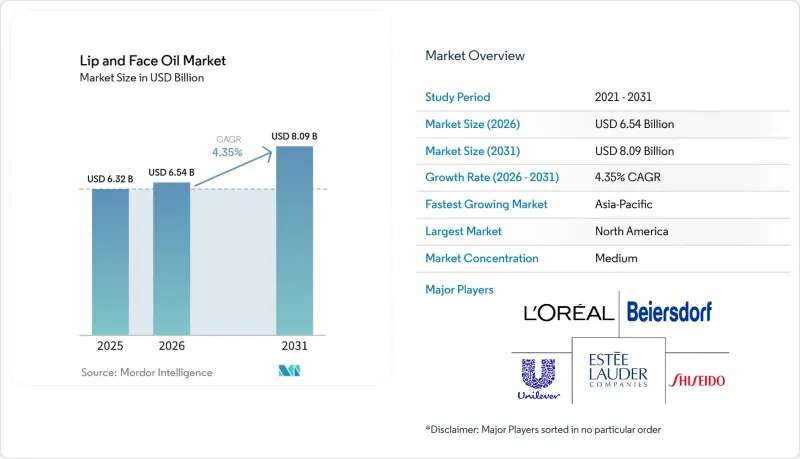
This report is Segmented by Product Type (Lip Oil and Face Oil), Oil Type (Jojoba Oil, Argan Oil, Rosehip Oil, Squalane, and Others), End-User (Men and Women), Distribution Channel (Supermarkets and Hypermarkets, Specialty Stores, Online Retail Stores, and Other Distribution Channels), and Geography. The Market Forecasts are Provided in Value (USD).
Global Lip and Face Oil Market Trends and Insights
Consumer preference for natural and plant-based beauty products
The increasing consumer preference for natural and plant-based beauty products is driving growth in the global lip and face oil market. Individuals are seeking formulations made with botanical ingredients and minimal synthetic additives. This trend toward ingredient-conscious beauty has heightened demand for oils derived from natural sources that offer nourishment, hydration, and skin-conditioning benefits, while meeting clean beauty standards. Consumers are prioritizing products with transparent ingredient lists, cruelty-free claims, and formulations free from harsh chemicals, prompting brands to develop plant-based lip and facial oils. For example, La Mior provides lip oil products with a vegan composition that are paraben-free and sulfate-free, catering to the rising demand for cleaner, naturally positioned beauty solutions. The increasing adoption of nature-inspired formulations continues to drive innovation and expansion within the lip and face oil market.
Demand for anti-aging and preventive skincare solutions
The demand for anti-aging and preventive skincare solutions is increasing as consumers prioritize maintaining skin health, improving firmness, and reducing visible signs of aging through targeted beauty formulations. Face oils containing antioxidants, vitamins, essential fatty acids, and skin-conditioning ingredients are becoming more popular due to their ability to enhance elasticity, improve moisture retention, and promote overall skin appearance. Additionally, the growing aging population is driving demand for products tailored to mature skincare needs. For example, according to the World Bank, Monaco had the highest proportion of people aged 65 years and above in 2024, accounting for 36% of its population, followed by Japan at approximately 30% . This expanding older demographic is fostering the development and adoption of nourishing lip and facial oil products aimed at long-term skincare maintenance.
Risk of skin irritation and allergic reactions
The risk of skin irritation and allergic reactions poses a challenge to the global lip and face oil market. Some consumers may experience sensitivity due to certain botanical extracts, essential oils, fragrances, and active ingredients commonly used in oil-based formulations. Given the high sensitivity of lip and facial areas, issues such as redness, clogged pores, itching, or irritation can deter consumers from trying new products, particularly those containing concentrated natural ingredients. Variations in individual skin tolerance necessitate that brands prioritize extensive safety testing, hypoallergenic formulations, and clear ingredient labeling, which adds complexity to product development. These concerns may reduce adoption among consumers with sensitive or reactive skin, impacting the overall acceptance of lip and face oil products.
Other drivers and restraints analyzed in the detailed report include:
- Rising adoption of premium and luxury skincare products
- Influence of social media and beauty content creators
- Concerns regarding clogged pores and acne breakouts
For complete list of drivers and restraints, kindly check the Table Of Contents.
Segment Analysis
In 2025, Face Oil accounted for 64.75% of the global lip and face oil market, fueled by the growing integration of facial oils into daily skincare routines. This trend is attributed to their capacity to deliver deep nourishment, enhance skin smoothness, and provide long-lasting hydration. The segment has achieved significant consumer acceptance as innovative formulations have improved absorption, minimized greasy textures, and made face oils appropriate for a broader spectrum of skin types. Increased awareness of the importance of maintaining the skin's natural moisture barrier and enhancing overall skin appearance has further promoted their use.
Lip Oil is experiencing the fastest growth among product types, with a CAGR of 5.07% projected through 2031. This surge is fueled by a rising preference for products that offer both lip care benefits and an enhanced aesthetic. The segment is gaining popularity as consumers increasingly opt for lightweight alternatives that provide hydration, a smooth texture, and a glossy finish, all without the sticky sensation often found in traditional products. The growing desire for healthier-looking lips and the demand for comfortable, everyday formulations have further accelerated this trend. Innovations in tinted oils, nourishing ingredients, and long-lasting moisture technologies are enhancing product attractiveness, allowing lip oils to gain significant growth momentum in the global lip and face oil market.
Jojoba Oil leads with 32.45% of the global lip and face oil market share in 2025, driven by its close similarity to the skin's natural sebum, which supports better absorption and makes it suitable for regular skincare routines. Its lightweight consistency, hydrating properties, and suitability for various skin types have made it a favored choice among consumers looking for gentle yet effective oil-based products. Additionally, the segment benefits from the oil's natural stability, extended shelf life, and its rich blend of vitamins, minerals, and fatty acids that contribute to improved skin softness and a healthy look. The rising demand for beauty solutions with minimal ingredients and naturally sourced components has further bolstered the incorporation of jojoba oil in lip and face care products, allowing it to maintain its dominant market position.
Squalane is the fastest-growing oil type, with a CAGR of 5.69% projected through 2031. This growth is driven by its increasing use as an emollient ingredient that meets modern consumer preferences for effective and comfortable skincare solutions. The segment benefits from squalane's formulation flexibility, as it is highly resistant to oxidation and enhances product texture, consistency, and performance. Its transparent, odorless, and lightweight properties make it a preferred choice in premium lip and facial oil formulations, where sensory appeal is critical. Furthermore, the transition from traditional oil ingredients to science-backed, bio-engineered alternatives, such as plant-derived squalane from sugarcane and olives, is boosting its adoption and contributing to the segment's expansion.
Complete Report Scope:
- By Product Type
- Lip Oil
- Face Oil
- By Oil Type
- Jojoba Oil
- Argan Oil
- Rosehip Oil
- Squalane
- Others
- By End-User
- Men
- Women
- By Distribution Channel
- Supermarkets and Hypermarkets
- Specialty Stores
- Online Retail Stores
- Other Distribution Channels
- By Geography
- North America
- United States
- Canada
- Mexico
- Rest of North America
- Europe
- Germany
- United Kingdom
- Italy
- France
- Spain
- Netherlands
- Poland
- Belgium
- Sweden
- Rest of Europe
- Asia-Pacific
- China
- India
- Japan
- Australia
- Indonesia
- South Korea
- Thailand
- Singapore
- Rest of Asia-Pacific
- South America
- Brazil
- Argentina
- Colombia
- Chile
- Peru
- Rest of South America
- Middle East and Africa
- South Africa
- Saudi Arabia
- United Arab Emirates
- Nigeria
- Egypt
- Morocco
- Turkey
- Rest of Middle East and Africa
- North America
Geography Analysis
North America is projected to account for 33.25% of the global lip and face oil market in 2025. This dominance is driven by the region's well-established beauty and personal care industry, where consumers increasingly prioritize advanced skincare routines and ingredient-focused formulations. The market benefits from strong acceptance of oil-based products that provide targeted benefits such as nourishment, skin comfort, and improved texture. Additionally, growing interest in clean-label beauty, dermatologist-inspired formulations, and premium personal care experiences has encouraged wider adoption of lip and face oils. The presence of advanced retail ecosystems, beauty-focused digital platforms, and evolving consumer preferences for high-performance skincare solutions further supports the region's leading position.
Asia-Pacific is the fastest-growing regional market, with a CAGR of 5.91% projected through 2031. This growth is driven by the rapid evolution of skincare habits and increasing adoption of beauty routines that emphasize prevention, maintenance, and ingredient efficacy. Consumer interest in lightweight textures, naturally derived ingredients, and multifunctional beauty formats aligns with changing skincare expectations, supporting market expansion. The rising influence of beauty trends, product experimentation, and a preference for innovative formulations have further accelerated demand for lip and facial oils, positioning Asia-Pacific as a key growth contributor during the forecast period.
Europe, South America, and the Middle East & Africa represent evolving markets influenced by regulatory standards, ingredient preferences, and changing beauty behaviors. Europe offers a differentiated landscape, supported by strict cosmetic safety and transparency requirements. For example, by July 31, 2026, Regulation (EU) 2023/1545 mandates individual labeling of fragrance allergens on cosmetic product packaging, requiring brands to declare an expanded list of fragrance allergens and improve ingredient visibility .
South America is gaining traction due to growing interest in botanical and nature-derived beauty formulations. Meanwhile, the Middle East & Africa market is supported by increasing consumer preference for nourishing skincare products and expanding awareness of specialized lip and facial care routines.
- L'Oreal S.A.
- The Estee Lauder Companies Inc.
- Shiseido Company, Limited
- Unilever PLC
- Beiersdorf AG
- Coty Inc.
- Amorepacific Corporation
- Procter and Gamble Co.
- Revlon, Inc.
- Kao Corporation
- Clarins Group
- LVMH Moet Hennessy Louis Vuitton SE
- e.l.f. Beauty, Inc.
- Natura andCo Holding S.A.
- Mary Kay Inc.
- Oriflame Holding AG
- The Body Shop International Limited
- WALA Heilmittel GmbH
- Tata Harper Skincare LLC
- Pai Skincare Ltd.
Additional Benefits:
- The market estimate (ME) sheet in Excel format
- 3 months of analyst support
TABLE OF CONTENTS
1 INTRODUCTION
- 1.1 Study Assumptions and Market Definition
- 1.2 Scope of the Study
2 RESEARCH METHODOLOGY
3 EXECUTIVE SUMMARY
4 MARKET LANDSCAPE
- 4.1 Market Overview
- 4.2 Market Drivers
- 4.2.1 Consumer preference for natural and plant-based beauty products
- 4.2.2 Demand for anti-aging and preventive skincare solutions
- 4.2.3 Rising adoption of premium and luxury skincare products
- 4.2.4 Influence of social media and beauty content creators
- 4.2.5 Popularity of clean beauty and chemical-free formulations
- 4.2.6 Expansion of multi-functional skincare products
- 4.3 Market Restraints
- 4.3.1 Risk of skin irritation and allergic reactions
- 4.3.2 Concerns regarding clogged pores and acne breakouts
- 4.3.3 Competition from alternative skincare products
- 4.3.4 Concerns over synthetic additives and ingredient transparency
- 4.4 Consumer Behavior Analysis
- 4.5 Regulatory Landscape
- 4.6 Technological Outlook
- 4.7 Porter's Five Forces Analysis
- 4.7.1 Threat of New Entrants
- 4.7.2 Bargaining Power of Buyers
- 4.7.3 Bargaining Power of Suppliers
- 4.7.4 Threat of Substitutes
- 4.7.5 Intensity of Competitive Rivalry
5 MARKET SIZE AND GROWTH FORECASTS (VALUE)
- 5.1 By Product Type
- 5.1.1 Lip Oil
- 5.1.2 Face Oil
- 5.2 By Oil Type
- 5.2.1 Jojoba Oil
- 5.2.2 Argan Oil
- 5.2.3 Rosehip Oil
- 5.2.4 Squalane
- 5.2.5 Others
- 5.3 By End-User
- 5.3.1 Men
- 5.3.2 Women
- 5.4 By Distribution Channel
- 5.4.1 Supermarkets and Hypermarkets
- 5.4.2 Specialty Stores
- 5.4.3 Online Retail Stores
- 5.4.4 Other Distribution Channels
- 5.5 By Geography
- 5.5.1 North America
- 5.5.1.1 United States
- 5.5.1.2 Canada
- 5.5.1.3 Mexico
- 5.5.1.4 Rest of North America
- 5.5.2 Europe
- 5.5.2.1 Germany
- 5.5.2.2 United Kingdom
- 5.5.2.3 Italy
- 5.5.2.4 France
- 5.5.2.5 Spain
- 5.5.2.6 Netherlands
- 5.5.2.7 Poland
- 5.5.2.8 Belgium
- 5.5.2.9 Sweden
- 5.5.2.10 Rest of Europe
- 5.5.3 Asia-Pacific
- 5.5.3.1 China
- 5.5.3.2 India
- 5.5.3.3 Japan
- 5.5.3.4 Australia
- 5.5.3.5 Indonesia
- 5.5.3.6 South Korea
- 5.5.3.7 Thailand
- 5.5.3.8 Singapore
- 5.5.3.9 Rest of Asia-Pacific
- 5.5.4 South America
- 5.5.4.1 Brazil
- 5.5.4.2 Argentina
- 5.5.4.3 Colombia
- 5.5.4.4 Chile
- 5.5.4.5 Peru
- 5.5.4.6 Rest of South America
- 5.5.5 Middle East and Africa
- 5.5.5.1 South Africa
- 5.5.5.2 Saudi Arabia
- 5.5.5.3 United Arab Emirates
- 5.5.5.4 Nigeria
- 5.5.5.5 Egypt
- 5.5.5.6 Morocco
- 5.5.5.7 Turkey
- 5.5.5.8 Rest of Middle East and Africa
- 5.5.1 North America
6 COMPETITIVE LANDSCAPE
- 6.1 Market Concentration
- 6.2 Strategic Moves
- 6.3 Market Share Analysis
- 6.4 Company Profiles (includes Global level Overview, Market level overview, Core Segments, Financials as available, Strategic Information, Market Rank/Share for key companies, Products and Services, and Recent Developments)
- 6.4.1 L'Oreal S.A.
- 6.4.2 The Estee Lauder Companies Inc.
- 6.4.3 Shiseido Company, Limited
- 6.4.4 Unilever PLC
- 6.4.5 Beiersdorf AG
- 6.4.6 Coty Inc.
- 6.4.7 Amorepacific Corporation
- 6.4.8 Procter and Gamble Co.
- 6.4.9 Revlon, Inc.
- 6.4.10 Kao Corporation
- 6.4.11 Clarins Group
- 6.4.12 LVMH Moet Hennessy Louis Vuitton SE
- 6.4.13 e.l.f. Beauty, Inc.
- 6.4.14 Natura andCo Holding S.A.
- 6.4.15 Mary Kay Inc.
- 6.4.16 Oriflame Holding AG
- 6.4.17 The Body Shop International Limited
- 6.4.18 WALA Heilmittel GmbH
- 6.4.19 Tata Harper Skincare LLC
- 6.4.20 Pai Skincare Ltd.
7 MARKET OPPORTUNITIES AND FUTURE OUTLOOK

