PUBLISHER: Mordor Intelligence | PRODUCT CODE: 2098595

PUBLISHER: Mordor Intelligence | PRODUCT CODE: 2098595
Cybersecurity Workforce Training and Simulation Platforms - Market Share Analysis, Industry Trends & Statistics, Growth Forecasts (2026 - 2031)
According to Mordor Intelligence, the cybersecurity workforce training and simulation platforms market size is projected to be USD 4.82 billion in 2025, USD 5.46 billion in 2026, and reach USD 11.29 billion by 2031, growing at a CAGR of 15.64% from 2026 to 2031.
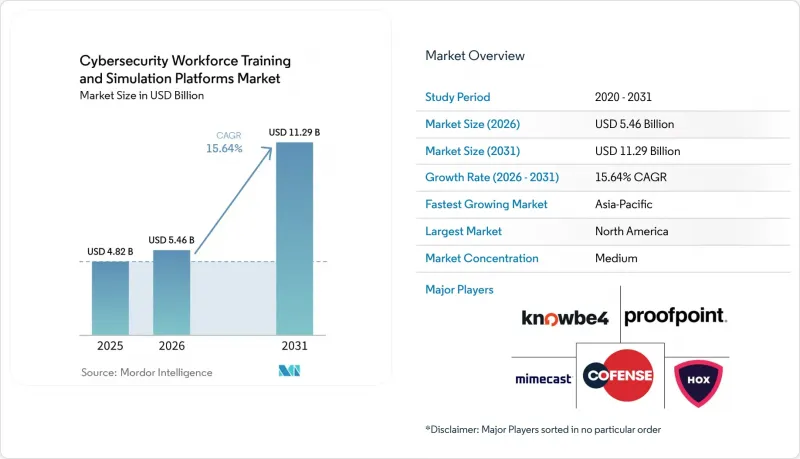
This report is Segmented by Component (Software and Services), Deployment (Cloud, On-Premises, and Hybrid), Enterprise Size (Large Enterprises, and Small and Medium Enterprises), Application (Security Awareness Training, and More), End-User Industry (BFSI, Healthcare and Life Sciences, and More), and Geography. The Market Forecasts are Provided in Terms of Value (USD).
Global Cybersecurity Workforce Training and Simulation Platforms Market Trends and Insights
Rising Phishing Proficiency Gaps Driven by AI-Generated Attacks
AI-generated attacks have weakened the old assumption that workers can spot phishing based solely on grammar mistakes, generic greetings, or visual inconsistencies. Hoxhunt reported a 14-fold increase in AI-generated phishing attacks in 2026, demonstrating how quickly attack quality has improved across employee-facing channels. The Cloud Security Alliance noted that AI-enabled tools can produce up to 100 personalized spear-phishing variants per hour, enabling a much wider share of the workforce to be targeted with tailored messages. In the cybersecurity workforce training and simulation platforms market, this changes the product requirement from occasional awareness refreshers to faster content updates and more adaptive simulation design. KnowBe4 also tracked a 41% increase in attacks via Microsoft Teams and a 49% increase in calendar invite phishing, indicating that vendors now need broader simulation coverage than email alone. Buyers in the cybersecurity workforce training and simulation platforms market are therefore favoring platforms that turn new threat patterns into active exercises within days instead of quarters.
Cyber Insurance and Audit Requirements for Measurable Human-Risk Controls
The cybersecurity workforce training and simulation platforms market is also gaining support from insurance and audit processes that increasingly focus on measurable workforce behavior rather than policy existence alone. Buyers now place greater value on platforms that can show phishing simulation outcomes, role-based completion, and reporting behavior in a format that risk and compliance teams can reuse. This matters because training programs are being reviewed alongside broader control frameworks such as HIPAA, PCI-DSS, SOC 2, and CMMC, underscoring the need for documented evidence rather than generic attendance records. The proposed HIPAA Security Rule updates underscore stronger expectations for protecting electronic protected health information, which supports a more formal approach to workforce cybersecurity controls in healthcare settings. In practice, this pushes the cybersecurity workforce training and simulation platforms market toward platforms that export audit-ready data and keep evidence trails that are easier to defend during reviews. The result is that purchasing decisions are moving away from HR-led content selection toward risk-led platform selection with deeper reporting.
Limited Ability To Prove Direct ROI on Reduced Breach Frequency
The hardest budget question in the cybersecurity workforce training and simulation platforms market remains whether better training can be tied directly to fewer successful breaches. This is difficult because prevented incidents are not directly observable, so finance teams often struggle to connect simulation activity with avoided loss. SANS found that 27% of organizations experienced breaches tied to capability gaps, which supports the need for training, but it still does not solve the reverse proof problem that boards often want. Vendors are responding by combining phishing-prone trends, reporting rates, and risk scores into unified dashboards that make progress easier to discuss. Even so, the cybersecurity workforce training and simulation platforms market still faces friction when buyers compare training spend with tools that have more direct incident or infrastructure metrics. This issue is likely to keep favoring vendors that can translate behavior change into language that audit, insurance, and finance teams can use without extra interpretation.
Other drivers and restraints analyzed in the detailed report include:
- Shift From Awareness Content to Continuous Simulation-Based Skill Validation
- Expanding Demand for Role-Based Training Across Security Operations and Incident Response Teams
- Content Localization And Scenario Maintenance Costs for Multi-Region Rollouts
For complete list of drivers and restraints, kindly check the Table Of Contents.
Segment Analysis
Software accounted for 59.87% of the cybersecurity workforce training and simulation platforms market in 2025, underscoring the shift toward centralized platforms. The software base remained larger because buyers preferred scalable content libraries, easier user administration, and broader integration options across distributed workforces. In the cybersecurity workforce training and simulation platforms market, cloud-delivered software also makes it easier to launch adaptive simulations at a large scale without corresponding increases in operational effort. That advantage has kept software at the center of buyer evaluations even as service intensity rises.
Services are projected to grow at a 16.72% CAGR through 2031, which signals that a different part of the value chain is strengthening. Many mid-market and resource-constrained buyers now want program management, campaign design, analytics interpretation, and reporting support instead of a stand-alone license. ISC2 reported that 77% of enterprises used a mix of in-house and third-party providers for training delivery, which supports the wider move toward managed support models. Across the cybersecurity workforce training and simulation platforms industry, this makes services more than an add-on because managed delivery helps buyers convert platform usage into measurable operational routines. It also increases renewal stickiness because behavioral data, campaign history, and reporting logic are embedded in the vendor relationship rather than confined solely to the software layer.
Cloud accounted for 52.91% of the cybersecurity workforce training and simulation platforms market in 2025, reflecting the ease of global rollout and continuous content maintenance. Buyers favored cloud models because they simplified updates, shortened deployment times, and connected well with identity, HR, and collaboration systems already used across the enterprise. The cybersecurity workforce training and simulation platforms market benefited from this model because new content, simulation templates, and administrative changes could be pushed without local infrastructure work. Cloud was especially well aligned with firms that had already standardized large parts of their security and productivity stack around SaaS.
Hybrid is projected to grow at a 16.83% CAGR through 2031, suggesting a more compliance-driven architecture choice. Regulated sectors increasingly want cloud-based content management and AI simulation benefits while keeping behavioral evidence, employee profiles, and other sensitive records in controlled, local environments. SoSafe's positioning around EU-only data residency highlighted how sovereignty and privacy requirements are shaping deployment selection in Europe. On-premises models still retain importance in defense and critical infrastructure settings where air-gapped or tightly isolated environments remain necessary. In the cybersecurity workforce training and simulation platforms market, hybrid growth suggests that the future choice will be less about cloud versus on-premises and more about where specific data elements are allowed to live.
Complete Report Scope:
- By Component
- Software
- Services
- By Deployment
- Cloud
- On-Premises
- Hybrid
- By Enterprise Size
- Large Enterprises
- Small and Medium Enterprises
- By Application
- Security Awareness Training
- Phishing and Social Engineering Simulation
- Cyber Range and Hands-on Technical Training
- Red Team / Blue Team / Purple Team Exercises
- Incident Response and Crisis Management Drills
- Secure Coding and DevSecOps Training
- Compliance Training
- Insider Threat Awareness
- By End-user Industry
- BFSI
- Healthcare and Life Sciences
- Information Technology and Telecom
- Retail and E-commerce
- Industrial Manufacturing
- Government and Public Sector
- Other End-user Industries
- By Geography
- North America
- United States
- Canada
- Mexico
- South America
- Brazil
- Argentina
- Rest of South America
- Europe
- Germany
- United Kingdom
- France
- Italy
- Spain
- Russia
- Rest of Europe
- Asia-Pacific
- China
- India
- Japan
- South Korea
- Australia
- Rest of Asia-Pacific
- Middle East and Africa
- Middle East
- Saudi Arabia
- United Arab Emirates
- Rest of Middle East
- Africa
- South Africa
- Nigeria
- Rest of Africa
- Middle East
- North America
Geography Analysis
North America accounted for 31.12% of the cybersecurity workforce training and simulation platforms market in 2025, making it the largest regional market. The region benefited from mature enterprise procurement, stronger security spending discipline, and a clearer link between training, insurance, and audit expectations. U.S. demand is reinforced by layered obligations such as CMMC, SEC cybersecurity disclosure requirements, and HIPAA-linked workforce expectations, which make documented training evidence more valuable across industries. The U.S. Department of War Office of the CIO launched the Cyber Registered Apprenticeship Program in April 2026, signaling sustained public investment in simulation-based cyber skills development. NIST also awarded more than USD 3 million across 13 states in 2025 to support cybersecurity workforce development, helping strengthen the regional talent and training ecosystem for cybersecurity workforce training and simulation platforms.
Europe remained the second-largest region in the cybersecurity workforce training and simulation platforms market in 2025, with demand shaped strongly by regulation. NIS2 expanded the number of organizations subject to cybersecurity obligations, and DORA added further pressure on financial entities to maintain stronger operational resilience and workforce preparedness. Germany's IT security market rose 10.1% in 2025 to EUR 11.1 billion (USD 11.99 billion) and is projected to grow 9.9% in 2026 to EUR 12.2 billion (USD 13.3 billion), which shows a healthy spending backdrop for training and security software adoption. SoSafe has benefited from this setting by building on GDPR-aligned data handling, EU-focused hosting, and multilingual content that aligns with local compliance and sovereignty expectations.
Asia-Pacific is projected to grow at a 17.27% CAGR through 2031, which makes it the fastest-expanding region in the cybersecurity workforce training and simulation platforms market. The region's biggest growth driver is the severe talent shortfall, which reached 3.4 million professionals in 2025, according to the supplied material. India is seeing stronger healthcare and enterprise demand as digital obligations tighten, while Japan's NICT launched a new cycle of practical cyber simulation training in April 2026 for registered security professionals. Malaysia's projected need for 28,068 cybersecurity professionals by 2026 against an existing base of 16,765 shows how wide the regional training gap remains. South America is advancing on the back of Brazil's LGPD enforcement maturity and the wider financial sector's digitalization, while the Middle East and Africa remain the smallest but still active, as outcome-based training becomes more important in regulated financial settings. The cybersecurity workforce training and simulation platforms market is therefore expanding fastest where threat exposure and workforce shortages are rising together, even if regional budgets remain less mature than in North America.
- KnowBe4, Inc.
- Proofpoint, Inc.
- Cofense, Inc.
- Hoxhunt Oy
- Mimecast Limited
- Barracuda Networks, Inc.
- CybeReady Ltd.
- Terranova Security Inc.
- Infosec Institute, Inc.
- SANS Institute
- NINJIO, Inc.
- Curricula, Inc.
- Fishbone Inc.
- Hook Security LLC
- AwareGO ehf.
- Phished.io B.V.
- SoSafe GmbH
- Blackbird.AI, Inc.
- Wizer Security, Inc.
- Cyberbit Ltd.
Additional Benefits:
- The market estimate (ME) sheet in Excel format
- 3 months of analyst support
TABLE OF CONTENTS
1 INTRODUCTION
- 1.1 Study Assumptions and Market Definition
- 1.2 Scope of the Study
2 RESEARCH METHODOLOGY
3 EXECUTIVE SUMMARY
4 MARKET LANDSCAPE
- 4.1 Market Overview
- 4.2 Market Drivers
- 4.2.1 Rising Phishing Proficiency Gaps Driven by AI-Generated Attacks
- 4.2.2 Cyber Insurance And Audit Requirements For Measurable Human-Risk Controls
- 4.2.3 Shift From Awareness Content To Continuous Simulation-Based Skill Validation
- 4.2.4 Expanding Demand For Role-Based Training Across Security Operations And Incident Response Teams
- 4.2.5 Growing Adoption Of Cloud-Native, API-Ready Training Platforms In Mid-Market Enterprises
- 4.2.6 Expansion Of Public Sector Cyber Workforce Upskilling Programs
- 4.3 Market Restraints
- 4.3.1 Limited Ability To Prove Direct ROI On Reduced Breach Frequency
- 4.3.2 Content Localization And Scenario Maintenance Costs For Multi-Region Rollouts
- 4.3.3 Integration Friction With LMS, SIEM, IAM, And GRC Stacks
- 4.3.4 Simulation Fatigue And Declining Employee Engagement Over Time
- 4.4 Industry Value-Chain Analysis
- 4.5 Regulatory Landscape
- 4.6 Technological Outlook
- 4.7 Porter's Five Forces Analysis
- 4.7.1 Bargaining Power of Buyers
- 4.7.2 Bargaining Power of Suppliers
- 4.7.3 Threat of New Entrants
- 4.7.4 Threat of Substitutes
- 4.7.5 Intensity of Competitive Rivalry
5 MARKET SIZE AND GROWTH FORECASTS (VALUE)
- 5.1 By Component
- 5.1.1 Software
- 5.1.2 Services
- 5.2 By Deployment
- 5.2.1 Cloud
- 5.2.2 On-Premises
- 5.2.3 Hybrid
- 5.3 By Enterprise Size
- 5.3.1 Large Enterprises
- 5.3.2 Small and Medium Enterprises
- 5.4 By Application
- 5.4.1 Security Awareness Training
- 5.4.2 Phishing and Social Engineering Simulation
- 5.4.3 Cyber Range and Hands-on Technical Training
- 5.4.4 Red Team / Blue Team / Purple Team Exercises
- 5.4.5 Incident Response and Crisis Management Drills
- 5.4.6 Secure Coding and DevSecOps Training
- 5.4.7 Compliance Training
- 5.4.8 Insider Threat Awareness
- 5.5 By End-user Industry
- 5.5.1 BFSI
- 5.5.2 Healthcare and Life Sciences
- 5.5.3 Information Technology and Telecom
- 5.5.4 Retail and E-commerce
- 5.5.5 Industrial Manufacturing
- 5.5.6 Government and Public Sector
- 5.5.7 Other End-user Industries
- 5.6 By Geography
- 5.6.1 North America
- 5.6.1.1 United States
- 5.6.1.2 Canada
- 5.6.1.3 Mexico
- 5.6.2 South America
- 5.6.2.1 Brazil
- 5.6.2.2 Argentina
- 5.6.2.3 Rest of South America
- 5.6.3 Europe
- 5.6.3.1 Germany
- 5.6.3.2 United Kingdom
- 5.6.3.3 France
- 5.6.3.4 Italy
- 5.6.3.5 Spain
- 5.6.3.6 Russia
- 5.6.3.7 Rest of Europe
- 5.6.4 Asia-Pacific
- 5.6.4.1 China
- 5.6.4.2 India
- 5.6.4.3 Japan
- 5.6.4.4 South Korea
- 5.6.4.5 Australia
- 5.6.4.6 Rest of Asia-Pacific
- 5.6.5 Middle East and Africa
- 5.6.5.1 Middle East
- 5.6.5.1.1 Saudi Arabia
- 5.6.5.1.2 United Arab Emirates
- 5.6.5.1.3 Rest of Middle East
- 5.6.5.2 Africa
- 5.6.5.2.1 South Africa
- 5.6.5.2.2 Nigeria
- 5.6.5.2.3 Rest of Africa
- 5.6.5.1 Middle East
- 5.6.1 North America
6 COMPETITIVE LANDSCAPE
- 6.1 Market Concentration
- 6.2 Strategic Moves
- 6.3 Market Share Analysis
- 6.4 Company Profiles (includes Global Level Overview, Market Level Overview, Core Segments, Financials as available, Strategic Information, Market Rank/Share, Products and Services, Recent Developments)
- 6.4.1 KnowBe4, Inc.
- 6.4.2 Proofpoint, Inc.
- 6.4.3 Cofense, Inc.
- 6.4.4 Hoxhunt Oy
- 6.4.5 Mimecast Limited
- 6.4.6 Barracuda Networks, Inc.
- 6.4.7 CybeReady Ltd.
- 6.4.8 Terranova Security Inc.
- 6.4.9 Infosec Institute, Inc.
- 6.4.10 SANS Institute
- 6.4.11 NINJIO, Inc.
- 6.4.12 Curricula, Inc.
- 6.4.13 Fishbone Inc.
- 6.4.14 Hook Security LLC
- 6.4.15 AwareGO ehf.
- 6.4.16 Phished.io B.V.
- 6.4.17 SoSafe GmbH
- 6.4.18 Blackbird.AI, Inc.
- 6.4.19 Wizer Security, Inc.
- 6.4.20 Cyberbit Ltd.
7 MARKET OPPORTUNITIES AND FUTURE OUTLOOK
- 7.1 White-Space and Unmet-Need Assessment

