PUBLISHER: Mordor Intelligence | PRODUCT CODE: 2099070

PUBLISHER: Mordor Intelligence | PRODUCT CODE: 2099070
Finance Lease - Market Share Analysis, Industry Trends & Statistics, Growth Forecasts (2026 - 2031)
According to Mordor Intelligence, the finance lease market size is projected to be USD 2.51 trillion in 2025, USD 2.59 trillion in 2026, and reach USD 3.13 trillion by 2031, growing at a CAGR of 3.89% from 2026 to 2031.
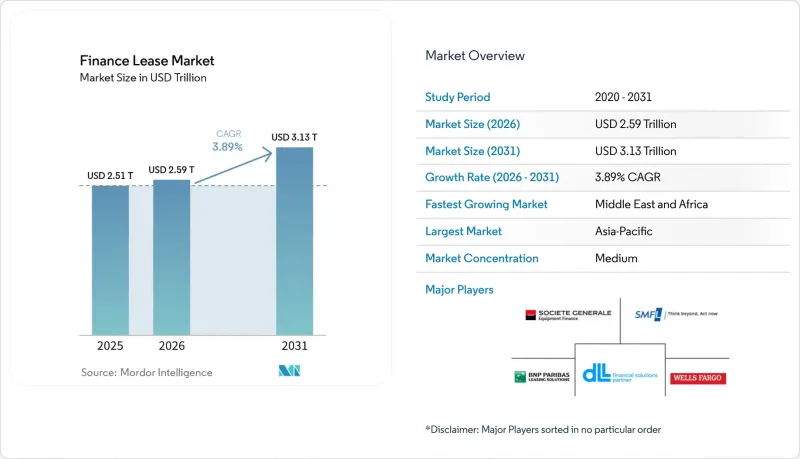
This report is Segmented by Business Mode (Domestic and International), by Asset Type (Machinery and Equipment, Vehicles, and More), by Industry (Transportation and Logistics, Manufacturing, and More), by Lessor Type (Bank-Owned / Bank-Affiliated Leasing Companies, and More), and by Geography (North America, South America, and More). The Market Forecasts are Provided in Terms of Value (USD).
Global Finance Lease Market Trends and Insights
Rising Asset-Light Financing Demand
The Finance lease market is benefiting from a broader move by companies to preserve cash while still securing access to revenue-generating assets. Corporate buyers are placing greater emphasis on liquidity discipline, which supports the use of finance leases for equipment, fleet, and technology assets that can be matched to operating cash flow. The Equipment Leasing and Finance Association said real equipment and software investment posted its strongest two-quarter performance in 20 years during H1 2025, indicating that demand has firmly shifted toward financing rather than outright ownership. This demand pattern also shifts more asset risk to lessors, especially when the financed equipment falls into categories with shorter useful lives or faster upgrade cycles. In the Finance lease market, that means growth is being supported by corporate caution on capital spending, but the quality of growth depends on whether lessors price residual and credit risk with enough discipline.
Balance Sheet Efficiency Under IFRS 16 and ASC 842
The Finance lease market is also supported by the way accounting standards now shape lease structuring decisions. The post-implementation review of IFRS 16 showed that the standard is generally working as intended, while EFRAG stated that it improved transparency and comparability by bringing most leases onto the balance sheet. That outcome has reduced the older presentation advantage that once supported operating lease selection in many cases. For many lessees, the choice now depends more on depreciation treatment, interest recognition, tax timing, and funding logic than on simple balance sheet optics. The International Accounting Standards Board is expected to publish its project summary before the end of 2026, and that continued review keeps lease accounting relevant for multinational and cross-border structuring decisions in the Finance lease market.
Interest Rate Volatility and Funding Spread Pressure
The Finance lease market remains exposed to funding conditions even when lease demand is healthy. The United States saw support from three Federal Reserve rate cuts in Q4 2025, and that helped underpin strong early 2026 activity, but global rate cycles are still moving unevenly across regions. Lessors with cross-border books can face a mismatch when receivables are linked to local cash flows while funding is raised in hard currency. SMBC Aviation Capital noted that aircraft shortages kept lease rates firm enough to preserve margins even as spreads eased during 2025, but that kind of pricing support is not available in every asset class. In the Finance lease market, rate volatility does not stop origination on its own, but it can narrow margins and make pricing discipline more important for independents and other non-bank platforms.
Other drivers and restraints analyzed in the detailed report include:
- SME Credit Gap and Fast-Track Equipment Access
- Digital Underwriting and Embedded Finance Adoption
- Residual Value Risk in Fast-Obsolescing Asset Classes
For complete list of drivers and restraints, kindly check the Table Of Contents.
Segment Analysis
Domestic business accounted for 76.12% of global volume in 2025, keeping it firmly in the lead in the Finance lease market. This position reflects how strongly finance leasing still depends on local credit assessment, local legal enforcement, local asset servicing, and practical collateral recovery. The domestic model also gives lessors more direct oversight across the full asset life cycle, which helps with pricing, monitoring, and remarketing. That keeps domestic business relevant even during a period when multinational customers are seeking broader program coverage. The Finance lease market, therefore, remains grounded in local execution even as customer demand becomes more regional and international.
International business is still the faster-moving part of this structure, with a projected 5.22% CAGR through 2026-2031. That faster pace points to rising activity in cross-border fleet deployments, aviation sale-and-leaseback structures, and procurement programs handled through single-lessor frameworks. Japan's consolidated leasing capital investment for FY2025 reached JPY 10,932.9 billion (USD 69.99 billion), with domestic activity rising 9.4% while overseas activity declined 2.1%. This shows that even experienced lessors are selective about how they take on international risk, particularly when currency, repossession, and tax conditions vary sharply across jurisdictions. For the Finance lease market, cross-border growth is real, but the pace of expansion will still depend on whether lessors can manage complexity without weakening portfolio quality.
Vehicles accounted for 32.79% of total volume in 2025, making them the largest asset category in the Finance lease market share mix. Their scale stems from widespread use across transport, delivery, public services, construction support, and business fleets, as well as from easier valuation standards than those for many specialized asset types. Vehicles also fit well with structured financing because utilization patterns, replacement timing, and resale channels are easier to track in many countries. This gives lessors a more standardized product that can be written at volume and distributed across multiple verticals. In the Finance lease market, vehicle leasing remains important because it combines repeat demand with manageable collateral processes.
Aircraft finance leases are projected to grow at 6.04% CAGR through 2031, which makes aviation the fastest-growing asset pocket in the draft. The growth case is tied to supply-constrained delivery pipelines and airline dependence on lessor-backed financing when direct purchases are less practical. That keeps finance lease structures relevant in an asset class where delivery schedules, capital intensity, and fleet planning are tightly linked. Other asset groups, such as machinery, IT equipment, and specialized equipment, continue to form a large part of the base, but they do not carry the same combination of size and growth. The Finance lease market also has to treat non-aviation technology assets more carefully, because faster depreciation in connected and compute-intensive equipment can weaken end-of-term value assumptions more quickly than in vehicles or traditional machinery.
Complete Report Scope:
- By Business Mode
- Domestic Business
- International Business
- By Asset Type
- Machinery and Equipment
- Vehicles
- Aircrafts
- IT, Technology and Office Equipment
- Other Assets
- By Industry
- Transportation and Logistics
- Manufacturing
- IT and Telecom
- Construction and Infrastructure
- Energy, Utilities and Renewables
- Healthcare and Life Sciences
- Retail, Wholesale and E-commerce
- Public Sector and Government
- Other Industry Segments
- By Lessor Type
- Bank-Owned / Bank-Affiliated Leasing Companies
- Captive Finance Companies (Manufacturer-owned)
- Independent Leasing Companies
- Other NBFIs / Specialized Lessors
- By Geography
- North America
- United States
- Canada
- Mexico
- South America
- Brazil
- Argentina
- Rest of South America
- Europe
- United Kingdom
- Germany
- France
- Italy
- Spain
- Rest of Europe
- Asia-Pacific
- India
- China
- Japan
- South Korea
- Australia
- South East Asia (Singapore, Malaysia, Thailand, Indonesia, Vietnam, and Philippines)
- Rest of Asia-Pacific
- Middle East and Africa
- United Arab Emirates
- Saudi Arabia
- South Africa
- Nigeria
- Rest of Middle East and Africa
- North America
Geography Analysis
Asia-Pacific captured 33.86% of the global Finance lease market size in 2025, which made it the largest regional block in the draft. The region combines large domestic leasing systems with broad demand across transport, industrial equipment, technology assets, and public-sector use. Japan remains an important anchor within this base, with total lease transaction volume reaching JPY 5,298.4 billion in FY2025, up 4.2% from FY2024. Japan's transport equipment segment posted double-digit growth, while information and communication equipment rose 8.7%. Personal auto leasing in Japan is projected to cross 1 million vehicles under lease by FY2026, up 50% from FY2023 end levels.
North America and Europe remained the second- and third-largest regions in the Finance lease market. In the United States, ELFA reported that total new business volumes in Q1 2026 rose 18.6% year over year, suggesting strong equipment finance demand at the start of the year. In the United Kingdom, the Finance & Leasing Association reported that total asset finance new business rose 3% in Q1 2026 versus Q1 2025, with plant and machinery finance up 16% in March and commercial vehicle finance up 13%. Germany continued to face a difficult operating environment, but Deutsche Leasing said that transformation-related demand in sustainability, digitalization, and mobility remained strong.
The Middle East and Africa is projected to grow at 6.52% CAGR through 2031, making it the fastest-growing regional segment in the Finance lease market. Saudi Arabia is an important part of that story, with Vision 2030-linked infrastructure and aviation activity creating demand across fleet, aircraft, and energy equipment financing. AviLease reported USD 664 million in revenue in 2025, up 19% year over year, and it completed its first lease deal with Riyadh Air in Q4 2025. South America also offers room for expansion, especially in domestic vehicle and machinery leasing, though currency volatility still complicates some cross-border structures. Across these higher-growth regions, the Finance lease market is being pulled forward by underpenetrated leasing adoption, expanding infrastructure needs, and the search for funding models that can support productive assets without immediate ownership outlays.
- BNP Paribas Leasing Solutions
- Sumitomo Mitsui Finance and Leasing Co. Ltd
- HSBC Group
- Wells Fargo Bank, N.A.
- DLL Group
- CIT Group Inc.
- Deutsche Leasing AG
- Societe Generale Equipment Finance
- Fifth Third Bank, National Association
- Texas Capital Bancshares, Inc.
- North Star Leasing, Inc.
- Crest Capital
- Bank of America Corporation
- SMBC Group
- Hitachi Capital Corporation
- CDB Leasing Co., Ltd.
- Industrial and Commercial Bank of China Financial Leasing Co., Ltd.
- Fuyo General Lease Co., Ltd.
- Mizuho Leasing Company, Limited
- PACCAR Financial Corp.
Additional Benefits:
- The market estimate (ME) sheet in Excel format
- 3 months of analyst support
TABLE OF CONTENTS
1 INTRODUCTION
- 1.1 Study Assumptions and Market Definition
- 1.2 Scope of the Study
2 RESEARCH METHODOLOGY
3 EXECUTIVE SUMMARY
4 MARKET LANDSCAPE
- 4.1 Market Overview
- 4.2 Market Drivers
- 4.2.1 Rising Asset-Light Financing Demand
- 4.2.2 Balance Sheet Efficiency Under IFRS 16 and ASC 842
- 4.2.3 SME Credit Gap and Fast-Track Equipment Access
- 4.2.4 Digital Underwriting and Embedded Finance Adoption
- 4.2.5 Replacement-Cycle Financing for EV Fleets and Connected Assets
- 4.2.6 Green Leasing for Energy-Efficient and Low-Carbon Assets
- 4.3 Market Restraints
- 4.3.1 Interest Rate Volatility and Funding Spread Pressure
- 4.3.2 Residual Value Risk in Fast-Obsolescing Asset Classes
- 4.3.3 Jurisdictional Tax, Accounting, and Repossession Complexity
- 4.3.4 Data Quality and Fraud-Detection Gaps in Digital Lease Origination
- 4.4 Value Chain Analysis
- 4.5 Regulatory Landscape
- 4.6 Technological Outlook
- 4.7 Porter's Five Forces Analysis
- 4.7.1 Threat of New Entrants
- 4.7.2 Bargaining Power of Suppliers
- 4.7.3 Bargaining Power of Buyers
- 4.7.4 Threat of Substitutes
- 4.7.5 Competitive Rivalry
5 MARKET SIZE AND GROWTH FORECASTS
- 5.1 By Business Mode
- 5.1.1 Domestic Business
- 5.1.2 International Business
- 5.2 By Asset Type
- 5.2.1 Machinery and Equipment
- 5.2.2 Vehicles
- 5.2.3 Aircrafts
- 5.2.4 IT, Technology and Office Equipment
- 5.2.5 Other Assets
- 5.3 By Industry
- 5.3.1 Transportation and Logistics
- 5.3.2 Manufacturing
- 5.3.3 IT and Telecom
- 5.3.4 Construction and Infrastructure
- 5.3.5 Energy, Utilities and Renewables
- 5.3.6 Healthcare and Life Sciences
- 5.3.7 Retail, Wholesale and E-commerce
- 5.3.8 Public Sector and Government
- 5.3.9 Other Industry Segments
- 5.4 By Lessor Type
- 5.4.1 Bank-Owned / Bank-Affiliated Leasing Companies
- 5.4.2 Captive Finance Companies (Manufacturer-owned)
- 5.4.3 Independent Leasing Companies
- 5.4.4 Other NBFIs / Specialized Lessors
- 5.5 By Geography
- 5.5.1 North America
- 5.5.1.1 United States
- 5.5.1.2 Canada
- 5.5.1.3 Mexico
- 5.5.2 South America
- 5.5.2.1 Brazil
- 5.5.2.2 Argentina
- 5.5.2.3 Rest of South America
- 5.5.3 Europe
- 5.5.3.1 United Kingdom
- 5.5.3.2 Germany
- 5.5.3.3 France
- 5.5.3.4 Italy
- 5.5.3.5 Spain
- 5.5.3.6 Rest of Europe
- 5.5.4 Asia-Pacific
- 5.5.4.1 India
- 5.5.4.2 China
- 5.5.4.3 Japan
- 5.5.4.4 South Korea
- 5.5.4.5 Australia
- 5.5.4.6 South East Asia (Singapore, Malaysia, Thailand, Indonesia, Vietnam, and Philippines)
- 5.5.4.7 Rest of Asia-Pacific
- 5.5.5 Middle East and Africa
- 5.5.5.1 United Arab Emirates
- 5.5.5.2 Saudi Arabia
- 5.5.5.3 South Africa
- 5.5.5.4 Nigeria
- 5.5.5.5 Rest of Middle East and Africa
- 5.5.1 North America
6 COMPETITIVE LANDSCAPE
- 6.1 Market Concentration
- 6.2 Strategic Moves
- 6.3 Market Share Analysis
- 6.4 Company Profiles (includes Global Level Overview, Market Level Overview, Core Segments, Financials as available, Strategic Information, Market Rank/Share, Products and Services, Recent Developments)
- 6.4.1 BNP Paribas Leasing Solutions
- 6.4.2 Sumitomo Mitsui Finance and Leasing Co. Ltd
- 6.4.3 HSBC Group
- 6.4.4 Wells Fargo Bank, N.A.
- 6.4.5 DLL Group
- 6.4.6 CIT Group Inc.
- 6.4.7 Deutsche Leasing AG
- 6.4.8 Societe Generale Equipment Finance
- 6.4.9 Fifth Third Bank, National Association
- 6.4.10 Texas Capital Bancshares, Inc.
- 6.4.11 North Star Leasing, Inc.
- 6.4.12 Crest Capital
- 6.4.13 Bank of America Corporation
- 6.4.14 SMBC Group
- 6.4.15 Hitachi Capital Corporation
- 6.4.16 CDB Leasing Co., Ltd.
- 6.4.17 Industrial and Commercial Bank of China Financial Leasing Co., Ltd.
- 6.4.18 Fuyo General Lease Co., Ltd.
- 6.4.19 Mizuho Leasing Company, Limited
- 6.4.20 PACCAR Financial Corp.
7 MARKET OPPORTUNITIES AND FUTURE OUTLOOK
- 7.1 White-Space and Unmet-Need Assessment

