PUBLISHER: Mordor Intelligence | PRODUCT CODE: 2099078

PUBLISHER: Mordor Intelligence | PRODUCT CODE: 2099078
Asia-Pacific Talent Management Software - Market Share Analysis, Industry Trends & Statistics, Growth Forecasts (2026 - 2031)
According to Mordor Intelligence, the Asia-Pacific talent management software market size is expected to grow from USD 2.19 billion in 2025 to USD 2.45 billion in 2026 and is forecast to reach USD 4.58 billion by 2031 at 13.35% CAGR over 2026-2031.
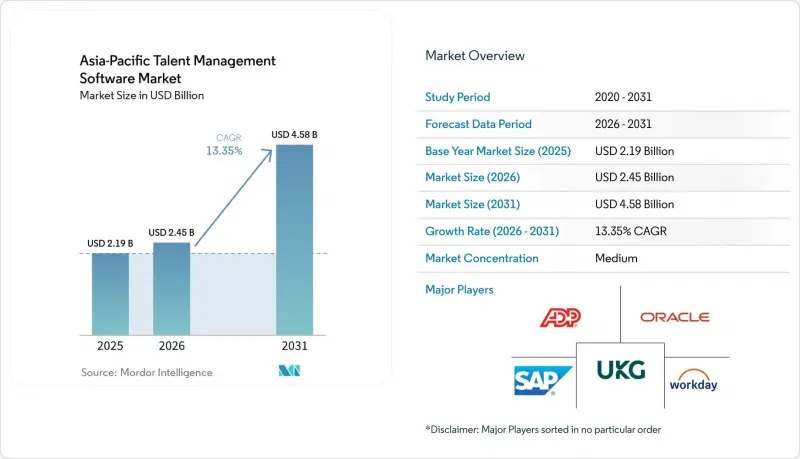
This report is Segmented by Component (Software, and Services), Application (Performance Management, Succession Planning, and More), Deployment (On-Premise, and Cloud), Organization Size (Large Enterprises, and Small and Medium Enterprises [SMEs]), End-Use Industry (Retail and E-Commerce, Manufacturing, and More), and Region. The Market Forecasts are Provided in Terms of Value (USD).
Asia-Pacific Talent Management Software Market Trends and Insights
Escalating Digital Transformation Budgets amid Workforce Reskilling Mandates
Enterprises across the Asia-Pacific talent management software market are allocating a larger share of transformation budgets to HR systems because workforce readiness is now more closely tied to enterprise execution. The buying process is shifting away from single-module adoption toward suites that support skills frameworks, learning pathways, performance visibility, and internal mobility in a single environment. This change matters because reskilling is no longer treated as a separate HR activity with its own limited budget window. It is becoming part of wider digital programs that require better employee data, cleaner workflows, and measurable outcomes from managers and HR teams. Singapore is reinforcing this direction through its HR Industry Transformation Plan and through workforce planning tools such as TalentTrack and TalentTrack+, which support skills-based planning and cloud-led HR modernization. As a result, the Asia-Pacific talent management software market is benefiting from spending that increasingly treats talent platforms as part of core operating infrastructure rather than as optional HR add-ons.
Rising Adoption of Artificial Intelligence for Data-Driven Recruitment
AI is becoming a more central layer in recruitment across the Asia-Pacific talent management software market because employers want faster candidate identification, more consistent screening, and stronger fit assessment. Vendors are responding by embedding conversational hiring tools, automation, and intelligence directly into recruitment workflows rather than offering them as add-ons. That shift is reducing the appeal of disconnected point tools and strengthening demand for platforms that link sourcing, screening, interview coordination, and workforce planning. Company examples also show that buyers are looking for systems that improve recruiter output without requiring major process redesign from the start. Eightfold AI stated that early deployments of its Recruiter Agent delivered up to 50% more candidate coverage and saved 4 hours per role, underscoring why AI-led recruiting modules are becoming more commercially relevant in the region. The Asia-Pacific talent management software market is therefore seeing stronger demand for platforms that use AI to raise recruiter productivity while keeping hiring decisions inside a broader talent system.
Data Residency and Cross-Border Compliance Complexities
Compliance remains a significant barrier to the Asia-Pacific talent management software market because employers often manage employee data across countries with varying legal and technical requirements. This issue is most pronounced for organizations operating in China, India, and Southeast Asia simultaneously, where data transfer rules, privacy expectations, and audit obligations do not align easily. ADP's 2026 review of Chinese enterprises noted that regulatory changes are making scalable compliance mechanisms a core buying requirement, especially for AI use in recruitment and cross-border data handling. That means vendors now need more than product functionality, because buyers also expect local legal readiness, secure architecture choices, and continuous compliance maintenance. These demands increase vendors' costs and lengthen buyers' implementation cycles, especially in large cross-border deployments. In the Asia-Pacific talent management software market, the result is slower rollout speeds in complex jurisdictions, even when demand conditions remain favorable.
Other drivers and restraints analyzed in the detailed report include:
- Government Incentives for Cloud-First Human Resource Systems across Asia-Pacific
- Surge in Distributed Workforce Models Post-Pandemic Accelerating SaaS TMS Uptake
- Limited IT Infrastructure in Frontier Asia-Pacific Markets
For complete list of drivers and restraints, kindly check the Table Of Contents.
Segment Analysis
Software held 78.19% of the Asia-Pacific talent management software market share in 2025, which confirmed that most spending was still centered on core platforms rather than surrounding service layers. This position reflects the strength of integrated HCM suites, applicant tracking systems, and performance management products that buyers treat as foundational HR infrastructure. Subscription models also helped software remain dominant by reducing upfront budget pressure and allowing organizations to spread spending over longer contract periods. Even so, the maturity of the Asia-Pacific talent management software market is making buyers more aware that software alone does not determine outcomes after purchase. Implementation quality, data migration discipline, and change management now directly influence whether organizations achieve faster adoption, better reporting, and more reliable employee records. That is why service spend is becoming more closely linked to platform decisions, rather than sitting in a separate procurement stream.
Services are projected to expand at a 15.91% CAGR from 2026 to 2031, making them the fastest-growing component within the Asia-Pacific talent management software market. This growth reflects a shift in buyer priorities from product selection to execution quality, especially in large, multi-country deployments. Enterprises increasingly need integration support, local configuration, analytics enablement, and post-go-live optimization to make broader suite investments work as intended. Professional services remain the larger sub-segment because buyers need help with architecture planning, implementation, workflow redesign, and structured data migration before automation can scale. Support and maintenance are also becoming more important as HR systems take on payroll, compliance, and workforce planning processes that buyers consider business critical. In practical terms, the Asia-Pacific talent management software industry is moving toward a model in which services do not replace software growth, but instead determine how much operational value buyers can extract from it over time.
Performance management accounted for 23.65% of the Asia-Pacific talent management software market in 2025, indicating that appraisal and review workflows remain the most common entry point to broader platform adoption. Many enterprises start there because performance cycles touch most employees and create structured data that can later support succession, compensation, and workforce planning. That installed base gives performance management a durable position in the Asia-Pacific talent management software market, especially among larger employers that are modernizing older HR processes in stages. At the same time, buyers are increasingly requesting tighter alignment between performance records, skills frameworks, career progression, and internal mobility decisions. This is changing how application bundles are sold, as standalone appraisal tools no longer meet the operational needs of many regional employers. As a result, performance management remains central, but it now works more often as the anchor module inside broader suite contracts.
Learning and development is forecast to grow at a 14.82% CAGR from 2026 to 2031, which makes it the fastest-growing application in the Asia-Pacific talent management software market. The shift reflects stronger enterprise demand for structured reskilling, especially as AI adoption reshapes job design, skill expectations, and career planning. Government-supported tools in Singapore are also reinforcing the move toward skills-based planning and internal capability development, which helps learning modules gain relevance beyond traditional training administration. Recruitment and talent acquisition are also becoming high-innovation application areas as vendors add automation, conversational tools, and skills-based matching inside broader suite environments. Other functions, such as succession planning, compensation management, workforce planning, onboarding, and contingent workforce support, are gaining traction because buyers want fewer disconnected employee records throughout the talent lifecycle. Within the Asia-Pacific talent management software industry, the application mix is therefore shifting from isolated process automation toward connected talent decision systems that support learning, hiring, retention, and workforce planning together.
Complete Report Scope:
- By Component
- Software
- Services
- Professional Services
- Support and Maintenance Services
- By Application
- Performance Management
- Learning and Development
- Succession Planning
- Compensation Management
- Recruitment and Talent Acquisition
- Workforce Planning
- Employee Engagement and Career Development
- Other Talent Management Applications
- By Deployment
- On-Premise
- Cloud
- By Organization Size
- Large Enterprises
- Small and Medium Enterprises (SMEs)
- By End-Use Industry
- IT and Telecommunications
- Banking, Financial Services and Insurance (BFSI)
- Healthcare and Life Sciences
- Retail and E-Commerce
- Manufacturing
- Government and Public Sector
- Other End-Use Industries
- By Region
- China
- Japan
- India
- South Korea
- Australia and New Zealand
- Rest of Asia-Pacific
List of Companies Covered in this Report:
- Workday Inc.
- SAP SE
- Oracle Corporation
- Cornerstone OnDemand Inc.
- Ceridian HCM Holding Inc.
- Automatic Data Processing Inc.
- Ultimate Kronos Group Inc.
- BambooHR LLC
- PageUp People Pty Ltd
- SumTotal Systems LLC
- PeopleFluent Inc.
- Zoho Corporation Private Limited
- iCIMS Inc.
- Eightfold AI Inc.
- ClearCompany Inc.
- Paycom Software Inc.
- Paylocity Holding Corporation
- Ramco Systems Limited
- Sage Group plc
- Infor Inc.
Additional Benefits:
- The market estimate (ME) sheet in Excel format
- 3 months of analyst support
TABLE OF CONTENTS
1 INTRODUCTION
- 1.1 Study Assumptions and Market Definition
- 1.2 Scope of the Study
2 RESEARCH METHODOLOGY
3 EXECUTIVE SUMMARY
4 MARKET LANDSCAPE
- 4.1 Market Overview
- 4.2 Market Drivers
- 4.2.1 Escalating Digital Transformation Budgets Amid Workforce Reskilling Mandates
- 4.2.2 Rising Adoption of Artificial Intelligence for Data-Driven Recruitment
- 4.2.3 Government Incentives for Cloud-First Human Resource Systems Across Asia-Pacific
- 4.2.4 Surge in Distributed Workforce Models Post-Pandemic Accelerating SaaS TMS Uptake
- 4.2.5 Intensifying Competition for High-Skilled Talent in Emerging Asian Economies
- 4.2.6 Integration With Regional Social-Media Platforms Enhancing Candidate Experience
- 4.3 Market Restraints
- 4.3.1 Data Residency and Cross-Border Compliance Complexities
- 4.3.2 Limited IT Infrastructure in Frontier Asia-Pacific Markets
- 4.3.3 Persistent Skills Gaps in HR Analytics Teams
- 4.3.4 High Switching Costs From Legacy On-Premises HR Suites
- 4.4 Industry Value Chain Analysis
- 4.5 Regulatory Landscape
- 4.6 Technological Outlook
- 4.7 Impact of Macroeconomic Factors on the Market
- 4.8 Porter's Five Forces Analysis
- 4.8.1 Threat of New Entrants
- 4.8.2 Bargaining Power of Suppliers
- 4.8.3 Bargaining Power of Buyers
- 4.8.4 Threat of Substitutes
- 4.8.5 Competitive Rivalry
5 MARKET SIZE AND GROWTH FORECASTS (VALUE)
- 5.1 By Component
- 5.1.1 Software
- 5.1.2 Services
- 5.1.2.1 Professional Services
- 5.1.2.2 Support and Maintenance Services
- 5.2 By Application
- 5.2.1 Performance Management
- 5.2.2 Learning and Development
- 5.2.3 Succession Planning
- 5.2.4 Compensation Management
- 5.2.5 Recruitment and Talent Acquisition
- 5.2.6 Workforce Planning
- 5.2.7 Employee Engagement and Career Development
- 5.2.8 Other Talent Management Applications
- 5.3 By Deployment
- 5.3.1 On-Premise
- 5.3.2 Cloud
- 5.4 By Organization Size
- 5.4.1 Large Enterprises
- 5.4.2 Small and Medium Enterprises (SMEs)
- 5.5 By End-Use Industry
- 5.5.1 IT and Telecommunications
- 5.5.2 Banking, Financial Services and Insurance (BFSI)
- 5.5.3 Healthcare and Life Sciences
- 5.5.4 Retail and E-Commerce
- 5.5.5 Manufacturing
- 5.5.6 Government and Public Sector
- 5.5.7 Other End-Use Industries
- 5.6 By Region
- 5.6.1 China
- 5.6.2 Japan
- 5.6.3 India
- 5.6.4 South Korea
- 5.6.5 Australia and New Zealand
- 5.6.6 Rest of Asia-Pacific
6 COMPETITIVE LANDSCAPE
- 6.1 Market Concentration
- 6.2 Strategic Moves
- 6.3 Market Share Analysis
- 6.4 Company Profiles (includes Global Level Overview, Market Level Overview, Core Segments, Financials as available, Strategic Information, Market Rank/Share, Products and Services, Recent Developments)
- 6.4.1 Workday Inc.
- 6.4.2 SAP SE
- 6.4.3 Oracle Corporation
- 6.4.4 Cornerstone OnDemand Inc.
- 6.4.5 Ceridian HCM Holding Inc.
- 6.4.6 Automatic Data Processing Inc.
- 6.4.7 Ultimate Kronos Group Inc.
- 6.4.8 BambooHR LLC
- 6.4.9 PageUp People Pty Ltd
- 6.4.10 SumTotal Systems LLC
- 6.4.11 PeopleFluent Inc.
- 6.4.12 Zoho Corporation Private Limited
- 6.4.13 iCIMS Inc.
- 6.4.14 Eightfold AI Inc.
- 6.4.15 ClearCompany Inc.
- 6.4.16 Paycom Software Inc.
- 6.4.17 Paylocity Holding Corporation
- 6.4.18 Ramco Systems Limited
- 6.4.19 Sage Group plc
- 6.4.20 Infor Inc.
7 MARKET OPPORTUNITIES AND FUTURE OUTLOOK
- 7.1 White-Space and Unmet-Need Assessment

