
PUBLISHER: Mordor Intelligence | PRODUCT CODE: 2099110

PUBLISHER: Mordor Intelligence | PRODUCT CODE: 2099110
China Timber Logistics - Market Share Analysis, Industry Trends & Statistics, Growth Forecasts (2026 - 2031)
According to Mordor Intelligence, the China timber logistics market size was valued at USD 17.95 billion in 2025 and estimated to grow from USD 18.97 billion in 2026 to reach USD 24.29 billion by 2031, at a CAGR of 5.07% during the forecast period 2026-2031.
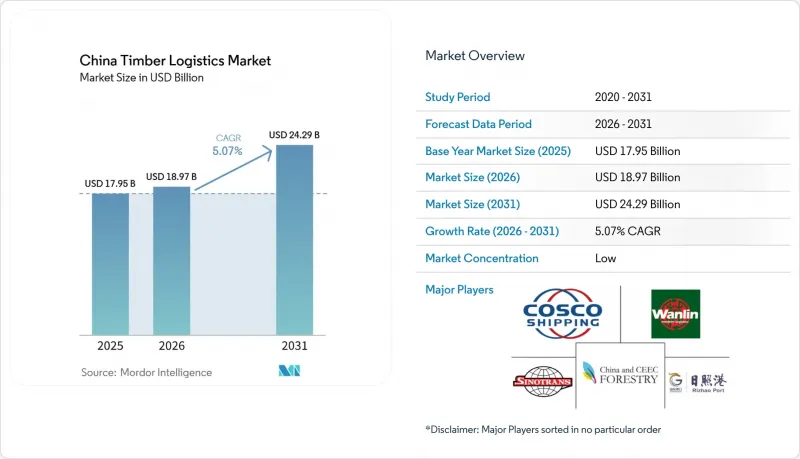
The China timber logistics market remains supported by structural import dependence, as domestic output has not fully replaced the large softwood logs and tropical hardwood grades needed by downstream manufacturers, despite domestic timber production estimated at 144 million m3 in 2025. This report is Segmented by Service (Transportation, Warehousing and Storage, and Value-Added Services), by Timber Product Type (Industrial Roundwood / Logs, Fuelwood & Biomass, and More), by End-Use Industry (Construction & Infrastructure, Pulp & Paper Industry, and More), and by Geography (East China, South China, North China, and More). The Market Forecasts are Provided in Terms of Value (USD).
China Timber Logistics Market Trends and Insights
Sustained Import Dependence for Log and Lumber Flows
The China timber logistics market remains tied to imported timber because domestic production does not fully cover the species mix and log dimensions used by furniture, panel, and engineered wood producers. China produced an estimated 144 million m3 of timber in 2025, yet imported wood still filled critical supply gaps for processors that depend on large-diameter softwood and tropical hardwood inputs. That dependence keeps the China timber logistics market active across seaborne arrivals, port handling, fumigation, and inland distribution even when end demand softens. The cargo mix also underscores the value of specialized logistics, as timber buyers need sorting, origin control, and timing support beyond freight movement alone. This is why the China timber logistics market keeps expanding in revenue terms even when raw throughput does not rise at the same pace.
Port-Centric Distribution Networks Along the East Coast
The China timber logistics market is still organized around East Coast ports because these locations offer berth access, bonded storage, customs capacity, and proximity to the country's largest wood-processing belts. Jiangsu, Shandong, Shanghai, Guangdong, Fujian, and Hebei remained the 6 leading wood-import provinces in the USDA account, underscoring how strongly import geography shapes the national logistics system. This concentration gives the China timber logistics market a clear coastal backbone, with inland processors depending on efficient transfer from the port gate to the industrial park. The model also supports higher service intensity because bonded yards near the ports can stage sorting, temporary storage, and release scheduling before timber moves inland. As a result, coastal logistics operators retain pricing power across service layers beyond base freight.
Real Estate Downcycle Weakening Timber Throughput
The China timber logistics market is facing its clearest demand restraint from the property downturn because new housing starts fell 20% in 2025 and remained 74% below 2020 levels. Lower residential activity reduces structural timber demand, softens fit-out related wood consumption, and weakens furniture demand tied to the housing cycle. That pressure feeds directly into the China timber logistics market through lower port throughput, lower storage yard utilization, and weaker turns on inland routes. Infrastructure spending still provides some support, but the timber mix in those projects is less favorable than that from residential construction. This leaves operators with heavier exposure to construction corridors under more strain than players that can sell bundled handling or compliance services.
Other drivers and restraints analyzed in the detailed report include:
- Rail And Intermodal Connectivity Into Inland Processing Clusters
- Digital Yard, Inventory, and Route Visibility Adoption
- Phytosanitary Holds And Border Inspection Delays
For complete list of drivers and restraints, kindly check the Table Of Contents.
Segment Analysis
Transportation held 66.48% of the China timber logistics market share in 2025, making it the largest service category across the report. Road haulage still handled the core movement between coastal log terminals and inland processing parks, while inland waterway flows on the Yangtze and Pearl River systems remained important for bulk distribution. Rail also became more relevant as inland processors looked for more stable long-distance routing. This kept transportation at the center of the China timber logistics market even as margins became more uneven across modes.
Value-added services are forecast to expand at a 7.30% CAGR through 2031, making them the fastest-growing service layer in the China timber logistics market. Debarking, grading, fumigation, wood chip processing, and supply chain financing are increasingly being sold as part of broader logistics contracts rather than as separate add-ons. This trend is strongest in bonded port parks where operators can handle sorting and verification before domestic release. China Railway's specialized timber service offerings also support more coordinated multimodal solutions that raise the value of managed transport packages.
Complete Report Scope:
- By Service
- Transportation
- Road
- Rail
- Waterway
- Multimodal
- Warehousing and Storage
- Value-Added Services
- Transportation
- By Timber Product Type
- Industrial Roundwood / Logs
- Fuelwood & Biomass
- Sawn Timber & Lumber
- Engineered Wood Products
- Pulpwood, Chips, and Fibre
- Pellets and Briquettes
- Other Timber Types
- By End-Use Industry
- Construction & Infrastructure
- Pulp & Paper Industry
- Furniture Manufacturing
- Packaging Industry
- Energy & Biomass Industry
- Other End-Use Industries
- By Geography
- East China
- South China
- North China
- Northeast China
- Central China
- Southwest China
- Northwest China
List of Companies Covered in this Report:
- Jiangsu Wanlin Modern Logistics Co., Ltd.
- China National Forest Products Group Company Limited
- Rizhao Port Co., Ltd.
- China COSCO Shipping Corporation Limited
- Sinotrans Limited
- China Merchants Port Holdings Company Limited
- Shanghai International Port (Group) Co., Ltd.
- Ningbo Zhoushan Port Company Limited
- Qingdao Port International Co., Ltd.
- Tianjin Port Co., Ltd.
- Guangzhou Port Company Limited
- Xiamen Port Development Co., Ltd.
- Liaoning Port Co., Ltd.
- Pacific Basin Shipping Limited
- A.P. Moller - Maersk
- C.H. Robinson Worldwide, Inc.
- Kuehne+Nagel International AG
- DSV A/S
- DHL Group
- CMA CGM Group
Additional Benefits:
- The market estimate (ME) sheet in Excel format
- 3 months of analyst support
TABLE OF CONTENTS
1 Introduction
- 1.1 Study Assumptions and Market Definition
- 1.2 Scope of the Study
2 Research Methodology
3 Executive Summary
4 Market Landscape
- 4.1 Market Overview
- 4.2 Market Drivers
- 4.2.1 Sustained Import Dependence for Log and Lumber Flows
- 4.2.2 Port-Centric Distribution Networks Along the East Coast
- 4.2.3 Rail And Intermodal Connectivity Into Inland Processing Clusters
- 4.2.4 Rising Traceability Requirements Across Cross-Border Timber Flows
- 4.2.5 Supply Diversification Away From Single-Origin Dependence
- 4.2.6 Digital Yard, Inventory, and Route Visibility Adoption
- 4.3 Market Restraints
- 4.3.1 Real Estate Downcycle Weakening Timber Throughput
- 4.3.2 Phytosanitary Holds and Border Inspection Delays
- 4.3.3 Export Bans in Supplier Countries Constraining Inbound Volumes
- 4.3.4 Fragmented Inland Haulage and Empty-Backhaul Inefficiency
- 4.4 Value / Supply-Chain Analysis
- 4.5 Regulatory Landscape
- 4.6 Technological Outlook
- 4.7 Porter's Five Forces Analysis
- 4.7.1 Bargaining Power of Suppliers
- 4.7.2 Bargaining Power of Buyers
- 4.7.3 Threat of New Entrants
- 4.7.4 Threat of Substitutes
- 4.7.5 Industry Rivalry
- 4.8 Impact of Geopolitical Events on the Market
5 Market Size & Growth Forecasts (Value in USD)
- 5.1 By Service
- 5.1.1 Transportation
- 5.1.1.1 Road
- 5.1.1.2 Rail
- 5.1.1.3 Waterway
- 5.1.1.4 Multimodal
- 5.1.2 Warehousing and Storage
- 5.1.3 Value-Added Services
- 5.1.1 Transportation
- 5.2 By Timber Product Type
- 5.2.1 Industrial Roundwood / Logs
- 5.2.2 Fuelwood & Biomass
- 5.2.3 Sawn Timber & Lumber
- 5.2.4 Engineered Wood Products
- 5.2.5 Pulpwood, Chips, and Fibre
- 5.2.6 Pellets and Briquettes
- 5.2.7 Other Timber Types
- 5.3 By End-Use Industry
- 5.3.1 Construction & Infrastructure
- 5.3.2 Pulp & Paper Industry
- 5.3.3 Furniture Manufacturing
- 5.3.4 Packaging Industry
- 5.3.5 Energy & Biomass Industry
- 5.3.6 Other End-Use Industries
- 5.4 By Geography
- 5.4.1 East China
- 5.4.2 South China
- 5.4.3 North China
- 5.4.4 Northeast China
- 5.4.5 Central China
- 5.4.6 Southwest China
- 5.4.7 Northwest China
6 Competitive Landscape
- 6.1 Market Concentration
- 6.2 Strategic Moves
- 6.3 Market Share Analysis
- 6.4 Company Profiles (includes Global Level Overview, Market Level Overview, Core Segments, Financials as available, Strategic Information, Market Rank/Share, Products and Services, Recent Developments)
- 6.4.1 Jiangsu Wanlin Modern Logistics Co., Ltd.
- 6.4.2 China National Forest Products Group Company Limited
- 6.4.3 Rizhao Port Co., Ltd.
- 6.4.4 China COSCO Shipping Corporation Limited
- 6.4.5 Sinotrans Limited
- 6.4.6 China Merchants Port Holdings Company Limited
- 6.4.7 Shanghai International Port (Group) Co., Ltd.
- 6.4.8 Ningbo Zhoushan Port Company Limited
- 6.4.9 Qingdao Port International Co., Ltd.
- 6.4.10 Tianjin Port Co., Ltd.
- 6.4.11 Guangzhou Port Company Limited
- 6.4.12 Xiamen Port Development Co., Ltd.
- 6.4.13 Liaoning Port Co., Ltd.
- 6.4.14 Pacific Basin Shipping Limited
- 6.4.15 A.P. Moller - Maersk
- 6.4.16 C.H. Robinson Worldwide, Inc.
- 6.4.17 Kuehne+Nagel International AG
- 6.4.18 DSV A/S
- 6.4.19 DHL Group
- 6.4.20 CMA CGM Group
7 Market Opportunities & Future Outlook
- 7.1 White-Space and Unmet-Need Assessment

