PUBLISHER: Mordor Intelligence | PRODUCT CODE: 2099121

PUBLISHER: Mordor Intelligence | PRODUCT CODE: 2099121
Predictive Maintenance For MedTech - Market Share Analysis, Industry Trends & Statistics, Growth Forecasts (2026 - 2031)
According to Mordor Intelligence, the predictive maintenance for MedTech market is projected to expand from USD 11.86 billion in 2025 and USD 13.24 billion in 2026 to USD 23.87 billion by 2031, registering a CAGR of 12.50% between 2026 to 2031.
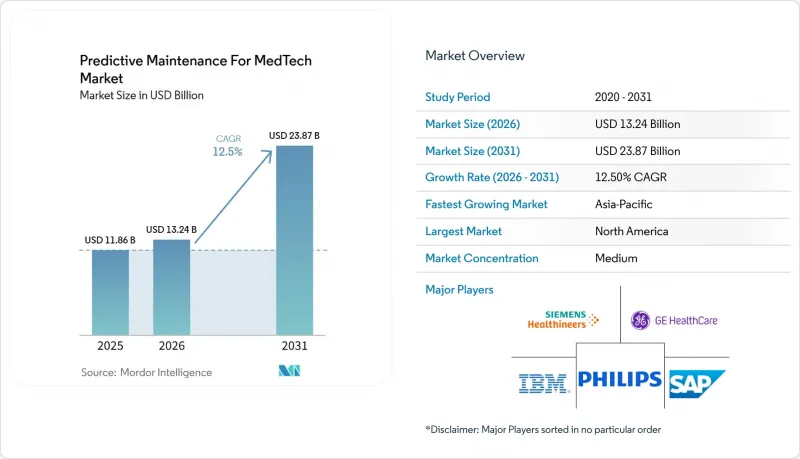
This report is Segmented by Component (Software, Services, Hardware), Deployment (Cloud-Based, On-Premise, Hybrid), Organization Size (Large Enterprises, Small and Medium Enterprises), Application (Imaging Systems, and Others), End-User (Hospitals, and Others), and Geography (North America, Europe, Asia-Pacific, and Others). The Market Forecasts are Provided in Terms of Value (USD).
Global Predictive Maintenance For MedTech Market Trends and Insights
Rising Installed Base of Connected Medical Equipment
The predictive maintenance for MedTech market is gaining momentum because connected clinical assets now produce a steady stream of operating data instead of isolated fault codes, which makes failure detection more precise and more useful in daily service planning. A 500-bed hospital in 2026 operates 15,000 to 20,000 connected medical devices, and that scale has changed maintenance from an equipment task into a fleet management problem that requires constant prioritization.Staffing constraints add more pressure because the same source notes that the U.S. labor pipeline remains far smaller than projected biomedical equipment technician demand, which makes predictive automation more relevant in routine operations. Procurement patterns are also helping adoption because new medical equipment increasingly ships with embedded sensors and cloud connectivity as standard features instead of optional upgrades. That change means newer hospitals can launch the predictive maintenance for MedTech market from a stronger starting point, with cleaner telemetry and fewer retrofit projects than older facilities had to manage.
Escalating Downtime Cost and Service-Level Pressure in Hospitals
The predictive maintenance for MedTech market is also being lifted by the direct financial cost of equipment failure, which has become easier for hospital leadership to measure and link to revenue disruption. One day of unplanned MRI downtime can cost more than USD 41,000 at hospitals averaging 380 MRI procedures per month in the United States, and that loss can represent more than 15 canceled scan sessions. GE HealthCare reported that its OnWatch Predict platform reduced unplanned downtime by up to 60% and lowered customer-initiated service requests by 35%, which translated into 2.5 additional operating days per MRI system each year across 1,500 EMEA installations. This matters more as hospital groups negotiate broader service contracts with uptime commitments, because availability is no longer treated as a service aspiration and is now tied more closely to contract performance. As these expectations spread across larger care networks, the predictive maintenance for MedTech market benefits vendors that can show measurable uptime gains and connect those gains to service-level outcomes.
Fragmented OEM Data Access and Limited Interoperability
The predictive maintenance for MedTech market still faces a major barrier because multi-vendor hospitals receive telemetry in proprietary formats that were built for OEM service portals rather than neutral analytics environments. A hospital that manages equipment from 5 or more manufacturers may need separate integration work for each vendor before a cross-fleet model can operate in a useful way, which extends deployment time and raises project cost. Even when access is contractually available, the most maintenance-relevant fields, including wear counters, drift indicators, and detailed error histories, are not always exposed in a complete form to third-party systems. HL7 FHIR R6 has introduced the DeviceAlert resource, which creates a formal path for device alert data inside a standardized framework, but adoption across large legacy fleets will take time. Until interoperability improves further, the predictive maintenance for MedTech market will remain easier for OEM-linked solutions to scale than for independent vendors that must normalize data across competing device ecosystems.
Other drivers and restraints analyzed in the detailed report include:
- Expansion of Remote Device Monitoring and Cloud-Connected Service Models
- AI Model Maturation for Anomaly Detection on Medical Assets
- High Validation Burden for Clinical-Grade Predictive Models
For complete list of drivers and restraints, kindly check the Table Of Contents.
Segment Analysis
Software held 57.11% of the predictive maintenance for MedTech market share in 2025, which confirms that buyers still place the highest value on analytics layers that can sit over installed device fleets without forcing hardware replacement. In the predictive maintenance for MedTech market, software remains attractive because health systems can extend one analytics environment across imaging, patient monitoring, laboratory systems, and infusion equipment under a recurring subscription model. Hardware is the smallest revenue component because gateways, edge nodes, and connected sensors are becoming more standardized and less differentiated in price. In the predictive maintenance for MedTech industry, value is shifting toward how data is interpreted and operationalized rather than toward the physical devices that collect it.
Services are expanding faster than the overall market, with a projected 12.93% CAGR from 2026 to 2031, because many health systems prefer outsourced analytics management instead of building internal capabilities from the ground up. The predictive maintenance for MedTech market is therefore seeing services move away from one-time implementation work and toward recurring managed support tied to uptime, intervention planning, and workflow execution. As more service value becomes linked to data ownership and model performance, the predictive maintenance for MedTech market may become harder for smaller service firms to penetrate unless they can partner for telemetry access or narrow their focus to selected device classes.
Cloud-based deployment held 58.71% market share in 2025, which reflects strong buyer preference for elastic compute capacity, centralized model updates, and subscription pricing that converts capital spending into operating cost. The predictive maintenance for MedTech market has favored cloud adoption because high-fidelity model training needs large volumes of historical device data that many hospital-owned systems cannot process efficiently on local infrastructure. Cloud delivery also makes it easier for vendors to push model improvements, software fixes, and workflow changes across distributed fleets without waiting for site-by-site intervention.
Hybrid architecture is the fastest-growing deployment mode with an anticipated CAGR at 12.86%, because it addresses a practical gap between local control and centralized analysis in the predictive maintenance for the MedTech market. In this setup, sensitive or time-critical telemetry can be processed at the edge, while model training and fleet-wide benchmarking can still occur in the cloud. On-premise systems will continue to hold a place in locations with strict data residency expectations, but the predictive maintenance for MedTech market is increasingly moving toward architectures that combine local processing with cloud-based learning and oversight.
Complete Report Scope:
- By Component
- Software
- Services
- Hardware
- By Deployment Mode
- Cloud-Based
- On-Premise
- Hybrid
- By Organization Size
- Large Enterprises
- Small and Medium Enterprises
- By Application
- Imaging Systems
- Patient Monitoring Systems
- Laboratory Diagnostics Equipment
- Surgical and Therapy Devices
- Sterilization and Support Equipment
- By End-User
- Hospitals
- Ambulatory Surgery Centers
- Diagnostic Imaging Centers
- Clinics and Specialty Centers
- Home Healthcare Providers
- By Geography
- North America
- United States
- Canada
- Mexico
- Europe
- Germany
- United Kingdom
- France
- Italy
- Spain
- Rest of Europe
- Asia-Pacific
- China
- Japan
- India
- Australia
- South Korea
- Rest of Asia-Pacific
- Middle East and Africa
- GCC
- South Africa
- Rest of Middle East and Africa
- South America
- Brazil
- Argentina
- Rest of South America
- North America
Geography Analysis
North America held 49.35% of the predictive maintenance for MedTech market share in 2025, supported by dense connected hospital infrastructure, mature third-party service organizations, and health systems with strong multi-site procurement capacity. The United States remains the main revenue center because large hospital networks are already managing complex fleets and are under pressure to standardize documentation, uptime, and maintenance governance across many facilities.
Europe remains the second-largest regional market, with Germany, the United Kingdom, and France serving as the main demand centers because they combine large hospital systems, strict governance expectations, and strong OEM presence. Germany stands out because university hospital networks operate broad multi-modality fleets and sit close to major OEM service organizations, which creates a demanding home environment for predictive service capability. Siemens Healthineers has used its digital health platform to combine equipment utilization analytics, remote diagnostics, and protocol optimization, showing how deeply maintenance intelligence can be integrated into broader care delivery software. The United Kingdom, France, Italy, the Nordics, Poland, and the Netherlands are also advancing as procurement programs push larger care networks toward more standardized equipment management models.
Asia-Pacific is forecasted to grow at 14.48% CAGR from 2026 to 2031, which makes it the fastest-growing regional segment in the predictive maintenance for MedTech market. China, India, Japan, and South Korea are creating new demand because government-backed hospital digitization is improving the data foundation needed for fleet-level equipment intelligence. Japan also presents a strong case for predictive service adoption because the pressure to keep devices available is rising alongside the need to control maintenance costs in a mature health system. China is adding momentum as more networked medical devices move under tighter cybersecurity and maintenance governance expectations, which pushes hospitals toward more formal monitoring practices. South America and the Middle East and Africa remain smaller today, but connected hospital buildouts in Brazil, the GCC, and South Africa are setting better conditions for future adoption because telemetry capability is being specified earlier in the equipment lifecycle.
- Agiliti, Inc.
- Althea Group
- Amazon Web Services, Inc.
- Aramark
- Aspen Technology, Inc.
- B. Braun
- Baxter
- Cisco Systems
- FUJIFILM
- GE Healthcare
- IBM
- Koninklijke Philips
- Medtronic
- Microsoft
- Oracle
- PTC Inc.
- SAP
- SAS Institute
- Schneider Electric SE
- Siemens Healthineers
Additional Benefits:
- The market estimate (ME) sheet in Excel format
- 3 months of analyst support
TABLE OF CONTENTS
1 Introduction
- 1.1 Study Assumptions and Market Definition
- 1.2 Scope of the Study
2 Research Methodology
3 Executive Summary
4 Market Landscape
- 4.1 Market Overview
- 4.2 Market Drivers
- 4.2.1 Rising Installed Base of Connected Medical Equipment
- 4.2.2 Escalating Downtime Cost and Service-Level Pressure in Hospitals
- 4.2.3 Expansion of Remote Device Monitoring and Cloud-Connected Service Models
- 4.2.4 AI Model Maturation for Anomaly Detection on Medical Assets
- 4.2.5 Underused Service Telemetry from Multi-Vendor Fleets
- 4.2.6 Cyber-Resilient Edge Analytics for Regulated Device Environments
- 4.3 Market Restraints
- 4.3.1 Fragmented OEM Data Access and Limited Interoperability
- 4.3.2 High Validation Burden for Clinical-Grade Predictive Models
- 4.3.3 Cybersecurity and Patient-Data Governance Complexity
- 4.3.4 Long Hospital Procurement and Integration Cycles
- 4.4 Supply/Value Chain Analysis
- 4.5 Regulatory Landscape
- 4.6 Technological Outlook
- 4.7 Porter's Five Forces Analysis
- 4.7.1 Threat of New Entrants
- 4.7.2 Bargaining Power of Suppliers
- 4.7.3 Bargaining Power of Buyers
- 4.7.4 Threat of Substitutes
- 4.7.5 Competitive Rivalry
5 Market Size & Growth Forecasts (Value, USD)
- 5.1 By Component
- 5.1.1 Software
- 5.1.2 Services
- 5.1.3 Hardware
- 5.2 By Deployment Mode
- 5.2.1 Cloud-Based
- 5.2.2 On-Premise
- 5.2.3 Hybrid
- 5.3 By Organization Size
- 5.3.1 Large Enterprises
- 5.3.2 Small and Medium Enterprises
- 5.4 By Application
- 5.4.1 Imaging Systems
- 5.4.2 Patient Monitoring Systems
- 5.4.3 Laboratory Diagnostics Equipment
- 5.4.4 Surgical and Therapy Devices
- 5.4.5 Sterilization and Support Equipment
- 5.5 By End-User
- 5.5.1 Hospitals
- 5.5.2 Ambulatory Surgery Centers
- 5.5.3 Diagnostic Imaging Centers
- 5.5.4 Clinics and Specialty Centers
- 5.5.5 Home Healthcare Providers
- 5.6 By Geography
- 5.6.1 North America
- 5.6.1.1 United States
- 5.6.1.2 Canada
- 5.6.1.3 Mexico
- 5.6.2 Europe
- 5.6.2.1 Germany
- 5.6.2.2 United Kingdom
- 5.6.2.3 France
- 5.6.2.4 Italy
- 5.6.2.5 Spain
- 5.6.2.6 Rest of Europe
- 5.6.3 Asia-Pacific
- 5.6.3.1 China
- 5.6.3.2 Japan
- 5.6.3.3 India
- 5.6.3.4 Australia
- 5.6.3.5 South Korea
- 5.6.3.6 Rest of Asia-Pacific
- 5.6.4 Middle East and Africa
- 5.6.4.1 GCC
- 5.6.4.2 South Africa
- 5.6.4.3 Rest of Middle East and Africa
- 5.6.5 South America
- 5.6.5.1 Brazil
- 5.6.5.2 Argentina
- 5.6.5.3 Rest of South America
- 5.6.1 North America
6 Competitive Landscape
- 6.1 Market Concentration
- 6.2 Market Share Analysis
- 6.3 Company Profiles (includes Global level Overview, Market level overview, Core Segments, Financials as available, Strategic Information, Market Rank/Share for key companies, Products & Services, Recent Developments)
- 6.3.1 Agiliti, Inc.
- 6.3.2 Althea Group
- 6.3.3 Amazon Web Services, Inc.
- 6.3.4 Aramark
- 6.3.5 Aspen Technology, Inc.
- 6.3.6 B. Braun SE
- 6.3.7 Baxter International Inc.
- 6.3.8 Cisco Systems, Inc.
- 6.3.9 FUJIFILM Holdings Corporation
- 6.3.10 GE HealthCare
- 6.3.11 IBM
- 6.3.12 Koninklijke Philips N.V.
- 6.3.13 Medtronic
- 6.3.14 Microsoft Corporation
- 6.3.15 Oracle Corporation
- 6.3.16 PTC Inc.
- 6.3.17 SAP SE
- 6.3.18 SAS Institute Inc.
- 6.3.19 Schneider Electric SE
- 6.3.20 Siemens Healthineers AG
7 Market Opportunities & Future Outlook
- 7.1 White-space & Unmet-need Assessment

