PUBLISHER: Mordor Intelligence | PRODUCT CODE: 2099135

PUBLISHER: Mordor Intelligence | PRODUCT CODE: 2099135
Banknotes - Market Share Analysis, Industry Trends & Statistics, Growth Forecasts (2026 - 2031)
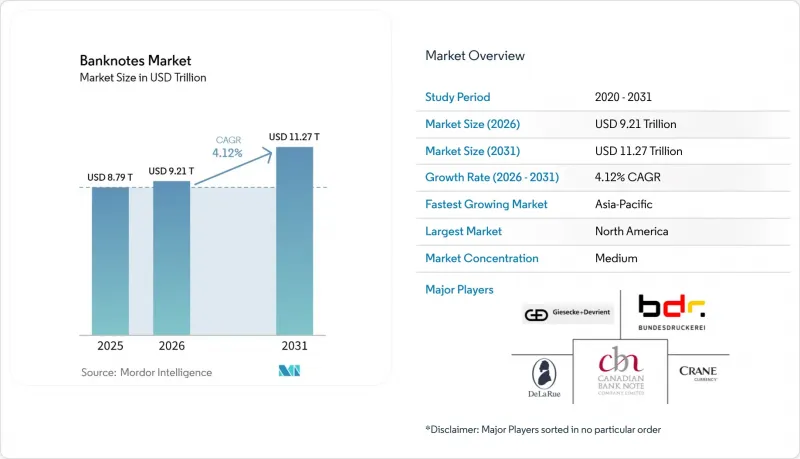
According to Mordor Intelligence, the banknotes market size was valued at USD 8.79 trillion in 2025 and is estimated to grow from USD 9.21 trillion in 2026 to reach USD 11.27 trillion by 2031, at a CAGR of 4.12% during the forecast period (2026-2031).
This report is Segmented by Material (Paper Banknotes, Polymer Banknotes, and More), by Security Feature (Substrate-Embedded Features (watermarks, Security Threads, Etc. ), and More), by Holder (Households / Individuals, Financial Institutions, and More), and by Geography (North America, South America, and More). The Market Forecasts are Provided in Terms of Value (USD).
Global Banknotes Market Trends and Insights
Rising Need for Anti-Counterfeit Currency Upgrades
The banknotes market is seeing stronger demand for security upgrades in countries where note circulation is still rising quickly. India's Reserve Bank data, as cited in the source draft, showed that detected fake 500 rupee notes increased 20.5% year over year to 141,907 pieces in FY26, while total banknote volumes in circulation increased 10.5% in the same period. The banknotes market is also being shaped by the fact that authentication no longer stops at central bank vaults, as ATMs and cash recyclers now verify notes at the teller and branch levels. That shift is shortening the effective security refresh cycle in high-volume markets, as older feature sets are under greater stress from both counterfeiting and machine handling. ECB counterfeit authentication standards and fitness protocols also continue to influence procurement specifications beyond Europe, which is pushing more central banks toward layered, machine-verifiable note security.
Expansion of Cash Circulation in Informal and Emerging Economies
The banknotes market is still supported by rising cash holdings in emerging economies, where notes serve both transactional and precautionary needs. India's currency in circulation reached INR 41.68 trillion (approximately USD 496 billion) in FY26, even as UPI volumes remained very high, indicating that cash and digital payments serve different roles rather than replacing one another on a one-for-one basis. The SBI research note cited in the source draft also found that the gap between ATM withdrawals and currency in circulation widened to INR 9,127 per capita in FY26 from INR 1,804 in FY24, suggesting stronger cash held outside the banking system as emergency reserves. The BIS reported that adult digital payment use in emerging market and developing economies rose from 35% to 57% between 2014 and 2021, yet cash demand also increased during that period. The banknotes market, therefore, remains linked to broad financial inclusion gaps and to the continued role of physical notes as the only liquid financial asset for many users. A peer-reviewed study in Economic Expressions Letters also supported the connection between informality and sustained demand for smaller note denominations.
Rising Substitution by Digital Payments and Card Usage
The banknotes market is under pressure in advanced economies, where digital channels are reducing cash transactions. The Federal Reserve's CY 2026 print order of 3.8 billion to 5.1 billion notes was 8.2% to 13.3% below the CY 2025 order range, which reflected lower replenishment needs in the United States for lower-value notes that now circulate less intensively. The banknotes market is still growing in value terms, but the volume mix is changing because the denominations most exposed to digital substitution are also the highest in terms of piece count. That creates pressure on print economics even when higher-value denominations remain in demand for reserve holding and international use. The IMF also warned that even unsuccessful CBDC pilots can unsettle existing cash systems through expectation effects, which adds another layer of uncertainty to long-cycle procurement planning.
Other drivers and restraints analyzed in the detailed report include:
- Shift Toward Polymer and Hybrid Substrates for Longer Note Life
- Central Bank Redesign and Note Replacement Cycles
- High Capital Intensity of Secure Printing and Substrate Conversion
For complete list of drivers and restraints, kindly check the Table Of Contents.
Segment Analysis
Paper accounted for 87.4% of the banknotes market size in 2025, and that lead reflected the very large installed base of cotton-fiber printing infrastructure across sovereign printers worldwide. The banknotes market still relies heavily on paper because that installed base represents decades of sunk capital, trained labor, and procurement processes that cannot be changed quickly. Even so, the paper's leading position is increasingly tied to legacy capacity rather than to stronger forward economics. The source draft noted that paper share is already declining in regions where polymer pilots have been completed and where lifecycle savings have been verified. That means the current balance in the banknotes market remains stable in the near term, but it is no longer as secure over the full forecast period.
Polymer is projected to expand at a 12.2% CAGR from 2026 to 2031, making it the fastest-growing material segment in the banknotes industry and the clearest growth engine within the banknotes market. The source draft linked that growth to second-wave adoption across Southeast Asia, Africa, and Latin America, where procurement risk and unit-cost barriers are falling. It also cited the Bangko Sentral ng Pilipinas completing its first full polymer series across all major denominations in December 2024 using CCL Secure's GUARDIAN substrate. Fiji's launch of its first fully polymer series in December 2025 further showed that smaller issuers are now moving beyond trials and toward full adoption. Hybrid formats also remain strategically important because they allow central banks to improve durability and sustainability without committing to a full polymer switch immediately.
Complete Report Scope:
- By Material
- Paper Banknotes
- Polymer Banknotes
- Hybrid Banknotes
- By Security Feature
- Substrate-Embedded Features (watermarks, security threads, etc.)
- Optical Variable Devices (holograms, color-shifting inks, etc.)
- Tactile & Printed Security Features (microprinting, intaglio, etc.)
- Machine-Readable Features (UV, IR, magnetic, etc.)
- By Holder
- Households / Individuals
- Non-Financial Corporations & Businesses
- Financial Institutions
- Government & Public Sector
- By Geography
- North America
- United States
- Canada
- Mexico
- South America
- Brazil
- Argentina
- Rest of South America
- Europe
- United Kingdom
- Germany
- France
- Italy
- Spain
- Rest of Europe
- Asia-Pacific
- China
- Japan
- India
- South Korea
- Australia
- Indonesia
- Thailand
- Malaysia
- Singapore
- Vietnam
- Rest of Asia-Pacific
- Middle East and Africa
- Saudi Arabia
- United Arab Emirates
- Turkey
- South Africa
- Egypt
- Rest of Middle East and Africa
- North America
Geography Analysis
North America held 36.2% of the banknotes market share in 2025, making it the largest regional market. That scale continued to rest on the role of the United States dollar in global reserves and trade settlement rather than on domestic transactional cash growth alone. The Federal Reserve's CY 2026 print order covered 3.8 billion to 5.1 billion notes with a value range of USD 108.9 billion to USD 139.6 billion, and the USD 100 denomination alone accounted for USD 75.8 billion to USD 87.7 billion of that value. The source draft said this mix pointed to a currency stack increasingly managed for store-of-value and international reserve use. North America also remains relevant to the banknotes market because Canada's long-term sovereign supply model supports a stable baseline, while Mexico continues to issue polymer denominations with its own security and procurement path.
Asia-Pacific is forecast to grow at a 6% CAGR from 2026 to 2031, making it the fastest-growing regional market for banknotes. The source draft linked this growth to South and Southeast Asia, where circulation growth and polymer transition programs are occurring simultaneously. It noted that India's currency in circulation increased 11.9% in FY26 to INR 41.68 trillion, approximately USD 496 billion, even as digital payment activity remained at record levels. It also cited CCL Secure's supply agreement with the State Bank of Vietnam for GUARDIAN polymer substrate for the VND 200,000 denomination in March 2026, alongside ongoing polymer use in the Philippines, Indonesia, and Thailand. The source draft further pointed to China Banknote Printing and Minting Corporation's paper-plastic composite substrate with translucent windows and flexible OLED elements as a sign that state-owned capacity in Asia-Pacific is building its own feature architecture base.
Europe remains one of the most important strategic regions in the banknotes market because the next euro redesign program creates one of the largest visible procurement pipelines in the forecast period. The source draft also linked this to the Bank of England's long-duration banknotes tender, which keeps European sovereign procurement at the center of supplier capacity decisions through the end of the period. The Middle East and Africa are active issuance zones as well, and the Central Bank of Uzbekistan signed separate memoranda with De La Rue and Oberthur Fiduciaire in April 2026 for cooperation on secure products and banknotes production. South America is also moving through a broader polymer transition, with the source draft citing Bolivia's Series B launch in 2025 and Paraguay's 2025 to 2029 institutional plan tied to a new banknotes family. Taken together, these regional patterns show that the banknotes market is not driven by one global trend, but by a mix of reserve currency demand, redesign cycles, and substrate modernization.
- De La Rue plc
- Giesecke+Devrient GmbH
- Crane Currency
- Bundesdruckerei GmbH
- Canadian Bank Note Company, Limited
- China Banknote Printing and Minting Corporation
- Oberthur Fiduciaire SAS
- Security Printing and Minting Corporation of India Limited
- CCL Secure
- SICPA Holding SA
- Authentix, Inc.
- Royal Joh. Enschede
- The Royal Mint Limited
- Note Printing Australia Limited
- Poland Security Printing Works
- Landqart AG
- Orell Fussli AG
- Koenig and Bauer AG
- Komori Corporation
- Bobst Group SA
Additional Benefits:
- The market estimate (ME) sheet in Excel format
- 3 months of analyst support
TABLE OF CONTENTS
1 INTRODUCTION
- 1.1 Study Assumptions and Market Definition
- 1.2 Scope of the Study
2 RESEARCH METHODOLOGY
3 EXECUTIVE SUMMARY
4 MARKET LANDSCAPE
- 4.1 Market Overview
- 4.2 Market Drivers
- 4.2.1 Rising Need for Anti-Counterfeit Currency Upgrades
- 4.2.2 Expansion of Cash Circulation in Informal and Emerging Economies
- 4.2.3 Shift Toward Polymer and Hybrid Substrates for Longer Note Life
- 4.2.4 Central Bank Redesign and Note Replacement Cycles
- 4.2.5 Machine-Readable Features for Cash Automation and Sorting
- 4.2.6 Low-Visibility Authentication for High-Denomination and Special Issue Notes
- 4.3 Market Restraints
- 4.3.1 Rising Substitution by Digital Payments and Card Usage
- 4.3.2 High Capital Intensity of Secure Printing and Substrate Conversion
- 4.3.3 Longer Procurement Cycles and Sovereign Approval Dependencies
- 4.3.4 Sustainability Pressure on Cotton-Based and Security-Coated Note Waste Streams
- 4.4 Value Chain Analysis
- 4.5 Regulatory Landscape
- 4.6 Technological Outlook
- 4.7 Porter's Five Forces Analysis
- 4.7.1 Bargaining Power of Suppliers
- 4.7.2 Bargaining Power of Buyers
- 4.7.3 Threat of New Entrants
- 4.7.4 Threat of Substitutes
- 4.7.5 Industry Rivalry
5 MARKET SIZE AND GROWTH FORECASTS
- 5.1 By Material
- 5.1.1 Paper Banknotes
- 5.1.2 Polymer Banknotes
- 5.1.3 Hybrid Banknotes
- 5.2 By Security Feature
- 5.2.1 Substrate-Embedded Features (watermarks, security threads, etc.)
- 5.2.2 Optical Variable Devices (holograms, color-shifting inks, etc.)
- 5.2.3 Tactile & Printed Security Features (microprinting, intaglio, etc.)
- 5.2.4 Machine-Readable Features (UV, IR, magnetic, etc.)
- 5.3 By Holder
- 5.3.1 Households / Individuals
- 5.3.2 Non-Financial Corporations & Businesses
- 5.3.3 Financial Institutions
- 5.3.4 Government & Public Sector
- 5.4 By Geography
- 5.4.1 North America
- 5.4.1.1 United States
- 5.4.1.2 Canada
- 5.4.1.3 Mexico
- 5.4.2 South America
- 5.4.2.1 Brazil
- 5.4.2.2 Argentina
- 5.4.2.3 Rest of South America
- 5.4.3 Europe
- 5.4.3.1 United Kingdom
- 5.4.3.2 Germany
- 5.4.3.3 France
- 5.4.3.4 Italy
- 5.4.3.5 Spain
- 5.4.3.6 Rest of Europe
- 5.4.4 Asia-Pacific
- 5.4.4.1 China
- 5.4.4.2 Japan
- 5.4.4.3 India
- 5.4.4.4 South Korea
- 5.4.4.5 Australia
- 5.4.4.6 Indonesia
- 5.4.4.7 Thailand
- 5.4.4.8 Malaysia
- 5.4.4.9 Singapore
- 5.4.4.10 Vietnam
- 5.4.4.11 Rest of Asia-Pacific
- 5.4.5 Middle East and Africa
- 5.4.5.1 Saudi Arabia
- 5.4.5.2 United Arab Emirates
- 5.4.5.3 Turkey
- 5.4.5.4 South Africa
- 5.4.5.5 Egypt
- 5.4.5.6 Rest of Middle East and Africa
- 5.4.1 North America
6 COMPETITIVE LANDSCAPE
- 6.1 Market Concentration
- 6.2 Strategic Moves
- 6.3 Market Share Analysis
- 6.4 Company Profiles (includes Global Level Overview, Market Level Overview, Core Segments, Financials as available, Strategic Information, Market Rank/Share, Products and Services, Recent Developments)
- 6.4.1 De La Rue plc
- 6.4.2 Giesecke+Devrient GmbH
- 6.4.3 Crane Currency
- 6.4.4 Bundesdruckerei GmbH
- 6.4.5 Canadian Bank Note Company, Limited
- 6.4.6 China Banknote Printing and Minting Corporation
- 6.4.7 Oberthur Fiduciaire SAS
- 6.4.8 Security Printing and Minting Corporation of India Limited
- 6.4.9 CCL Secure
- 6.4.10 SICPA Holding SA
- 6.4.11 Authentix, Inc.
- 6.4.12 Royal Joh. Enschede
- 6.4.13 The Royal Mint Limited
- 6.4.14 Note Printing Australia Limited
- 6.4.15 Poland Security Printing Works
- 6.4.16 Landqart AG
- 6.4.17 Orell Fussli AG
- 6.4.18 Koenig and Bauer AG
- 6.4.19 Komori Corporation
- 6.4.20 Bobst Group SA
7 MARKET OPPORTUNITIES AND FUTURE OUTLOOK
- 7.1 White-Space and Unmet-Need Assessment

