PUBLISHER: Mordor Intelligence | PRODUCT CODE: 2099160

PUBLISHER: Mordor Intelligence | PRODUCT CODE: 2099160
United States Saccharin - Market Share Analysis, Industry Trends & Statistics, Growth Forecasts (2026 - 2031)
According to Mordor Intelligence, the United States saccharin market size was valued at USD 132.06 million in 2025 and is estimated to grow from USD 138.32 million in 2026 to reach USD 174.36 million by 2031, at a CAGR of 4.74% during the forecast period (2026-2031).
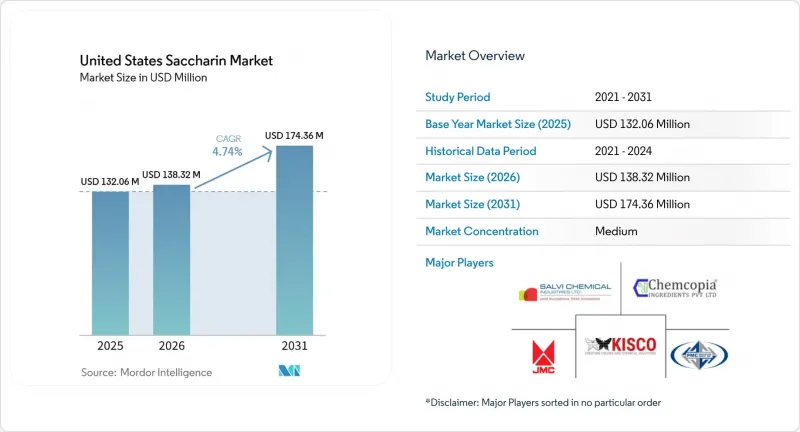
This report is Segmented by Product Type (Sodium Saccharin, Calcium Saccharin, and Insoluble Saccharin), Form (Powder and Liquid), and Application (Food and Beverages, Pharmaceuticals, Personal Care and Cosmetics, Animal Feed, and Others). The Market Forecasts are Provided in Terms of Value (USD).
United States Saccharin Market Trends and Insights
Prevalence of obesity and diabetes driving consistent demand
The structural health burden supporting saccharin demand continues to intensify, as clinical data indicate. The 2021-2023 National Health and Nutrition Examination Survey (NHANES) measured US adult obesity at 40.3%, with 9.7% of adults classified as severely obese. In parallel, the Gallup 2025 National Health and Well-Being Index reported diabetes diagnoses at an all-time high of 13.8%, creating a recurring structural demand floor for zero-calorie sweeteners in food and medicine. Saccharin's zero-calorie and blood-sugar-neutral profile makes it highly relevant for diabetic-compliant product formulations, including sugar-free syrups, chewable medications, and dietary beverages. Pediatric use of saccharin is also increasing in pharmaceutical formulations, an often-overlooked demand driver. Its regulatory acceptance in oral liquid suspension manufacturing supports formulation decisions when a patient's glycemic sensitivity is a clinical constraint. This demand remains insulated from broader "clean label" sentiment because functional requirements, rather than aesthetic preferences, drive its use.
Consumer shift toward low-glycemic ingredients reshaping formulation strategy
The transition from sugar reduction as a marketing differentiator to an operational reformulation requirement is well underway. The 2025 IFIC Food & Health Survey found that "low in sugar" ranked among the top three purchase-driving claims cited by US consumers, with 34% identifying it as a key consideration. According to industry formulation analysis reported by Innova, 5% of US food and beverage product launches in 2025 carried a "no added sugar" or "sugar-free" claim. Saccharin offers a significantly lower cost per sweetness unit than stevia concentrates or monk fruit extracts, which require multi-step agricultural extraction. This cost advantage makes saccharin the default specification in price-sensitive reformulation programs. The advantage becomes more pronounced as packaged food companies aim to absorb inflationary pressures without raising retail prices. The GLP-1 medication wave is also driving a nuanced structural shift. GLP-1 users reduce caloric intake and show the largest reductions in sugary food consumption, expanding the net addressable base of low-calorie product consumers. This trend positions saccharin favorably within the accelerating dietary management segment.
Consumer safety perceptions creating selective demand compression
Residual skepticism about artificial sweeteners remains one of the most persistent structural restraints on saccharin's addressable market in the United States. The 2025 Innova Health and Nutrition survey is expected to show that at least one-quarter of US consumers actively limit artificial sweeteners, even as they seek to reduce sugar intake. This behavioral contradiction narrows the effective commercial window for saccharin-containing product launches. The MAHA movement's 2026 food policy agenda, which may include a potential FDA review of ingredient labeling for non-nutritive sweeteners, could introduce regulatory uncertainty. Some large consumer packaged goods companies have already pre-empted this risk by reformulating premium and children's product lines to remove synthetic sweeteners. Under 21 CFR 180.37, the compliance framework classifies saccharin as an interim food additive that remains technically "pending additional study." This unusual regulatory position permits legal use but does not provide the definitive "generally recognized as safe" status that newer additives hold. As a result, saccharin may remain vulnerable in brand-conscious reformulation decisions, even where scientific evidence supports its safety.
Other drivers and restraints analyzed in the detailed report include:
- Expanding use in oral care: an underappreciated volume driver
- Sugar-free confectionery and packaged foods creating a durable demand layer
- Natural sweetener alternatives eroding market share in premium applications
For complete list of drivers and restraints, kindly check the Table Of Contents.
Segment Analysis
Sodium Saccharin is projected to hold a 74.67% market share in 2025, supported by decades of regulatory acceptance, broad use across the food, pharmaceutical, and personal care sectors, and a well-established supply chain led by primary producers in China, South Korea, and India. Its solubility profile and taste characteristics make it the default specification for high-volume applications, including diet beverages, sugar-free confectionery, cough syrups, and oral care products. Insoluble Saccharin serves a specialized niche, mainly in food applications requiring controlled-release or delayed sweetness delivery; its market contribution remains modest and stable. Calcium Saccharin is expected to grow the fastest, at a 5.64% CAGR through 2031. Notably, Blue Jet Healthcare confirmed the successful scale-up and initial commercial production of Calcium Saccharin during FY2024-25 in response to a specific formulation requirement from an FMCG customer. This signals real-world demand for Calcium Saccharin in oral care and pharmaceutical formulations, where its lower bitterness threshold compared to Sodium Saccharin offers a measurable taste-profile advantage. Both Sodium Saccharin and Calcium Saccharin are explicitly listed under the FDA's 21 CFR 180.37, maintaining compliance eligibility across all key US application categories.
The product type segment also has a notable supply chain dimension. Henan Kaifeng Pingmei Shenma Xinghua Fine Chemical accounts for an outsized share of Chinese saccharin production. Collectively, Chinese producers exported 19,000 metric tons in 2024, a 19% increase from the previous year, with the United States among the key receiving markets. This production surge kept commodity-grade Sodium Saccharin prices under pressure, with US import prices averaging USD 9,579 per ton in 2024. However, pharmaceutical-grade specifications command a significant premium, reflected in the US average export price of USD 38,262 per ton in 2024. This price differential confirms that product type selection in this market is not only a formulation decision but also a strategic choice that separates commodity saccharin from value-added saccharin trade flows.
Complete Report Scope:
- By Product Type
- Sodium Saccharin
- Calcium Saccharin
- Insoluble Saccharin
- By Form
- Powder
- Liquid
- By Application
- Food and Beverages
- Bakery and Confectionery
- Beverages
- Dairy Products
- Others
- Pharmaceuticals
- Personal Care and Cosmetics
- Animal Feed
- Others
- Food and Beverages
List of Companies Covered in this Report:
- PMC Specialties Group, Inc.
- Henan Kaifeng Pingmei Shenma Xinghua Fine Chemical Co., Ltd.
- JMC Corporation
- Kyung-In Synthetic Corporation
- Tianjin North Food Co., Ltd.
- Tianjin Changjie Chemical Co., Ltd.
- PRODUCTOS ADITIVOS, S.A.
- Batang Alum Industrie
- Blue Jet Healthcare Limited
- Ganesh Benzoplast Limited
- Swati Chemical Industries
- Anhui Suntran Chemical Co., Ltd.
- Shanghai Fortune Chemical Co., Ltd.
- MUBY CHEMICALS
- Shree Vardayini Chemical Industries Pvt. Ltd.
- Anmol Chemicals Private Limited
- CDH - Central Drug House (P) Ltd.
- DK Pharmachem
- Chemcopia Ingredients Pvt. Ltd.
- Salvi Chemical Industries Ltd.
Additional Benefits:
- The market estimate (ME) sheet in Excel format
- 3 months of analyst support
TABLE OF CONTENTS
1 INTRODUCTION
- 1.1 Study Assumptions and Market Definition
- 1.2 Scope of the Study
2 RESEARCH METHODOLOGY
3 EXECUTIVE SUMMARY
4 MARKET LANDSCAPE
- 4.1 Market Overview
- 4.2 Market Drivers
- 4.2.1 Prevalence of obesity and diabetes is accelerating demand for zero-calorie sweeteners.
- 4.2.2 Increasing consumer preference for low-glycemic food ingredients
- 4.2.3 Expanding use of saccharin in oral care formulations
- 4.2.4 Growth in convenience and packaged food consumption is expanding the use of high-intensity sweeteners
- 4.2.5 Growing use of saccharin in veterinary pharmaceuticals and animal nutrition
- 4.2.6 Consumption of sugar-free chewing gum, confectionery, and desserts
- 4.3 Market Restraints
- 4.3.1 Lingering consumer concerns regarding the safety of artificial sweeteners
- 4.3.2 Growing popularity of stevia, monk fruit, and allulose
- 4.3.3 Stringent food labeling and regulatory compliance requirements
- 4.3.4 Fluctuations in raw material and manufacturing costs
- 4.4 Supply Chain Analysis
- 4.5 Regulatory Outlook
- 4.6 Porter's Five Forces
- 4.6.1 Threat of New Entrants
- 4.6.2 Bargaining Power of Buyers
- 4.6.3 Bargaining Power of Suppliers
- 4.6.4 Threat of Substitute Products
- 4.6.5 Intensity of Competitive Rivalry
5 MARKET SIZE AND GROWTH FORECASTS (VALUE)
- 5.1 By Product Type
- 5.1.1 Sodium Saccharin
- 5.1.2 Calcium Saccharin
- 5.1.3 Insoluble Saccharin
- 5.2 By Form
- 5.2.1 Powder
- 5.2.2 Liquid
- 5.3 By Application
- 5.3.1 Food and Beverages
- 5.3.1.1 Bakery and Confectionery
- 5.3.1.2 Beverages
- 5.3.1.3 Dairy Products
- 5.3.1.4 Others
- 5.3.2 Pharmaceuticals
- 5.3.3 Personal Care and Cosmetics
- 5.3.4 Animal Feed
- 5.3.5 Others
- 5.3.1 Food and Beverages
6 COMPETITIVE LANDSCAPE
- 6.1 Market Concentration
- 6.2 Strategic Moves
- 6.3 Market Ranking Analysis
- 6.4 Company Profiles (includes Global-level Overview, Market-level Overview, Core Segments, Financials (if available), Strategic Information, Market Rank/Share, Products and Services, Recent Developments)
- 6.4.1 PMC Specialties Group, Inc.
- 6.4.2 Henan Kaifeng Pingmei Shenma Xinghua Fine Chemical Co., Ltd.
- 6.4.3 JMC Corporation
- 6.4.4 Kyung-In Synthetic Corporation
- 6.4.5 Tianjin North Food Co., Ltd.
- 6.4.6 Tianjin Changjie Chemical Co., Ltd.
- 6.4.7 PRODUCTOS ADITIVOS, S.A.
- 6.4.8 Batang Alum Industrie
- 6.4.9 Blue Jet Healthcare Limited
- 6.4.10 Ganesh Benzoplast Limited
- 6.4.11 Swati Chemical Industries
- 6.4.12 Anhui Suntran Chemical Co., Ltd.
- 6.4.13 Shanghai Fortune Chemical Co., Ltd.
- 6.4.14 MUBY CHEMICALS
- 6.4.15 Shree Vardayini Chemical Industries Pvt. Ltd.
- 6.4.16 Anmol Chemicals Private Limited
- 6.4.17 CDH - Central Drug House (P) Ltd.
- 6.4.18 DK Pharmachem
- 6.4.19 Chemcopia Ingredients Pvt. Ltd.
- 6.4.20 Salvi Chemical Industries Ltd.
7 MARKET OPPORTUNITIES AND FUTURE OUTLOOK

