PUBLISHER: Mordor Intelligence | PRODUCT CODE: 2099199

PUBLISHER: Mordor Intelligence | PRODUCT CODE: 2099199
Digital Marketing Market - Market Share Analysis, Industry Trends & Statistics, Growth Forecasts (2026 - 2031)
According to Mordor Intelligence, the digital marketing market size is projected to expand from USD 0.67 trillion in 2025 and USD 0.76 trillion in 2026 to USD 1.27 trillion by 2031, registering a CAGR of 10.91% between 2026 and 2031.
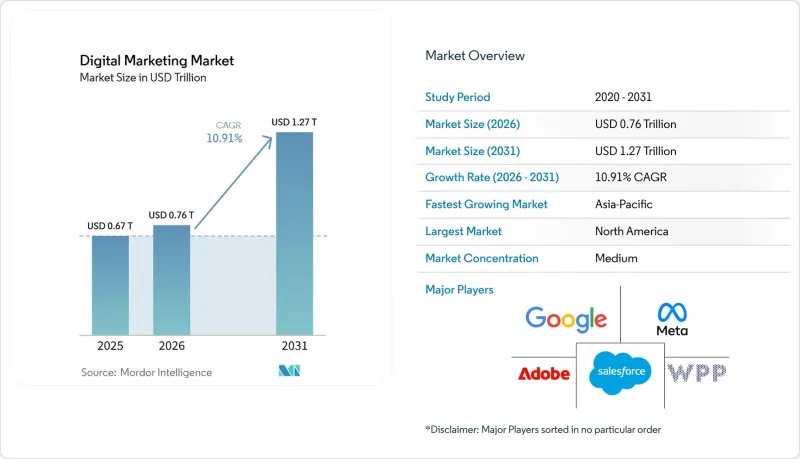
This report is Segmented by Digital Channel (SEO, Social Media Marketing, Online Advertising Search and Display, Content Marketing, Email Marketing, and More), Enterprise Size (Large Enterprises, and Small and Medium Enterprises), End-User Industry (Retail and E-Commerce, IT and Telecommunications, BFSI, and More), and Geography. The Market Forecasts are Provided in Terms of Value in USD.
Global Digital Marketing Market Trends and Insights
Rapid Shift to AI-Assisted Campaign Planning and Optimization
AI-assisted campaign services are changing how the digital marketing market operates because agencies can now deliver planning, testing, and optimization with less manual effort. Large holding groups moved early to scale this shift across their operating systems and client workflows. WPP signed a five-year USD 400 million partnership with Google in October 2025 to integrate generative and agentic AI tools into WPP Open, which strengthened automation across creative and campaign delivery. Publicis Groupe expanded its partnership with Microsoft in April 2026 and deployed Microsoft 365 Copilot across more than 114,000 employees while naming Azure as its preferred cloud infrastructure. This shift matters in the digital marketing market because service speed, workflow consistency, and data connectivity are becoming as important as traditional creative execution. It also raises entry barriers, since smaller firms can adopt tools, but they still struggle to match enterprise-grade infrastructure, model governance, and integrated client data environments.
Rising First-Party Data Adoption across Walled Gardens
The digital marketing market is seeing stronger demand for first-party data work because brands want more control over targeting, measurement, and customer intelligence. This need has grown as more media spend moves into closed platforms where measurement is strong inside the platform but weaker across channels. IAB reported that digital advertising revenue approached USD 300 billion globally in 2025, and commerce media, the fastest-growing programmatic category, rose 18.0% year over year to USD 63.4 billion. That environment rewards agencies in the digital marketing market that can connect customer data platforms, clean-room workflows, and server-side data pipelines into usable campaign systems. It also changes the client relationship, because advisory work around data ownership now sits closer to budget decisions than standard media execution. As a result, the digital marketing market is capturing more service demand in data architecture, identity resolution, and closed-loop reporting.
Signal Loss From Cookie Deprecation and Mobile Privacy Controls
Signal loss remains one of the clearest operational limits on the digital marketing market because it reduces visibility across customer journeys and weakens standard attribution setups. Privacy controls across browsers, mobile operating systems, and consent frameworks have made deterministic tracking harder to maintain at scale. The practical effect is that the digital marketing market must spend more on server-side integration, identity stitching, and experimental measurement just to preserve reporting confidence. This adds cost for agencies and clients, and it can slow optimization when data flows are incomplete or delayed. It also creates uneven performance across regions, since compliance requirements and consent behaviors differ by market. Until privacy-resilient measurement becomes more widely standardized, the digital marketing market will continue to face friction in proving campaign impact with older tracking methods.
Other drivers and restraints analyzed in the detailed report include:
- Expansion Of Commerce-Led Social and Creator Marketing
- Growth Of Privacy-Resilient Measurement and Incrementality Testing
- MarTech Stack Fragmentation and Integration Debt
For complete list of drivers and restraints, kindly check the Table Of Contents.
Segment Analysis
Online Advertising, Search and Display accounted for 33.32% share of the digital marketing market size in 2025, which kept it as the largest channel in this market. The segment remains central to the digital marketing market because it sits closest to direct response, audience targeting, and measurable conversion activity. Its position is supported by the continued rise of retail media networks and programmatic buying systems that tie exposure to purchase intent. IAB noted that commerce media reached USD 62 billion in 2026 and remained the fastest-growing programmatic subsegment. That pattern supports agency demand in search management, display optimization, retail media activation, and closed-loop reporting. Social Media Marketing and SEO still carry meaningful weight in the digital marketing market because they complement paid acquisition with ongoing traffic capture and content visibility.
SEO is also changing within the digital marketing market as answer-engine behavior pushes agencies to adapt content strategies for AI-led discovery environments. HubSpot stated in April 2026 that customer organic traffic had declined 27% year over year while AI referral traffic tripled, which supported the launch of HubSpot AEO as a distinct service capability. Influencer Marketing is projected to expand at a 15.13% CAGR through 2031, making it the fastest-growing digital channel in the digital marketing market. IAB projected U.S. creator economy ad spend at USD 43.9 billion in 2026, which shows how quickly this channel is moving into core media planning. CreatorIQ added that creator content already represented 44% of paid media creative assets on average, which suggests that creators now influence both media mix and asset production. As a result, the digital marketing industry is allocating more resources to creator sourcing, content testing, and attribution-ready partnership models.
Complete Report Scope:
- By Digital Channel
- Search Engine Optimization (SEO)
- Social Media Marketing
- Online Advertising, Search and Display
- Content Marketing
- Email Marketing
- Influencer Marketing
- Marketing Automation
- Digital Customer Engagement Solutions
- Analytics and Reporting Tools
- Other Digital Channels
- By Enterprise Size
- Large Enterprises
- Small and Medium Enterprises
- By End-User Industry
- Retail and E-Commerce
- IT and Telecommunications
- BFSI
- Healthcare and Life Sciences
- Media and Entertainment
- Travel and Hospitality
- Manufacturing and Industrials
- Other End-User Industries
- By Geography
- North America
- United States
- Canada
- Mexico
- South America
- Brazil
- Argentina
- Chile
- Rest of South America
- Europe
- Germany
- United Kingdom
- France
- Italy
- Spain
- Rest of Europe
- Asia-Pacific
- China
- Japan
- India
- South Korea
- Australia
- Rest of Asia-Pacific
- Middle East
- Saudi Arabia
- United Arab Emirates
- Qatar
- Rest of Middle East
- Africa
- South Africa
- Egypt
- Nigeria
- Rest of Africa
- North America
Geography Analysis
North America held 36.68% share of the digital marketing market size in 2025, which kept it as the leading regional contributor. The region remains the largest part of the digital marketing market because it combines mature platform adoption, large enterprise budgets, and early investment in AI-enabled campaign systems. The Interactive Advertising Bureau reported that U.S. digital advertising revenue approached USD 300 billion in 2025, while commerce media reached USD 63.4 billion. Canada and Mexico add regional depth, with Mexico benefiting from a growing digitally native consumer base and rising SME use of social and search channels.
Asia-Pacific is projected to grow at a 16.12% CAGR through 2031, making it the fastest-growing geography in the digital marketing market. Dentsu reported that digital media represented 70% of total APAC ad spend, while programmatic grew 24% and outpaced global benchmarks. Dentsu also noted that India's digital media advertising grew 20% in 2025, while China's top six platforms posted 6.7% year-over-year growth, led by Douyin or TikTok at 11%. These trends show why the digital marketing market is scaling quickly in mobile-first commerce environments with strong platform integration. In the Middle East, IAB MENA reported that digital advertising reached USD 8.185 billion in 2025, up 17.8% year over year, and that Egypt recorded 23.1% growth.
Europe continues to contribute a material share to the digital marketing market, but growth is shaped by stricter compliance requirements than in most other regions. GDPR enforcement and the EU AI Act are pushing agencies and brands toward more privacy-aware campaign design, consent management, and measurement frameworks. South America is anchored by Brazil, where digital commerce and mobile-led ad activity are supporting broader adoption across performance channels. Africa remains smaller in scale, but the digital marketing market is gaining momentum there as South Africa and Nigeria continue to attract most of the region's digital advertising investment.
- Google LLC
- Meta Platforms, Inc.
- Adobe Inc.
- Salesforce, Inc.
- WPP plc
- Publicis Groupe S.A.
- Interpublic Group of Companies, Inc.
- Dentsu Group Inc.
- Accenture plc
- HubSpot, Inc.
- SAP SE
- Microsoft Corporation
- Oracle Corporation
- IBM Corporation
- Hootsuite Inc.
- Sprinklr, Inc.
- Braze, Inc.
- Criteo S.A.
- Klaviyo, Inc.
- The Trade Desk, Inc.
Additional Benefits:
- The market estimate (ME) sheet in Excel format
- 3 months of analyst support
TABLE OF CONTENTS
1 INTRODUCTION
- 1.1 Study Assumptions and Market Definition
- 1.2 Scope of the Study
2 RESEARCH METHODOLOGY
3 EXECUTIVE SUMMARY
4 MARKET LANDSCAPE
- 4.1 Market Overview
- 4.2 Market Drivers
- 4.2.1 Rising First-Party Data Adoption Across Walled Gardens
- 4.2.2 Rapid Shift To AI-Assisted Campaign Planning And Optimization
- 4.2.3 Expansion Of Commerce-Led Social And Creator Marketing
- 4.2.4 Growth Of Privacy-Resilient Measurement And Incrementality Testing
- 4.2.5 Increasing Demand For Vertical-Specific MarTech Workflows
- 4.2.6 Convergence Of Marketing Automation With CRM And Customer Data Platforms
- 4.3 Market Restraints
- 4.3.1 Signal Loss From Cookie Deprecation And Mobile Privacy Controls
- 4.3.2 Martech Stack Fragmentation And Integration Debt
- 4.3.3 Rising Content, Talent, And Paid Media Costs
- 4.3.4 Measurement Complexity Across Cross-Device And Multi-Touch Journeys
- 4.4 Industry Supply-Chain Analysis
- 4.5 Value Chain Analysis
- 4.6 Industry Value Chain Analysis
- 4.7 Regulatory Landscape
- 4.8 Technological Outlook
- 4.9 Impact of Macroeconomic Factors on the Market
- 4.10 Porter's Five Forces Analysis
- 4.10.1 Threat of New Entrants
- 4.10.2 Bargaining Power of Suppliers
- 4.10.3 Bargaining Power of Buyers
- 4.10.4 Threat of Substitutes
- 4.10.5 Industry Rivalry
5 MARKET SIZE AND GROWTH FORECASTS (VALUE)
- 5.1 By Digital Channel
- 5.1.1 Search Engine Optimization (SEO)
- 5.1.2 Social Media Marketing
- 5.1.3 Online Advertising, Search and Display
- 5.1.4 Content Marketing
- 5.1.5 Email Marketing
- 5.1.6 Influencer Marketing
- 5.1.7 Marketing Automation
- 5.1.8 Digital Customer Engagement Solutions
- 5.1.9 Analytics and Reporting Tools
- 5.1.10 Other Digital Channels
- 5.2 By Enterprise Size
- 5.2.1 Large Enterprises
- 5.2.2 Small and Medium Enterprises
- 5.3 By End-User Industry
- 5.3.1 Retail and E-Commerce
- 5.3.2 IT and Telecommunications
- 5.3.3 BFSI
- 5.3.4 Healthcare and Life Sciences
- 5.3.5 Media and Entertainment
- 5.3.6 Travel and Hospitality
- 5.3.7 Manufacturing and Industrials
- 5.3.8 Other End-User Industries
- 5.4 By Geography
- 5.4.1 North America
- 5.4.1.1 United States
- 5.4.1.2 Canada
- 5.4.1.3 Mexico
- 5.4.2 South America
- 5.4.2.1 Brazil
- 5.4.2.2 Argentina
- 5.4.2.3 Chile
- 5.4.2.4 Rest of South America
- 5.4.3 Europe
- 5.4.3.1 Germany
- 5.4.3.2 United Kingdom
- 5.4.3.3 France
- 5.4.3.4 Italy
- 5.4.3.5 Spain
- 5.4.3.6 Rest of Europe
- 5.4.4 Asia-Pacific
- 5.4.4.1 China
- 5.4.4.2 Japan
- 5.4.4.3 India
- 5.4.4.4 South Korea
- 5.4.4.5 Australia
- 5.4.4.6 Rest of Asia-Pacific
- 5.4.5 Middle East
- 5.4.5.1 Saudi Arabia
- 5.4.5.2 United Arab Emirates
- 5.4.5.3 Qatar
- 5.4.5.4 Rest of Middle East
- 5.4.6 Africa
- 5.4.6.1 South Africa
- 5.4.6.2 Egypt
- 5.4.6.3 Nigeria
- 5.4.6.4 Rest of Africa
- 5.4.1 North America
6 COMPETITIVE LANDSCAPE
- 6.1 Market Concentration
- 6.2 Strategic Moves
- 6.3 Vendor Positioning Analysis
- 6.4 Company Profiles (includes Global Level Overview, Market Level Overview, Core Segments, Financials as available, Strategic Information, Products and Services, Recent Developments)
- 6.4.1 Google LLC
- 6.4.2 Meta Platforms, Inc.
- 6.4.3 Adobe Inc.
- 6.4.4 Salesforce, Inc.
- 6.4.5 WPP plc
- 6.4.6 Publicis Groupe S.A.
- 6.4.7 Interpublic Group of Companies, Inc.
- 6.4.8 Dentsu Group Inc.
- 6.4.9 Accenture plc
- 6.4.10 HubSpot, Inc.
- 6.4.11 SAP SE
- 6.4.12 Microsoft Corporation
- 6.4.13 Oracle Corporation
- 6.4.14 IBM Corporation
- 6.4.15 Hootsuite Inc.
- 6.4.16 Sprinklr, Inc.
- 6.4.17 Braze, Inc.
- 6.4.18 Criteo S.A.
- 6.4.19 Klaviyo, Inc.
- 6.4.20 The Trade Desk, Inc.
- 6.5 MARKET OPPORTUNITIES AND FUTURE OUTLOOK
- 6.6 White-Space and Unmet-Need Assessment

