PUBLISHER: Mordor Intelligence | PRODUCT CODE: 2099248

PUBLISHER: Mordor Intelligence | PRODUCT CODE: 2099248
Benelux Frontline Worker Technology - Market Share Analysis, Industry Trends & Statistics, Growth Forecasts (2026 - 2031)
According to Mordor Intelligence, the benelux frontline worker technology market size was USD 300 million in 2025 and is forecast to reach USD 910 million by 2031 at a CAGR of 21.76% during 2026-2031.
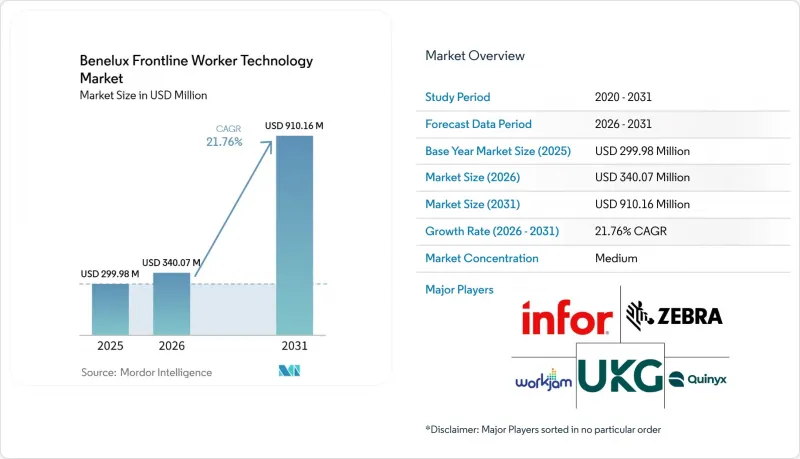
This report is Segmented by Component (Software, and Services), Deployment (Cloud-Based, Hybrid, and On-Premises), Organization Size (Large Enterprises, and Small and Medium Enterprises), Application (Employee Communication and Engagement, and More), End-User Industry (Retail and E-Commerce, and More), and Geography. The Market Forecasts are Provided in Terms of Value (USD).
Benelux Frontline Worker Technology Market Trends and Insights
Rising Demand for Real-Time Task Orchestration across Distributed Frontline Teams
The Benelux frontline worker technology market is benefiting from the simple fact that legacy task boards and email chains do not work well across multi-site frontline operations. Employers in logistics, manufacturing, field service, and public operations now need live visibility into who is available, what work is pending, and how quickly shift changes can be absorbed. SD Worx reported in 2026 that 44.6% of European organizations were redesigning work and workflows in response to AI and automation, which supports the move toward integrated orchestration tools instead of isolated point solutions. UKG reinforced this shift in June 2026 by adding an agentic orchestration layer to its Workforce Operating Platform, including the Workforce Intelligence Hub and Dynamic Workforce Operations, which connected real-time data to frontline execution in a single interface. This matters in the Benelux frontline worker technology market because many buyers now prefer suites that connect scheduling, pay, performance, and coverage decisions on a shared database. It also raises the bar for smaller vendors, as buyers in the region increasingly expect a single system to manage execution across multiple sites, languages, and shift structures.
Stricter Worker Safety and Compliance Digitization Requirements
The Benelux frontline worker technology market is also gaining support from the shift toward digital compliance records in frontline settings. Paper logs and local spreadsheets are becoming less practical because employers need timestamped records that can be reviewed quickly and stored consistently across sites. The European Commission confirmed that the EU AI Act entered into force on August 1, 2024, and that high-risk obligations will become fully applicable from August 2, 2026, thereby increasing the governance burden for automated scheduling and workforce analytics tools. This is pushing employers toward platforms that can document model behavior, store audit trails, and support cleaner oversight of workplace automation. The result for the Benelux frontline worker technology market is that compliance has become part of the product value rather than a separate administrative layer. It also helps explain why service work remains important because each policy update, workflow change, or audit requirement can trigger configuration, training, and support work after the first deployment.
Integration Friction with Legacy HR, ERP, POS, and WMS Stacks
Integration remains one of the clearest brakes on the Benelux frontline worker technology market, especially in large manufacturing and logistics accounts. Many employers still run core HR, inventory, warehouse, payroll, and production functions on older systems that were not built for fast two-way data exchange with modern workforce tools. Belgium's Federal Public Service Economy reported in 2025 that only 5.7% of the country's active workforce worked in ICT-related roles, indicating a capacity gap that can slow implementation within buying organizations. When internal technical capacity is limited, even a well-scoped deployment can take longer, as buyers rely more on external integrators and staged rollouts. That raises perceived risk for mid-market buyers and can delay full adoption beyond the initial pilot stage. For the Benelux frontline worker technology market, this means vendors with pre-built connectors and lower implementation effort can defend pricing better than vendors that still rely on custom integration work.
Other drivers and restraints analyzed in the detailed report include:
- Accelerating Replacement of Paper-Based and Spreadsheet-Based Shift Operations
- Rising Adoption of Rugged Mobile Devices And Smart Wearables
- Frontline User Resistance to Complex or Opaque AI Scheduling
For complete list of drivers and restraints, kindly check the Table Of Contents.
Segment Analysis
Software accounted for 82.22% of revenue in 2025, which shows that subscriptions remain the economic core of the Benelux frontline worker technology market. Cloud applications still dominate buyer budgets because they can be rolled out faster across distributed sites and usually need less upfront infrastructure than older enterprise systems. The software lead also reflects the practical buying pattern seen across the region, where employers often start with communication, scheduling, or task management and then add more workflows over time. This keeps the Benelux frontline worker technology market centered on platforms that can support repeat use across daily operations rather than on one-time technology projects. It also means vendors are judged heavily on usability, mobile access, and how quickly supervisors can begin using the tools at the site level.
Services are still the fastest-growing component, with a projected CAGR of 22.19% through 2031, because larger deployments now involve more integration, training, change support, and ongoing configuration work. This part of the Benelux frontline worker technology industry is expanding as employers buy broader suites instead of single modules and need help aligning them with payroll, ERP, and operational systems. Compliance changes add another layer, as policy updates can require workflow redesign, reporting changes, and additional user training after the original rollout. Belgium's Federal Public Service Economy has already identified the region's digital skills gap, which supports external service demand when internal IT teams are stretched. In effect, the software layer keeps scale high, while the services layer is gaining importance because buyers in the Benelux frontline worker technology market want faster deployment and stronger local support once the platform is live.
Cloud-based deployment accounted for 81.11% of spending in 2025, which makes it the clear default model in the Benelux frontline worker technology market. That share reflects a strong preference for faster rollout, subscription pricing, automatic updates, and easier management across multiple frontline locations. Cloud also suits the regional operating model because many employers need to manage shift communication, tasks, and compliance across sites in multiple countries or languages. In practical terms, cloud has become the easiest path for employers seeking quick onboarding and central oversight without rebuilding their entire IT stack. Cloud-based deployment also has the strongest growth outlook, with a 23.84% CAGR through 2031, indicating the market is still in an expansion phase rather than a maturity phase.
Hybrid deployment remains strategically relevant because many large employers still depend on on-premises systems for plant operations, point-of-sale workflows, or regulated records that cannot be replaced at the same pace as frontline applications. That need is evident in manufacturing and logistics, where companies often want cloud workflows at the user level but still need stable links to legacy back-end systems. As a result, buyers in the Benelux frontline worker technology market often view hybrid as a transition model rather than a legacy holdout. On-premises tools, therefore, remain in use in parts of government and critical infrastructure where network control and data handling remain sensitive. This structure means the cloud continues to lead the Benelux frontline worker technology market, while hybrid still matters because it reduces disruption for large employers that cannot move every system at once.
Complete Report Scope:
- By Component
- Software
- Services
- By Deployment
- Cloud-Based
- Hybrid
- On-Premises
- By Organization Size
- Large Enterprises
- Small and Medium Enterprises
- By Application
- Employee Communication and Engagement
- Workforce Execution and Task Management
- Workforce Scheduling and Coordination
- Learning and Knowledge Enablement
- Workforce Analytics and Performance Management
- Safety and Compliance Management
- Other Applications
- By End-User Industry
- Retail and E-Commerce
- Industrial Manufacturing
- Healthcare and Life Sciences
- Transportation and Logistics
- Hospitality
- Construction
- Government and Public Administration
- Other Industries
- By Geography
- Belgium
- Netherlands
- Luxembourg
- Rest of Benelux
List of Companies Covered in this Report:
- UKG Inc.
- Infor Inc.
- WorkJam Inc.
- Quinyx AB
- Legion Technologies, Inc.
- Deputy Group Pty Ltd
- Reflexis Systems, Inc.
- Zebra Technologies Corporation
- Honeywell International Inc.
- SAP SE
- Microsoft Corporation
- Oracle Corporation
- Salesforce, Inc.
- ServiceNow, Inc.
- NICE Ltd.
- Talkdesk, Inc.
- PTC Inc.
- Augmentir, Inc.
- Tulip Interfaces, Inc.
- TeamViewer SE
- Workday, Inc.
Additional Benefits:
- The market estimate (ME) sheet in Excel format
- 3 months of analyst support
TABLE OF CONTENTS
1 INTRODUCTION
- 1.1 Study Assumptions and Market Definition
- 1.2 Scope of the Study
2 RESEARCH METHODOLOGY
3 EXECUTIVE SUMMARY
4 MARKET LANDSCAPE
- 4.1 Market Overview
- 4.2 Market Drivers
- 4.2.1 Rising Demand for Real Time Task Orchestration Across Distributed Frontline Teams
- 4.2.2 Stricter Worker Safety and Compliance Digitization Requirements
- 4.2.3 Accelerating Replacement of Paper-Based And Spreadsheet-Based Shift Operations
- 4.2.4 Rising Adoption of Rugged Mobile Devices And Smart Wearables
- 4.2.5 Labor Shortages and Need For Productivity Uplift In Benelux Operations
- 4.2.6 Privacy First Workforce Analytics and Consent Based Mobile Management
- 4.3 Market Restraints
- 4.3.1 Integration Friction With Legacy HR, ERP, POS, and WMS Stacks
- 4.3.2 Frontline User Resistance To Complex or Opaque AI Scheduling
- 4.3.3 Limited ROI Visibility in Small Multi Site Deployments
- 4.3.4 Data Residency and Mobile Cybersecurity Compliance Burden
- 4.4 Impact of Macroeconomic Factors on the Market
- 4.5 Industry Value Chain Analysis
- 4.6 Technology Outlook
- 4.7 Regulatory Landscape
- 4.8 Porter's Five Forces Analysis
- 4.8.1 Threat of New Entrants
- 4.8.2 Bargaining Power of Suppliers
- 4.8.3 Bargaining Power of Buyers
- 4.8.4 Threat of Substitutes
- 4.8.5 Intensity of Competitive Rivalry
5 MARKET SIZE AND GROWTH FORECASTS (VALUE)
- 5.1 By Component
- 5.1.1 Software
- 5.1.2 Services
- 5.2 By Deployment
- 5.2.1 Cloud-Based
- 5.2.2 Hybrid
- 5.2.3 On-Premises
- 5.3 By Organization Size
- 5.3.1 Large Enterprises
- 5.3.2 Small and Medium Enterprises
- 5.4 By Application
- 5.4.1 Employee Communication and Engagement
- 5.4.2 Workforce Execution and Task Management
- 5.4.3 Workforce Scheduling and Coordination
- 5.4.4 Learning and Knowledge Enablement
- 5.4.5 Workforce Analytics and Performance Management
- 5.4.6 Safety and Compliance Management
- 5.4.7 Other Applications
- 5.5 By End-User Industry
- 5.5.1 Retail and E-Commerce
- 5.5.2 Industrial Manufacturing
- 5.5.3 Healthcare and Life Sciences
- 5.5.4 Transportation and Logistics
- 5.5.5 Hospitality
- 5.5.6 Construction
- 5.5.7 Government and Public Administration
- 5.5.8 Other Industries
- 5.6 By Geography
- 5.6.1 Belgium
- 5.6.2 Netherlands
- 5.6.3 Luxembourg
- 5.6.4 Rest of Benelux
6 COMPETITIVE LANDSCAPE
- 6.1 Market Concentration
- 6.2 Strategic Moves
- 6.3 Market Share Analysis
- 6.4 Company Profiles (includes Global Level Overview, Market Level Overview, Core Segments, Financials as available, Strategic Information, Market Rank/Share, Products and Services, Recent Developments)
- 6.4.1 UKG Inc.
- 6.4.2 Infor Inc.
- 6.4.3 WorkJam Inc.
- 6.4.4 Quinyx AB
- 6.4.5 Legion Technologies, Inc.
- 6.4.6 Deputy Group Pty Ltd
- 6.4.7 Reflexis Systems, Inc.
- 6.4.8 Zebra Technologies Corporation
- 6.4.9 Honeywell International Inc.
- 6.4.10 SAP SE
- 6.4.11 Microsoft Corporation
- 6.4.12 Oracle Corporation
- 6.4.13 Salesforce, Inc.
- 6.4.14 ServiceNow, Inc.
- 6.4.15 NICE Ltd.
- 6.4.16 Talkdesk, Inc.
- 6.4.17 PTC Inc.
- 6.4.18 Augmentir, Inc.
- 6.4.19 Tulip Interfaces, Inc.
- 6.4.20 TeamViewer SE
- 6.4.21 Workday, Inc.
7 MARKET OPPORTUNITIES AND FUTURE OUTLOOK
- 7.1 White-Space and Unmet-Need Assessment

