PUBLISHER: Mordor Intelligence | PRODUCT CODE: 2099261

PUBLISHER: Mordor Intelligence | PRODUCT CODE: 2099261
GCC Frontline Worker Technology - Market Share Analysis, Industry Trends & Statistics, Growth Forecasts (2026 - 2031)
According to Mordor Intelligence, the GCC frontline worker technology market size is expected to increase from USD 0.44 billion in 2025 to USD 0.52 billion in 2026 and reach USD 1.56 billion by 2031, growing at a CAGR of 24.57% over 2026-2031.
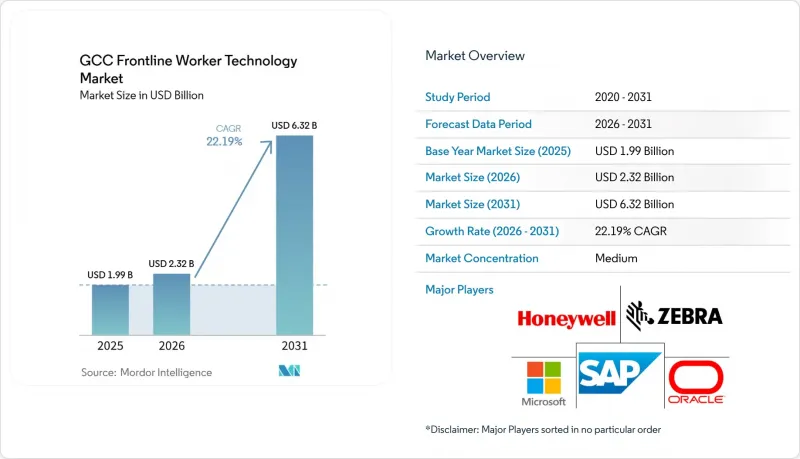
This report is Segmented by Component (Software, and Services), Deployment (Cloud-Based, Hybrid, and On-Premises), Organization Size (Large Enterprises, and Small and Medium Enterprises), Application (Employee Communication and Engagement, and More), End-User Industry (Industrial Manufacturing, BFSI, and More), and Geography. The Market Forecasts are Provided in Terms of Value (USD).
GCC Frontline Worker Technology Market Trends and Insights
Rising Investment in Connected Field Operations
Public and private investment in digital operations is creating a strong demand base for the GCC frontline worker technology market. Large national programs are moving beyond office digitization and now include field workforce management, operational visibility, and mobile service delivery as part of day-to-day execution. This matters because construction sites, transport networks, industrial facilities, and public services all require tools to coordinate large worker populations across multiple locations. Procurement behavior is also changing, as major project owners increasingly expect contractors and subcontractors to work through digital systems rather than manual reporting. That trend gives the GCC frontline worker technology market a more stable demand pattern than one driven only by voluntary software adoption. Microsoft's announced USD 15.2 billion AI and cloud commitment in the UAE through 2029 also strengthens the regional technology base that supports these deployments.
Mandatory Safety and Compliance Digitization
Safety and compliance requirements are turning digital frontline systems into a practical necessity in high-risk work environments across the GCC frontline worker technology market. Construction, energy, and industrial employers are under pressure to maintain digital records for permits, incidents, training, and hazard reporting because paper processes are slower to verify and harder to audit. This is one reason safety and compliance management is the fastest-growing application area in the GCC frontline worker technology market. The shift also changes vendor selection, because platforms that combine workflow control, monitoring, and traceable records are more useful than stand-alone communication tools. As project owners tighten operational standards, adoption is being pushed down the supply chain to smaller contractors that must meet the same documentation expectations. Honeywell's regional work on automation and digitalization for infrastructure projects reflects how compliance and operational control are now being packaged together in frontline technology deployments.
Integration Complexity with Legacy ERP, EAM, and OT Systems
Integration remains one of the clearest constraints on the GCC frontline worker technology market, especially in industrial and asset-heavy environments. Many employers already operate ERP, asset management, and operational systems that were not designed to connect easily with newer mobile platforms. That creates deployment delays, increases implementation costs, and often shifts project focus away from frontline use cases toward back-end system work. The challenge is more serious in sectors where field data must move across enterprise software, operational control environments, and compliance systems without interruption. Vendors with ready connectors and stronger implementation ecosystems, therefore, have an advantage over those that rely on heavier customization. This is one reason the services side of the GCC frontline worker technology market is growing strongly alongside software adoption, since integration work remains a recurring requirement.
Other drivers and restraints analyzed in the detailed report include:
- Rapid Cloud-Native Workforce Orchestration Adoption
- Expansion of AI-Assisted Dispatch and Remote Supervision
- User Adoption Friction in Heat-Intensive and Shift-Based Work Environments
For complete list of drivers and restraints, kindly check the Table Of Contents.
Segment Analysis
Software accounted for 79.11% of the GCC frontline worker technology market share in 2025, indicating that buyers still place the greatest value on core platforms that bring tasking, communication, safety, and analytics into a single environment. That leadership reflects the region's preference for integrated tools that can support multi-site operations without forcing workers to move across many separate applications. In practical terms, software remains the center of adoption because employers first need a system of record for workforce execution before they expand into more specialized services. The largest deals, therefore, continue to begin with platform licenses and then widen into broader operational use.
Software accounted for 79.11% of the GCC frontline worker technology market share in 2025, indicating that buyers still place the greatest value on core platforms that bring tasking, communication, safety, and analytics into a single environment. That leadership reflects the region's preference for integrated tools that can support multi-site operations without forcing workers to move across many separate applications. In practical terms, software remains the center of adoption because employers first need a system of record for workforce execution before they expand into more specialized services. The largest deals, continue to begin with platform licenses and then widen into broader operational use.er 2025 partnership activity in Saudi Arabia, including a local training center, fits this pattern of building in-country capability around enterprise platform adoption.
Cloud-based deployment held 74.66% of the GCC frontline worker technology market share in 2025 and was also the fastest-growing deployment model with a 26.18% CAGR through 2031. That combination shows that cloud is not only the current standard, but also the main path for future expansion across the region. Employers prefer cloud delivery because it supports faster rollout, centralized updates, and easier scaling across sites, crews, and contractor layers. It also aligns with subscription pricing, lowering the barrier to first adoption and later expansion.
On-premises and hybrid models remain relevant where data-handling rules or internal control requirements limit full cloud migration. The GCC frontline worker technology market, therefore, is not moving toward a single deployment model in every case, but toward a cloud-first architecture that allows for regulated variations. As sovereign and local infrastructure expands, the balance continues to move in favor of cloud-based systems for more workloads. That matters because the GCC frontline worker technology market size is increasingly tied to deployments that can scale quickly across public and private organizations without heavy infrastructure setup at each site. Microsoft's UAE investment plans support that environment by strengthening regional cloud capacity, while large enterprise partnerships in Dubai demonstrate that AI-enabled frontline workflows are being layered on that same infrastructure.
Complete Report Scope:
- By Component
- Software
- Services
- By Deployment
- Cloud-Based
- Hybrid
- On-Premises
- By Organization Size
- Large Enterprises
- Small and Medium Enterprises
- By Application
- Employee Communication and Engagement
- Workforce Execution and Task Management
- Workforce Scheduling and Coordination
- Learning and Knowledge Enablement
- Workforce Analytics and Performance Management
- Safety and Compliance Management
- Other Applications
- By End-User Industry
- Retail and E-Commerce
- Industrial Manufacturing
- Healthcare and Life Sciences
- Transportation and Logistics
- Hospitality
- Construction
- Government and Public Administration
- Other Industries
- By Geography
- Saudi Arabia
- United Arab Emirates
- Qatar
- Kuwait
- Oman
- Bahrain
List of Companies Covered in this Report:
- Zebra Technologies Corporation
- Honeywell International Inc.
- TeamViewer AG
- Microsoft Corporation
- Oracle Corporation
- SAP SE
- IFS AB
- PTC Inc.
- ServiceNow, Inc.
- Salesforce, Inc.
- Dozuki, Inc.
- Augmentir, Inc.
- Poka Inc.
- Beekeeper AG
- WorkJam, Inc.
- Staffbase GmbH
- Connecteam Ltd.
- Fujitsu Limited
- Trimble Inc.
- Hexagon AB
Additional Benefits:
- The market estimate (ME) sheet in Excel format
- 3 months of analyst support
TABLE OF CONTENTS
1 INTRODUCTION
- 1.1 Study Assumptions and Market Definition
- 1.2 Scope of the Study
2 RESEARCH METHODOLOGY
3 EXECUTIVE SUMMARY
4 MARKET LANDSCAPE
- 4.1 Market Overview
- 4.2 Market Drivers
- 4.2.1 Rising GCC Public and Private Investment in Connected Field Operations
- 4.2.2 Mandatory Worker Safety and Compliance Digitization in High-Risk Sites
- 4.2.3 Rapid Adoption of Cloud-Native Workforce Orchestration Across GCC Enterprises
- 4.2.4 Expansion of AI-Assisted Dispatch, Tasking, and Remote Supervision
- 4.2.5 Under-Reported, National Data Residency Requirements for Frontline Worker Applications
- 4.2.6 Under-Reported, Multi-Language Workforce Design Need Across Expat-Dense Operations
- 4.3 Market Restraints
- 4.3.1 High Integration Complexity With Legacy ERP, EAM, and OT Systems
- 4.3.2 Frontline User Adoption Friction In Heat-Intensive and Shift-Based Work Environments
- 4.3.3 Cybersecurity and Device Hardening Costs for Distributed Worker Fleets
- 4.3.4 Under-Reported, Fragmented Procurement Across Small Contractors and Subcontractors
- 4.4 Impact of Macroeconomic Factors on the Market
- 4.5 Industry Value Chain Analysis
- 4.6 Technology Outlook
- 4.7 Regulatory Landscape
- 4.8 Porter's Five Forces Analysis
- 4.8.1 Threat of New Entrants
- 4.8.2 Bargaining Power of Suppliers
- 4.8.3 Bargaining Power of Buyers
- 4.8.4 Threat of Substitutes
- 4.8.5 Intensity of Competitive Rivalry
5 MARKET SIZE AND GROWTH FORECASTS (VALUE)
- 5.1 By Component
- 5.1.1 Software
- 5.1.2 Services
- 5.2 By Deployment
- 5.2.1 Cloud-Based
- 5.2.2 Hybrid
- 5.2.3 On-Premises
- 5.3 By Organization Size
- 5.3.1 Large Enterprises
- 5.3.2 Small and Medium Enterprises
- 5.4 By Application
- 5.4.1 Employee Communication and Engagement
- 5.4.2 Workforce Execution and Task Management
- 5.4.3 Workforce Scheduling and Coordination
- 5.4.4 Learning and Knowledge Enablement
- 5.4.5 Workforce Analytics and Performance Management
- 5.4.6 Safety and Compliance Management
- 5.4.7 Other Applications
- 5.5 By End-User Industry
- 5.5.1 Retail and E-Commerce
- 5.5.2 Industrial Manufacturing
- 5.5.3 Healthcare and Life Sciences
- 5.5.4 Transportation and Logistics
- 5.5.5 Hospitality
- 5.5.6 Construction
- 5.5.7 Government and Public Administration
- 5.5.8 Other Industries
- 5.6 By Geography
- 5.6.1 Saudi Arabia
- 5.6.2 United Arab Emirates
- 5.6.3 Qatar
- 5.6.4 Kuwait
- 5.6.5 Oman
- 5.6.6 Bahrain
6 COMPETITIVE LANDSCAPE
- 6.1 Market Concentration
- 6.2 Strategic Moves
- 6.3 Market Share Analysis
- 6.4 Company Profiles (includes Global Level Overview, Market Level Overview, Core Segments, Financials as available, Strategic Information, Market Rank/Share, Products and Services, Recent Developments)
- 6.4.1 Zebra Technologies Corporation
- 6.4.2 Honeywell International Inc.
- 6.4.3 TeamViewer AG
- 6.4.4 Microsoft Corporation
- 6.4.5 Oracle Corporation
- 6.4.6 SAP SE
- 6.4.7 IFS AB
- 6.4.8 PTC Inc.
- 6.4.9 ServiceNow, Inc.
- 6.4.10 Salesforce, Inc.
- 6.4.11 Dozuki, Inc.
- 6.4.12 Augmentir, Inc.
- 6.4.13 Poka Inc.
- 6.4.14 Beekeeper AG
- 6.4.15 WorkJam, Inc.
- 6.4.16 Staffbase GmbH
- 6.4.17 Connecteam Ltd.
- 6.4.18 Fujitsu Limited
- 6.4.19 Trimble Inc.
- 6.4.20 Hexagon AB
7 MARKET OPPORTUNITIES AND FUTURE OUTLOOK
- 7.1 White-Space and Unmet-Need Assessment

